



.png?width=27&height=27&name=Group(1).png)

-1.svg)
-1.svg)


-2.svg)


%201-1.webp?width=148&height=74&name=our%20work%20(2)%201-1.webp)




.svg)





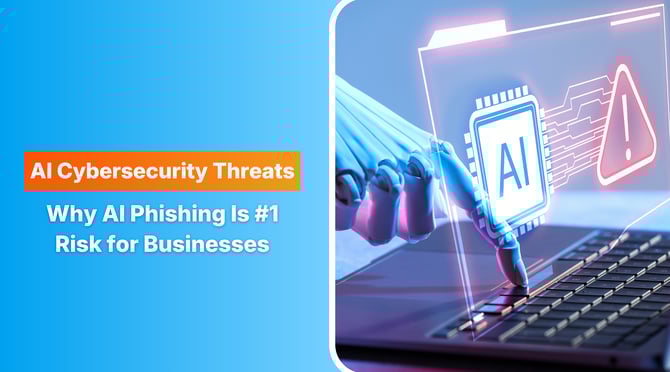
Artificial intelligence is transforming the cybersecurity landscape.
But not only for defenders.
Malicious actors are increasingly using generative AI tools to launch more sophisticated and scalable cyber threats. Among these emerging risks, AI phishing attacks have quickly become one of the most dangerous forms of cybercrime targeting businesses today.
Traditional phishing attacks often relied on poorly written messages, obvious spelling errors, or suspicious links. Modern AI-driven phishing attacks are far more advanced. Powered by large language models and natural language processing, attackers can generate convincing phishing emails that mimic legitimate correspondence, corporate websites, and trusted entities with remarkable accuracy.
The scale is equally alarming. As of early 2025, industry research indicates that phishing has intensified, with some reports associating it with up to 92% of data breaches. More importantly, AI-generated phishing emails are increasing the success rate of phishing campaigns.
For security teams and business leaders, the challenge is clear: defending against AI cybersecurity threats requires smarter detection systems. The current situation demands a stronger security posture brought through reliable AI cybersecurity solutions.
 Generate
Key Takeaways
Generate
Key Takeaways

• AI phishing attacks create highly convincing messages that easily bypass traditional spam filters or security checks.
• Generative AI tools allow attackers to launch large-scale phishing campaigns faster.
• Businesses face growing risks, including financial fraud, identity theft, and large-scale enterprise data breaches.
• AI-powered cybersecurity solutions help security teams detect sophisticated phishing attempts before they cause damage.
Why AI Phishing Attacks Are the Biggest Cybersecurity Threat to Businesses This Year?
Phishing has always been one of the most common cyber threats. But AI phishing attacks have dramatically changed the scale and sophistication of such attacks.
Using generative AI tools and large language models, malicious actors can now create convincing phishing emails that mimic legitimate communications from trusted entities.
Unlike traditional phishing attacks, which often contain spelling errors and obvious red flags, AI-generated phishing emails use natural human language and context to appear legitimate. These AI-powered phishing attacks can be launched at scale, enabling attackers to send thousands of tailored messages targeting employees, partners, or executives.
For businesses, the risk is significant. These AI-driven phishing attacks are designed to steal sensitive information, redirect payments, or lead users to fake login pages and phishing websites that mimic legitimate websites.
Why is AI-powered phishing more dangerous?
- Generates personalized phishing messages at scale
- Evades traditional security filters and spam detection
- Exploits human behavior through social engineering
|
Traditional Phishing |
AI-Powered Phishing |
|
Generic phishing emails |
Personalized phishing messages |
|
Obvious spelling errors |
Natural human language |
|
Easier for spam filters to detect |
Designed for evading detection |
To counter these AI cybersecurity threats, organizations increasingly rely on AI cybersecurity solutions, behavioral analytics, and real-time threat detection to prevent phishing attacks before they escalate into data breaches.
How AI is Transforming Modern Phishing Attacks?
In 2025, Cofense analysts documented a watershed moment in cyber defense: a malicious email attack every 19 seconds - more than doubling from 2024’s pace of one every 42 seconds.
Artificial intelligence is fundamentally changing how phishing campaigns are designed and executed. Instead of sending generic scam emails, attackers now use generative AI tools, machine learning, and large language models to create highly sophisticated phishing messages that closely resemble legitimate communications.
These technologies allow malicious actors to automate phishing campaigns, personalize messages, and replicate human language with remarkable accuracy. As a result, AI-driven phishing attacks are becoming harder for both users and traditional security systems to detect.
Key ways AI is transforming phishing attacks include:
- AI-generated phishing emails that mimic legitimate correspondence: Using natural language processing, attackers generate convincing phishing emails that closely resemble communication from trusted entities.
- Hyper-personalized phishing messages: AI tools analyze public data and user behavior to craft personalized phishing messages targeting specific employees.
- Automated phishing campaigns at scale: Generative AI enables attackers to quickly launch thousands of phishing attempts, increasing the reach of phishing campaigns.
- Realistic phishing websites and fake login pages: AI-generated content helps attackers build convincing phishing websites designed to capture sensitive information.
The Business Impact of AI-Driven Phishing Attacks
The consequences of AI-driven phishing attacks extend far beyond a suspicious email landing in an inbox. For businesses, these attacks can quickly escalate into serious financial, operational, and reputational damage.
Because AI-generated phishing attacks are more convincing and personalized, employees are more likely to trust messages that appear to come from legitimate entities, such as executives, vendors, or financial institutions.
Once attackers gain access through AI-generated phishing emails, they can steal credentials, redirect payments, or access sensitive business systems. This often leads to broader cybersecurity incidents that affect the entire organization.
Some of the most significant business impacts include:
- Financial fraud and payment redirection through highly convincing phishing emails or fake invoices.
- Credential theft and identity compromise allow attackers to access corporate systems.
- Enterprise data breaches that expose sensitive information associated with the intellectual property.
- Regulatory penalties and compliance risks following a major data breach.
- Reputational damage that can erode long-term business value.
Therefore, AI cybersecurity threats are increasingly viewed as a potential business risk rather than just another IT problem.
Why Traditional Security Systems Struggle Against AI-Powered Attacks?
|
Security Factor |
Traditional Security Systems |
AI-Powered Phishing Attacks |
|
Detection Method |
Relies on rule-based filters and known spam patterns |
Uses AI-generated content that constantly changes to evade detection |
|
Email Analysis |
Flags obvious signals like spelling errors, suspicious links, or repeated templates |
AI-generated phishing emails use natural human language and mimic legitimate correspondence |
|
Adaptability |
Slow to adapt to new phishing techniques |
AI tools rapidly evolve phishing messages and attack methods |
|
Scale of Attacks |
Designed to handle traditional phishing volumes |
AI-driven phishing attacks can launch thousands of personalized phishing messages instantly |
|
False Positives & Missed Threats |
High false positives or missed threats due to rigid filtering rules |
AI-generated phishing campaigns bypass traditional security filters |
|
User Targeting |
Mostly detects generic phishing emails |
AI analyzes public data to create personalized phishing messages targeting employees |
Traditional security systems rely on static rules. Whereas AI-powered phishing attacks are dynamic, allowing malicious actors to continually modify phishing emails, phishing websites, and social engineering tactics to bypass defenses. As per the numbers, there has been a 46% rise in AI-generated phishing content and a staggering 1,265% surge in phishing attacks linked to generative AI.
This is why organizations are increasingly working on AI cybersecurity solutions and behavioral analytics to strengthen threat detection and breach prevention.
Emerging AI Cybersecurity Threats CXOs Must Prepare For
While AI phishing attacks remain one of the most pressing risks, they are only one part of a rapidly evolving cyber threat landscape.
The growing use of generative AI, machine learning, and other AI tools is enabling malicious actors to launch sophisticated attacks. For businesses, cybersecurity strategies must evolve to address a broader range of AI cybersecurity threats.
Some emerging threats organizations should watch closely include:
1. Deepfake scams and AI-generated impersonation: Attackers can now create AI-generated video and voice recordings that mimic executives or trusted contacts. These deepfake scams are often used in phone scams or urgent financial requests, making social engineering attacks far more convincing.
2. AI-generated malware: AI systems can help attackers write and modify malicious code faster. It allows cybercriminals to create adaptive malware that changes its behavior to evade detection by conventional security systems.
3. Automated vulnerability discovery: AI algorithms can scan software and corporate systems to identify system vulnerabilities much faster than manual methods. Once weaknesses are found, attackers can quickly exploit them.
4. AI-powered social engineering attacks: By analyzing user behavior and public data, AI tools can craft highly targeted messages that manipulate employees into sharing sensitive information. It can be done through clicking on malicious attachments or accessing phishing websites.
As these technologies evolve, cybersecurity professionals must strengthen threat detection, real-time threat intelligence, and breach prevention strategies to keep pace with emerging threats.
How Businesses Can Defend Against AI-Powered Cyber Threats?
As AI cybersecurity threats continue to evolve, businesses must move beyond traditional security measures and adopt a multi-layered defense strategy.
Since AI-powered phishing attacks and social engineering campaigns exploit both technology and human behavior, organizations need a combination of advanced security tools, strong policies, and employee awareness to reduce risk.
Key strategies businesses can implement include:
1. AI-driven threat detection: Modern security platforms use machine learning and behavioral analytics to identify unusual activity, detect AI-generated phishing emails, and flag suspicious login attempts before they escalate into data breaches.
2. Advanced identity and access protection: Implementing multi-factor authentication (MFA), identity verification, and access controls helps prevent credential theft and unauthorized access to corporate systems.
3. Employee security awareness training: Employees should be trained to identify phishing messages, malicious attachments, and fake login pages. Regular phishing simulations help improve critical thinking and reduce the success of social engineering attacks.
4. Zero-trust security architecture: A zero-trust approach ensures that every access request is verified, limiting the impact of compromised accounts and reducing the risk of lateral movement inside networks.
5. Continuous monitoring and threat intelligence: Real-time monitoring, combined with AI-powered cybersecurity solutions and threat intelligence, helps security teams detect emerging threats quickly and strengthen breach-prevention strategies.
How CEOs can build an AI-Ready Cybersecurity Strategy?
As AI cybersecurity threats continue to evolve, businesses must adopt a proactive cybersecurity framework that combines intelligent tools, strong policies, and continuous monitoring. Modern threats such as AI phishing attacks, AI-generated malware, and automated social engineering require organizations to move beyond traditional security systems.
Below are practical steps and security practices businesses should adopt to strengthen their defense.
Key Practices for an AI-Ready Cybersecurity Strategy
1. Implement AI-Driven Threat Detection: Use machine learning and behavioral analytics to identify unusual user behavior, detect AI-generated phishing emails, and flag suspicious activities in real time.
2. Adopt a Zero-Trust Security Architecture: A zero-trust model verifies every access request regardless of location or device, reducing the risk of unauthorized access and lateral movement within enterprise systems.
3. Strengthen Identity and Access Management: Deploy multi-factor authentication (MFA), privileged access management, and identity verification tools to protect critical systems from credential theft.
4. Integrate Real-Time Threat Intelligence: Threat intelligence platforms monitor global cyber activity and help organizations detect emerging AI-powered phishing campaigns before they cause damage.
5. Establish Continuous Security Monitoring: Enterprise-grade monitoring systems track network activity, system vulnerabilities, and suspicious login attempts to improve threat detection and breach prevention.
6. Invest in Employee Security Awareness: Regular training and phishing simulations help employees to recognize phishing messages, fake login pages, etc.
By combining these practices with AI cybersecurity solutions and proactive threat monitoring, businesses can build a resilient security posture that defends against today’s rapidly evolving cyber threats.
Signity’s Perspective: Securing the Future of Enterprise AI
As businesses accelerate AI adoption, cybersecurity must evolve from reactive defense to strategic governance. At Signity, we believe organizations must treat AI security as a core part of digital transformation, not an afterthought.
Our enterprise approach combines AI risk assessment, AI governance frameworks, and AI security strategy to help companies identify vulnerabilities and manage AI-driven risks.
Signity works with enterprises to design resilient security architectures that integrate AI-powered threat detection, governance policies, and continuous monitoring.
By aligning cybersecurity with business strategy, we help organizations innovate with confidence while maintaining strong protection against emerging AI cybersecurity threats.
Our goal is simple: help enterprises adopt AI responsibly, securely, and sustainably.
Conclusion
Artificial intelligence is rapidly reshaping the cyber threat landscape, with hackers increasingly resorting to sophisticated digital attacks.
Today’s AI-driven phishing attacks can mimic legitimate correspondence and launch large-scale campaigns within minutes. For businesses, it means phishing is no longer just an occasional nuisance; it has become a gigantic business risk.
Consider a common scenario: an employee receives an email that appears to be from the company’s finance head requesting an urgent update on a vendor payment. The message is well-written, contextually accurate, and includes a link to what appears to be a legitimate website.
In reality, it is an AI-generated phishing email designed to steal login credentials.
Thus, a single successful interaction can quickly escalate into unauthorized access or even a large-scale data breach. The example highlights why businesses must rethink traditional security approaches.
Key lessons for organizations include:
- Traditional security filters alone are no longer enough to stop AI-driven phishing attacks.
- Human awareness and critical thinking remain essential in detecting sophisticated social engineering attempts.
- AI-powered threat detection and behavioral analytics help identify suspicious activity faster.
Organizations that run modern AI cybersecurity solutions that combine proactive threat monitoring with employee awareness programs will be far better prepared to protect their digital infrastructure against evolving cyber threats.

Mangesh Gothankar


Ashwani Sharma
Achin Verma
Frequently Asked Questions
Have a question in mind? We are here to answer. If you don’t see your question here, drop us a line at our contact page.
How should enterprises prepare for AI-driven cybersecurity threats?

Enterprises should adopt a proactive approach that includes AI risk assessment, AI governance frameworks, and an AI security strategy.
Combining AI-powered threat detection with continuous monitoring helps security teams identify vulnerabilities early. Moreover, it reduces exposure to evolving cyber threats.
What role does AI governance play in enterprise cybersecurity?
AI governance ensures that AI systems are deployed securely and responsibly across the enterprise.
It establishes policies for data protection and compliance, helping organizations manage AI risks while enabling secure AI adoption.
What are AI phishing attacks, and how do they work?
AI phishing attacks use generative AI tools and large language models to create convincing phishing messages that mimic legitimate communications.
These attacks often imitate trusted entities. They direct users to fake login pages designed to steal sensitive information.
How are phishing attacks using AI different from traditional phishing attacks?
Unlike traditional phishing attacks, which often contain spelling errors and generic messages, AI-generated phishing emails use natural human language. This makes AI-driven phishing attacks far more convincing and harder for traditional security filters and users to detect.
Why are AI-powered phishing campaigns increasing?
The availability of generative AI tools has made it easier for malicious actors to automate phishing campaigns. Attackers can quickly generate thousands of personalized phishing messages, increasing the scale and success rate of phishing attempts.
How can businesses prevent AI phishing attacks?
Businesses can prevent phishing attacks by implementing AI-powered threat detection and multi-factor authentication.
Also, they can work on employee security awareness training, phishing simulations, and real-time threat intelligence to identify suspicious activity early.
What role do AI cybersecurity solutions play in threat detection?
AI cybersecurity solutions use machine learning, behavioral analytics, and threat intelligence to detect suspicious user behavior.
They identify AI-generated phishing emails and respond to emerging cyber threats before they cause data breaches.