

.png?width=27&height=27&name=Group(1).png)

-1.svg)
-1.svg)


-2.svg)


%201-1.webp?width=148&height=74&name=our%20work%20(2)%201-1.webp)




.svg)






For most CEOs, the hesitation around AI in finance stems from concerns about accountability.
And that concern is justified. Financial operations demand precision, auditability, and regulatory alignment, but the truth is, introducing AI without a clear structure can create more uncertainty than value.
However, the data shows that the market is moving faster than most organizations are prepared for. A 2025 study by Gartner indicates that 59% of finance functions are already using AI in some form, particularly in planning and analytics. At the same time, Deloitte reports that over 80% of enterprises are increasing AI investments, yet a significant share still struggles to achieve consistent ROI.
This creates a clear divide between organizations that can operationalize AI and those that remain stuck in pilots. This blog addresses a practical question. How are finance teams actually putting AI to work today in a way that maintains control, ensures compliance, data privacy, and delivers real business value?
 Generate
Key Takeaways
Generate
Key Takeaways

- AI in finance is already delivering measurable outcomes across planning, risk, and operations.
- The real challenge is scaling AI beyond pilots into integrated workflows
- Data architecture and integration quality determine success more than algorithms
- Governance and explainability are essential for enterprise adoption
- Finance is becoming the most structured pathway for enterprise-wide AI adoption
- A phased roadmap supported by the right technology stack is critical for ROI.
Where Artificial Intelligence for Finance is Creating Measurable Value?
Finance leaders are no longer evaluating AI based on theoretical potential. The focus has shifted to where it drives tangible impact across core functions. What stands out in 2026 is the consistency of outcomes across risk management, operations, and liquidity management.
Functional Impact Across Finance
|
Function |
AI Application |
Outcome |
|
FP&A |
Predictive planning |
Faster scenario modeling and improved forecast accuracy |
|
AP/AR |
Intelligent automation |
Reduced manual effort with faster processing cycles |
|
Risk |
Pattern detection |
Early fraud signals and proactive risk mitigation |
|
Treasury |
Cash flow modeling |
Improved liquidity visibility and capital optimization |
What is important here is not the use of AI itself, but where it is applied. Each of these functions represents a decision layer, not just a process layer. AI is being embedded where financial judgment needs to be faster, more informed, and continuously updated.
The Shift from Automation to Decision Intelligence
The current phase is different in both intent and impact.
AI is now enabling real-time financial decision-making as forecasts function as dynamic models that adapt to new inputs. It means, instead of generating reports after the fact, systems continuously analyze data streams and surface insights that inform decisions.
This shift is changing the role of finance leadership.
- Planning cycles are becoming shorter and more iterative
- Risk identification is moving from reactive to predictive
- Treasury decisions are guided by continuously updated liquidity positions
Finance leaders are no longer relying solely on historical data. They are operating with forward-looking intelligence that evolves with the business environment.
The Real Constraints Slowing AI in Finance (What CEOs Must Understand)
The conversation around AI for finance often focuses on opportunity. In practice, the real story is shaped by constraints that go beyond surface-level challenges and address structural issues. In short, what separates AI success amongst finance organizations is their ability to recognize the challenges early.
Data Readiness as the Primary Bottleneck
Despite years of technical progress, financial ecosystems still struggle to build that ability to master real-time intelligence.
First of all, it is the fragmented financial systems that make the core data spread across ERP systems and spreadsheets. Such type of setups lead to inconsistencies in AI outputs.
Secondly, it is organizations that rely on batch processing over real-time data pipelines. It means AI models get delayed data, hampering time-sensitive financial decisions.
Lastly, without clear visibility into data origins, finance teams struggle to trust AI-generated insights due to poor data lineage and traceability.
All in all, data integrity is foundational to financial setups, as AI models can only get as effective as the data they consume.
Regulatory and Compliance Complexity
Finance-related operations should necessarily be subject to strict regulatory oversight. However, AI introduces a new layer of scrutiny.
- AI auditability requirements: Black-box outputs are not acceptable in financial environments, which means every recommendation must be justified.
- Increasing scrutiny: Regulators are developing frameworks to assess AI use, especially in areas such as lending and financial reporting.
- Risk of non-compliance: Most of the time, organizations often delay implementation due to uncertainty about compliance.
The ROI Paradox
Investment in AI is accelerating, but with uneven returns. The issue is not the technology adoption but how AI is deployed. For instance:
- AI initiatives are often disconnected from business KPIs
- Use cases are selected based on feasibility
- Scaling attempts are made before validating the value.
Talent and Operating Model
AI in finance is not just a technology shift. It is an operating model transformation.
- Finance teams lack AI-native skill sets
Traditional expertise in accounting and reporting does not automatically translate to working with predictive models and data-driven insights. - A disconnect between the business and the technology team
Finance defines the problem, while technology builds the solution. Without alignment, implementations fail to deliver usable outcomes.
What is emerging is a need for hybrid capabilities: finance professionals who understand data and technology teams that understand the financial context to bridge the gap from concept to execution.
A Practical Roadmap for AI in Finance
Most organizations fail at sequencing AI correctly. For the finance industry, AI teams need to aim at a layered progression where each phase builds on the previous. After all, the goal is to introduce intelligence without losing control of the operations.
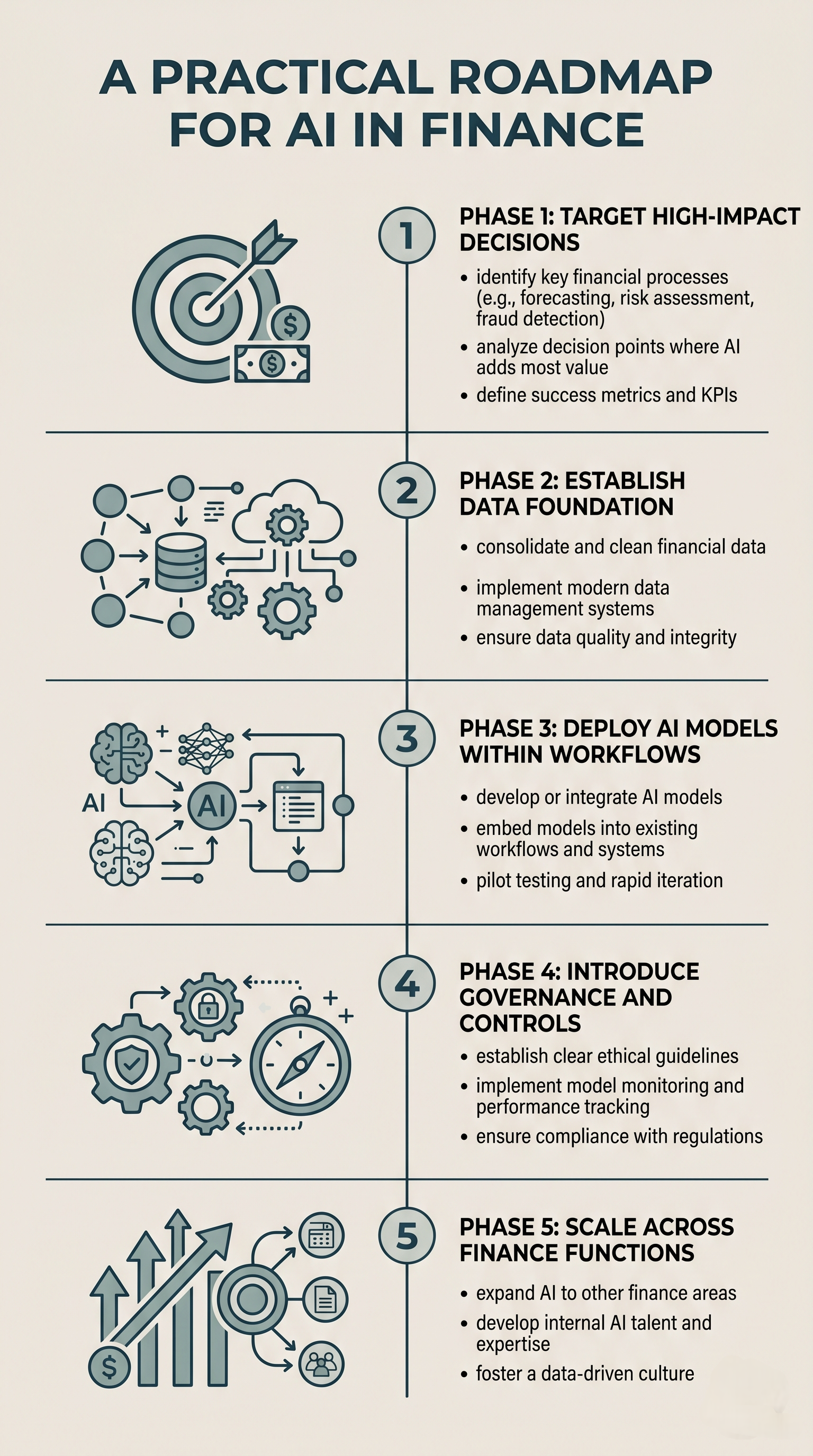
Phase 1: Target High-Impact Decisions
Finance teams that see real returns begin by isolating decision bottlenecks where delays or inaccuracies directly affect business outcomes.
These typically include forecasting cycles that take weeks to finalize, risk assessments that rely heavily on historical transaction patterns, and working capital decisions that lack real-time visibility.
The shift here is subtle but critical. Instead of asking, “What can we automate?” the question becomes, “Where does better intelligence change outcomes?”
Phase 2: Establish Data Foundation
As financial data is often scattered across systems, AI development teams find it difficult to create a unified view. The objective in this phase is to build a centralized data layer that brings together structured financial data and consistent access.
Besides, it is necessary to establish real-time or near-real-time ingestion pipelines that ensure AI models are not working with outdated information.
Common technology stack at this stage:
|
Capability |
Tools Commonly Used |
|
Data warehousing |
Snowflake, Databricks |
|
Data streaming |
Apache Kafka |
|
Data integration |
AWS Glue, Azure Data Factory |
This phase is less visible but highly critical. Without it, even the most advanced AI models will produce limited value.
Phase 3: Deploy AI Models Within Workflows
With the data foundation in place, organizations can begin introducing AI models into actual finance workflows.
The key here is integration. Instead of building standalone AI tools, high-performing teams embed models directly into legacy systems already used by finance companies. The approach ensures that insights are consumed where decisions are made.
At this stage, AI acts as an augmentation layer that enhances human judgment. Forecasts become dynamic, risk signals become proactive, and recommendations are surfaced in context.
Typical Technologies Involved:
|
Layer |
Tools / Technologies |
|
Model development |
Python, TensorFlow, PyTorch |
|
Language models |
OpenAI APIs, Azure OpenAI |
|
Feature management |
Feast |
This is where AI becomes visible to business users, but it still operates within controlled boundaries.
Phase 4: Introduce Governance and Controls
As AI begins to influence financial decisions, governance becomes non-negotiable.
At this stage, organizations focus on ensuring that every model output can be trusted, traced, and validated. This involves establishing frameworks for explainability, monitoring model performance, and maintaining audit trails.
Rather than slowing innovation, strong governance enables confident scaling.
Key Capabilities Introduced here:
|
Area |
Tools / Approaches |
|
Model tracking |
MLflow |
|
Explainability |
SHAP, LIME |
|
Data governance |
Collibra, Alation |
This phase addresses one of the biggest concerns at the executive level: maintaining control while increasing automation.
Phase 5: Scale Across Finance Functions
Only after value is demonstrated and governance is in place does scaling begin.
This expansion is not vertical, but horizontal. Organizations extend AI capabilities across adjacent finance functions, building a connected ecosystem of intelligent workflows.
One of the defining shifts at this stage is the introduction of AI copilots for finance teams. These systems assist in analysis, surface insights proactively, and support faster decision-making without replacing human oversight.
What starts as a targeted initiative evolves into a distributed intelligence layer across the finance function.
The Technical Architecture Behind AI in Finance
If AI in finance is expected to deliver consistent, auditable, and scalable outcomes, the conversation has to move beyond models to architecture. This is where most implementations either gain momentum or break under the weight of complexity.
What leading organizations have realized is that AI success is not driven by a single tool or platform. It is built through a well-orchestrated stack, where each layer has a clear role and integrates seamlessly with the rest.
The Modern AI Finance Stack
At a high level, the architecture is designed to ensure that data flows reliably, intelligence is generated in context, and outputs remain controlled and explainable.
|
Layer |
Description |
Tools |
|
Data Layer |
Consolidates financial and operational data from ERP, CRM, and external systems into a unified foundation |
Snowflake, BigQuery |
|
Integration Layer |
Enables seamless data movement and system communication through APIs and pipelines |
Apache Kafka, MuleSoft |
|
AI Layer |
Hosts machine learning models and language models that generate predictions and insights |
PyTorch, OpenAI |
|
Governance Layer |
Ensures compliance, auditability, and control over data and model outputs |
Collibra |
|
Experience Layer |
Delivers insights through dashboards, reports, and AI copilots used by finance teams |
Power BI, custom applications |
What makes this stack effective is not just the presence of these layers, but how tightly they are connected. Data feeds intelligence, intelligence feeds decisions, and governance ensures that every output can be trusted.
Architecture Patterns Emerging in 2026
There are a few architectural patterns that are beginning to define how AI in finance is evolving.
One of the most notable shifts is the rise of agentic AI systems. These are not just models generating insights, but systems capable of managing multi-step financial workflows. For example, an AI agent can monitor cash flow, trigger alerts, recommend actions, and even initiate predefined workflows within controlled boundaries for repetitive tasks.
Apart from agentic systems, it is the adoption of event-driven architectures that is complementing the shift. Instead of waiting for scheduled updates, financial systems are responding to events in real time. A transaction, market signal, or anomaly can immediately trigger analysis and decision support. This significantly reduces latency in financial decision-making.
Besides, teams are harnessing natural language processing, image recognition, along with data analytics to reform the financial markets. From rapid fraud detection to wealth management using machine learning, deep learning, and AI tools, the financial modeling architecture is rapidly moving towards AI innovation.
There is also a growing market trend of embedding AI into ERP systems rather than treating it as an external layer. In other words, AI capabilities are integrated into the core systems used by finance teams. It allows cutting the friction and ensures that valuable insights are available within existing workflows.
Together, these patterns signal a shift from isolated AI deployments to deeply integrated, continuously operating intelligence systems.
For CEOs and finance leaders, this reinforces a critical point. The value of artificial intelligence for finance is not just in what it can compute, but in how effectively it is embedded into the systems that drive everyday decisions.
From Assisted Finance to Autonomous Finance Systems
AI in finance is moving beyond support functions into systems that act continuously within defined boundaries. The shift is not about removing human control, but about reducing latency in financial decision-making. It means working on systems that can be trained on data strategy to target anomaly detection and work at predictive forecasting using intelligent technologies.
What Autonomous Finance Looks Like
|
Capability |
Impact |
|
Continuous forecasting |
Always-updated financial outlook |
|
Self-adjusting models |
Adaptive to market and business changes |
|
AI-driven recommendations |
Faster, context-aware decisions |
Finance teams move from periodic analysis to real-time decision environments.
Guardrails That Make It Viable
|
Control |
Purpose |
|
Policy boundaries |
Enforce financial rules and risk limits |
|
Human approvals |
Oversight for critical decisions |
|
Continuous monitoring |
Ensure accuracy and compliance |
Autonomy works only when control, transparency, and accountability are built into the system.
What Differentiates High-Maturity Finance Organizations?
High-maturity finance organizations are defined less by the AI-powered tools they use and more by how naturally AI is embedded into decision-making and leadership workflows. Finance stops being a reporting layer and becomes a real-time decision function that actively shapes business direction.
In these setups, AI is integrated into budgeting, forecasting, and investment discussions as a continuous input rather than a periodic output. This shifts finance from retrospective analysis to forward-looking planning, where decisions are informed by live data signals instead of static reports.
Roles also evolve significantly. Finance professionals move beyond reporting into decision interpretation and insight validation, while the CFO–CTO relationship becomes operational rather than collaborative in name only. Technology and finance teams co-own outcomes, ensuring AI systems are both technically sound and financially relevant.
This alignment is what separates experimentation from scaled Finance AI adoption.
Case Study – AI-Driven Financial Transformation in Action
Our developers at Signity worked on an implementation that focused on embedding AI into a compliance-driven finance environment while ensuring full continuity of existing ERP systems and audit processes.
Business Challenge
The finance function was constrained by operational delays and limited predictive capability:
- Forecasting cycles were slow due to manual consolidation across fragmented systems.
- Financial data was spread across multiple sources, resulting in inconsistent reporting.
Implementation Approach
AI was layered onto the existing ERP environment rather than replacing it. Predictive models were introduced for planning and forecasting, enabling scenario-based analysis on structured financial data while maintaining governance and compliance controls.
Outcomes
- 40% faster decision cycles in financial planning with 30% improvement in forecast accuracy.
The Future of AI for Finance Leaders (2026 and Beyond)
From Signity’s perspective, the next phase of AI in finance is shifting from reporting to orchestration, where finance evolves into a real-time decision layer for the enterprise. This transition is already underway in organizations that are embedding AI into existing ecosystems rather than building isolated tools.
Based on Signity’s implementation experience, the most effective path forward is treating AI as a layered intelligence capability built on existing finance systems.
1. Start with Decision-Critical Use Cases
Focus on high-impact areas such as cash flow forecasting, risk modeling, or scenario planning where faster decisions create measurable value.
2. Integrate AI into Existing Workflows
Embed AI into current finance tools and processes rather than introducing standalone systems, ensuring adoption without operational disruption.
3. Build a Unified Data Foundation
Consolidate financial and operational data to enable accurate, real-time insights across business functions.
4. Enable Continuous Learning Loops
Allow AI models to evolve with new data, improving forecasting accuracy and decision relevance over time.
5. Align Governance with Intelligence
Establish clear controls, auditability, and compliance frameworks to ensure AI-driven decisions remain transparent and accountable.
Conclusion
AI is no longer in an experimental phase within the financial industry; it is already embedded in core planning, forecasting, and risk workflows across leading organizations. The real differentiator now is not adoption, but how structured and scalable that adoption is across the enterprise.
The gap between leaders and laggards is widening because execution maturity varies significantly. Organizations that approach AI with a clear roadmap, strong governance, and integrated architecture are already moving faster in decision-making and financial responsiveness.
From a leadership standpoint, the advantage will belong to those who invest early in building AI-ready finance systems rather than isolated use cases. In a landscape defined by speed and uncertainty, structured execution is what converts AI from capability into long-term competitive advantage.

Mangesh Gothankar


Ashwani Sharma
Achin Verma
Frequently Asked Questions
Have a question in mind? We are here to answer. If you don’t see your question here, drop us a line at our contact page.
What is Artificial Intelligence for Finance?

It refers to the use of AI technologies such as machine learning and predictive analytics to improve financial planning, forecasting, risk management, and decision-making across finance functions.
How are Finance teams using AI Today?
Finance teams use AI applications and AI-powered tools for forecasting, cash flow trends, fraud detection, and optimizing financial workflows and financial operations.
What are the biggest challenges in AI Adoption for Finance?
Challenges include fragmented unstructured data, legacy systems, limited data science expertise, and ensuring accurate risk modeling, credit risk analysis, and compliance in financial operations.
How does AI improve portfolio management and Investment Research?
AI uses natural language processing and deep learning to analyze unstructured data, enabling asset managers to enhance portfolio management, investment research, and scenario modeling in financial markets.
What role do AI Technologies play in asset management and service delivery?
Emerging technologies like autonomous AI agents improve asset management, service delivery, and operational efficiency, helping investment firms streamline spend management while supporting human intelligence in decisions.
What Technologies are used in AI for Finance?
Common technologies include Python-based ML frameworks, TensorFlow, PyTorch, Snowflake, Databricks, Kafka, and LLM APIs such as OpenAI or Azure OpenAI.
How much does AI implementation cost in finance?
Costs vary widely based on scale, but typically depend on data infrastructure readiness, integration complexity, and scope of use cases rather than just model development.






.png?width=352&name=top-ai-tools-financial-services%20(2).png)