

.png?width=27&height=27&name=Group(1).png)

-1.svg)
-1.svg)


-2.svg)


%201-1.webp?width=148&height=74&name=our%20work%20(2)%201-1.webp)




.svg)





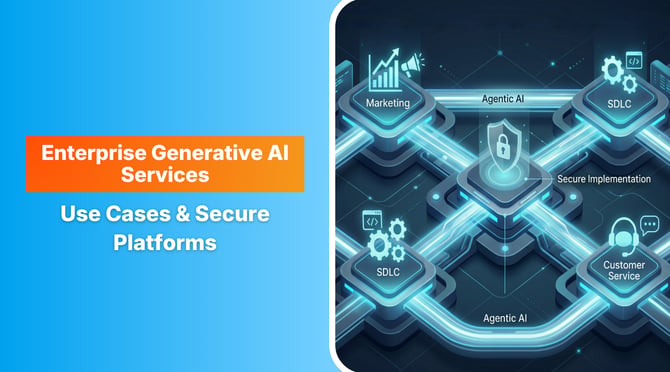
Enterprise AI is rapidly becoming core business infrastructure, and in 2025 alone, enterprise generative AI spending crossed $37 billion.
Yet, most enterprises struggle to scale it. Disconnected systems, unreliable outputs, and workflows that still rely on manual effort prevent AI from delivering real business value.
This is where enterprise generative AI is evolving, moving beyond experimentation into systems that can generate, reason, and execute tasks across business functions.
Here is a blog that breaks down how businesses use enterprise generative AI, the technologies behind it, and how organizations can implement secure, scalable AI solutions for enterprise that deliver real business value.
 Generate
Key Takeaways
Generate
Key Takeaways

- Generative AI is moving from experimentation to enterprise-wide implementation.
- Technologies like RAG and agentic AI are improving accuracy and automation.
- Choosing the right AI platform and model (LLM vs SLM) is critical for scale.
- Secure, phased implementation ensures long-term ROI and adoption.
What is Enterprise Generative AI?
Enterprise generative AI refers to the use of advanced AI models, especially designed for business applications. It helps create content, images, automate workflows, and generate appropriate insights. It is far different from traditional AI, which could only perform tasks like analyzing historical data. Generative AI helps produce new outputs and also helps with decision recommendations.
At its core, it combines large language models, machine learning models, and natural language processing to deliver meaningful insights and recommendations. This makes it quite valuable for enterprise AI applications.
For example, businesses are using generative AI to:
- Boost customer interaction via intelligent assistants.
- Automate repetitive tasks across the business processes.
- Generate AI-driven reports and insights.
- Personalize customer experience as per their preference and behavior
Generative AI has the potential to integrate with existing systems and operate at enterprise scale. This makes it a critical component of modern AI solutions.
As enterprises continue to scale generative AI across business functions, it becomes vital to ensure the accuracy of the outputs, and RAG helps with it.
Key Enterprise Generative AI Use Cases Driving Real ROI
Rather than experimenting with tools, enterprises are now deploying AI across core business operations that help boost efficiency and customer satisfaction at scale. Let us highlight some of the most impactful enterprise AI applications in 2026.
1. Agentic Customer Service
Enterprises deploy AI agents, and these agents can seamlessly handle end-to-end customer interactions without requiring any human intervention. No matter if businesses want a quick resolution to their queries, refunds, track order, these systems work around the clock and help improve response time. It also reduces the burden on the operational team, allowing customers to leverage a much faster resolution time.
2. Content Generation and Personalization
Marketing and content generation teams leverage the capabilities of generative AI to create high-quality content, images, and more aligned with the brand's needs. No matter if they want content for e-mail, brochures, campaigns, or videos, AI seamlessly understands the behavior of the customer and offers a tailored experience. This boosts engagement and accelerates campaign execution as well.
3. Software Development (SDLC Acceleration)
Generative AI helps transform software development as it offers code generation in real-time, debugging, and creates test cases. It can be integrated with the development ecosystem and streamlines the process of software development. The manual workload is reduced, and the delivery cycle is accelerated. This is the key driver of productivity in the modern enterprise AI development.
4. Knowledge Management with RAG
RAG-powered assistants allow enterprises to access the internal knowledge base, documents, and policies. Employees can query systems in natural language and receive accurate, context-aware responses backed by enterprise data. This improves decision-making, reduces search time, and enhances overall operational efficiency.
5. Operational Workflow Automation
No matter if it's processing of documents, analyzing legal documents, or financial operations, with AI-driven workflows, there is no chance of errors, and the process is automated. This ensures that enterprises can seamlessly optimize resource allocation and streamline crucial business processes.
What is RAG and How It Reduces AI Hallucinations in Enterprises
One of the challenges with generative AI is the output accuracy. While the models are quite powerful, they may produce inconsistent results or misleading outputs. These inconsistencies are called AI hallucinations. This can have a critical impact, especially for high-stakes business operations.
Thanks to RAG, which connects LLMs to the trusted external enterprise data sources in real-time. It does not rely on pre-trained models; it retrieves information from an internal database and sources to generate a response. With RAG development services, the outputs remain accurate, up-to-date, and per the business data. For enterprises, this significantly improves the reliability of AI systems.
With RAG, businesses can:
- Generate responses based on trusted enterprise data rather than generic training data.
- Improve accuracy in customer interactions and internal workflows.
- Strengthen data governance and data security by controlling data sources.
- Reduce risks associated with misinformation in critical decision-making
In practice, RAG is widely used in enterprise AI applications such as intelligent search, virtual assistants, knowledge management systems, and data-driven reporting.
How Agentic AI Workflows Automate Complex Business Tasks
While RAG helps boost data accuracy and outputs of the enterprise generative AI, the next step here is enabling AI to take appropriate actions.
And this is where the agentic AI workflows step in.
Agentic AI refers to using systems that are powered by AI agents. These agents are independent agents who work independently to plan and execute multi-step tasks, requiring minimal human interaction. The system helps automate complex tasks and business processes, and helps businesses to take action accordingly.
Real-World Example: In one of our implementations for an e-commerce enterprise, agentic AI was used to streamline customer operations and backend processes. Instead of relying on manual workflows, AI agents were deployed to handle customer queries in real-time, automate tasks like order updates, support request and issue resolution and escalate complex cases to human teams.
LLMs vs SLMs for Enterprise AI: Key Differences
As enterprises adopt agentic AI workflows, choosing the right AI models helps balance performance and scalability. Therefore, it becomes vital to understand the difference between LLMs and SLMs and choose the right model.
|
Factor |
LLMs (Large Language Models) |
SLMs (Small Language Models) |
|
Capability |
High, as it handles complex reasoning and diverse tasks |
Moderate, optimized for specific tasks |
|
Data Handling |
Trained on vast, generalized datasets |
Trained on domain-specific or enterprise data |
|
Performance |
Strong for advanced natural language processing tasks |
Efficient for targeted business functions |
|
Cost |
Higher infrastructure and operational costs |
More cost-effective for enterprise use |
|
Latency |
Slower due to model size and complexity |
Faster response times |
|
Scalability |
Challenging at enterprise-scale AI without optimization |
Easier to scale across workflows |
|
Use Cases |
AI assistants, content generation, complex analytics |
Automation, internal tools, task-specific workflows |
|
Customization |
Limited without fine-tuning |
Easier to build custom AI models |
Recommended Post: Generative AI vs LLM: What is Best For Your Business?
Secure and Compliant Implementation Strategy for Enterprise Generative AI
As enterprises scale enterprise generative AI, what about the concerns related to security and compliance? Yes, they are no longer optional, but for a successful AI implementation, focusing on data control and transparency helps at every stage.
Modern enterprise AI solutions focus on a security-first approach and ensure that AI systems are compliant. Some of the strong pillars that seamlessly define this shift are:
1. Data Security and Privacy
Enterprises adopt private cloud or on-premises deployment to ensure that sensitive data remains safe and secure. It is one of the critical approaches that ensures proprietary data is not exposed to external systems or used for external purposes. Also, it is vital to ensure encryption, a secure API, and controlled pipelines to safeguard data across the lifecycle.
2. Governance-Led Approach (GenOps)
The “GenOps” framework is being implemented, which helps manage and monitor the AI lifecycle. Whether it is model training, deployment, or learning, a governance-led approach ensures better control over the AI models. It also helps enable auditability and compliance in the regulated environment.
3. Grounding with RAG
To boost the reliability of the outcomes, businesses leverage RAG. It helps ground AI outputs in internal data sources. This not only helps improve accuracy but also reduces hallucinations caused by wrong information. Integrating RAG is vital to make AI systems more dependable for the vital business operations.
4. Role-Based Access Control (RBAC)
AI systems are seamlessly integrated with existing control systems. This ensures that users and AI agents retrieve information and act on data they have the authority to access. When only the authorized person has access to data, the data governance is improved, and the security breach risks are minimized.
5. Human-in-the-Loop Oversight
No matter what kind of automation is implemented, human supervision remains the key to the best decision-making and mitigating the risks associated with it. Here, tasks can automatically be escalated to human operators when the AI's confidence score in its decision falls below a set threshold.
Best Generative AI Platforms for Enterprise Deployment
There are many platforms available that supports the capabilities of generative AI, so let's dig deeper and talk about the top enterprise AI platforms driving real-world adoption:
1. Noxus
It is one of the top choices for highly regulated industries, including healthcare. These industries have the most critical data, and ensuring compliance and security is vital. The platform works with legacy systems like SAP and allows the execution of multi-system workflows.
2. Kore.ai
It is also called a multi-agent orchestration platform and allows multiple agents to collaborate and streamline workflows. It helps with fast business outcomes, offers superior customer service, improves employee productivity, and facilitates process automation.
3. Microsoft Copilot Studio
It is ideal for businesses that are already working within the Microsoft ecosystem. The platform allows building and maintaining agents with a low-code environment. It can be integrated with tools like Teams and SharePoint, so that organizations can leverage data internally.
4. Google Cloud Vertex AI
Vertex AI is a fully-managed AI development platform that helps build and use generative AI models at the enterprise level. It offers a robust integration with Google Workspace, Gemini 3, and more, making it a top-notch choice for enterprises that focus on data-driven decision-making.
How to Implement Generative AI in Your Enterprise
Generative AI company need to follow a structured and agile approach to successfully deploy generative AI. Here is how you can implement generative AI in your business:
1. Define a Clear Strategy
Begin by identifying where generative AI is able to generate the most value. Check whether the value it offers is in customer interaction, internal process, or data-driven decision making. Ensure to align these use cases with the goals of your business and set outcomes from the very beginning.
2. Choose the Right Platform
It is time to choose the right platform. Choose a platform that fits your business technology stack, requirements, and can scale as per your business needs. Ensure it is compatible with your existing system.
3. Train and Customize Models
Use your business data to refine and adapt models so that outputs are correct and aligned with your business. The step ensures that solutions can deliver accurate results, not a generic response.
4. Integrate into Existing Workflows
Embed the solution into everyday business processes instead of treating it as a standalone tool. Seamless integration helps teams adopt it faster and improves overall efficiency.
5. Monitor, Improve, and Scale
It is vital to track the performance continuously, check outputs, and continue making improvements. As you monitor the performance, confidence grows, and more users can rely on it. This ultimately helps maximize the long-term impact.
Conclusion
Generative AI is the driver of more efficiency and innovation, and offers a competitive advantage. No matter if it's about improving customer satisfaction, interaction, or automating complex business processes, enterprises can leverage generative AI and see a measurable impact across the business functions.
However, its success depends on the right strategy, secure implementation, and whether it can scale effectively. Therefore, choosing the right partner for Generative AI development services becomes vital. It ensures that your solutions are robust and align with the business goals.

Mangesh Gothankar


Ashwani Sharma
Achin Verma
Frequently Asked Questions
Have a question in mind? We are here to answer. If you don’t see your question here, drop us a line at our contact page.
How long does it take to implement generative AI in an enterprise?

Timelines can vary, but most enterprises see initial results within a few weeks, while full-scale implementation may take a few months, depending on complexity.
Can generative AI work with legacy systems?
Yes, with the right integration approach and APIs, generative AI can be connected to existing systems without requiring complete infrastructure changes.
What type of data is required for enterprise generative AI?
High-quality, structured, and unstructured enterprise data, such as documents, customer data, and internal knowledge bases, helps improve accuracy and performance.
Is generative AI suitable for small teams within large enterprises?
Absolutely. Many organizations start with specific departments or use cases and gradually scale across the enterprise based on results.





.png?width=352&name=agentic-ai-strategy-for-enterprise-software%20(4).png)