

.png?width=27&height=27&name=Group(1).png)

-1.svg)
-1.svg)


-2.svg)


%201-1.webp?width=148&height=74&name=our%20work%20(2)%201-1.webp)




.svg)





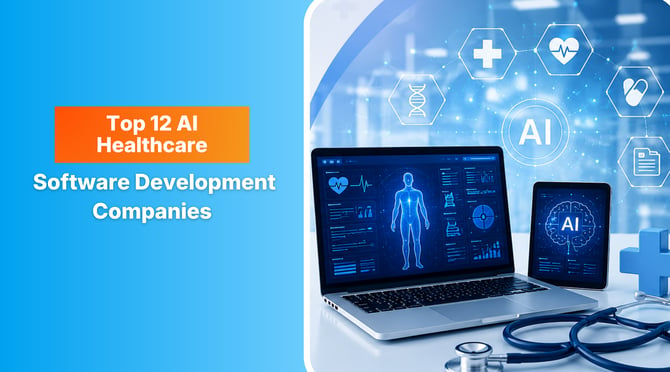
Healthcare operates in an environment where every decision carries weight. AI-powered diagnostic tools help facilities catch abnormalities in medical data faster than manual review alone.
The same kind of system can predict a patient's readmission risk before they are even discharged. These tools are already reshaping how organizations deliver care and manage operations day to day.
Most healthcare organizations aren't short on interest in AI. What they lack is clarity on who to build it with. Developing AI healthcare software takes more than machine learning expertise. A development partner needs to understand healthcare workflows.
They need to understand sensitive health data and interoperability standards. Security requirements and regulatory considerations both come into play. And they need a real grasp of what deploying AI inside a clinical environment actually involves.
This makes choosing the right AI healthcare software development company a strategic decision.
In this guide, we have identified 12 companies with capabilities across healthcare software engineering and artificial intelligence. Moreover, we will understand how machine learning is integrated into healthcare interoperability to offer connected healthcare and workflow automation.
The goal is not simply to identify companies that offer AI services. It is to help healthcare organizations understand which AI development companies for healthcare are best suited to different project requirements.
 Generate
Key Takeaways
Generate
Key Takeaways

-
The right AI healthcare software development company combines AI expertise with real healthcare domain experience.
-
Building healthcare AI solutions demands attention to compliance. Interoperability matters just as much.
-
Different companies specialize in different areas. Some focus on enterprise analytics. Others build patient-facing healthcare applications.
-
We handle end-to-end healthcare AI development with strong integration and compliance capabilities built in.
What to Look for Before Hiring an AI Healthcare Development Company
Choosing among the best AI healthcare software development companies takes more than checking technical boxes. A capable partner needs to understand clinical workflows and sensitive health data. Interoperability and security can't be an afterthought either. Regulatory responsibilities matter just as much. And none of it works without a grip on what deploying AI inside a healthcare setting actually requires day-to-day.
The factors below help organizations judge whether a partner can carry an AI project from the initial concept through production and keep improving it once it's live.
1. Healthcare Security, Privacy, and Compliance Experience
Healthcare AI solutions may process protected health information and other highly sensitive data. Look for a development partner with documented experience addressing requirements such as HIPAA, GDPR, CCPA, and applicable healthcare security practices. The team should be able to explain how sensitive data is protected across data ingestion, storage, model training or fine-tuning, inference, APIs, and application workflows.
For projects involving clinical decision support or medical devices, also evaluate the partner's experience with relevant regulatory and validation requirements rather than treating HIPAA compliance as the only benchmark.
2. Healthcare Domain Expertise
In-depth knowledge of AI alone is not enough. The development team also needs to understand healthcare workflows and clinical data. Medical terminology and patient journeys matter just as much. Provider operations add another layer. Every healthcare segment has its own specific requirements on top of that.
Look for experience with healthcare-specific systems and workflows. Practical knowledge of interoperability standards like HL7 and FHIR carries real weight here. A technically strong AI system still has limited value if it doesn't fit naturally into how clinicians actually work day to day. The same holds for administrators and patients and everyone else involved in care.
3. EHR/EMR Integration Capabilities
Enterprise healthcare solutions rarely operate in isolation. They often need to exchange information with EHR and EMR platforms, laboratory systems, imaging systems, patient portals, billing platforms, and other healthcare applications.
Evaluate whether the development company has experience with healthcare APIs. HL7 and FHIR experience matters here too. For projects involving medical imaging, DICOM and PACS experience may also be relevant. Strong interoperability capabilities help AI-generated insights reach the right workflow instead of staying stuck in a separate application.
4. AI and Healthcare Software Engineering Expertise
Look beyond a generic list of AI services. The right expertise depends on the project. It might mean machine learning or deep learning. It might mean natural language processing or computer vision.
Predictive analytics and generative AI are relevant for some projects. Others call for retrieval-augmented generation (RAG) or AI agents. Cloud infrastructure and MLOps round out the list of areas worth checking.
The right technology stack should be selected according to the healthcare use case, available data, required accuracy, integration environment, and security requirements
5. Long-Term Support Model
AI systems require ongoing attention after deployment. Models can experience performance changes as data, workflows, user behavior, and clinical environments evolve.
Ask how the development partner handles model monitoring and evaluation. Retraining and version management matter just as much. So does managing data drift. Infrastructure scaling and security updates need a clear plan too. Performance optimization rounds out the list. A long-term support model becomes particularly important once AI is part of an operational or clinical workflow.
How We Selected the Top AI Healthcare Software Development Companies
This list is designed to help organizations compare healthcare-focused AI development partners rather than simply identify companies that mention AI on their service pages.
We evaluated companies across the following factors:
| Evaluation Factor | What We Considered |
| Healthcare expertise | Experience building software for healthcare providers, payers, digital health, life sciences, or related healthcare environments |
| AI capabilities | Experience across AI/ML, generative AI, NLP, computer vision, predictive analytics, and AI agents |
| Interoperability | Experience with EHR/EMR integration, APIs, HL7, FHIR, DICOM, or other healthcare data standards |
| Security and compliance | Healthcare data protection, privacy, security engineering, and regulatory awareness |
| Product engineering | Ability to design, develop, integrate, deploy, and scale production healthcare software |
| Healthcare use cases | Evidence of work across clinical, operational, administrative, patient engagement, or connected-health applications |
| Post-launch support | Model monitoring, maintenance, optimization, infrastructure support, and long-term development capabilities |
The ranking is intended as a practical starting point for vendor evaluation. Company capabilities, products, certifications, team structures, and service offerings can change over time, so organizations should independently verify current information before making a vendor decision.
Top AI Development Companies in Healthcare
The demand for AI in healthcare continues to rise, but its implementation depends on choosing the right development company. These companies have a mix of healthcare expertise domains, engineering capabilities, and regulatory understanding.
1. Signity Solutions
With over a decade of experience in healthcare engineering and a strong focus on building AI solutions, the company is one of the most reliable organizations. Whether you are a startup or a healthcare provider, their expertise offers a full development lifecycle, model development, deployment, and post-launch optimization.
They have experienced developers with hands-on experience with healthcare-specific systems. The teams have successfully worked with EHR-integrated applications, remote monitoring platforms, connected healthcare systems, and more. This makes it a critical choice for organizations that wish to build regulated healthcare products.
Core Capabilities
- Custom AI and ML development for healthcare use cases
- Generative AI for medical summaries and patient communication
- Agentic AI for workflow automation
- HIPAA-compliant AI systems and private LLM deployment offering AI governance
- Predictive analytics for patient outcomes
- AI chatbots and remote patient monitoring
Why Healthcare Organizations Choose Signity
Their approach starts with discovery, understanding the clinical context, the data environment, and the regulatory requirements before writing a line of code. That upfront investment pays off throughout the build. Projects move faster, integrations land cleanly, and the end product fits the actual workflow instead of requiring clinical staff to adapt around it.
2. Softeq
If your use case involves medical devices, wearables, or remote monitoring tools, they bring engineering depth that software-only firms simply cannot match. Their work spans sensor integration, device firmware, and the AI layers that process the data those devices generate. For digital health companies building physical products alongside software platforms, Softeq understands how the two have to work together.
Core Capabilities
• IoT hardware and software integration for connected medical devices
• Embedded AI and on-device machine learning for wearables
• Remote patient monitoring system development
• Cloud connectivity and real-time data pipelines for health devices
• Firmware development and sensor calibration for regulated hardware
Why Consider Softeq
If your product has a hardware component, they are the partner that bridges physical engineering and AI software into a coherent solution.
3. Intellectsoft
The company has a robust track record in mobile-first healthcare AI. They are particularly effective when the end-user experience carries as much weight as the underlying technology. For digital health companies building chronic disease management tools and mental health applications, Intellectsoft brings a good balance of product thinking and technical execution.
Core Capabilities
- AI-powered healthcare application and platform development
- Telemedicine and virtual healthcare solution development
- Patient engagement and digital health application development
- Predictive analytics and data-driven healthcare solutions
- Cloud-based healthcare software and system integration.
Why Consider Intellectsoft
They understand that a technically sound healthcare app that patients do not use is not a success. Their teams approach healthcare AI with the user journey in mind.
4. Itransition
Their teams are experienced with HL7, FHIR, and the integration standards. These standards govern how health data moves between EHRs and third-party platforms. Many AI initiatives in healthcare are delayed because the data is fragmented across incompatible systems. Itransition solves the infrastructure layer that makes downstream AI possible.
Core Capabilities
- HL7 and FHIR-compliant healthcare data integration
- EHR interoperability across multiple platforms
- Clinical data exchange and API development
- AI development on top of a unified health data infrastructure
- Healthcare portal and patient data access solutions
Why Consider Itransition
If your AI project is being blocked by data that lives in silos across incompatible systems, Itransition clears that roadblock first and builds the AI second.
Recommended Post: AI in Healthcare: Use Cases, Real-Life Examples, and Trends
5. Andersen
Andersen has grown into a substantial technology firm with genuine capabilities in data engineering and AI for regulated industries, including healthcare. Their work covers data pipeline design, predictive modeling, cloud migration, and the analytics infrastructure that clinical and operational teams actually rely on day to day.
They are a practical choice for mid-market healthcare organizations that need solid technical execution without taking on the overhead of a very large consultancy. Their teams work efficiently and communicate clearly, which matters as much as technical depth on most projects.
Core Capabilities
- Healthcare data engineering and cloud infrastructure
- Predictive analytics and clinical outcome modeling
- AI integration with existing healthcare platforms
- Business intelligence and health operations reporting
- Cloud migration and data warehouse modernization
Why Consider Andersen
For organizations that need AI built on a solid data foundation and want a partner that delivers without excessive process overhead, Andersen brings both the engineering capability and the project discipline to make that happen reliably.
6. Miquido
Their teams combine product design sensibility with technical AI capability. It helps produce applications that users engage with consistently over time, which is a challenge that more technically focused firms often underestimate. Their portfolio spans health and wellness apps, mental health platforms, and digital therapeutics.
Core Capabilities
- UX-led health and wellness app development
- AI-powered personalization for consumer health products
- Digital therapeutics platform development
- Mental health application design and engineering
- Behavioral engagement features for long-term health habit formation
Why Consider Miquido
There is a real difference between a healthcare app that works technically and one that users open every day. Miquido understands that difference and builds for both dimensions, which is why their health products tend to outperform on engagement and retention.
7. Velvetech
Velvetech focuses on AI-driven automation for healthcare operations. Their work covers claims processing, prior authorization workflows, billing operations, and administrative communication, all areas where AI can reduce manual workload without introducing compliance risk. which means their automation solutions are built around how those workflows actually function in hospitals, clinics, and insurance environments.
Core Capabilities
- AI-powered claims processing and adjudication automation
- Prior authorization and utilization management workflows
- Healthcare billing and revenue cycle AI
- Administrative communication automation
- Intelligent document processing for health records
Why Consider Velvetech
For payers and provider organizations whose primary AI goal is operational efficiency rather than clinical decision support, Velvetech's focused experience in healthcare administration makes them a relevant and practical option.
8. Inoxoft
Inoxoft focuses on AI-assisted clinical documentation and cloud migration. They work with cloud technologies like clinical notes, structured medical data to address the pain point of documentation workload. It is the top frustration for clinical staff and AI helps reduce it.
Core Capabilities
- NLP for clinical note processing and documentation automation
- AI-assisted discharge summary and coding support
- Cloud migration for healthcare data infrastructure
- Medical record analysis and structuring
- HIPAA-compliant document processing pipelines
Why Consider Inoxoft
Inoxoft offers a focused and practical path to reducing that workload through AI, without requiring a large internal team to manage the engagement.
9. Chetu
The company excels in EHR and EMR system modernization. For hospital systems running traditional clinical software that need an update and new functionality. Chetu brings the experience that comes from having done the work across different healthcare clients. Their healthcare software expertise makes them a reliable partner when AI work is part of broad system modernization.
Core Capabilities
- EMR and EHR development, customization, and modernization
- Integration of AI capabilities into existing clinical software
- Legacy healthcare system upgrades and data migration
- Practice management software development
- Regulatory compliance engineering for clinical platforms
Why Consider Chetu
Chetu's familiarity with how older healthcare software is structured means fewer surprises and fewer integration failures during that kind of project.
10. LeewayHertz
LeewayHertz has carved out a clear position in generative AI development for healthcare. For organizations that want to explore what generative AI can do in clinical or operational contexts, they bring relevant and current experience.They are a good fit for companies that want to build quickly with newer AI technologies and need a partner who has already worked through the practical challenges.
Core Capabilities
- Generative AI and LLM integration for healthcare applications
- Custom AI product development for clinical and administrative use
- AI agents for patient engagement and clinical workflow support
- Healthcare knowledge base development using RAG systems
- AI-powered medical Q&A and clinical decision support tools
Why Consider LeewayHertz
For healthcare organizations specifically looking to apply generative AI, LeewayHertz has built a depth of practical experience in this area that makes them a relevant option to evaluate.
11. ScienceSoft
ScienceSoft brings deep healthcare software engineering experience together with AI, data analytics, and modern cloud technologies. With healthcare IT experience dating back to 2005 and 150+ healthcare projects, the company works across providers, healthtech companies, life sciences organizations, and medical device manufacturers. Its AI capabilities span clinical workflows, patient communication, diagnostic decision support, medical data analysis, and intelligent automation.
Core Capabilities
- Custom AI and machine learning development for healthcare
- AI-powered clinical decision support and diagnostic assistance
- Healthcare data analytics and predictive modeling
- AI chatbots and intelligent patient communication
- EHR integration using HL7 and FHIR
- Medical software and SaMD development
- AI transformation and workflow automation.
Why Consider ScienceSoft?
For healthcare organizations that need AI combined with strong software engineering and healthcare domain expertise, ScienceSoft offers an end-to-end approach. Its experience with healthcare interoperability, regulatory requirements, secure architectures, and AI implementation makes it a strong option for organizations developing complex AI healthcare software.
12. Imagine Software
Their AI co-pilot tool, Imagine Co-Pilot, delivers automation across claims processing, denial management, and payment workflows. It is the kind of number that only comes from a system that has been trained and refined against real-world payer behavior across millions of claims. For physician groups and billing companies dealing with denial rates, staffing costs, and collections pressure, that level of automation has a direct and measurable financial impact.
Core Capabilities
- End-to-end AI-driven revenue cycle management via the ImagineOne platform
- Automated claims processing, scrubbing, and denial management with 95%+ accuracy
- Prior authorization and eligibility verification automation
- AI-powered patient engagement and payment collection tools
Why Consider Imagine Software
Revenue cycle management is one of the most expensive administrative burdens in healthcare, and it is one of the areas where AI delivers the fastest and most measurable returns.
What Can AI Healthcare Software Development Companies Build?
AI healthcare software development can support both clinical and non-clinical workflows. The right application depends on the organization's data, workflow, users, and desired outcome.
AI-Powered Clinical Decision Support
AI can analyze clinical information and surface relevant patterns, risks, or recommendations to support healthcare professionals. These systems require careful validation and appropriate human oversight, particularly when outputs can influence clinical decisions.
Medical Imaging AI
Computer vision and deep learning can be applied to medical images to support image analysis, triage, anomaly detection, and workflow prioritization.
Clinical Documentation Automation
Natural language processing and generative AI can help structure clinical information, summarize conversations, draft documentation, and reduce manual administrative work.
Predictive Analytics
Machine learning models can support use cases such as readmission prediction, patient-risk stratification, demand forecasting, deterioration detection, and population health analytics.
Remote Patient Monitoring
AI can analyze continuous streams of data from connected devices and wearables to identify patterns that may require attention and help healthcare teams manage patients outside traditional care settings.
Healthcare Chatbots and Virtual Assistants
Conversational AI can support patient navigation, appointment-related interactions, healthcare information access, and administrative communication while maintaining appropriate safeguards around sensitive information.
Generative AI and RAG
Generative AI can support clinical summarization, healthcare knowledge retrieval, patient communication, documentation, and internal knowledge assistants. Retrieval-augmented generation can help ground responses in approved organizational or clinical information.
Healthcare AI Agents
AI agents can coordinate multi-step workflows across healthcare applications, databases, APIs, and business systems. Because agents can take actions rather than simply generate text, healthcare deployments require strong access controls, monitoring, validation, and human oversight.
Revenue Cycle and Administrative Automation
AI can automate or assist with claims processing, document classification, coding support, denial management, eligibility workflows, and other repetitive administrative processes.
Personalized Healthcare
AI can combine clinical, behavioral, and other relevant data to support personalized engagement, risk assessment, and care-management experiences.
Technologies Used in AI Healthcare Software Development
Different healthcare AI use cases require different technologies. A development company should recommend the technology stack based on the problem, available data, security requirements, integration environment, and expected scale.
| Technology | Common Healthcare Applications |
| Machine Learning | Risk prediction, forecasting, patient segmentation |
| Deep Learning | Medical imaging and complex pattern recognition |
| Natural Language Processing | Clinical notes, medical records, documentation |
| Generative AI | Summarization, assistants, content generation |
| RAG | Grounded healthcare knowledge retrieval |
| AI Agents | Multi-step workflow automation |
| Computer Vision | Medical imaging and visual analysis |
| Predictive Analytics | Risk stratification and healthcare forecasting |
| IoT and Edge AI | Wearables and remote patient monitoring |
| MLOps | Model deployment, monitoring, evaluation, and retraining |
| Cloud AI | Scalable healthcare data and AI infrastructure |
AI Governance in Healthcare: What Your Development Partner Should Handle
AI governance becomes especially important when healthcare software processes sensitive information or produces outputs that influence clinical or operational decisions.
A capable development partner should have a clear approach to:
- Data governance and lineage: Keep data secure and traceable.
- Model evaluation: Regularly assess model accuracy and performance.
- Bias and security testing: Identify unfair outcomes and system vulnerabilities.
- Human oversight: Define clear escalation and intervention processes.
- Explainability: Make AI decisions easier to understand where needed.
- Audit trails: Record AI activity and system changes for accountability.
- Version management: Track changes to models, prompts, and configurations.
- Generative AI monitoring: Detect hallucinations and inaccurate outputs.
- Model drift detection: Identify performance changes after deployment.
For generative AI and agentic systems, organizations should also understand what data is sent to external models, how prompts and outputs are handled, whether data is retained by third-party providers, and which actions an AI system is authorized to perform.
How Much Does AI Healthcare Software Development Cost?
The cost of AI healthcare software development depends heavily on the application's complexity, data requirements, integrations, AI architecture, security requirements, and regulatory considerations.
As an indicative planning range:
| Project Type | Typical Development Range |
| AI-enabled healthcare MVP | $40,000–$100,000 |
| Patient-facing healthcare AI application | $75,000–$200,000 |
| Healthcare AI platform with EHR integration | $150,000–$400,000+ |
| Generative AI/RAG healthcare platform | $100,000–$400,000+ |
| Enterprise healthcare AI platform | $300,000–$1M+ |
| AI-enabled medical-device software | $250,000–$1M+ |
These are planning-level estimates rather than fixed market prices. Actual costs can vary significantly based on the number of integrations, data complexity, model development requirements, cloud infrastructure, compliance needs, clinical validation, user interfaces, and post-launch monitoring.
For this reason, organizations should evaluate total cost of ownership rather than comparing development quotes alone. Infrastructure, model/API usage, monitoring, maintenance, security, retraining, and future integrations can all contribute to the long-term cost of a healthcare AI solution.
Should You Build, Buy, or Customize Healthcare AI Software?
Healthcare organizations do not always need to build an AI platform entirely from scratch. The right approach depends on how unique the workflow is, what systems already exist, and how much control the organization needs over data, models, and product functionality.
| Approach | Best For | Main Advantage | Main Limitation |
| Custom development | Unique workflows and proprietary products | Maximum flexibility and control | Higher initial investment |
| Buy an existing platform | Standardized healthcare workflows | Faster deployment | Less customization |
| Customize an existing platform | Organizations with established systems | Balance of speed and flexibility | Platform constraints |
| AI API integration | Specific AI capabilities | Faster experimentation | Dependence on external models |
| Hybrid approach | Complex enterprise environments | Combines existing systems with custom AI | Greater architecture complexity |
The decision should be based on workflow differentiation, integration requirements, regulatory considerations, data ownership, scalability, and long-term operating costs.
Final Thoughts
Healthcare AI is no longer experimental. From clinical environments to reducing documentation burden and more, it is being used in nearly every department to make operations smooth and efficient. However, the real question remains: how to execute it well.
And that is why we thoroughly created a list of companies that bring something real to the table.

Mangesh Gothankar


Ashwani Sharma
Achin Verma
Frequently Asked Questions
Have a question in mind? We are here to answer. If you don’t see your question here, drop us a line at our contact page.
1. How do AI healthcare software development companies ensure patient data security?

2. What services does an AI healthcare software development company typically offer?
3. How much does it cost to hire an AI healthcare software development company?
4. How do I choose the best AI healthcare software development company for my project?





.png?width=352&name=agentic-ai-infrastructure-trends%20(1).png)
.png?width=352&name=Building%20HIPAA-Compliant%20Healthcare%20AI%20Solutions%20(2).png)