


.png?width=27&height=27&name=Group(1).png)

-1.svg)
-1.svg)


-2.svg)


%201-1.webp?width=148&height=74&name=our%20work%20(2)%201-1.webp)




.svg)





An AI system can perform a task perfectly but still be of little value to your business. The problem could be with poor data, disconnected systems, unclear process steps, or a workflow that was never designed to work with AI.
AI automation implementation is about solving such problems before they become production issues. This begins with understanding the process. Followed by identifying where automation can improve the workflow, where human judgment is required, and what systems, data, and access controls the solution.
An AI consulting team can help define the implementation scope, assess data readiness, and identify potential integration and governance gaps before development begins.
The goal need not be automating every task. The goal should be to improve operational efficiency, reduce manual effort, and turn the right automation opportunities into measurable business value.
This guide explains how to prioritize AI automation use cases, prepare data and systems, move from pilot to production, manage implementation risks, and measure business impact.
 Generate
Key Takeaways
Generate
Key Takeaways

- Choose AI automation use cases based on volume, data, and ROI.
- Prepare data quality and system integrations before building AI solutions.
- Match AI capabilities to the complexity of each business workflow.
- Move from process baselines to controlled pilots before production deployment.
- Build governance, access controls, and exception handling into automation early.
- Measure cycle time, costs, accuracy, autonomy, and business impact continuously.
Which Business Processes Should You Automate With AI First?
Process automation pays off most where volume is high, inputs repeat in a recognizable way, and the outcome can be measured against a defined baseline. This differs from a first AI automation implementation project that earns a second round of budget from one that quietly disappears after the pilot.
Getting this first selection right matters beyond the pilot itself. A visible early win shapes how quickly the rest of the organization buys into further automation, and it gives finance teams a reference point for approving the next round of investment.
| Business process | AI capability applied | Why it qualifies | Baseline metric |
| Invoice processing and data entry | OCR, LLM field extraction | High volume, repetitive tasks | Cost per invoice, error rate |
| Customer support triage | NLP, intent classification | Large ticket flow, defined routing | First response time, escalation rate |
| Demand forecasting | Predictive analytics, machine learning | Deep historical data | Forecast accuracy, stockout rate |
| Predictive maintenance | ML on sensor data | Continuous data, costly downtime | Unplanned downtime hours |
| Legal operations review | LLMs, document classification | Repetitive clause checks | Review hours per contract |
| Employee and resident onboarding | Computer vision, LLM document checks | Multi-step paperwork | Days to complete onboarding |
A process that scores low on data availability usually needs a data engineering pass first. Train a model on incomplete records and it will look fine in testing, then fall apart the week it goes live. Stable rule based automation with zero exceptions stays cheaper to run than traditional automation or RPA, so there is little business case for replacing it with AI purely for the sake of modernization.
Save the AI budget for processes that involve unstructured data, variable inputs, or genuine prediction, where the return on that investment is easiest to demonstrate to finance and operations leadership alike.
How to Implement AI Automation From Use Case to Production?
Programs that move through AI automation implementation in defined phases reach production with fewer reversals. The sequence below mirrors how AI implementation services automation engagements typically run, and the guide to AI implementation services for mid-sized enterprises covers vendor selection and budgeting in more detail.
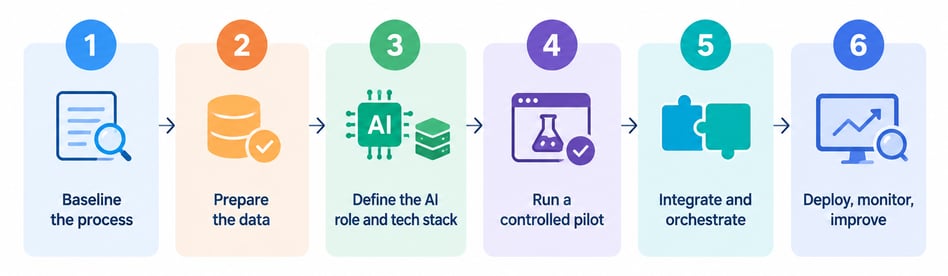
Step 1. Baseline the process
Document the current steps, monthly volume, handling time, error rate, and cost per transaction. Without this, nobody can prove the savings later.
Step 2. Prepare the data
Profile the source systems, strip duplicates, and assign a data owner per domain. Lineage tracking should record where every field originated. That record helps keep data quality intact as volumes climb.
Step 3. Define the AI role and tech stack
First decide whether the work needs classification, extraction, prediction, or generation. Then select the machine learning models, large language models, and orchestration tools that match.
Step 4. Run a controlled pilot
Begin with one process and 10 to 20 percent of its volume. Shadow mode first, where AI output gets reviewed but nothing acts on it yet. Then supervised mode. Autonomous execution only kicks in for categories that clear the agreed accuracy threshold.
Step 5. Integrate and orchestrate
Wire the AI solutions into ERP, CRM, and ticketing platforms through APIs. Workflow orchestration keeps tasks moving across systems, and exception handling sends low-confidence cases to a human reviewer with full context attached, not a bare flag.
Step 6. Deploy, monitor, improve
Watch model drift, accuracy, and throughput weekly. Retrain on reviewed exceptions and carry what works into the next set of business workflows.
Six steps later, there is a documented baseline, a governed data pipeline, a tested integration layer, and a working monitoring setup on the table. Each one addresses a specific reason programs stall out, which is worth looking at directly.
AI Automation Implementation Challenges and How to Overcome Them
The major challenges with AI automation implementation stick around data, governance, and integration far more often than the models themselves. In Bain's 2026 survey, 41% of companies named data access and integration as their single biggest obstacle to AI progress. IDC found a related pattern on the readiness side. By 2027, companies that do not prioritize AI-ready data are projected to see a 15% productivity loss, trying to scale generative AI and agentic systems on a foundation that was never designed to carry them.
Here is where most implementation programs actually run into trouble.
-
Fragmented data: Consolidate sources into a governed pipeline with automated quality checks running before model training begins.
-
Legacy integration: Use API middleware or RPA where existing systems have no modern interface to connect through.
-
Weak governance: Classify AI agents by autonomy level, then apply access controls, audit logging, and rollback procedures matched to each level.
-
Exception volume: Set confidence thresholds and route low-confidence cases to trained reviewers along with the source documents, not just a summary.
-
Model drift: Put monitoring and retraining on a schedule. Accuracy does not hold on its own once input patterns shift.
-
Regulatory compliance: Map each workflow to the data protection rules that apply and log every automated decision for later review.
-
Skills and change management: Bring operations staff into the pilot early. People reviewing exceptions need to understand why the system flagged something, or they stop trusting it.
Governance gaps rarely show up during a pilot. They become visible when automation scales, which is why access controls and audit logging need to be built in from day one. A workforce management platform built for a US healthcare network connected live patient census and credential data, triggered renewal alerts, and automatically blocked scheduling when credentials expired. The result depended as much on governance and integration as it did on AI.
How to Measure the Business Impact of AI Automation
Budgets usually get cut in the gap between what leadership expects and what a program actually delivers. Bain's 2026 survey found that 37% of companies targeted cost reductions of 11% to 20%, yet nearly 40% of those companies landed savings of only 0% to 10%. The companies that hit their numbers shared something specific.
It found that companies that met their targets were far more likely to have moved past supervised review into guardrails-level autonomy; underperformers stayed stuck requiring manual approval on every decision. A measurement framework built before launch supplies the evidence those budget reviews need, not a scramble to pull numbers together once a CFO starts asking. The AI implementation strategy and ROI guide covers the financial modeling side in more depth. Below are the operational measures worth tracking from day one.
Cycle time and turnaround: Compare handling time per transaction against the Step 1 baseline. In the Propellia property management platform, average maintenance resolution time fell from 6.4 days to under 2.8 days once GPT-4o-based triage started routing requests to pre-approved vendors.
-
Manual effort released: Track hours removed from manual tasks such as reporting. On the same platform, investor report generation moved from 11 hours monthly to under 20 minutes.
-
Error and exception rates: Measure accuracy and the share of cases still needing human review. A falling exception rate is usually the clearest sign the models are learning from real data, not test data
-
Cost per transaction and operational costs: Multiply volume by unit cost before launch and after. Model inference, licensing, and support costs need to show up in that after number too.
-
Straight-through processing rate: Track the share of cases completed with zero human touch, by category, so autonomy expands only where accuracy has actually earned it.
-
Autonomy level achieved: Check whether the system still needs approval on every action, runs under guardrails with exceptions escalated, or operates fully on its own. This one measure often separates the programs that hit their targets from the ones that do not.
Report these numbers monthly, and leadership gets a defensible view of business impact, plus a real answer for what to automate next. Programs that skip this step run on early enthusiasm instead of evidence, and enthusiasm rarely survives the next budget cycle.
What to Look for in an AI Automation Implementation Partner
Most enterprises running their first AI automation implementation project bring in outside help for data engineering and integration, keeping strategy in house. A company's second or third AI automation implementation effort almost always moves faster, since the governance and integration groundwork is already sitting there. A useful partner covers a readiness assessment before any build starts, governed data pipelines with lineage tracking, a team that can work across generative AI, agentic AI, and machine learning, and a governance layer that is part of the architecture from day one, not bolted on later.
Signity Solutions has been working in this space for long. We are known to be offering AI automation services and building automation for finance, healthcare, and real estate clients whose complex workflows need to hold up against enterprise security, privacy, and regulatory requirements.
-
AI consulting and assessment: Process inventory, readiness scoring, and a prioritized roadmap tied to baseline metrics.
-
AI development services: Generative AI, agentic AI, and machine learning work built by the AI development company team, with advanced technologies applied differently for each business function.
-
Governance and compliance: Access controls, audit logging, and data protection built into the architecture from the start.
-
Data engineering and integration: Governed pipelines, data lineage tracking, and API connections into existing systems.
-
Continuous improvement: Monitoring, retraining, and expansion into more workflows once the first process settles.
Have an AI automation initiative in mind? We can help you identify the right opportunities across your business operations. Choose the right AI tools and automation approach, and build artificial intelligence solutions that fit your existing workflows.
Whether you want to automate routine tasks or need custom development and system integration, the focus stays on cost savings, operational efficiency, and measurable business impact. Discuss your AI automation needs with our team to find the finest implementation approach designed to deliver measurable results.

Mangesh Gothankar


Ashwani Sharma
Achin Verma
Frequently Asked Questions
Have a question in mind? We are here to answer. If you don’t see your question here, drop us a line at our contact page.
How long does AI automation implementation typically take?

What roles need to be involved on the implementation team?
Is it better to build an implementation team in house or bring in a partner?
What should happen if a pilot misses its targets?






.png?width=352&name=Why%20Enterprise%20AI%20Pilots%20Fail%20And%20How%20to%20Fix%20Them%20(1).png)