


.png?width=27&height=27&name=Group(1).png)

-1.svg)
-1.svg)


-2.svg)


%201-1.webp?width=148&height=74&name=our%20work%20(2)%201-1.webp)




.svg)





Most mid-sized enterprises are losing the AI race because they don’t have a proper structure.
By 2026, global spending on AI systems will cross $300 billion, and yet McKinsey finds that only 5.5% of organizations are seeing real financial returns on those investments. The gap is not about access to AI tools. It is about knowing how to implement them properly.
That is exactly where AI implementation services come in.
For mid-sized companies sitting between corporations and an AI-based startup, structured implementation is what differentiates an AI strategy that can deliver meaningful results and impact that actually stalls at the pilot stage.
Here is a guide that walks you through everything, from what enterprise AI implementation services cover to how generative AI and agentic AI help shape the business processes. It also helps you choose the right AI consulting company aligned to your specific business goals. By the end, you will have a clear and practical roadmap so that you can move forward.
 Generate
Key Takeaways
Generate
Key Takeaways

- AI implementation is a structured process, not a one-time deployment.
- Mid-sized enterprises have a real advantage, but only if they act now.
- Define KPIs before implementation begins, not after.
- The right consulting partner is the difference between a pilot and a product.
What Are Enterprise AI Implementation Services?
What are AI implementation services? Basically, AI implementation services are professional solutions that help businesses integrate Artificial Intelligence into their daily workflows. They help businesses seamlessly plan and manage AI solutions from end-to-end. The services cover the entire lifecycle, no matter if it's identifying use-cases and preparing data for system integration, it helps with everything.
Buying an AI tool without implementation support is like buying accounting software without an accountant. The tool exists. The results don't follow automatically.
For mid-sized and large organizations, the scope gets more specific. Enterprise AI implementation services typically cover:
- AI strategy: identifying the right use cases tied to real business objectives
- Data engineering: building data pipelines that AI models need to work
- AI development: building ML models, generative AI, and computer vision solutions as per business needs
- AI integration: connecting new AI systems with existing systems and processes
- AI governance: keeping AI operations compliant and auditable
- Change management: getting your people to actually use what's been built
The distinction worth remembering: implementation services are not a one-time software deployment. They are a structured discipline that turns AI investments into measurable business impact.
Why Mid-Sized Enterprises Are the Biggest Winners
Large businesses have dedicated infrastructure labs, data scientists, developers, and more that can help with experimentation. AI-based startups and mid-sized companies do not have that much luxury, and they lack real operational complexity, customer relationships, and enough scale to make AI investment worthwhile. That is exactly why the opportunity here is so large.
The Mid-Market AI Gap
AI adoption among large enterprises sits at 55% compared to just 17% among smaller firms, and mid-sized companies are caught between those two numbers. The data engineering, machine learning expertise, and change management capability needed to implement AI do not exist inside most mid-market teams. This is not a technology problem. It is a resource and expertise problem. This is what professional AI implementation services solve.
Competitive Pressure Is Real
Early movers towards AI are dominating in the real world. AI-native competitors help automate the business processes, reduce operational cost, and boost customer engagement, which manual operations can not actually help with. For mid-sized enterprises, waiting is no longer a safe option.
The ROI Case Is Strong
Mid-market companies actually have an edge: fewer legacy systems, faster decisions, and a tighter focus. That means AI investments hit the right business functions quicker and deliver measurable results sooner than most expect.
The AI Implementation Lifecycle: End-to-End Breakdown
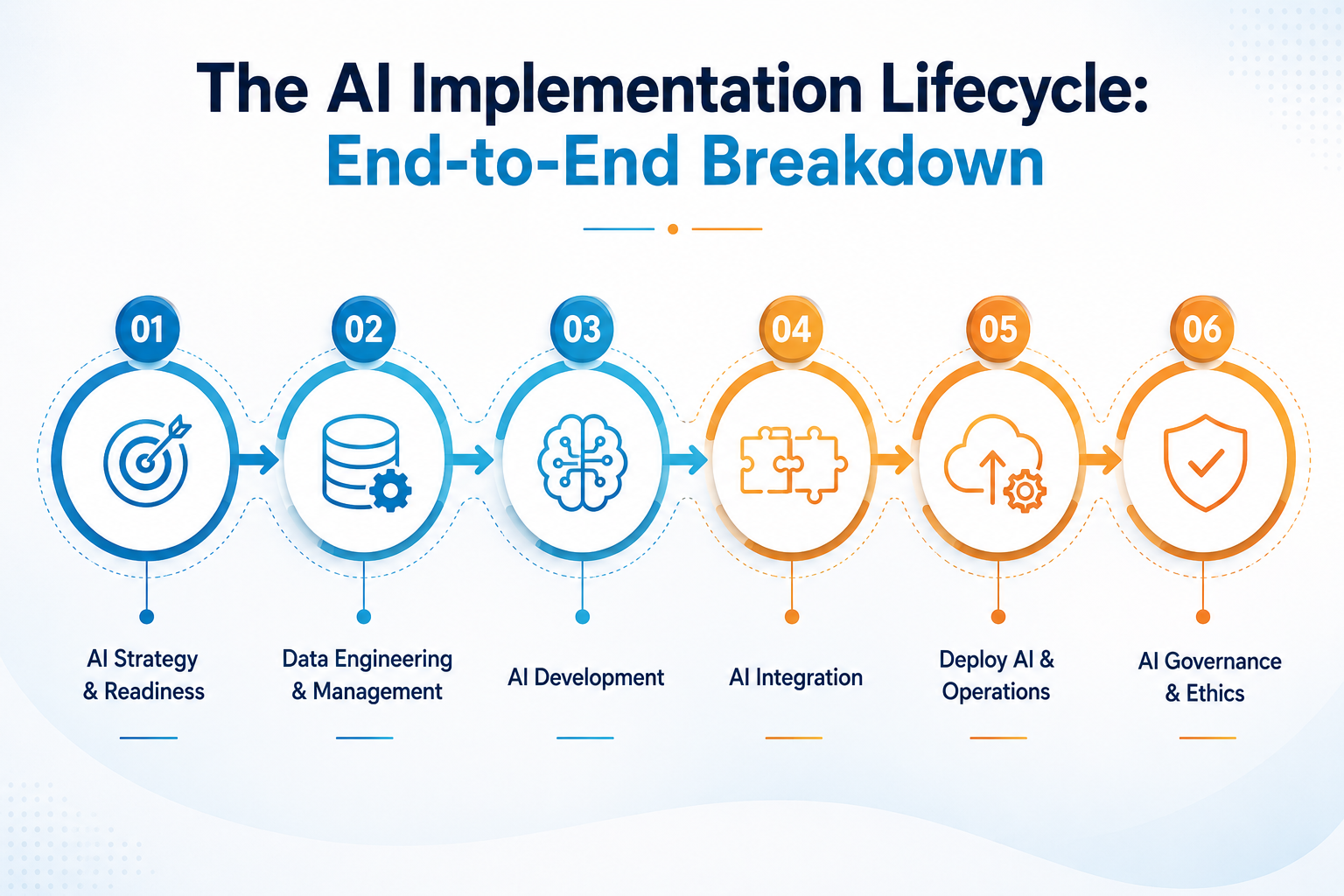
Yes, mid-sized businesses do struggle with the problems, and one of them is that AI has a process problem, not a technology problem. Businesses rush to develop AI applications without having a proper process and foundation. A well-structured implementation lifecycle changes, and here is the AI implementation lifecycle businesses need to follow:
AI Strategy & Readiness
The process begins with finalising what you actually want AI to help with. This can simply mean following the right business objectives, narrowing down use cases, and taking a look at whether the infrastructure can support AI or not. Skipping this phase does not help you save time; rather makes the expensive work to be redone.
Data Engineering & Management
If the data is fragmented or messy, the AI models can not perform well. So, before proceeding with AI development, businesses need a clear pipeline and proper data management. For mid-sized businesses, this reveals the gaps they did not know existed.
AI Development
With clean data and a clear strategy, the actual building begins. Whether that's machine learning models, generative AI implementation services, natural language processing tools, or computer vision applications designed around specific business needs, the development process is streamlined.
AI Integration
When the new AI system is connected with the existing legacy system and platform, the implementation hits its first wall. For a seamless integration, there must be careful planning so that AI can enhance the business operation, not disrupt it.
Deploy AI & Operations
Going live is just the beginning. Maintaining consistent performance over time means continuous monitoring, regular model updates, and dedicated AI operations, work that keeps the system delivering value well beyond the launch date.
AI Governance & Ethics
Regulatory compliance and AI ethics need to be woven right from the very beginning of the project. The organizations that treat AI governance as a major priority and not as an afterthought can find out why the mistake was impossible to ignore.
Types of AI Solutions for Mid-Sized Enterprises
Not all AI is the same, and choosing the wrong type for your business is one of the more expensive mistakes you can make. Here is a breakdown of what mid-sized enterprises are actually deploying in 2026 and what each one does.
Generative AI
Generative AI is known via Chat GPT, Claude and other such tools that help generate text, videos and a lot more. It goes much deeper when it comes to enterprise context. Whether it is automated report generation, building AI-assisted code, or intelligent document summarization, Generative AI implementation services help with everything within your own infrastructure.
Agentic AI Systems
This is way ahead of generative AI and is genuinely more exciting. Generative AI just responds to prompts; however, AI agents work autonomously and execute multiple-step tasks across the business functions. Also, as per a report from Gartner, around 40% of enterprise applications will have task-specific AI agents. This shift is moving fast than most of the mid-market leaders actually realize.
AI-Powered Chatbots
When the AI chatbots are built on solid natural language processing, the AI-powered chatbots can go far beyond the scripted FAQs. They can seamlessly handle customer queries and respond to them immediately, and manage the internal knowledge management that helps reduce the workload rather than adding to it.
Recommended Post: How To Build An AI Chatbot For Your Business?
Predictive Analytics & Predictive Maintenance
It addresses problems before they even happen. Predictive analytics uses ML models to flag risks and forecast demand. In the context of manufacturing and supply chain, it can help identify equipment issues before they cause downtime. The operational cost savings here tend to be among the most measurable of any AI investment.
Computer Vision & OCR
Optical character recognition and computer vision are automating document processing, quality inspection, and compliance workflows across logistics, life sciences, and the public sector, work that used to require significant manual effort and time.
Custom AI Solutions
When the problems are generic, the everyday process works best to solve the problems. However, when the business processes are specific, and no existing product fits, it becomes vital to choose custom AI solutions. Here you can build around your own data and workflow and leverage results that can hold up over time.
The Business Case: Measuring ROI on AI Investments
Investing in AI without a clear measurement framework is one of the fastest ways to burn budget and lose internal confidence. The value is there; most organizations just don't know how to track it properly.
Start With KPIs Before Implementation Begins
The organizations that extract real business value from AI define their key performance indicators before a single model gets built. Not after. Chasing ROI, trying to fit results to a business case that was never clearly defined, is where most AI projects lose credibility internally. Tie every AI initiative to a specific, measurable business objective from day one.
Cost Reduction vs. Revenue Growth
These are two very different targets that require different measurement approaches. Companies that move AI from pilots into production-scale processes report an average ROI of 1.7x, with cost savings of 26–31% reported across different industries. Cost reduction tends to show up faster and is easier with AI. Revenue growth takes longer and requires more sophisticated tracking, but the upside is significantly larger.
Efficiency is a Starting Point, Not the Destination
Efficiency gains matter, but they are not a business outcome on their own. The goal is to connect those efficiency improvements to financial impact, lower operational costs, faster decision making, and reduced risk, so that AI investments tell a clear story at the board level.
Tie AI Projects Back to Business Objectives
Every AI project should answer one simple question: what business problem does this solve? When that answer is vague, ROI will be too. The strongest implementations link each AI solution directly to a business function, whether that's reducing customer churn, cutting supply chain costs and accelerating data-driven decisions across businesses.
Common Challenges in Implementing AI at Enterprise Scale
Organizations are now using AI, but a few of them get stuck in the pilot phase, or there may be other challenges. Here are the blockers that organizations generally face.
| Challenge | What It Looks Like | How to Address It |
| Poor Data Quality | Fragmented, inconsistent, or incomplete data | Build data engineering foundations before AI development begins |
| Legacy Systems | Outdated infrastructure that does not support modern workloads | Plan integration strategy early; modernize incrementally |
| AI Talent Shortage | Lack of in-house data scientists and ML experts | Partner with an experienced AI consulting company |
| Change Management | Employee resistance, low AI adoption across teams | Invest in training, communication, and workflow redesign |
| Unclear ROI | No KPIs defined before implementation | Tie every AI project to specific business objectives upfront |
What to Look for in an AI Consulting Company
Choosing the wrong partner is expensive. The gap between a pilot that stalls and one that scales almost always comes down to who you hired to help you get there. Here is what actually matters:
Proven Track Record
Look beyond case studies on their website. Ask for specific enterprise AI projects they have delivered, the business problem, the solution, and the measurable outcome. Vague answers here are a red flag.
Approach to Agentic AI
Agentic AI professional services implementation is still relatively new territory. A capable partner should have a clear, structured methodology for building and deploying agentic AI systems, not just generative AI experience repackaged with new terminology.
Post-Deployment Support
Building AI is one part of the work. Ongoing AI operations, monitoring, retraining, and performance optimization is the other. Make sure post-deployment support is clearly scoped before you sign anything.
Change Management Capability
Technical delivery without adoption is wasted investment. The right AI consulting company understands that change management is part of the implementation, not an afterthought.
Conclusion
AI is a present day competitive necessity and for mid-sized businesses, the question now is no longer whether businesses should implement it, but it is how to do it in a way that can help deliver real and actual business value.
The organizations that are moving ahead are not the ones that have a higher budget, but they are the ones that have right structure and a clear implementation plan and roadmap.
If you are ready to move from experimentation to execution, Signity Solutions can help. From AI strategy and data engineering to custom AI solutions and agentic AI systems, we handle the full implementation lifecycle so you can focus on results.
Frequently Asked Questions
Have a question in mind? We are here to answer. If you don’t see your question here, drop us a line at our contact page.
How long does AI implementation and development services take for a mid-sized enterprise?

Anywhere from 3 to 12 months, depending on project scope, data readiness, and complexity. Simple process automation moves faster; full agentic AI systems take longer.
How much do AI implementation services cost?
It varies by scope. Budget separately for data engineering, AI development, integration, and ongoing AI operations support rather than treating it as a single project cost.
What is the difference between generative AI and agentic AI?
Generative AI responds to prompts. Agentic AI autonomously plans and executes multi-step tasks across business processes with minimal human input.
Do we need to replace existing systems to implement AI?
Rarely. Most AI integration is designed to work alongside legacy systems, extending their life while adding new AI capabilities on top.





.png?width=352&name=Enterprise%20Generative%20AI%20Services%20(4).png)
.png?width=352&name=How%20to%20Build%20an%20AI%20Implementation%20Strategy%20That%20Delivers%20Business%20ROI%20(2).png)
.png?width=352&name=Why%20Enterprise%20AI%20Pilots%20Fail%20And%20How%20to%20Fix%20Them%20(1).png)