


.png?width=27&height=27&name=Group(1).png)

-1.svg)
-1.svg)


-2.svg)


%201-1.webp?width=148&height=74&name=our%20work%20(2)%201-1.webp)




.svg)





Six months after go-live, a Fortune 500 CTO receives a report no one wants to read. The internal AI pilot is failing at the orchestration layer. Agents can't hand off tasks reliably across distributed workflows. Rework estimates land in the millions.
And the root cause? No one on the internal team had genuine experience with autonomous agent architecture before the build began.
The scenario is playing out across enterprises right now. In practice, many organizations deploying AI agents discover they lack formal governance frameworks before production launch, creating downstream compliance and operational challenges.
The gap between a working proof-of-concept and a production-ready deployment is wide, and it's getting wider as multi-agent orchestration grows more complex. This is why selecting enterprise AI agent deployment consultants has become a board-level decision. The wrong partner costs you rework cycles, compliance exposure, and organizational trust you can't easily rebuild.
The right evaluation covers four areas: consultant capability criteria, realistic implementation expectations, deployment failures that surface only after launch, and partnership structures that sustain long-term agent performance. Let’s dive into the details.
 Generate
Key Takeaways
Generate
Key Takeaways

- Prioritize consultants with verifiable deployment case studies in your specific industry, not portfolio logos.
- Most POC-to-production failures happen at the orchestration handoff layer, not during initial development.
- Compliance coverage (HIPAA, SOC 2, GDPR) and token cost controls are non-negotiable contract terms, not optional add-ons.
- Change management for AI adoption must appear as a named workstream in the statement of work before signing.
- Require a defined AI ROI measurement framework, with specific agent benchmarking metrics, as a pre-engagement deliverable rather than a post-launch promise.
Why Enterprise AI Agent Deployment Consultants Matter in 2026?
Agentic AI has outgrown the chatbot era. Enterprise deployments now involve distributed agent networks where autonomous agents call external tools, query live databases, and hand off tasks across multi-agent orchestration layers. The architectural complexity is precisely where internal IT teams run into trouble.
Industry analysts project that agentic AI systems will increasingly handle routine enterprise decision-making autonomously over the next several years, with adoption expected to accelerate through 2026 and beyond. In practice, many organizations lack mature agent benchmarking metrics and AI governance frameworks when preparing for production agent deployments, often discovering these gaps only after launch.
Here's what that gap looks like in practice. The two failure modes that surface most often post-launch are operational. Agent hallucination rates climb when retrieval-augmented generation pipelines aren't grounded against freshly indexed enterprise knowledge.
Latency spikes hit when tool-calling chains exceed four hops without a timeout or fallback policy in place. Consultants who have run real production deployments instrument for both conditions before go-live. Generalist vendors discover them in incident reports.
Skipping specialist guidance creates concrete, measurable exposure:
- Orchestration failures at agent handoff points that don't appear in POC environments
- Token cost explosion when unconstrained agents run production-scale query volumes
- Compliance drift in regulated industries when agent inference calls aren't logged to satisfy HIPAA or SOC 2 audit requirements
- Knowledge graph failures tied to poorly labeled enterprise data that break retrieval pipelines.
The business case for qualified enterprise AI agent deployment consultants is the difference between a production system that runs and one that gets rebuilt.
Related Read: Transforming Business with Custom AI Agents
Key Capabilities of Enterprise AI Agent Consulting Partners
Qualifying a consulting partner on paper is straightforward. Qualifying one against the specific failure modes of enterprise agent deployments is a different exercise entirely. Five capability pillars that separate firms with real production depth:
Autonomous agent architecture design
Agents that break in regulated environments almost always share a root cause: the architecture wasn't designed for deterministic fallback. In fintech and healthcare, non-deterministic agent behavior without a documented fallback path is a compliance liability, not just a reliability issue.
LLM integration strategy, covering both model fine-tuning services and OpenAI API implementation
Generic API wrappers don't cut it at scale. Firms need demonstrated experience selecting the right model tier per task type, because over-provisioning models is where token cost spirals begin.
Retrieval-augmented generation (RAG) for grounding agents in enterprise knowledge
RAG quality depends entirely on data labeling quality upstream. Consultants who don't audit your data schema before scoping RAG architecture will underestimate the remediation work required.
Legacy system integration via structured API integration for agents
Most enterprise environments have a mix of REST APIs, SOAP endpoints, and flat-file data sources. A consulting firm that's only worked in greenfield environments won't anticipate the authentication and rate-limiting constraints that surface mid-deployment.
AI safety compliance against frameworks like NIST AI RMF or ISO 42001
These aren't checkbox standards. Firms that can't map their agent validation methodology to a named framework should be disqualified before the RFP stage.
| Capability Pillar | Specialist Consultant | Generalist IT Vendor |
| Agent architecture design | Deterministic fallback, multi-agent orchestration | Single-agent, no fallback logic |
| LLM integration | Model selection by task, cost controls | Default API integration only |
| RAG implementation | Data audit included in scoping | Assumes clean data |
| Legacy system integration | Handles mixed API environments | Greenfield-only experience |
| AI safety compliance | Maps to NIST AI RMF or ISO 42001 | Generic security review |
Ask any enterprise AI agent consulting candidate how they handle adversarial prompt inputs during agent training and validation. If the answer references prompt injection testing, input sanitization at the tool-calling layer, and edge-case simulation against your actual data schema, that's a firm worth advancing. A vague answer about "guardrails" is a disqualifier.
Enterprise AI Agent Implementation Services: What to Expect
Most consulting firms can describe an engagement model. Fewer can tell you exactly where their past deployments broke down and what they changed because of it.
Quality AI agent implementation services follow a disciplined five-phase arc:
- AI maturity assessment: Audit your data pipelines, integration surfaces, and team readiness before any architecture decisions are made. Skipping this phase often results in significant project delays, with many teams reporting the need to revisit foundational assessments mid-implementation.
- Proof-of-concept development: Scope a single, bounded agent workflow with defined success thresholds. The POC exists to surface data quality problems, not to validate the technology.
- Agent workflow automation design: Map task handoffs across your actual system topology, including authentication constraints and rate limits on legacy endpoints.
- Scalable agent infrastructure setup: Configure observability, token budgeting, and fallback logic before the first production request runs.
- Production deployment with agent performance monitoring: Instrument structured trace logging from day one. Post-hoc debugging in a distributed agent network is genuinely painful and avoidable.
On engagement models: fixed-scope POCs work when your use case is well-defined. Time-and-materials fits complex integrations where scope evolves mid-build. A managed MLOps retainer makes sense once agents are live and need ongoing drift monitoring and cost controls.
The handoff between phases two and three is where engagements fail. Consultants who don't include change management as a named workstream deliver agents that work technically and get ignored organizationally.
Critical Evaluation Criteria for Selecting Your Consultant
Slide decks with Fortune 500 logos aren't evidence. Verifiable deployment case studies in your specific vertical are. A healthcare organization evaluating AI agent consulting partners needs documented proof that the firm has handled HIPAA-compliant inference logging at the tool-calling layer, not a general reference about "healthcare experience."
Industry practitioners and procurement teams increasingly recognize that vendor concentration in AI service providers creates significant operational risk and dependency concerns. Single-vendor dependency is the risk most procurement teams miss entirely.
Ask any shortlisted firm how a client would exit their engagement cleanly, including how proprietary agent logic, fine-tuned model weights, and knowledge graph schemas transfer at contract end. Vague answers here are a structural red flag. IP ownership terms and escalation paths matter as much as technical capability. Therefore, it is necessarily required that both appear in the statement of work before signatures.
The Evaluation Checklist
Bring these questions to every vendor conversation:
- Can you show a deployment case study in my industry with named agent benchmarking metrics and go-live outcomes?
- How do you define and document your AI ROI measurement framework before the engagement begins?
- What's your compliance track record across HIPAA, SOC 2, and GDPR on production agent deployments?
- How do you handle knowledge graph implementation when our source data has labeling gaps?
- Who specifically is on the delivery team, and what's the escalation path if the lead architect rolls off?
- How do your agentic AI systems integrate with third-party tools our agents will call in production?
- What does a clean client exit look like, and which artifacts transfer to us at contract end?
- How do you instrument agent traces before go-live rather than diagnosing failures after them?
Common Deployment Challenges and How Expert Consultants Solve Them
Five failure modes show up in real enterprise rollouts. None of them appear in vendor demos. Each one has a specific mitigation that experienced consultants apply before go-live, not after an incident ticket arrives. 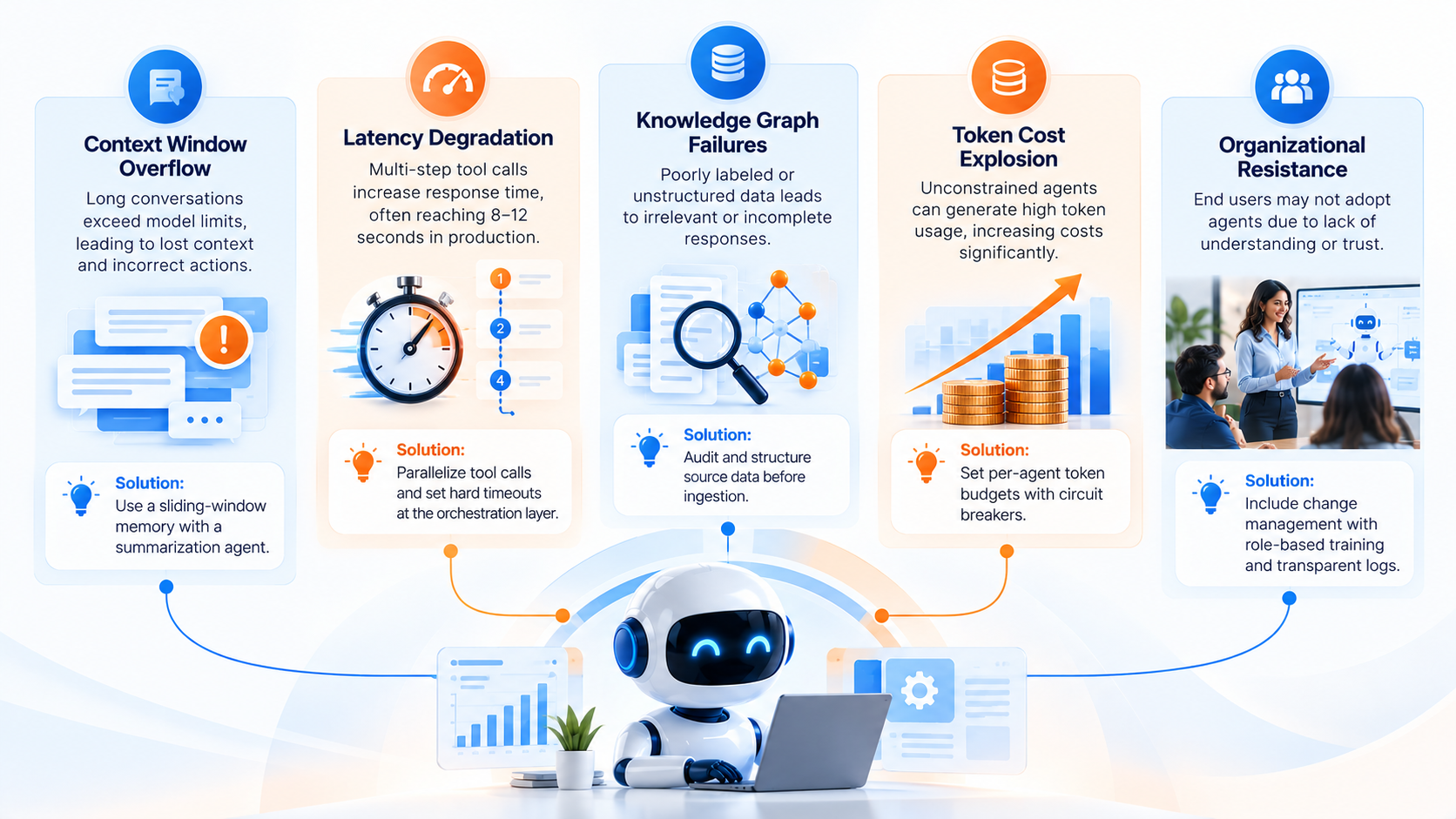
Context window overflow in multi-turn agent conversations
At scale, long conversation histories push token counts past model limits mid-task, corrupting agent memory and producing nonsensical tool calls. Expert mitigation: implement a sliding-window memory strategy with a summarization agent that compresses older turns before the context boundary is reached. This requires profiling your actual conversation length distributions during the POC phase, not after.
Latency degradation in distributed agent networks
When tool-calling chains exceed four sequential hops, round-trip latency compounds fast. Industry estimates put acceptable agent response windows below two seconds for most enterprise workflows, yet unchecked chains routinely hit eight to twelve seconds in production. The fix is parallelizing independent tool calls where possible and setting hard timeouts at the orchestration layer.
Knowledge graph failures from poorly labeled data
RAG systems don't fail because the retrieval architecture is wrong. They fail because the source data schema wasn't audited before ingestion. Consultants who skip that audit are adding weeks of unplanned remediation to your timeline.
Token cost explosion in unconstrained production agents
Set per-agent token budgets with hard circuit breakers. Without them, a single runaway workflow in a parallel agent pool can generate costs that erase the ROI case entirely.
Organizational resistance from change management gaps
Technically sound agents get quietly abandoned when end users don't understand what the agent is doing or why it sometimes escalates to a human. Structured adoption workstreams, including role-specific training and transparent agent decision logs, cut resistance before it becomes a rollout failure.
The detail that separates experienced consultants from everyone else: structured trace logging must be instrumented before the first production request runs, not added reactively when something breaks.
Building Your AI Agent Strategy With The Right Partners
A responsible AI framework isn't a compliance artifact you file after deployment. It's the structural foundation your agent strategy either rests on or collapses without when regulatory scrutiny arrives.
Experienced consultants build that foundation before any code is written. The sequence matters: first, a responsible AI framework audit that maps your existing data governance against NIST AI RMF or ISO 42001 requirements.
Then, agent benchmarking metrics get defined with specific success thresholds, so you're measuring against a predetermined bar rather than deciding post-launch what "good" looks like.
Industry-specific requirements make this more concrete. Fintech agents need deterministic audit trails at every decision point, not just at the API boundary. Healthcare agents require HIPAA-compliant data handling at the inference layer itself.
(Encrypting data at rest while passing unmasked patient context through an LLM call is a compliance failure, full stop.) These aren't edge cases your consultant should discover mid-engagement.
And here's what actually delays projects: enterprises that skip the AI maturity assessment and move straight to implementation routinely discover their data isn't ready. In practice, enterprises that defer maturity assessments often encounter unexpected data readiness issues that can extend project schedules. The assessment isn't overhead. It's the work that keeps the rest of the schedule honest.
Why Choose Signity for AI Agent Deployments?
With over 16 years of experience delivering enterprise technology solutions, Signity brings deep engineering expertise and a practical understanding of complex deployments. That experience now supports our approach to enterprise AI, helping teams anticipate integration challenges, build scalable architectures, and address potential deployment risks early in the development process.
Signity's 200+ certified experts cover autonomous agent architecture, multi-agent orchestration, retrieval-augmented generation, and MLOps as core disciplines. Not as adjacent capabilities pulled in for a single engagement.
On the security side, every agent deployment meets HIPAA, GDPR, SOC 2, and ISO/IEC 27001 requirements at the inference layer. (Most vendors secure data at rest and treat the LLM call itself as a gap. That gap is where regulated-industry audits find failures.) Signity closes it by design, not by amendment.
An AI ROI measurement framework is defined before the engagement contract is signed. Cost controls in production come standard: per-agent token budgets, circuit breakers, and fallback routing. In practice, enterprise clients report meaningful reductions in project costs when cost controls are implemented early in the deployment lifecycle, such as per-agent token budgets and circuit breakers.
Change management for AI adoption is a named workstream in every statement of work.
Getting Started: Next Steps for Enterprise Leaders
Before you contact a single vendor, run an internal AI maturity assessment. Audit your data pipelines, integration surfaces, and team capabilities against the demands of agentic AI systems. This work takes two to four weeks. Skipping it guarantees scope surprises mid-engagement.
Next, build your shortlist using the vendor evaluation matrix covered earlier. Require verifiable case studies with named metrics in your industry. Slide-deck references don't qualify.
Then, before signing any full engagement, demand a scoped proof-of-concept proposal. It must include defined agent benchmarking metrics and specific success thresholds. A consultant who can't name those thresholds upfront won't measure ROI honestly later.
Finally, insist that a responsible AI framework review appears as a named deliverable in the statement of work. It means the enterprises that wait until 2027 to begin structured agentic deployment will inherit technical debt that compounds quarterly as the competitor agent infrastructure matures around them. Thus, the right enterprise AI agent deployment consultants make that gap smaller today.

Mangesh Gothankar


Ashwani Sharma
Achin Verma
Frequently Asked Questions
Have a question in mind? We are here to answer. If you don’t see your question here, drop us a line at our contact page.
What is the typical cost range for enterprise AI agent deployment consulting engagements?

Engagement costs vary by scope and regulated-industry requirements. Fixed-scope proof-of-concept projects for enterprise AI agents typically range from $50,000 to $150,000, though actual costs vary significantly based on complexity and industry requirements. Full production deployments with MLOps retainers run considerably higher.
Organizations frequently underestimate the effort required for data remediation work, which often adds a significant percentage above initial architecture budgets.
How long does a production-ready AI agent deployment take from assessment to go-live?
How do consultants handle data privacy in regulated industries like healthcare or fintech?
What agent benchmarking metrics should enterprises define before an engagement begins?