


.png?width=27&height=27&name=Group(1).png)

-1.svg)
-1.svg)


-2.svg)


%201-1.webp?width=148&height=74&name=our%20work%20(2)%201-1.webp)




.svg)





.png?width=670&height=445&name=agentic-ai-strategy-for-enterprise-software%20(14).png)
When the customer service is poor, half of the users are already gone. The static, rigid scripts failed to resolve customer queries, leaving them frustrated. The new generation of users demands instant and smart support, and is no longer satisfied with static chatbots. They demand intelligent, autonomous systems that drive real business outcomes.
The shift led to the emergence of next-generation AI agents, the software entities that help execute the complex workflow, make autonomous decisions, and streamline operations across different domains like marketing, sales, customer support, and more.
 Generate
Key Takeaways
Generate
Key Takeaways

- Autonomous AI agents can plan and execute multi-step business workflows, not just answer queries.
- AI agent development services enable integration with APIs, databases, and more to deliver tailored solutions.
- Companies build AI agents aligned with domain logic, compliance, and security needs.
- AI agents improve operational efficiency, reduce manual workload, and accelerate decision cycles.
- Enterprises are moving beyond AI-powered chatbots toward fully autonomous, task-driven AI systems.
The AI agents market size was around USD 7.84 billion in 2025 and is expected to grow to USD 52.62 billion by 2030, a CAGR of 46.3%. The stats clearly show that businesses are embracing intelligent agents to stay competitive.
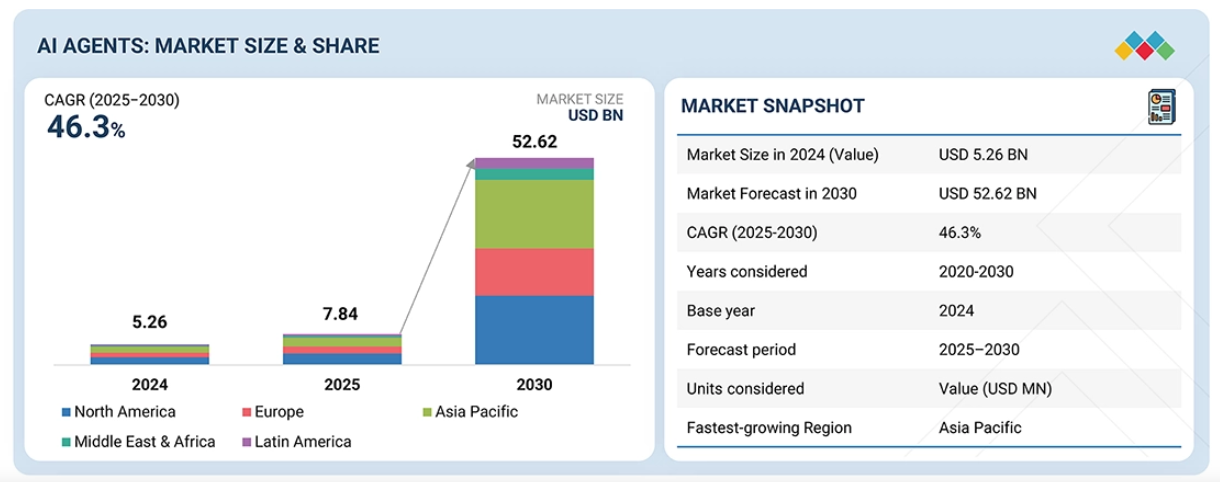
Source: marketsandmarkets
The evolution is a pivotal moment for businesses, where the demand for an AI agent development company becomes critical. Businesses are partnering with custom AI agent development companies to build intelligent AI agents that can deliver measurable results, ROI, automate business processes, and elevate customer experience, far beyond the traditional and rule-based chatbots.
From Chatbots to Autonomous AI Agents: What’s Changed?
Traditional chatbots could handle structured conversations. From normally answering the questions to routing the tickets and more, they were not able to actually satisfy the customers. Though support was offered via an AI chatbot development service, its capabilities remain limited.
Autonomous AI agents turned in and became a game changer. Unlike the traditional bots, the agents use generative AI and are built on large language models. They can interpret and gather information from other systems, analyze data, make context-based decisions, and take independent actions.
AI agent development solutions help enable systems that can:
- Execute multi-step tasks simultaneously.
- Interact with APIs and databases.
- Keep learning from interactions and improve over time.
- Personalize response with real-time context and memory.
Suppose a customer has doubts about the bill payment and has questions. The autonomous agent verifies the account details, retrieves invoices, and processes adjustments if needed. All the actions are simultaneously done within a single interaction. That is one of the reasons most organizations are choosing to partner with an AI consulting company rather than relying on chatbot platforms.
Capabilities of Custom Autonomous AI Agents
Custom autonomous AI agents are intelligent execution systems that operate across different business environments. They are built through advanced AI agent development solutions and combine reasoning, planning, and more to add value. Here are some of the core capabilities that distinguish custom AI agents from standard AI chatbot development services:
1. Goal-Driven Task Execution
Traditional chatbots are driven by response and only answer what is being asked. Autonomous AI agents are driven by goals, understand the challenges and bottlenecks, and work toward a defined outcome. That simply means they don’t stop at a single reply; they continue executing until the objective is achieved.
For example, if there is a refund request that needs to be resolved, the AI agent will check for eligibility, match transaction details, and begin to process the refund, without the need for multiple manual steps.
2. Multi-System Tool Integration
System isolation is the major limitation in the basic AI chatbot development services. Usually, chatbots interact with a messaging interface, but the autonomous agents are built to operate across different enterprise systems. The custom AI agent development company allows agents to connect with ERP systems, CRM, payment gateways, internal databases, and others to perform real transactions and workflow actions. It results in actual automation and customer engagement, not just assisted conversations.
3. Context Awareness and Memory
With autonomous agents, you can seamlessly maintain contextual continuity across different workflow steps. They don’t treat the message as an isolated event, as it starts to work with the input. From tracking history to work progression and state of task, the agents perform everything.
For example, if an agent is handling a service request, they will remember the troubleshooting steps, user preferences, previous outcomes, and more, which ultimately prevents repetitive questioning of the users.
4. Multi-Step Reasoning and Decision Logic
AI agents use reasoning frameworks to evaluate the actions and plan for the next ones. They do not follow a fixed decision tree. They analyze content, compare paths, and then choose the ideal steps to be followed dynamically. It is ideal to be used in scenarios like technical support diagnostics, claims processing, or troubleshooting operations.
An experienced AI agent development company helps design reasoning pipelines that enable agents to make informed decisions while adhering to business rules.
5. Adaptive Learning and Optimization
AI agents are not a static deployment. With the proper feedback signals, performance logs, and human review loops, agents are refined and updated over time. The optimization may cover prompt tuning, workflow optimization and refinement, response quality scoring, and decision threshold adjustments.
This continuous improvement approach separates professional AI agent development solutions from one-time chatbot builds.
Real Business Use Cases of Autonomous AI Agents
As autonomous AI agents move from pilot projects to real-world environments, many industries are leveraging their full benefits. Let us understand where multi-agent systems are actually helping to deliver outcomes.
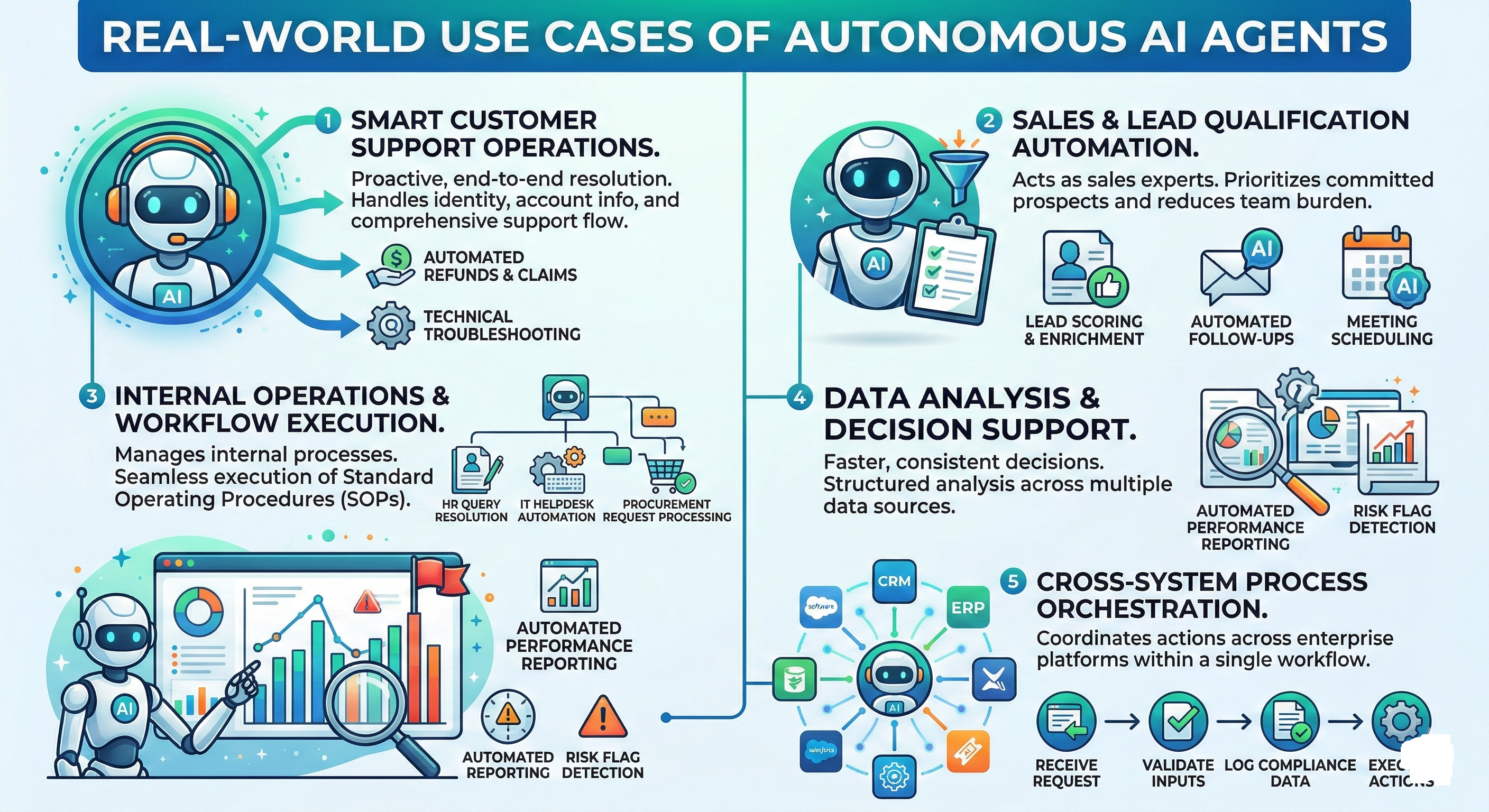
1. Smart Customer Support Operations
Customer support integrates AI agents and is turning from reactive response to proactive resolution engines. They are now handling end-to-end customer support, not a single question. From identifying user identity to fetching account information and initiating the resolutions, they offer a comprehensive solution. Use cases include:
- Ticket triage and routing
- Automated refund and claims processing
- Technical troubleshooting flows
- SLA monitoring and escalation
2. Sales and Lead Qualification Automation
Autonomous agents act as sales experts and help analyze the inbound sales, enrich prospect data, and offer personalized follow-ups automatically. This ensures that committed prospects and leads are prioritized and managed by autonomous agents. It also reduces the burden on the sales team.
Examples:
- Lead scoring and enrichment
- Automated follow-ups
- Meeting scheduling
- Proposal draft generation
- Updates on CRM
3. Internal Operations and Workflow Execution
Organizations rely on custom Artificial Intelligence agents to manage their internal operations and ensure the workflow is executed seamlessly. It works across different industries like IT, HR, finance, and more to process the internal requests, gather required information, and execute standard operating procedures.
Examples:
- HR query resolution and document workflows
- IT helpdesk automation
- Procurement request processing
- Report generation
- Compliance checklist execution
Related Read : 30+ AI Agent Use Cases for Business Success
4. Data Analysis and Decision Support
The custom agents can support faster and more consistent decision-making. Extracting data from multiple sources, they can run a structured analysis and highlight the anomalies. It eliminates the manual and monotonous data reporting cycles and leads to faster decision-making.
Examples:
- Automated performance reporting
- Market signal monitoring
- Risk flag detection
- KPI anomaly alerts
5. Cross-System Process Orchestration
It is another powerful use case of autonomous agents. Agents can coordinate actions across different enterprise platforms within a single workflow. In a single execution chain, an AI agent can receive requests, validate inputs, and log compliance data.
For example, an agent can:
Receive a request → validate data → update CRM → trigger billing → notify stakeholders → log compliance record — automatically.
This kind of orchestration is beyond the traditional bot support and is delivered by a smart custom AI agent development company.
Architecture of Enterprise Autonomous AI Agents
AI agents come with a layered architecture that offers intelligence and control. The modern AI agent development solutions offer more scalability and reliability, ensuring agents can operate effectively in the real-world environment.
Intelligence Layer: LLLM and Reasoning Engines
At the core of autonomous agents, there is an intelligence layer that is powered by Large language models and reasoning frameworks. The step allows agents to understand the intent and generate a response accordingly. They use dynamic reasoning to adapt their behavior based on goals and inputs.
Planning and Task Orchestration Layer
This is the planning layer that converts the goals into steps that can be seamlessly executed. Based on the inputs, agents can decide what actions to take next. It helps them break complex objectives into simple and manageable steps with a complete multi-step workflow.
Tool and System Integration Layer
Agents only become valuable if they are connected to business processes, and therefore, the integration layer allows agents to interact with APIs, CRM, or datasets. These secure integrations allow agents to retrieve data and trigger action accordingly.
Memory and Context Management Layer
This layer allows agents to store the chat history, state of workflow, and user preferences, and retains context across interactions. This offers context-aware behavior, personalization, and more accurate decision-making, rather than isolated one-turn responses.
Governance and Monitoring Layer
Enterprise agents have guardrails, approval controls, and monitoring systems. A custom AI agent development company will help build these controls to ensure compliance and enable continuous improvement.
ROI and Business Impact of Autonomous AI Agents
AI agents are the productivity boosters, not simply a technology upgrade. Organizations that adopt advanced AI agent development solutions can improve efficiency and control costs, compared to traditional AI chatbot development services. Let us highlight the ROI and business impact of autonomous AI agents.
Cost Reduction at Scale: Agents can execute actions, not just respond. As a result, businesses can reduce support costs and rework. Over time, well-designed AI agent systems lower cost per transaction and improve service margins without increasing headcount.
Improved Decision Quality: AI agents can gather data from multiple systems, evaluate, and offer recommended actions. This supports better and informed decision-making, especially in operations and customer success workflows.
Better Customer Experience: Agents provide faster resolutions, more personalized interactions, and consistent responses across channels. Internally, they reduce tool switching and manual coordination, improving employee productivity and satisfaction.
Scalable Automation Foundation: Businesses that invest early in AI agent development solutions build a reusable automation layer that scales across different use cases. These include support, sales, analytics, and more, creating a long-term strategic benefit.
Ready to Move Beyond Chatbots to Autonomous AI Agents?
The shift from traditional chatbots to autonomous AI agents marks an evolution in how AI relies on businesses. Rather than simply solving the customer queries, these AI agents can reason, plan, and integrate withthe enterprise system, executing multi-step workflows. That is the reason why organizations are making this shift and moving to autonomous AI agents.
Partnering with the right and reliable AI software development company, businesses can design secure and scalable agents that are customized to their workflow and compliance needs. The right partner not only delivers advanced AI agent development services, but also aligns agent architecture with real business objectives and ecosystem.

Mangesh Gothankar


Ashwani Sharma
Achin Verma
Frequently Asked Questions
Have a question in mind? We are here to answer. If you don’t see your question here, drop us a line at our contact page.
How are AI agent development services different from traditional AI chatbot development services?

AI chatbot development services focus on conversation handling and scripted responses, while AI agent development services go further by building autonomous systems that can reason, make decisions, use tools, and execute multi-step workflows. AI models function more like digital operators than simple conversational interfaces.
How long does it take an AI agent development company to develop AI agents?
Timelines depend on complexity, integrations, and compliance needs. A basic task-oriented agent may take a few weeks, while enterprise-grade autonomous agents with system integrations, guardrails, and monitoring can take several months.
Can custom AI agent development solutions integrate with existing enterprise software for ongoing support?
Yes. Modern AI agent development solutions are designed to integrate with CRMs, ERPs, databases, APIs, and internal tools. A custom AI agent development company builds connectors and secure workflows that enable agents to operate within your existing systems.
How does multi-agent collaboration work in advanced AI agent platforms?
Multi-agent collaboration allows multiple AI agents to coordinate tasks and offer ongoing support. For example, one agent gathers data, another validates it, and another executes actions. This approach is increasingly used in enterprise systems to automate complex, cross-functional workflows.
How do businesses develop AI chatbots and AI agents that actually improve customer satisfaction?
To improve customer satisfaction, businesses must go beyond basic scripted bots and develop agentic AI solutions with contextual understanding, memory, and workflow execution. Modern AI agent development services combine LLMs, system integrations, and feedback learning loops to deliver faster and more accurate outcomes.





.png?width=352&name=agentic-ai-strategy-for-enterprise-software%20(4).png)