

.png?width=27&height=27&name=Group(1).png)

-1.svg)
-1.svg)


-2.svg)


%201-1.webp?width=148&height=74&name=our%20work%20(2)%201-1.webp)




.svg)





.png?width=670&height=445&name=agentic-ai-strategy-for-enterprise-software%20(4).png)
The conversation around AI agents is shifting. According to Gartner, by 2026 nearly 40% of enterprise applications are expected to embed AI agents. This is up from less than 5% in 2025.
This acceleration changes the conversation. The question is no longer whether AI agents can assist employees. It is how organizations design, govern, and scale autonomous systems responsibly.
The following ten trends outline how AI agents are moving from productivity tools to enterprise infrastructure. And also what business leaders should prepare for next.
For a foundational overview of how AI agents function and where they are being adopted today, read this detailed guide on AI Agents.
 Generate
Key Takeaways
Generate
Key Takeaways

-
AI agents are becoming core enterprise infrastructure.
-
Multi-agent systems outperform standalone AI assistants.
-
Autonomy demands stronger governance and oversight frameworks.
-
Vertical AI agents outperform generic horizontal tools.
-
Orchestration readiness determines scalable competitive advantage.
9 AI Agent Trends Defining Enterprise Strategy
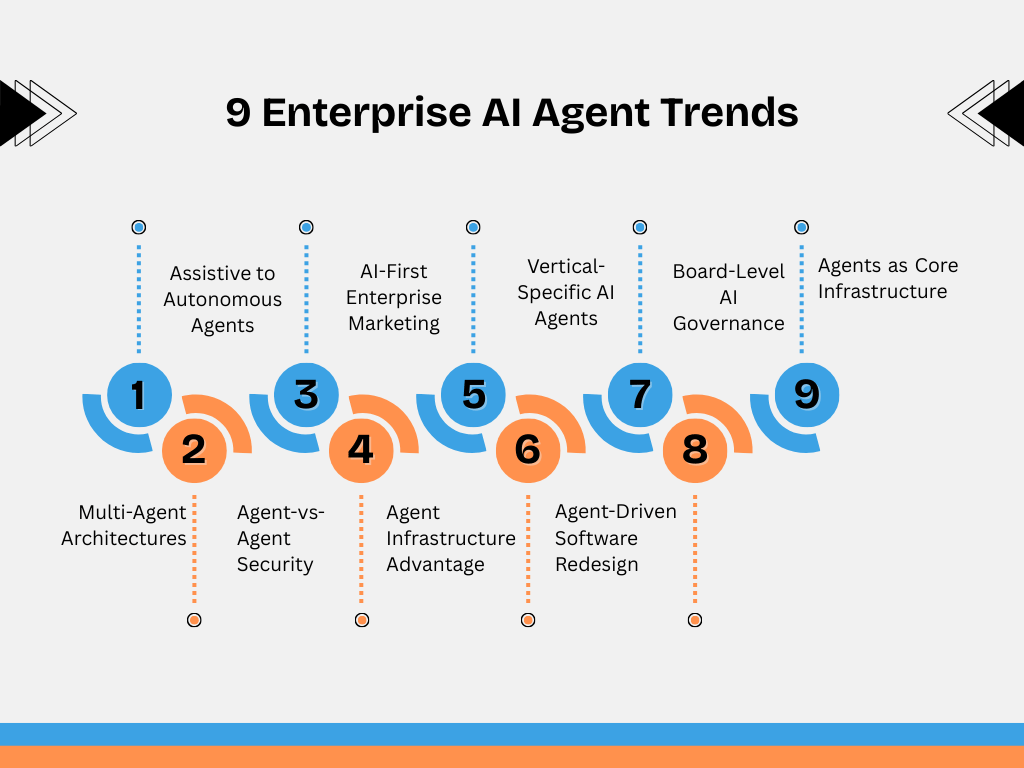
1. AI Agents Will Move From Assistive to Autonomous
Most AI systems today operate in “human-in-the-loop” mode. They recommend, and humans approve.
In 2026, more organizations will allow agents to execute actions independently within defined boundaries.
McKinsey reports that 65 percent of organizations are already using generative AI in at least one function. The next step is automation depth. Instead of drafting emails, agents will schedule meetings, update CRM records, resolve tickets, and trigger downstream workflows without manual intervention.
This transition from assistance to autonomy increases efficiency but raises new operational risks. Enterprises will need clearer guardrails, escalation paths, and audit logs. Autonomy requires governance maturity.
2. Agentic Teamwork Will Replace Single-Agent Systems
Early AI deployments were centered around individual assistants. A chatbot for customer support. A copilot for developers. A research assistant for analysts.
Now that the model is evolving, and as adoption increases, organizations are discovering that single agents cannot manage complex, cross-functional workflows alone.
Multi-agent systems are emerging instead. In this model, specialized agents collaborate. One agent gathers data, another analyzes it, and the third executes actions across enterprise systems. Hence, an orchestration layer coordinates the flow.
For enterprises, this changes architecture decisions. AI is no longer embedded as a feature. It becomes a coordinated digital workforce requiring orchestration, monitoring, and governance at scale.
Also Read: Learn how AI agent orchestration works in enterprise environments.
3. Marketing Will Adapt to AI Decision-Makers
As AI agents begin evaluating products, comparing vendors, and filtering information on behalf of users, traditional marketing strategies will shift.
Instead of optimizing solely for human readability, businesses will optimize for machine interpretability. Structured metadata, transparent pricing, API accessibility, and clear product documentation will influence whether an agent recommends a solution.
According to the G2 Enterprise AI Agents Report, 57% of companies already have AI agents in production, especially in areas tied to decision workflows and evaluation processes.
For B2B organizations, this introduces a new audience: the AI proxy.
Marketing teams will need to ensure that product information is structured, accessible, and machine-readable.
4. Cybersecurity Will Become Agent Versus Agent
As enterprises deploy autonomous agents, adversaries will do the same.
In 2026, security teams will rely increasingly on defensive agents for anomaly detection, automated threat containment, and continuous monitoring.
The future security environment will involve autonomous systems detecting and countering other autonomous systems. Human oversight remains critical, but response speed will depend on AI-driven automation.
5. Vertical Industry Agents Will Gain Traction
General-purpose AI agents are valuable, but domain complexity limits their effectiveness in regulated industries.
Financial services, healthcare, manufacturing, and energy require deep regulatory awareness, structured workflows, and industry-specific terminology.
McKinsey’s report states that organizations in highly regulated industries are significantly more likely to pursue domain-specific AI deployments. The list includes businesses, particularly in financial services and healthcare, where compliance and data governance requirements are highest.
As a result, verticalized agents trained on industry-specific data and processes will outperform horizontal tools in complex environments. Enterprises will increasingly invest in domain-native digital operators rather than generic assistants.
Explore real-world enterprise applications across industries in our breakdown of agentic AI enterprise use cases.
6. Agent Infrastructure Will Become a Competitive Layer
As agent deployments scale, infrastructure requirements expand. Organizations will require orchestration frameworks, memory layers, monitoring dashboards, identity management systems, and kill-switch controls.
Just as cloud computing created a platform economy, agent orchestration layers will define competitive advantage in AI-native enterprises.
CIOs will prioritize integration standards, security frameworks, and lifecycle management tools before scaling agent networks broadly. Infrastructure maturity will determine how quickly AI capabilities translate into business value.
7. Governance and Auditability Will Move to the Board Level
Trust remains a central concern. The World Economic Forum highlights AI governance as one of the top global risk considerations for enterprises deploying advanced automation.
When agents execute actions autonomously, every decision must be traceable. Audit logs, decision explainability, compliance validation, and risk frameworks will no longer be optional technical features. They will become executive oversight priorities. Organizations that embed governance early will scale faster with fewer disruptions.
8. Enterprise Application Design Will Change
Software vendors are redesigning products to be agent-compatible. Instead of purely graphical user interfaces, applications will expose structured tools and contextual endpoints that agents can invoke directly.
Applications built without agent interfaces may struggle to remain competitive. Product design will increasingly consider AI interoperability as a core requirement.
9. AI Agents Will Become Operational Infrastructure
The most significant shift is conceptual. In early deployments, AI was treated as a feature. In 2026, it will be treated as infrastructure.
Much like APIs or cloud computing, AI agents will sit beneath business workflows, quietly executing tasks across systems. When agents become embedded in finance operations, customer service flows, procurement systems, and analytics environments, downtime or misconfiguration carries real operational risk.
Enterprises that treat agent architecture as foundational infrastructure, rather than experimental tooling, will gain resilience, scalability, and competitive advantage.
Conclusion
AI agents are no longer experimental add-ons to enterprise software. They are becoming part of the operational backbone. The trends outlined above point to a consistent direction- autonomy is increasing, orchestration is becoming essential, and governance is moving to the forefront.
Organizations that treat agents as isolated productivity tools will see incremental gains. Those who design for coordinated, secure, and scalable agent ecosystems will benefit from structural advantages.
For enterprises evaluating where to begin, the focus should be on use-case clarity, architectural readiness, and long-term governance models.
If you are exploring how to design and deploy scalable AI agents tailored to your industry and workflows, dedicated expertise matters.
Signity Solutions offers specialized AI agent development services to help organizations move from experimentation to production-grade implementation. The competitive gap in 2026 will not be defined by who adopted AI first. It will be defined by who scaled it responsibly and strategically.
Frequently Asked Questions
Have a question in mind? We are here to answer. If you don’t see your question here, drop us a line at our contact page.
What are AI agents in enterprises?

How are AI agents different from copilots?
- Copilots require human prompts for each step.
- Agents can initiate and complete tasks independently.
- Agents operate across systems, not just within one interface.
Why is orchestration important for AI agents?
As enterprises deploy multiple agents, coordination becomes critical.
Orchestration ensures:
-
Task sequencing across systems
-
Conflict resolution between agents
- Centralized monitoring and governance
Without orchestration, agents operate in silos and cannot scale effectively.
Are AI agents suitable for regulated industries?
Yes, but only with domain customization and governance controls.
In industries like financial services and healthcare, agents must align with compliance standards, audit requirements, and structured workflows. Vertical, industry-trained agents typically deliver better accuracy and lower operational risk than generic models.

Mangesh Gothankar


Ashwani Sharma
Achin Verma





.png?width=352&name=Enterprise%20Agentic%20AI%20Architecture%20A%20Guide%20for%20Autonomous%20AI%20at%20Scale%20(1).png)