

.png?width=27&height=27&name=Group(1).png)

-1.svg)
-1.svg)


-2.svg)


%201-1.webp?width=148&height=74&name=our%20work%20(2)%201-1.webp)




.svg)





.png?width=670&height=445&name=agentic-ai-strategy-for-enterprise-software%20(9).png)
Agentic AI is currently transitioning from isolated experiments to engines of enterprise-wide transformation. According to recent industry research, enterprises are rapidly increasing investment in AI agents as part of broader digital strategies.
A 2025 IBM study projects that AI-enabled workflows, mostly driven by agentic AI systems, will grow from 3 percent of business processes to 25 percent by the end of 2025. The shift involves 83 percent of executives expecting improvements in process efficiency and output by 2026.
Despite strong enthusiasm, many organizations struggle to move beyond pilot projects. McKinsey research indicates that only about 12 percent of enterprises have scaled agentic AI implementations across multiple functions. However, a larger share plans to make significant investments in the next year.
For business leaders, this inflection point means shifting focus from proof of concept to outcome ownership. Agentic AI is redefining how organizations deploy advanced tech.
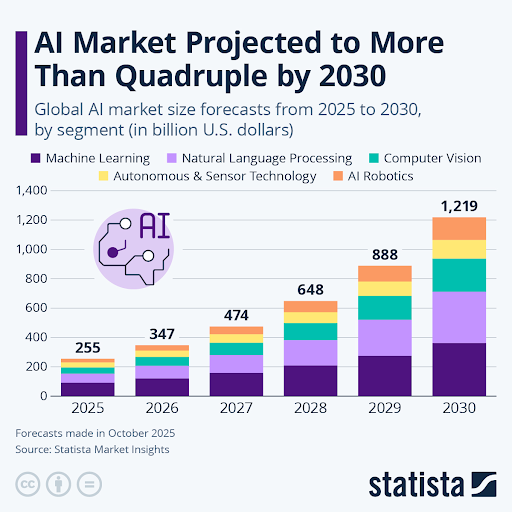
From machine learning to intelligent automation, the blog underlines the use cases that define value generation through integrated workflows.
 Generate
Key Takeaways
Generate
Key Takeaways

- Agentic AI delivers value when it is driven to deliver impact, not just by working on isolated tasks.
- Most enterprises struggle to scale agentic AI without strong workflow design and governance.
- Machine learning and RPA create impact only when coordinated through agentic workflows.
- The biggest gains in 2026 will come from redesigning workflows, not deploying smarter models.
10 High-Impact Agentic AI Use Cases Driving Business Transformation
Each use case focuses on organizational change and not generic AI tasks. These agentic AI use cases show how enterprises are restructuring core workflows. The focus is on execution speed, cost control, and scalable decision-making across the business.
1. Agentic AI for Revenue Operations (Sales, Finance, & Forecasting)
Most revenue teams operate with fragmented systems that have poor pipeline visibility. Since sales, finance, and operations often work from different data states, missed opportunities and inflated overheads are frequent. In short, such disconnection becomes costly as deal volumes and customer complexity increase.
Agentic AI agents continuously monitor CRM activity and deal progression, along with renewal timelines. They resolve data gaps and coordinate actions across sales and finance systems. Machine learning models assess deal risk while RPA executes system updates to aid Agentic AI systems. The result is cleaner forecasts and reduced operational effort across revenue teams.
2. Agentic AI for Enterprise Cost Optimization
FinOps in enterprises still relies on periodic cost reviews that fail to reflect real-time spending behavior. By the time operational efficiencies are identified, margin leakage has already occurred. Here, manual oversight limits the ability to act across cloud, infrastructure, and operational systems.
Agentic AI can track spending patterns across platforms, identify anomalies, and recommend corrective actions. Once approved, RPA executes optimizations across billing management systems. Besides, the machine learning models work at accuracy by learning from outcomes. Such an approach enables continuous cost control with quick response to inefficiencies.
3. Agentic AI for Procurement and Vendor Management
Procurement often deals with slower business cycles due to largely fragmented vendor and product data. Such gaps lead to higher operating costs and increased maverick spending outside approved frameworks.
AI agents can manage the entire hassle, simplifying vendor discovery, price validation, and compliance. They are trained to work on route approvals and coordinate onboarding across systems.
Besides, the machine learning models are engaged to gauge supplier performance for potential risks. Further, RPA is integrated to work on repeatable actions within procurement systems.
Ultimately, the entire AI tech stack complements quick sourcing decisions and improved spend control.
4. Agentic AI for Customer Retention and Revenue Expansion
Many organizations address churn only after revenue impact becomes visible. The reactive approach reduces predictability in customer lifetime value. The results? Teams lacking real-time visibility into customer health signals spread across multiple systems.
AI agents continuously monitor usage patterns to support interactions. They detect early signs of churn and trigger personalized interventions, determining errors within systems. Here, machine learning supports risk scoring, complementing higher retention and predictable revenue growth.
Related Read: How AI-Powered Personalization Is Redefining Business Relationships
5. Compliance First Financial Operations
Finance teams in regulated environments rely heavily on manual reviews and post-process audits. The process often struggles with high operational costs while staying exposed to the compliance risk. In short, delays in reconciliation and reporting limit financial visibility. Implementing a dedicated soc 2 compliance software helps automate the tracking of internal controls and provides a clear audit trail to ensure that data security standards are met without increasing the manual workload of the finance team.
Agentic AI executes reconciliations. It validates transactions to help prepare reports with full traceability. The process enforces policy rules before execution and flags exceptions early.
While machine learning improves anomaly-detection accuracy over time, RPA can help deterministic execution. Such an approach can cut the audit efforts, reducing compliance risks for real-time financial oversight.
6. Agentic AI for Workforce Planning and Utilization
Most organizations rely on static workforce plans that fail to reflect changing demand. It may lead to underutilized teams in some areas and capacity gaps in others. Thus, hiring often becomes the default response that increases costs and never addresses structural operational efficiency.
Agentic AI forecasts workload demand using operational data. The reports can be used to allocate skills and balance assignments to avoid any capacity risks early.
In this process, machine learning aids demand accuracy, and RPA updates scheduling systems. Such an approach reduces burnout while cutting any unnecessary hirings.
7. Agentic AI for Contract Lifecycle Management
Business teams often struggle with visibility into contract status and compliance requirements. Thus, contract management slows revenue with legal reviews as bottlenecks.
Manual tracking of obligations and renewals takes time. Agentic AI agents can be worked to review contracts by validating clauses that are against policies or need obligation tracking.
AI agents can be trained to trigger approvals, monitor renewal timelines, and escalate exceptions. Machine learning supports risk classification. Overall, the system can result in faster deal execution and lower legal overhead.
8. Agentic AI for Supply Chain Resilience and Planning
Supply chains remain vulnerable to disruptions caused by demand shifts as well as logistics constraints. Traditional response models rely on manual intervention and fragmented data. The fragmentation increases the entire recovery time and cost.
Agentic AI can monitor supplier performance and logistics signals based on real-time inventory data. The information can further be used to reroute orders, adjust inventory positions, and rebalance logistics plans.
Here, machine learning helps to forecast the impact of disruption with RPA infused at system updates. It can help supply chain management teams to hasten the response time with minimal disruption rate and high resilience.
9. Agentic AI for Executive Decision Intelligence
Leadership often relies on reports that lag behind real business conditions. By the time insights reach the hands of executives, the window to act is already narrowed. Such a decision-making approach uses instinct over data.
AI agents can synthesize data across risk systems. They can run scenario analyses, assess tradeoffs, and surface recommended actions aligned with objectives.
While machine learning improves forecasting accuracy, RPA works with repetitive inputs across platforms. It means automated systems can help executives gain trusted insights and make decisions under changing conditions.
10. Agentic AI for Post-Merger Integration
Post-merger integration often fails due to disconnected systems with manual coordination across teams. Furthermore, it is the delays in aligning processes and data that reduce the value of acquisitions.
Agentic AI tools can work at so many integrations with rapid data consolidation and workflow alignment across merged entities. AI can trigger required actions across functions by tracking dependencies and flagging conflicts.
In the same environment, machine learning can help identify overlap while RPA executes repeatable integrations. These systems can facilitate quicker synergy realization and ensure smoother transitions following acquisitions.
How do Agentic AI Workflows Actually Work?
Agentic AI workflows operate in clear stages, all designed around business outcomes. In simple language, the process starts with a goal definition. Each AI agent is aligned to an objective, which can be anything like reducing cost leakage, improving compliance, etc. The goal further guides every decision that follows.
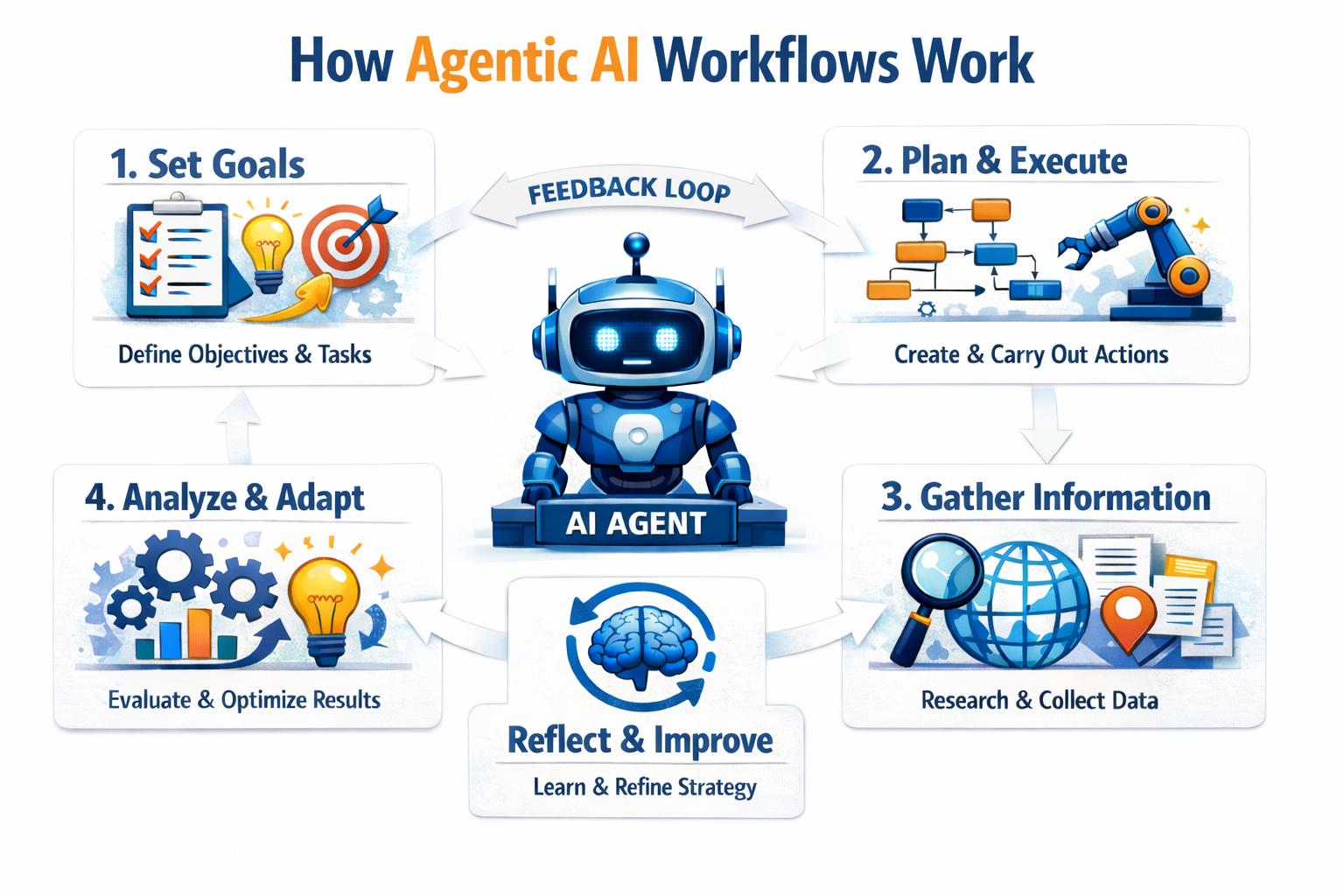
Next comes continuous context gathering, where agents pull real-time data from disintegrated systems like CRM, ERP, and finance. The shared context ensures all agents work from the same view of the business.
The third stage is coordinated decision-making. Specialized agents analyze options and agree on the next action. While one agent assesses risk, another validates business rules, and others can be deployed to work on execution.
Execution follows through controlled system access. Agents act using APIs, RPA, and workflow engines that apply validations before any action runs. It all comes down to forging an integrated system where every step is logged and traceable.
The final stage is learning and oversight. Outcomes are reviewed with models improving over time. On the other hand, leaders maintain visibility through decisions and exceptions.
Ultimately, it is the observability of the systems that keeps agentic workflows trustworthy.
Governance, Risk, and Control
Agentic AI systems operate within defined permission boundaries. Each agent has limited access to data and actions based on its role. It is done to prevent uncontrolled execution in critical systems.
Agentic AI development teams usually work on all the points that need human override in the workflow. It means agents have the permissions to recommend actions, but any high-risk decisions are done through human review. Such detail reduces any chance of error for financial approvals, contract changes, or compliance exceptions.
Also, with auditability being non-negotiable in production environments, every agent decision and outcome is logged with full traceability. When issues arise, teams can immediately roll back actions, get to the root causes, and adjust rules quickly.
In real enterprise systems, effective governance is achieved through autonomous decision-making. This involves agents acting independently while adhering to clear guidelines.
Conclusion
True business value can never be generated by implementing smarter models alone. Therefore, agentic AI should never be considered as another layer of automation. Rather, it is a shift in how enterprises run work.
Organizations that succeed with agentic AI treat it as a part of business architecture. They work to define ownership with governance embedded to meet the measurable goals. After all, intelligence supports execution, but structure helps drive results.
By 2026, those who move early will operate with more control than manual systems can no longer support.
Frequently Asked Questions
Have a question in mind? We are here to answer. If you don’t see your question here, drop us a line at our contact page.
What makes an agentic AI workflow different from automation?

Traditional automation follows fixed and predefined rules to complete repetitive tasks. It works well for stable processes with limited variation. Agentic AI work is different because agents pursue goals instead of scripts. They can act independently and adjust actions using real-time data from disconnected systems.
Agents reason over processed data and inputs from multiple data sources. They use natural language to understand context and intent. A feedback loop allows them to improve outcomes over time. This makes it possible to automate complex processes across service management, CRM systems, and human resources. The result is an execution that adapts to change rather than breaking when conditions shift.
Are agentic AI applications safe for regulated industries?
Agentic AI applications are safe when built with strong governance. Agents operate within defined security controls and permission limits. Access to proprietary data sources is restricted and monitored through application programming interfaces.
Human input is required for business-critical decision-making. Security teams maintain oversight and approval authority. All actions are logged for audit and review. This approach allows agents to act independently while remaining compliant. Regulated industries already use agentic systems in real-world applications by combining control, traceability, and clear ownership.
How do enterprises measure ROI from agentic AI use cases?
Enterprises measure ROI through speed, cost, and risk reduction. Common metrics include faster execution in service management and lower effort spent on repetitive tasks. Teams also track improvements across CRM systems and reductions in errors caused by disconnected systems.
Additional value comes from better use of data sources and cleaner process data. Human resources teams often see gains in utilization and planning accuracy. Leaders also assess decision quality and alignment with market trends to understand long-term impact.
Where should companies start with agentic AI transformation?
Companies should start with workflows that span multiple systems. Such areas often struggle with delays due to high manual coordination. AI teams can focus on processes where human input increases the execution time with potential risks.
The Agentic AI journey can be started by defining the key components before deployment. The process includes planning the ownership of tasks for maximum governance and attaining the pre-defined success metrics.
Remember, early wins often come from finance, customer operations, or security teams. Besides, success also depends on soft skills like change management, not just external tools.
What does agentic AI refer to in enterprise environments?
Agentic AI refers to AI-driven systems that work toward business goals as they access proprietary data sources.
They go beyond routine tasks. These systems access data from multiple sources. They connect actions across other business systems.
Agentic AI continuously improves through feedback. This makes it useful for fraud detection and other high-impact enterprise use cases.

Mangesh Gothankar


Ashwani Sharma
Achin Verma