



.png?width=27&height=27&name=Group(1).png)

-1.svg)
-1.svg)


-2.svg)


%201-1.webp?width=148&height=74&name=our%20work%20(2)%201-1.webp)




.svg)





.png?width=670&height=445&name=top-ai-tools-financial-services%20(3).png)
The integration of AI and automation in healthcare is no longer speculative — it is a defining strategic priority for health systems worldwide in 2026.
An American Medical Association survey shows that 66% of physicians reported using AI tools in 2024. The number jumps from 38% in 2023, representing a 78% year-over-year increase. Also, the surge can be taken as the urgent need for speed in care planning, translation support, and other clinical adjunct areas.
At the global level, the World Health Organization (WHO), together with the International Telecommunication Union (ITU) and World Intellectual Property Organization (WIPO), has launched the Global Initiative on AI for Health (GI-AI4H) — a coordinated United Nations-linked effort to set robust policies, governance frameworks, and evidence-based guidance for AI deployment in healthcare.
This initiative underscores that the ethical, standardized, and globally scalable deployment of AI and automation in healthcare is now a key priority for health leadership worldwide.
In parallel, hospitals and health systems, as evidenced by surveys from the American Hospital Association and other organizations, report increasing use of predictive models. Most often, these are automated tools designed to improve patient outcomes and reduce operational burdens.
This convergence of clinician adoption and global governance frameworks means leaders treat AI automation in healthcare as central to achieving quality, efficiency, and equitable care delivery.
 Generate
Key Takeaways
Generate
Key Takeaways

-
AI agents are redefining healthcare automation, enabling systems to plan, decide, and act across workflows.
-
Automation is expanding beyond back-office tasks into clinical, care coordination, and patient engagement.
-
Human-AI collaboration is the dominant model, not full autonomy.
-
Governance, trust, and compliance will determine winners, not algorithm sophistication.
The Evolution of AI and Automation in Healthcare (2020 - 2026)
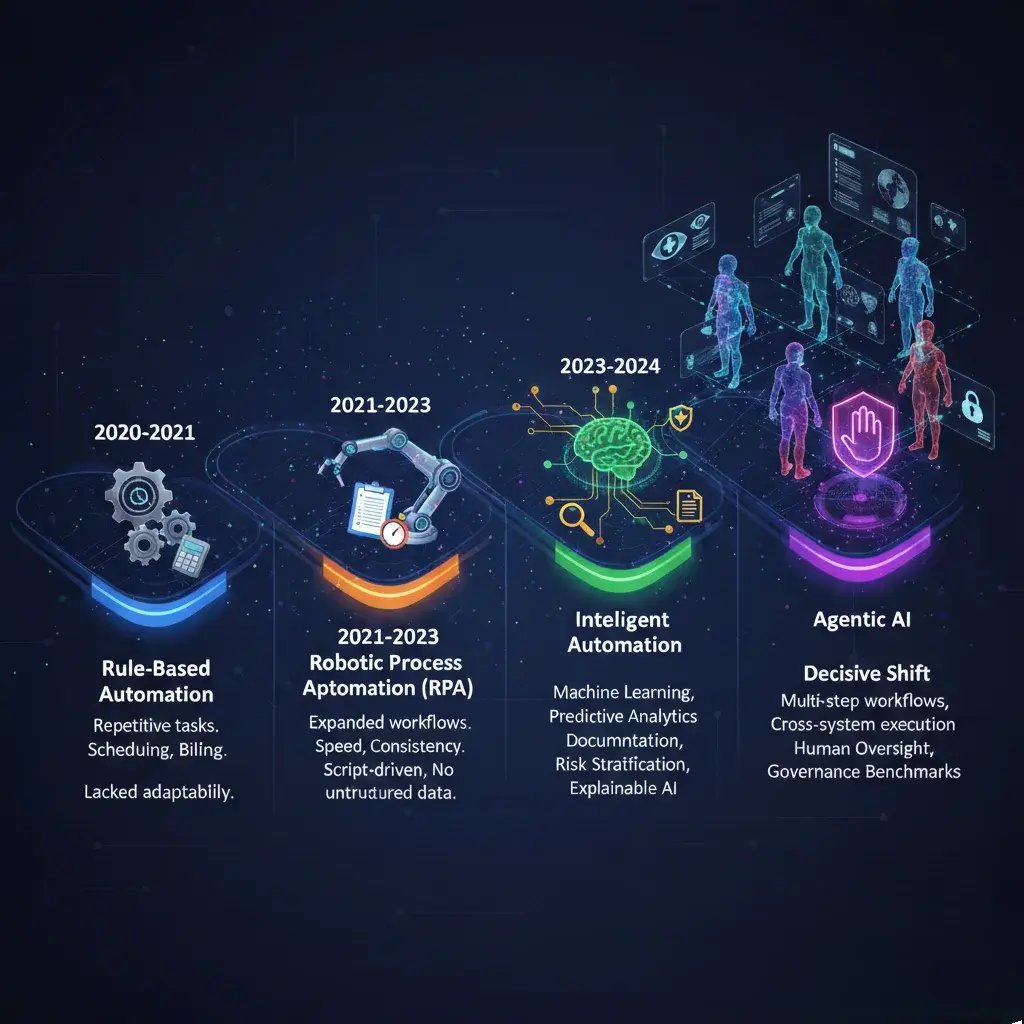
The evolution of AI and automation in healthcare shows a steady shift from task efficiency to autonomous, intelligence-driven systems.
-
2020–2021: Rule-Based Automation
Focused on repetitive administrative tasks such as scheduling, billing, etc. These systems reduced workload but lacked adaptability or clinical relevance.
-
2021–2023: Robotic Process Automation (RPA)
Expanded automation across revenue cycle and operational workflows. RPA or Robotic Process Automation improved speed and consistency. However, the automation remained script-driven with an inability to handle unstructured data.
-
2023–2024: Intelligent Automation
Integrated machine learning and predictive analytics. AI began supporting documentation, risk stratification, and workflow prioritization. It aligned with WHO guidance on human-centered and explainable AI.
-
2025–2026: Agentic AI
Marks a decisive shift for AI automation in healthcare. AI agents can execute multi-step workflows across systems; however, the systems are operated under human oversight to meet governance benchmarks.
Key Distinctions
-
AI tools: Perform single and defined tasks.
-
AI copilots: Assist human decision-making.
-
AI agents: Execute end-to-end workflows with accountability.
By 2026, automation is no longer about efficiency alone—it is about autonomy with oversight, resilience, and system-level impact.
Agentic AI: The Next Frontier of Healthcare Automation
Agentic AI represents the next evolution of AI and automation in healthcare. It is about moving from systems that assist humans to systems that can act on defined goals with built-in oversight. Unlike traditional AI tools or copilots, agentic AI systems are designed to manage outcomes.
What Is Agentic AI in Healthcare?
Agentic AI refers to autonomous AI systems. It aligns with global health guidance emphasizing human-in-the-loop autonomy. These systems can:
-
Understand objectives.
-
Plan action steps.
-
Execute workflows.
-
Simplify the decision process when human judgment is required.
How AI Agents Work?
-
Interpret context: Analyze patient data, operational constraints, and real-time signals.
-
Coordinate across systems: Interact with EHRs, scheduling platforms, billing systems, and care networks.
-
Execute multi-step workflows: Trigger actions, monitor outcomes, and adapt next steps dynamically.
Clinical Impact: Towards Predictive & Preventive Care
Clinical adoption of AI and automation in healthcare has moved beyond decision support. Some of the additional use cases of AI Automation in healthcare can be listed as:
-
AI-Assisted Diagnostics
AI now supports clinicians in interpreting medical images and pathology reports. Also, they can feed on patient histories to flag anomalies and prioritize high-risk cases. These systems act as a second layer of review. It means AI improves diagnostic confidence without bypassing clinical judgment.
-
Predictive Analytics for Early Intervention
Predictive models analyze historical patient data to identify early signs of deterioration. They work on readmission risks as well as chronic disease escalation. The practice enables care teams to intervene sooner shifting from reactive treatment to proactive prevention.
-
Personalized Treatment Planning
AI enables individualized care by analyzing patient profiles and treatment responses. Clinicians receive data-backed recommendations that bring precise medicinal guidance.
-
Remote Monitoring & Post-Discharge AI Agents
AI agents monitor patients beyond hospital walls using remote data inputs. They automate follow-ups and alert care teams to deviations. It closes critical gaps in post-discharge care.
Related Read : AI Agents in Healthcare 2026: Automating Post-Discharge Care & Compliance
-
Ambient Clinical Documentation (AI Scribes)
Ambient AI captures clinical conversations. It cuts documentation and allow clinicians to focus on patient interaction.
-
Clinical Outcomes That Matter
-
Save clinician burnout by minimizing administrative load.
-
Improved care quality through early decisions.
-
Enhanced AI-based patient care that includes personalization and responsiveness.
Operational Automation: From Efficiency to Enhanced Orchestration
Operationally, AI and automation in healthcare have evolved to fully orchestrated workflows. In 2026, the focus is on connecting the processes. Modern healthcare automation now simplifies:
-
Patient access: Digital intakes and referral routing.
-
Scheduling: Demand-based appointment management and capacity optimization.
-
Claims & billing: Automated submissions and denial management.
-
Prior authorizations: Data-driven approvals and exception handling.
-
Supply chain & workforce planning: Predictive demand forecasting and staffing alignment.
From Siloed RPA to Connected Automation Ecosystems
Early RPA initiatives were only centred on siloed departmental operations. However, the modern-day health systems are working in connected automation ecosystems. They create modules where workflows span clinical, operational, and financial domains. It means the future of successful automation is coordinated and targets measurable departmental efficiency.
The Role of AI in Handling Unstructured Data
AI enables automation beyond structured inputs. Such capabilities allow systems to interpret context, which can aid dynamic decisions and actions. It means AI Automation can be run to process:
-
Clinical notes
-
Referral documents
-
Patient communications
-
Claims narratives
Human & AI Intelligence: Redefining the Healthcare
The future of AI and automation in healthcare is not about replacing clinicians. It is about augmenting human expertise at scale. As AI systems take on administrative and analytical tasks, healthcare professionals are able to focus on clinical judgment, patient interaction, and complex decision-making.
AI as an Augmentation Layer
The human-centered model aligns with global health guidance. It emphasizes AI that can enhance professional autonomy without affecting trust.
AI usually helps healthcare systems through:
-
Reduced documentation and administrative workload.
-
Surfacing relevant insights at the point of care.
-
Supporting consistency in clinical and operational decisions.
Emerging Roles in AI-Enabled Healthcare
As AI automation in healthcare is surfacing for new roles. These include:
-
AI supervisors: Monitor AI behavior for optimal performance.
-
Automation architects: Design end-to-end workflows..
-
Clinical informatics leaders: Bridge clinical practice with data and AI systems.
Change Management Challenges
Even the most advanced systems fail without well-defined change management. AI Adoption is often constrained by:
-
Trust gaps in AI recommendations
-
Workflow disruption
-
Resistance to role redefinition
Upskilling for AI-Enabled Workflows
Healthcare organizations should invest in:
-
AI literacy amongst clinicians and staff
-
Training on human-in-the-loop workflows
-
Cross-functional collaboration between clinical, IT, and operations teams.
Ultimately, success depends not on AI capability alone, but on how well people coordinate with intelligent systems.
Data, Interoperability, and Platform Readiness
The effectiveness of AI in healthcare depends on data readiness more than any algorithm sophistication. AI projects stall because data is not managed. The lack of data quality follows the limited context and accuracy. Moreover, poor interoperability limits automation to isolated workflows.
To scale AI automation in healthcare, organizations are prioritizing API-first platforms. These cloud-native solutions are made to do real-time data exchange and modular automation. These architectures allow systems to evolve without disrupting core operations while supporting governance and compliance.
Scalable platforms are necessary for AI agents. Especially, as they rely on continuous data access and cross-system coordination, with the right data and platform foundation, AI can move from experimentation to enterprise-wide impact.
Governance, Ethics, and Compliance
As AI and automation expand in healthcare, governance is paramount.
Issues like fragmented regulatory oversight create uncertainty for healthcare organizations that are deploying AI. In parallel, patient data privacy risks continue to rise as AI systems process loads of operational data.
Transparency and bias are equally pressing concerns. AI models trained on unbalanced datasets can reinforce disparities in care. Besides, opaque decision-making hampers clinicians’ trust. High-profile AI safety incidents—including conversational systems generating inaccurate or misleading outputs—have reinforced the need for robust safeguards and human oversight.
To manage such risks, healthcare leaders should work on formal governance practices. These are aimed at working on accountability, validation standards, and escalation protocols. However, the foundational requirements include human-in-the-loop controls for auditability and explainability.
Measuring ROI: What Should Be Tracked?
As AI and automation mature in the health industry, AI leaders should work on outcome-driven ROI. After all, value is realized not through experimentation metrics but through sustained clinical impact.
Key metrics healthcare leaders should track include:
-
Reduced Administrative burden:
Measure time saved per clinician or staff member by automating documentation, billing, and scheduling workflows. -
Faster Care Delivery:
Track reductions in patient wait times, turnaround time for diagnostics, and discharge processing cycles. -
Improved Clinician Productivity:
Monitor increases in patient-facing time and reductions in after-hours documentation. -
Revenue Cycle Optimization:
Assess improvements in claim approval rates, denial reductions, faster reimbursements, and lower cost-to-collect. -
Patient satisfaction Improvements:
Evaluate engagement scores, follow-up adherence, and overall patient experience metrics.
Strategic Roadmap for Healthcare Leaders in 2026
To succeed with AI and automation in healthcare, leaders need a clear, outcome-driven roadmap—one that balances innovation with responsibility and execution.
Key steps Healthcare leaders have to follow:
-
Identify high-impact automation opportunities: Focus on workflows that create measurable value in care coordination. It can be everything related to revenue cycle management to post-discharge follow-ups.
-
Align AI initiatives with clinical and business goals: Ensure AI investments directly support quality of care, patient outcomes, cost efficiency, and organizational priorities.
-
Build governance: Establish clear validation processes that include human oversight before scaling AI automation.
-
Design for human–AI collaboration: Enable clinicians and staff to train on AI systems. It can help map clear escalation paths and better decision-making.
-
Partner with execution-focused AI specialists: Choose a professional AI development company like Signity, which can combine healthcare domain expertise with secure architectures. It helps you foster your AI strategy for real-world impact.
Conclusion
In 2026, AI and automation in healthcare are incremental projections. These technologies are changing the way care is perceived. Intelligent automation is enabling more personalized care, streamlining operations and creating more resilient healthcare systems.
For healthcare leaders, the mandate is clear: move beyond isolated pilots. The goal is to build scalable platforms that integrate AI for clinical domains.
It means organizations that treat AI automation as a core strategy and not just an experiment will be better positioned. AI and automation can unlock secrets to manage workforce pressures, reduce costs, and meet patient expectations.
Those who act decisively today will not only gain operational and clinical advantages but will also shape the future of connected, intelligent healthcare ecosystems.
Frequently Asked Questions
Have a question in mind? We are here to answer. If you don’t see your question here, drop us a line at our contact page.
What is AI and Automation in Healthcare?

AI and automation in healthcare refer to the use of artificial intelligence and automation solutions to support patient care. These technologies help healthcare providers save administrative loads.
AI systems also assist with medical images and work on patient scheduling to aid timely decisions. When used correctly, these solutions can improve patient outcomes and support medical professionals with better clinical judgment.
How is AI automation in healthcare evolving in 2026?
In 2026, AI automation in healthcare is moving from task-based tools to connected systems. The healthcare sector is using AI to support patient flow, automate routine tasks, and enable timely interventions. AI models now work across electronic health records and healthcare data systems. The shift helps healthcare providers deliver fast and improved patient care.
What are AI agents, and how do they Impact Healthcare?
AI agents are advanced AI systems that can plan and execute complex tasks across health systems. They work across electronic health record systems, insurance claims, and patient data platforms. These agents support care coordination and discharge planning. By reducing human error and cognitive burden, AI agents can work on patient safety.
What are the biggest Risks of AI Adoption in healthcare?
The biggest risks of AI adoption include:
-
Poor data quality
-
Low or zero transparency
-
Patient data privacy issues.
AI algorithms can showcase bias if trained on poor medical data. Also, fragmented regulations create significant compliance challenges.
How can healthcare leaders ensure compliance and ROI from AI automation?
Healthcare leaders must align AI automation with clinical goals. They should build governance early and monitor AI systems continuously. Measuring ROI requires tracking of administrative tasks to ensure improved patient outcomes and better patient experience. Besides, outcome-based metrics matter more than pilots. In short, strong execution ensures long-term value.
How does AI in healthcare help improve patient outcomes?
AI in healthcare helps improve patient outcomes by enabling early risk detection and personalized treatment plans. AI tools analyze historical data and electronic health data. The predictive insights generated help healthcare professionals to act sooner. The process leads to better health outcomes and safer care delivery.
Why is data quality critical for healthcare artificial intelligence?
Data quality is essential for healthcare artificial intelligence to function with precision. Since AI systems depend on clean patient data and medical records, poor data leads to unreliable predictions. On the other hand, high-quality data can help professionals to strengthen trust in AI technology to avoid readmissions.