

.png?width=27&height=27&name=Group(1).png)

-1.svg)
-1.svg)


-2.svg)


%201-1.webp?width=148&height=74&name=our%20work%20(2)%201-1.webp)




.svg)





.png?width=670&height=445&name=agentic-ai-infrastructure-trends%20(1).png)
Healthcare is undergoing a transformative technological revolution, and AI is not just a possibility; it is inevitable. By 2026, the global AI market will grow from USD 56.01 billion to USD 1,033.27 billion by 2035, at a CAGR of 43.96%. This is due to the rising demand for intelligent automation, predictive analytics, and real-time decisions.
Well, the breakthrough is not just AI; it is the rise of AI agents, which are software systems in healthcare and work autonomously to interpret data, trigger workflows, and continue to learn from the outcomes. This shift towards AI agents marks a turning point for the healthcare ecosystem and its operations.
The future of AI agents in healthcare is all about their ability to transform fragmented and reactive systems into connected and proactive environments. In the sections ahead, we will explore further and see how AI agents will transform healthcare in 2026 and discover some practical examples of AI agents in healthcare and how they shape patient care, operational efficiency, and more.
 Generate
Key Takeaways
Generate
Key Takeaways

- AI agents in healthcare autonomously execute decisions and manage workflows.
- The future of AI agents lies in proactive, data-driven, and value-based care models.
- AI agents on healthcare platforms improve clinical efficiency and enhance patient engagement.
- Organizations investing in secure AI will lead healthcare transformation in 2026.
What Are AI Agents in Healthcare?
AI agents in healthcare are software systems that work autonomously to analyze data, make context-aware decisions, and execute tasks. The traditional AI models simply generate predictions and insights, and AI agents on healthcare platforms take appropriate actions. The actions include workflow triggers, coordination across systems, real-time decision-making, and continuous improvement via a feedback loop.
The global AI agents in healthcare market are expected to reach USD 6.92 billion by 2030, up from USD 1.11 billion in 2025, with a CAGR of 44.1%.
Agents combine machine learning, natural language processing, data processing, and decision intelligence that help them operate within a complex environment. From EHR to medical imaging and lab reports, they can interpret all and respond intelligently based on predefined objectives.
To understand the differences in a better way, here is a table that highlights how AI agents in healthcare differ from traditional AI systems.
How AI Agents Differ from Traditional AI Systems
|
Why 2026 Is a Turning Point for AI Agents' Healthcare Adoption
The healthcare industry is driving the booming adoption of AI agents. By 2026, here are the critical factors that make AI agents vital in healthcare.
1. Workforce Shortages
Healthcare systems are facing critical workforce shortages. The World Health Organization estimates that there will be a shortage of around 10 million healthcare experts by 2030. This shortage means that there are longer patient waits, clinical burnout, and potential gaps in the quality of care.
AI agents in healthcare help bridge this gap and automate all the repetitive tasks, manage administrative tasks, and more.
2. Data Explosion
Healthcare data generates plenty of data, from EHRs and lab reports to personal data of patients. It is difficult to manage and derive insights from the complex data. AI agents in the healthcare process both structured and unstructured data in real-time and generate actionable insights for operational efficiency.
AI agents turn the raw data into intelligent insights and help providers deliver more precise and personalized care.
3. Value-Based Care Model
Healthcare is shifting from a traditional model to value-based care, where providers are reimbursed based on patient outcomes rather than the services delivered. This transition means there is a need for data-driven management. AI agents in healthcare help optimize care delivery, monitor patient progress, and support evidence-based decision-making.
AI agents can seamlessly deliver better outcomes with an optimized cost and have become critical for the success of value-based care models.
4. Generative AI & Agentic AI Integration
The combination of generative AI and agentic AI has proved to be a game-changer and revolutionized healthcare. Generative AI helps create insights and summaries, and agentic AI executes multi-step decisions autonomously across clinical systems.
With this combination, there is intelligent workflow automation, predictive care, and proactive patient engagement, all vital for the healthcare system in 2026.
Related Read : Strategies to Integrate Generative AI in Business Workflow Effectively
How AI Will Transform Healthcare in 2026
AI agents in 2026 are offering their support beyond clinicians and are offering insights to transform how care is delivered and managed. These are intelligent systems that boost efficiency and patient outcomes, ultimately supporting clinical decision-making. Here are a few critical areas where AI will transform healthcare in the future:
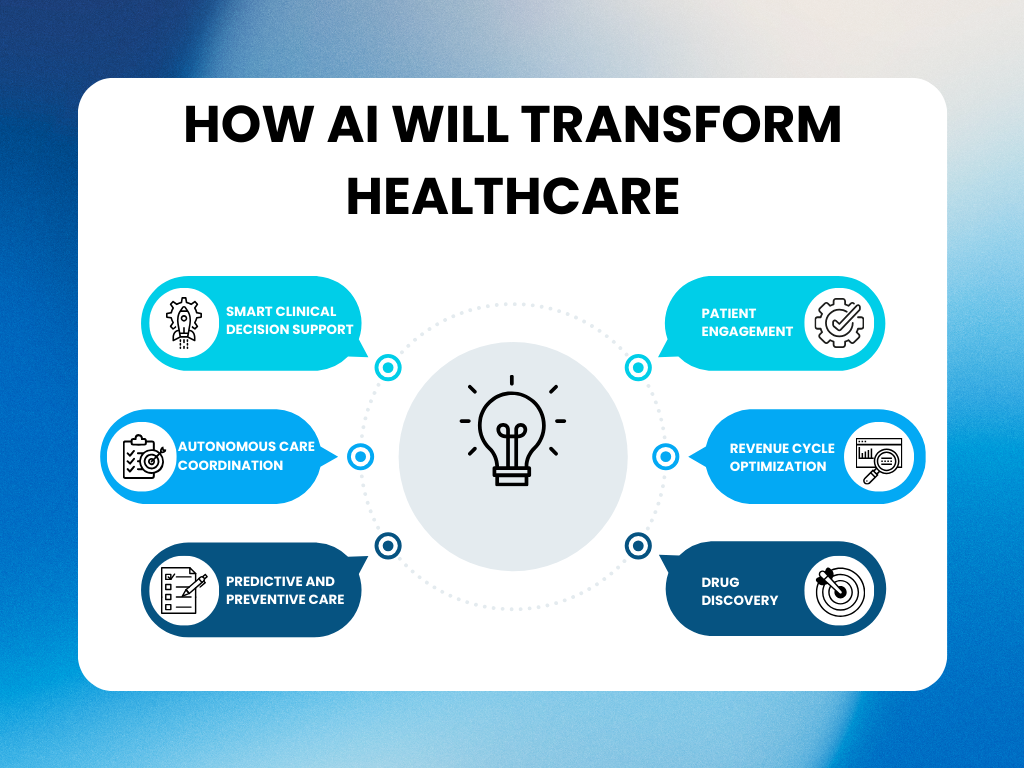
1. Smart Clinical Decision Support
AI agents analyze the patient's history, lab results, and imaging and guide physicians and the care teams. From evidence-based treatment to identifying patients with a higher risk, they help with intelligent clinical decision support. These act as proactive agents and help clinicians make informed decisions.
2. Autonomous Care Coordination
Care coordination is quite a challenge in healthcare. AI agents manage the patient journey across different providers, schedule appointments, and monitor medications. Automating these workflows allows businesses to reduce errors, improve patient outcomes, and free staff so that they can focus on high-value clinical tasks.
3. Predictive and Preventive Care
The future of healthcare is no longer reactive; it is now proactive. With real-time patient insights and early disease detection, AI agents can identify the major health risks to the patient. Whether it is detecting early signs of chronic disease or predicting deterioration in health, AI agents can help with all. With this approach, healthcare organizations can focus more on preventing illness rather than treating it.
4. Patient Engagement & Virtual Assistants
Conversational AI agents transform patient engagement as they offer smart and personalized support. The agents can group the symptoms even before the consultation with a physician, answer the queries of patients, and even offer guidance post-treatment. With real-time communication, the assistants can improve adherence and boost satisfaction, making healthcare more accessible and patient-centered.
5. Operational and Revenue Cycle Optimization
A little administrative mistake can cost billions of dollars to the healthcare industry. With the integration of AI agents in healthcare, businesses can automate claim processing, audit billing, detect fraud before it happens, and manage the supply chain efficiently. As the operational bottlenecks are reduced, organizations can focus more on patient care, rather than being stuck in paperwork.
6. Accelerated Drug Discovery and Clinical Trials
AI agents can process a vast amount of clinical and complex data that is somehow impossible to analyze manually. This biological and molecular data allow AI agents to identify the promising drug candidates, tell about their efficacy, tell about the potential side effects at an early stage, and more. AI agents can also match patients to clinical trials based on medical history, genetics, and real-time health data.
Examples of AI Agents in Healthcare
Agentic AI in healthcare is already making headlines among stakeholders. Here are some practical examples that illustrate the transformative potential of AI agents.
Diagnostic Imaging Agents: AI agents can analyze medical images, such as X-rays and CT scans, to detect anomalies and predict disease at an early stage. Radiologists can seamlessly highlight critical findings, reducing interpretation time. It enables healthcare professionals to deliver faster, more accurate diagnoses.
ICU Monitoring Agents: These agents can track patients' vital signs and send alerts to the care teams. It awakens the care team and alerts them if there are any early signs of deterioration. Real-time data analysis from multiple sources enables agents to prevent critical issues and supports early intervention.
Care Navigation Agents: Guide patients through complex treatment plans and healthcare systems. They schedule appointments, provide medication reminders, and ensure follow-ups are completed, improving adherence and overall patient outcomes.
Claims Review Agents: These AI agents automate the claim process and billing. It identifies the potential fraud and discrepancies before submission. AI agents help reduce administrative errors, expedite reimbursement, and optimize the revenue cycle in healthcare.
Future of AI Agents in Healthcare: What to Expect Beyond 2026
The future of AI agents is beyond automation. As the healthcare system continues to evolve into smart and interconnected ecosystems, here is what you can expect in 2026 and beyond.
1. Multi-Agent Ecosystems
From isolated tools to interconnected AI agent ecosystems, healthcare organizations continue to move. The decentralized system, where autonomous agents, powered by LLM and multimodal AI, collaborate across departments. From the diagnostics department to billing and pharmacy, the data is seamlessly shared, and coordination is done in real time. They act as digital care teams and boost efficiency, ultimately enabling a seamless patient journey.
2. Autonomous Hospital Operations
Apart from clinical tasks and care, these AI agents seamlessly manage hospital operations with minimal human intervention. Whether it is allocating beds to patients or managing inventory and staff availability, these intelligent agents operate in real time and adjust operations accordingly. It also helps reduce bottlenecks and improve the performance of hospitals.
3. Ethical and Explainable AI
As dependency on AI agents increases, transparency and accountability become vital. Healthcare providers will prioritize compliant AI systems that align with regulatory standards and patient privacy needs. Governance frameworks will ensure fairness and provide a clear explanation for automated decisions.
4. Personalized AI Care Companions
Personalized care companions are one of the most transformative developments of these AI agents. From tracking patient health data to their lifestyle patterns and medical history, the agents offer recommendations in real time and also high-risk alerts. Acting as a digital healthcare partner, they allow personalized and proactive care.
Challenges to Address
While AI agents in healthcare offer significant benefits, organizations must address critical challenges to ensure safe and effective deployment.
|
Why Healthcare Organizations Must Act Now
The adoption of AI agents in healthcare continues to grow rapidly. Organizations that are not adopting the AI agents fall behind the scenes and are left out in the competitive environment. Early adopters gain a measurable advantage in efficiency and patient satisfaction.
Healthcare businesses that do not implement the AI agents may face:
- High operational cost as the manual workflow and inefficiencies rise.
- Slow patient service delivery leads to reduced satisfaction.
- Administrative burden rises on already overstretched staff.
- Competitive disadvantage against digitally advanced healthcare providers
In a landscape shifting toward automation and value-based care, understanding how AI will transform healthcare is strategic. Proactive investment in AI agents' healthcare platforms today will position organizations for scalability and long-term growth in 2026 and beyond.
Final Thoughts
AI agents in healthcare shift from reactive and fragmented systems to proactive and connected ecosystems. From supporting clinical decision support to care coordination, the autonomous agents define how care is delivered.
The future of AI agents in healthcare will be shaped by organizations that embrace innovation more strategically. Investing in secure, compliant AI infrastructures enables scalability, boosts data protection, and ensures long-term operational resilience.
For healthcare businesses that want to implement automation, it becomes vital to partner with an experienced AI development company that can help accelerate deployment and ensure compliance and long-term scalability.

Mangesh Gothankar


Ashwani Sharma
Achin Verma
Frequently Asked Questions
Have a question in mind? We are here to answer. If you don’t see your question here, drop us a line at our contact page.
How are AI agents in healthcare different from traditional healthcare automation tools?

Traditional automation tools follow predefined rules and workflows, while AI agents in healthcare operate autonomously using machine learning and contextual reasoning. They can analyze complex data, make decisions, trigger multi-step workflows, and continuously improve over time, making them far more adaptive and intelligent.
Are AI agent healthcare systems compliant with healthcare regulations like HIPAA?
Yes, AI agents' healthcare platforms can be designed to comply with HIPAA and other regulatory standards. However, compliance depends on proper implementation, secure infrastructure, data encryption, and governance frameworks to ensure patient data privacy and transparency.
What is the ROI of implementing AI agents in healthcare organizations?
The ROI of AI agents in healthcare comes from reduced administrative costs, improved clinical efficiency, lower readmission rates, and optimized revenue cycle management. Over time, these systems help healthcare providers increase operational efficiency while improving patient outcomes.
Can small and mid-sized healthcare providers adopt AI agents, or is it limited to large hospitals?
The future of AI agents in healthcare extends beyond enterprise hospitals. Cloud-based deployment models and modular AI systems make adoption feasible for small and mid-sized healthcare providers, enabling scalable implementation without heavy infrastructure investment.





.png?width=352&name=choose%20Agentic%20AI%20Framework%20(1).png)
.png?width=352&name=top-ai-tools-financial-services%20(3).png)