


.png?width=27&height=27&name=Group(1).png)

-1.svg)
-1.svg)


-2.svg)


%201-1.webp?width=148&height=74&name=our%20work%20(2)%201-1.webp)




.svg)






Healthcare data is expanding rapidly. Research from RBC estimates that healthcare organizations generate about 30% of all data, a higher share than most other industries produce. Electronic health records and patient monitoring systems all contribute to the data.
Business intelligence tools convert this raw data into insights that hospital stakeholders can act on. After all, well-organized information supports more accurate decision-making.
Today, healthcare businesses need systems that not only visualizes data but also predict the risk for disease outcomes. It can then be used to recommend necessary actions with fully automated decisions.
The shift ultimately redefines the role of business intelligence in healthcare, while moving it from historical reporting to real-time AI-driven support. In this blog, we will try to understand how business intelligence is transforming the healthcare industry, generating maximum value from the data.
 Generate
Key Takeaways
Generate
Key Takeaways

- Healthcare BI is moving from historical reporting to actionable AI-driven intelligence.
- AI-powered BI helps predict risks and support faster decisions.
- Trusted data foundations are essential for reliable BI and AI outcomes.
- AI-driven BI can improve care outcomes and operational and financial performance.
What Is Business Intelligence Healthcare?
Business intelligence in healthcare describes the tools used to collect and analyze healthcare data. These tools support clinical and operational decision-making. Data sources include health records and insurance claims as well as billing systems and patient surveys.
It combines data engineering, dashboards, and reporting tools to turn the raw healthcare data into actual usable insights. The platform collects data from multiple sources, such as electronic health records, revenue cycle systems, billing platforms, IoT/ wearable devices, and insurance databases, and turns it into meaningful information.
Business Intelligence tools in healthcare, like Tableau, AWS healthLake and others, can be used to bring information from EHRs and medical devices. Modern platforms increasingly embed AI algorithms and machine learning algorithms to automatically detect patterns, generate predictions, and enhance healthcare decision support.
The healthcare institutions leverage business intelligence to innovate patient care, reduce costs, and improve claim management. It also plays a critical role in making healthcare more accessible via business intelligence. The transition towards more predictive and intelligent engines helps with real-time data analysis.
What Data Does Healthcare BI Analyze?
Modern healthcare business intelligence pulls together data from clinical and operational systems along with financial and patient-facing systems. The result is a fuller picture of how an organization is actually performing. Healthcare BI works across these sources at the same time rather than one at a time. That makes it easier to spot patterns and support better decisions.
Healthcare BI typically draws on the following data sources:
- Clinical data includes electronic health records as well as diagnoses, medications, lab results, procedures, imaging and clinical notes.
- Financial data includes claims as well as billing records, payer information, reimbursement data, denial records and revenue cycle information.
- Operational data includes bed occupancy as well as staffing, scheduling, patient flow, equipment utilization and supply chain data.
- Patient-generated data includes surveys as well as engagement platforms, wearables, remote monitoring and patient-reported outcomes.
- Population and external data includes demographics as well as public health datasets, social determinants of health and other outside sources.
- Research data includes clinical trial information as well as real-world evidence.
Bringing these sources together gives organizations a more contextual view. It also builds the data foundation that predictive analytics and AI can feed on. Machine learning can then identify the risks by understanding surface patterns and supporting proactive decision-making.
The value of these insights comes down to the underlying data work. Integration, standardization, and governance all play a role in that. So does making the data accessible to the people and systems that need it.
Limitations of Traditional Business Intelligence in Healthcare
Healthcare organizations shifted towards business intelligence in healthcare because the traditional BI systems could not meet the requirements in the fast-moving and data-centric environment. Traditional, static dashboards could not keep up with real-time clinical demands.
Organizations must partner with a healthcare AI development company that can seamlessly support AI-driven intelligence. Here are a few drawbacks of the traditional business intelligence system in healthcare.
Retrospective Analysis
It is one of the major limitations of traditional business intelligence. Traditional BI tools focus on historical data, not real-time data; they cannot predict what is likely to happen next.
In the healthcare industry, a single delay in insight leads to missed intervention, inefficient resource allocation, and ultimately, risks that can’t be prevented.
Data Fragmentation
Healthcare data lives in too many separate places. EHRs hold one piece. Billing tools hold another. Medical imaging platforms hold a third. Integration is what ties these systems together. Without it, BI tools can't offer a complete view. What's left are interoperability gaps. Analytics investments never pay off.
Limited Context and Manual Interpretation
Traditional healthcare BI can show that a metric moved. It rarely explains why. Analysts end up comparing several reports. They compare multiple data sources too. All of this just to work out what needs attention. That manual step slows decisions down. It's worse with large patient populations. It's worse when operations change quickly. AI-powered analytics narrows this gap. It combines variables. It spots relevant patterns. It surfaces the cases that genuinely need review.
Limited Ability to Act
Traditional BI stops at reporting. A dashboard might show rising readmissions. It might show longer wait times. It might show more claim denials. Someone still has to read it. Someone has to interpret it. Someone has to decide what happens next. Healthcare BI is now connecting analytics to alerts. It's connecting to predictive models too. It's connecting to workflows and automation. That shift puts intelligence closer to the actual decision. Teams can respond before a small issue turns into a larger one.
Shift from Data Visualization to Actionable AI in Healthcare BI
Healthcare organizations in clinical practice have relied on dashboards and charts for years, assuming they lead to better data visualization and ultimately better decision-making. But visibility is not the solution and cannot guarantee action. A dashboard can not tell if the patient is at risk tomorrow or what intervention will reduce the risk.
The next generation of business intelligence is bridging this gap and offering actionable AI-powered intelligence.
Modern healthcare generates millions of data points across clinical and operational systems. Human-led analysis, however, could not keep pace with this scale and high level of complexity. Thanks to AI-driven insights, that changes the entire scenario.
Rather than waiting for analysts to interpret reports, the AI models continue to learn from data streams. Further, they detect hidden patterns while offering decision-ready insights in real-time. So rather than simply answering the query, What happened?
AI-Powered BI will answer:
- What is expected to happen next?
- Which patterns or patients are at the highest risk?
- What intervention can create the best outcome?
- What immediate decision should I make?
The Evolution of Business Intelligence in Healthcare
The evolution of business intelligence in healthcare is moving from understanding past performance to anticipating risks, recommending actions, and supporting workflows. Each stage builds on the previous one:
| BI stage | Key question | Healthcare example |
| Descriptive BI | What happened? | How many patients were admitted last month? |
| Diagnostic analytics | Why did it happen? | Why did emergency department wait times increase? |
| Predictive analytics | What is likely to happen? | Which patients are at higher risk of readmission? |
| Prescriptive analytics | What should we do? | Which intervention could help reduce the identified risk? |
| AI-powered action | What can be acted on? | Trigger an alert, prioritize a case, or initiate an approved workflow. |
Traditional dashboards remain important for monitoring KPIs and understanding performance. The difference is that modern healthcare business intelligence adds predictive models, contextual insights, and AI-driven recommendations around that information.
The future is therefore not about replacing BI with AI. It is about building AI capabilities on top of a trusted BI and data foundation so healthcare organizations can move from reporting to prediction, decision support, and action.
Advanced AI development for healthcare allows business platforms to move far from trends towards predictive and prescriptive intelligence. Here are some examples:
- The AI models can predict deterioration in patient health conditions even before the clinical sign appears.
- With operational AI, the hospitals can rectify the occupancy of beds and staffing needs.
- With financial intelligence systems, they can detect claim-denial risks before submitting claims.
- Care analytics offers personalized treatment pathways.
Another leap is the integration of AI healthcare solutions with natural language processing and generative AI. This allows decision-makers to query systems, turn complex datasets into simple insights, and recommend actions accordingly. Clinicians do not need to visit the dashboard for the updates; they can simply ask the system and get things resolved.
Business Intelligence in Health Care: How Does It Work?
Business intelligence tools in healthcare help transform fragmented medical and operational data into structured and business-ready insights. They work via a multi-layered intelligence pipeline behind the scenes, and here is how it works:
1. Data Collection from Different Healthcare Systems
Healthcare generates a large volume of data across different platforms. Business intelligence works as a structured and multi-layered process that transforms the fragmented data from imaging platforms, EHRs, and more into actionable insights. Because every platform uses different formats, the data is fragmented and inconsistent. At this stage, the raw data is inconsistent and not ideally ready for the analysis.
2. Data Integration and Standardization
Here, the data collected is cleaned and normalized. It is consolidated into centralized repositories like data warehouses. All the duplication and conflicts are removed at this particular stage, and consistency across all the records is maintained. The BI environment relies on interoperability and transformation pipelines to align structured and unstructured data. It is a vital step; the accuracy of analytics directly depends on the quality of data.
3. Analytics and Modeling Layer
Once the data is standardized, it is processed by analytics engines via statistical models and rule-based logics. Traditional business intelligence focuses on descriptive analytics, whereas advanced AI analytics extends its capabilities and helps organizations to anticipate outcomes. This helps them identify the next action. This stage of building AI for healthcare systems is where predictive models and decision-support algorithms are designed to work on real clinical and operational data.
4. Visualization and Insight Delivery
After the analysis is done, insights are delivered via visualization and reporting layers. Decision-makers can check the dashboards, reports, and interactive visual interfaces to monitor performance.
These business intelligence tools in healthcare are used by stakeholders to track KPIs like patient outcomes, resource utilization, and quality benchmarks. The next-generation BI is more proactive and automatically pushes alerts and notifications when a threshold or risk signal appears.
5. Actionable AI Layer
The next generation of business intelligence introduces an AI-driven action layer. It goes far beyond reporting and visualization. They do not stop at insight generation; they trigger intelligent responses like risk alerts, workflow automation, and more. With these actionable insights, healthcare organizations can respond much faster and optimize operations while driving measurable performance improvements.
Key Use Cases of Business Intelligence in Healthcare
The value of business intelligence in healthcare becomes clearer when analytics are connected to specific clinical, operational, and financial decisions. With AI and predictive analytics, healthcare organizations can move beyond monitoring performance to identifying risks and opportunities earlier.
Clinical Decision Support
Healthcare BI can combine EHR data, laboratory results, medications, diagnoses, and patient histories to identify care gaps and high-risk patients. AI-powered analytics can support risk stratification, readmission prediction, and other decision-support applications while keeping clinical judgment at the center of care.
Revenue Cycle and Claims Optimization
Healthcare organizations can analyze claims, denials, reimbursement patterns, billing data, and payer performance to identify revenue leakage and process inefficiencies. Predictive models can also flag claims with a higher likelihood of denial, allowing teams to intervene earlier.
Population Health Management
Healthcare business intelligence can help organizations analyze patient populations to identify chronic disease trends, care gaps, and high-risk groups. Combining population-level analytics with AI can help care teams prioritize interventions and allocate resources more effectively.
Hospital Operations and Capacity Planning
BI can provide visibility into patient flow, bed utilization, staffing, scheduling, equipment usage, and supply availability. Predictive analytics can then help forecast demand and identify potential bottlenecks before they affect operations.
Patient Experience and Remote Monitoring
Patient engagement data, feedback, appointment information, wearables, and remote monitoring devices can provide insights beyond traditional clinical systems. Analyzing these signals can help organizations identify service issues and support more proactive patient engagement.
Research and Clinical Trials
Healthcare and life sciences organizations can also use BI to analyze clinical trial, research, enrollment, and real-world evidence data. Connecting these datasets can improve oversight and help researchers identify trends and issues earlier.
Benefits for Healthcare Organizations
AI-powered business intelligence in healthcare offers measurable benefits around clinical, operational, and financial dimensions. Here are a few of the critical benefits it offers across different domains.
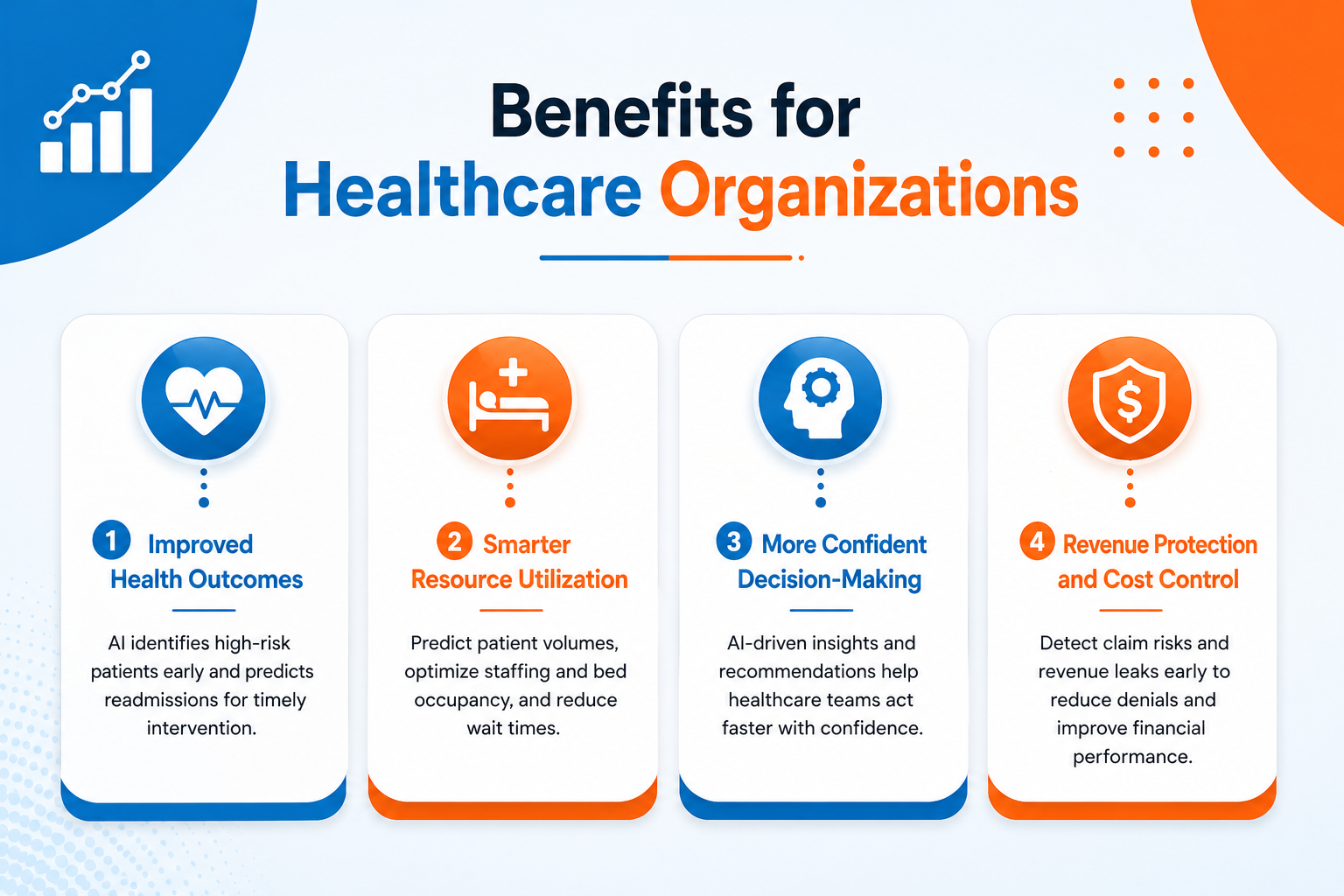
1. Improved Health Outcomes
AI-driven BI systems allow clinicians to identify patients with a higher risk. It analyzes the data in real-time, analyzes the historical patterns of patients, and provide real-time signals. These models flag deterioration risks, readmission probabilities, and enable early intervention. This ultimately leads to improved patient safety and outcomes.
Recommended Read: AI in Healthcare: Use Cases, Real-Life Examples, Benefits, and Trends
2. Smarter Resource Utilization
Healthcare operations are quite complex and require substantial resources. The AI healthcare solutions forecast patient volumes, optimize the staff and availability, predict bed occupancy, and more. This allows the hospital staff and admin to allocate resources more accurately without any chaos, even during the busy hours. Hospitals relying on predictive analytics can notice a significant reduction in the wait times and delays.
3. More Confident Decision-Making
Because the traditional dashboards rely on manual interpretation, there are always chances of errors. Thanks to the AI-enabled BI platforms that prioritize insights and recommended actions, reducing the decision lag. Instead of the raw data, healthcare professionals receive contextual alerts that help them act faster with confidence.
4. Revenue Protection and Cost Control
AI-powered business intelligence strengthens the financial performance as it brings predictive visibility to cost drivers. The advanced BI models help scan the billing data, track the payer behavior, and claim histories to detect anomalies. It also flags the risk-denial claims and identifies the revenue leakage system before the submission process. This approach allows healthcare to reduce denials, boost reimbursement, and ultimately improve the overall revenue cycle.
The impact of healthcare BI should ultimately be measured through outcomes rather than the number of dashboards created. Organizations can track indicators such as readmission rates, patient wait times, bed utilization, claim denial rates, revenue leakage, staff utilization, patient satisfaction, and time saved through automation. Establishing a baseline before implementation makes it easier to measure the business and clinical value generated by AI-powered analytics.
Business Intelligence Implementation Challenges
While BI offers significant benefits in healthcare, its implementation can pose additional challenges. It is vital to understand these barriers and address them with the right approach and strategy. Here are a few of the challenges.
Data Silos and Interoperability Gaps
Healthcare data is fragmented across legacy and modern systems, that does not integrate easily. Without interoperability frameworks and data engineering capabilities, BI outputs are incomplete. Therefore, it is imperative to build robust integration pipelines and standardized data models from the outset.
Data Quality and Governance Issues
Data is vital in healthcare, and AI models are only as good as what they learn from it. If the records are inconsistent, there are errors or missing fields, it leads to distorted information. Robust data governance policies and automated validation rules are the foundations for accurate analytics.
Legacy Infrastructure Limitations
Healthcare providers still rely on outdated infrastructure that is unable to support real-time analytics. Modernization via cloud-native and hybrid architectures allows scalable AI healthcare solutions without disturbing the existing systems.
Compliance, Privacy, and Security Risks
It is imperative for healthcare analytics to operate via strict regulatory frameworks. Secure data pipelines, role-based access control, and audit controls should be built via BI and AI, not simply as a layer.
The Future of Business Intelligence in Healthcare
The future of business intelligence in healthcare will be defined by how effectively organizations connect trusted data with AI, real-time analytics, and decision-making workflows. The focus is shifting from producing more reports to delivering relevant intelligence at the point where action is required.
AI-Augmented Decision Intelligence
Healthcare professionals will increasingly interact with BI systems through natural language, predictive insights, and contextual recommendations. Instead of manually navigating multiple dashboards, users can ask questions about operational or clinical data and receive relevant insights grounded in trusted organizational information.
Real-Time and Continuous Intelligence
Healthcare BI will increasingly process information as it is generated. EHR events, connected devices, patient monitoring systems, and operational platforms can provide continuously updated signals that help organizations identify emerging risks and respond sooner.
AI Agents and Workflow Automation
The next stage will extend beyond recommendations toward defined workflow actions. AI agents can help retrieve information, monitor conditions, prioritize tasks, and initiate approved processes under appropriate governance and human oversight.
Multimodal Healthcare Intelligence
Future BI environments will increasingly combine structured records with clinical notes, documents, medical images, device data, and other forms of unstructured information. Bringing these sources together can provide richer context for analytics and AI-driven decision support.
The direction is clear: healthcare BI is moving from historical reporting toward connected intelligence that combines data, analytics, AI, and workflows. Organizations that establish a trusted data foundation today will be better positioned to adopt these capabilities as they mature.
How the Right AI Development Partner Helps
Shifting from traditional reporting to AI-powered business intelligence needs simply more than tools. Successfully implementing AI-powered healthcare BI requires more than technology; it requires the right expertise and execution model.
Signity Solutions is a leading organization that helps healthcare providers and organizations design and implement custom AI healthcare solutions tailored to their specific needs and operational goals. From data pipeline design to interoperability integration and model development, we offer support with a full lifecycle.
With the right development partner, AI-powered BI becomes not just a technology upgrade, but a strategic capability.

Mangesh Gothankar


Ashwani Sharma
Achin Verma
Frequently Asked Questions
Have a question in mind? We are here to answer. If you don’t see your question here, drop us a line at our contact page.
How is AI-powered business intelligence in healthcare different from traditional healthcare analytics?

Traditional healthcare analytics primarily focuses on historical reporting and dashboard visualization, showing what has already happened. AI-powered business intelligence in health systems goes further by using machine learning models to predict outcomes, treatment plans, recommend actions, and trigger automated alerts.
Do Artificial Intelligence healthcare solutions require replacing existing hospital systems?
No, most modern AI healthcare solutions are designed to integrate with existing systems, including EHRs, billing platforms, and hospital management software. Through APIs, data pipelines, and interoperability layers, AI and BI platforms can work on top of current infrastructure and offer ease to healthcare leaders.
How long does it take to implement AI-driven business intelligence tools in healthcare organizations?
Implementation timelines vary based on data readiness, system complexity, and project scope. A focused AI development company for a healthcare analytics project can begin delivering value in a few months, especially when starting with a pilot use case such as risk prediction or revenue analytics.
What should healthcare organizations look for in an AI development partner for BI projects?
Healthcare organizations should look for an AI development partner with experience in healthcare data standards, secure architecture design, interoperability, and scalable analytics systems. Strong expertise in AI development for healthcare, data engineering, and custom intelligence platforms is essential.





.png?width=352&name=choose%20Agentic%20AI%20Framework%20(1).png)