


.png?width=27&height=27&name=Group(1).png)

-1.svg)
-1.svg)


-2.svg)


%201-1.webp?width=148&height=74&name=our%20work%20(2)%201-1.webp)




.svg)





.png?width=670&height=445&name=top-ai-tools-financial-services%20(2).png)
The AI in the finance market is likely to reach $190.33 billion by 2030, jumping from $38.36 billion in 2024.
The numbers clearly show how the sector is shifting toward AI-first operating models.
Numbers have always driven finance teams. Today, they are driven by data at a scale never seen before. Transaction volumes are higher. Reporting cycles are tighter. Compliance expectations keep growing, leaving traditional finance processes overwhelmed with complexity.
This is where AI in finance steps in. AI enables finance teams to automate routine tasks, analyze large datasets in real time, and surface insights that support better decisions. Instead of spending time on manual work, finance professionals can focus on planning, risk management, and strategic priorities.
AI adoption is no longer limited to innovation-focused organizations. According to reports, more than half of finance teams use AI in their operations. The confidence in AI-driven finance continues to grow as AI has proven to be a practical shift. The change signals a clear move toward data-led finance functions.
 Generate
Key Takeaways
Generate
Key Takeaways

-
Most finance teams now use AI for reporting and forecasting, turning experimentation into everyday practice.
-
AI improves both routine and complex financial workflows, accelerating operations.
-
Implementing AI for financial operations delivers faster insights, streamlined processes, and stronger data reliability.
-
AI is no longer optional; it’s critical for maintaining competitive performance and enabling data-driven decision-making.
What AI in Finance Really Means In 2026?
In 2026, AI in finance goes far beyond task automation. It represents intelligent systems that actively support finance teams' decision-making.
At its core, AI in finance enables organizations to:
- handle vast amounts of financial data without delays,
- automate workflows that once depended on manual effort, and
- generate insights that guide planning, forecasting, and risk management.
What sets today’s AI apart is its ability to learn from customer data. These systems do not rely on fixed rules. They improve by identifying patterns, predictions, and responding to new inputs.
Modern AI finance platforms combine multiple capabilities. Predictive models help anticipate outcomes. Natural language processing tools interpret financial documents while predictive analytics surface trends that are difficult to spot otherwise.
Together, these capabilities support both operational finance tasks and higher-level strategic decisions. In 2026, Artificial intelligence is becoming a core layer of the finance function.
How AI Enhances Financial Operations?
Finance in 2026 is all about adopting AI for financial operations solutions to improve control across everyday processes. Instead of relying on manual interventions, AI helps finance functions operate with greater consistency.
Automation & Operational Efficiency
AI automates routine tasks that are time-consuming, such as:
- Account reconciliation
- Invoice matching and processing
- Standard financial reporting.
It reduces manual effort and shortens processing cycles, allowing financial institutions to focus on high-value work.
Improved Data Quality & Accuracy
Financial data often comes from multiple systems and sources. Artificial intelligence tools continuously scan the data to:
- Identify inconsistencies and errors
- Flag unusual transactions
- Maintain data integrity at scale
As a result, finance teams develop more confidence in the numbers and reports.
Real-Time Alerts & Monitoring
AI enables continuous monitoring, overcoming the errors of periodic reviews. These systems:
- Detect unusual patterns or deviations early
- Alert teams to potential risks or compliance issues as they arise.
The real-time visibility strengthens financial controls and reduces reactive firefighting.
Smarter Forecasting
Machine learning analyze historical data. Unlike static forecasts, these models:
- Adjust as new data becomes available
- Reflect changing business conditions more accurately.
Together, these capabilities make financial operations fast and easy to scale, creating a solid foundation for data-driven finance.
AI in Corporate Finance: What’s Changing?
When finance leaders talk about Artificial intelligence in corporate finance, the focus has shifted from efficiency to impact. AI is no longer limited to supporting back-office work. It is shaping how strategic financial software development is done.
Artificial intelligence enables corporate finance teams to:
- Generate deeper, data-driven insights for budgets and long-term forecasts
- Run scenario and “what-if” analyses to test financial decisions before committing
- Strengthen fraud detection and compliance reviews with continuous intelligence
- Reduce time spent on repetitive tasks so leaders can focus on strategy and business alignment.
This shift of financial sector is already well underway. According to Gartner’s 2025 AI survey, nearly 59% of finance teams now use AI, and confidence in its strategic value continues to rise as finance leaders see tangible results from real-world adoption.
AI in corporate finance is no longer about doing the same work faster. It is about making better decisions with greater clarity and foresight.
Common Use Cases of AI Solutions for Finance
AI solutions for financial institutions are already embedded in day-to-day financial workflows. These use cases focus on solving specific problems that limit the team’s visibility.
Fraud Detection & Risk Control
AI continuously scans transaction data to identify unusual patterns. It allows finance teams to detect potential fraud earlier and respond before issues escalate.
Forecasting & Planning
Machine learning tools analyze historical data while monitoring current trends. It helps teams anticipate cash flow changes or assess scenarios to work with greater confidence.
Automated Financial Reporting
AI cuts manual reporting effort for consistency at the stakeholders’ end. AI-backed tools fetch summaries to define performance narratives that are further translated as standardized reports.
Accounts Payable & Receivable
Artificial intelligence accelerates invoice matching with quick approvals and exception handling. It helps financial institutions to manage payments effectively while overcoming any processing delays.
Together, these use cases improve financial visibility, allowing finance teams to hold a more strategic role beyond basic human intelligence.
Benefits of AI in Finance
AI delivers clear and measurable value across finance functions. The impact goes beyond efficiency and directly strengthens decision quality and resilience.
Efficiency Gains
AI systems allows financial institutions to spend more time on initiatives that drive business value by automating repetitive work.
Better Actionable Insight
Finance departments gain a clearer view of trends, risks, and opportunities before they surface in reports. Such liberty allows finance teams to harness more forward-looking visibility.
Risk Reduction
AI identifies potential issues early in the process by monitoring patterns. Such a proactive approach eliminates surprises, enabling teams to have stronger financial controls.
Improved Compliance
AI systems in financial services industry help validate transactions and reports against changing regulatory requirements. This improves consistency and lowers the risk of non-compliance.
Together, these benefits help finance institutions operate with greater speed and resilience.
Challenges to Smooth AI Adoption
AI in finance brings value, but some real obstacles must be addressed before teams can scale their impact. Here are the most common challenges finance leaders face:
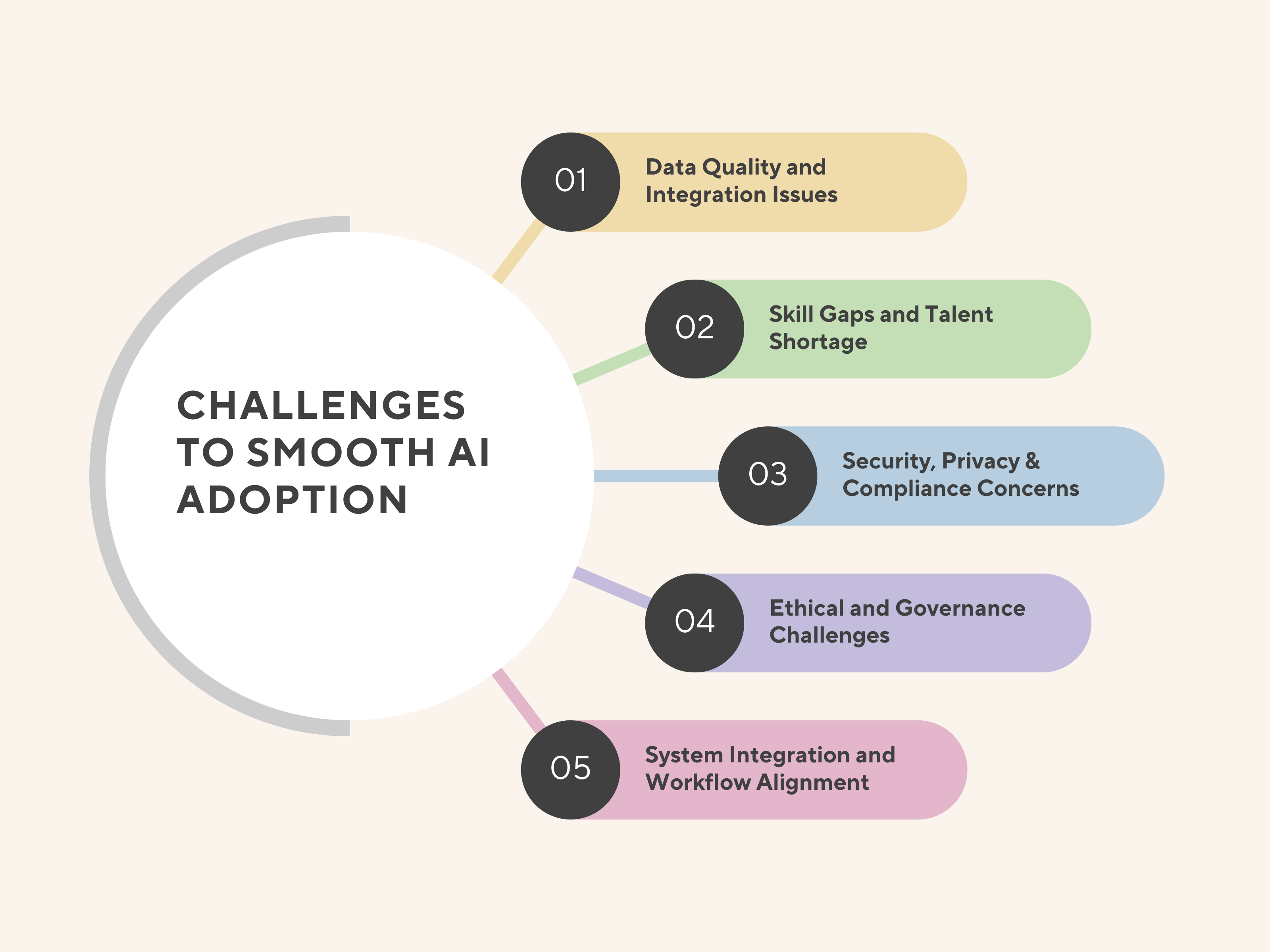
1. Data Quality and Integration Issues
Many organizations struggle with siloed data hampering AI systems that depend on clean data to deliver precise insights. Unstructured data reduces model accuracy and limits trust in AI outcomes, says European Business Magazine.
2. Skill Gaps and Talent Shortage
Many finance teams lack the training needed to deploy and manage AI technologies effectively. As per Fortune Business Insights, a significant percentage of business leaders identify skill gaps as a top barrier to AI adoption and ROI realization.
3. Security, Privacy & Compliance Concerns
Finance functions handle sensitive data. Therefore, integrating Artificial intelligencee creates new risks related to privacy and regulatory compliance. Such risks make AI-driven solutions a mandate for Finance-based organizations to secure model governance and strong privacy safeguards.
4. Ethical and Governance Challenges
Governance frameworks are critical for responsible use of AI solutions. At times, AI models behave like “black boxes,” especially when decision logic is not transparent. Such actions raise ethical concerns for compliance-led transactions.
5. System Integration and Workflow Alignment
AI tools must integrate smoothly with existing financial workflows. If integration is poor, AI projects can struggle with delayed value realization.
These challenges are real but navigable with the right data, AI model training, and governance framework. Overcoming such hurdles lies the foundation for AI to deliver measurable value.
Looking Ahead: The Future of AI in Finance
AI in finance is evolving rapidly. It’s no longer just a tool for efficiency—it’s becoming a core part of how financial institutions and investment firms operate. By 2026, adoption will move beyond pilots to fully integrated, everyday applications.
Finance professionals are increasingly investing in:
-
Smarter predictive models to anticipate cash flow, revenue trends, and risks.
-
Case-specific decision support tools guide strategic budgeting through intelligent investment strategies.
-
Integrated AI platforms connect with existing ERP to aid accounting and analytics systems for seamless operations.
Over 60% of large organizations plan to implement multiple AI-driven processes in finance within the next two years. The numbers signal that AI will become an essential part of financial operations rather than becoming an optional enhancement.
These advancements mean finance teams won’t just work faster—they’ll work smarter, making data-driven decisions in real time and contributing directly to business strategy.
Conclusion
AI in finance has evolved from experimental pilots to real, operational use. Today, it enables financial institutions to work faster, make smarter decisions, and strengthen risk prevention while freeing up leaders to focus on strategy.
Organizations that adopt AI thoughtfully gain more than efficiency—they gain data-driven insights, improved forecasting, and resilient financial operations. From automating routine tasks to supporting high-level decision-making, AI is reshaping finance functions for the future.
Now is the right moment to explore how an AI for financial operations solution can become a core part of your finance strategy, driving both operational excellence and strategic advantage.
Frequently Asked Questions
Have a question in mind? We are here to answer. If you don’t see your question here, drop us a line at our contact page.
What does AI in Finance actually do for my business?

AI in finance helps businesses modernize core finance functions. It supports faster reporting and better forecasting. It can assess credit risk and improve credit decisions using AI powered tools. These tools analyze transaction patterns and cash flow trends from vast amounts of data. As AI adoption grows, businesses reduce errors and improve service delivery across key financial processes.
How can AI improve my Financial operations?
AI improves daily finance functions by automating approvals and validations. It reduces manual work and lowers operational costs. With strong risk modeling, AI helps manage credit risk and prevent losses. Fraud detection systems spot unusual behavior early. This leads to measurable cost savings and smoother workflows across the finance industry.
What AI tools are most effective for corporate Finance?
AI powered tools like forecasting engines and analytics platforms support modern finance functions. They help analyze cash flow trends and deliver tailored financial advice. A credit card company may use them to monitor spending behavior. Financial firms rely on these tools to strengthen risk modeling and improve decision accuracy as AI adoption increases.
Is AI secure and compliant for sensitive Financial Data?
Yes. AI systems are safe when built with governance in mind. They protect data and support compliance across financial processes. Many financial firms use AI to strengthen controls without slowing teams down. When implemented correctly, AI improves trust and reliability across core finance functions while supporting long-term service delivery.
How will AI in Finance evolve, and what should I plan for?
Expect AI to become fully integrated into financial workflows for scenario modeling, powering deeper predictive insights. It will complement real-time decision support for budgeting, risk management, and reporting. Besides, early adoption ensures your finance team stays competitive and can attain highest level of customer satisfaction.
How can asset managers leverage AI to improve portfolio and investment decisions?
Asset managers can leverage AI to make faster and smarter decisions across portfolio management and investment strategies. AI powered systems use machine learning models and advanced algorithms to analyze data from structured data, market trends, and credit history.
These AI algorithms work across multiple layers to identify risks, predict outcomes, and provide insights that traditional tools often miss. With strong roots in data science and financial modeling, AI helps teams move from intuition-based decisions to data-backed strategies while maintaining data privacy.
How does AI powered automation help accounting teams save time and money?
AI-powered automation helps accounting teams reduce manual effort by handling routine tasks like reconciliations, reporting, and spend management. Using machine learning algorithms and AI applications, systems can quickly process data, flag errors, and improve accuracy.
This allows firms operating in the financial industry to save money, focus on high-value work, and improve decision-making. Behind the scenes, machine learning models continuously learn from data, helping businesses scale without adding complexity or risk.