


.png?width=27&height=27&name=Group(1).png)

-1.svg)
-1.svg)


-2.svg)


%201-1.webp?width=148&height=74&name=our%20work%20(2)%201-1.webp)




.svg)





.png?width=670&height=445&name=agentic-ai-strategy-for-enterprise-software%20(11).png)
Though large language models (LLMs) are powerful, they have two major drawbacks; the first one is that their knowledge is limited during training. This means they can not access real-time updates or evolve as per business needs. And secondly, they can not interact with the world outside. This means they can not natively query databases, access CRMs, or execute actions in the enterprise apps.
If there is no structured integration, they remain disconnected. For businesses connecting AI to business systems, this creates a critical gap. To bridge this gap, the Model Context Protocol (MCP) comes into action.
MCP acts as a standardization layer and framework for AI applications and AI models, enabling them to communicate with external services, remote servers, tools, and predefined templates. It helps execute business-aware responses in real-time. Today, MCP is helping MCP clients connect AI to business systems and streamline operations.
Rather than building a fragmented and one-off integration, MCP offers a consistent protocol for how AI systems request and access business data. This kind of communication model makes AI integration more powerful and reliable.
For businesses exploring MCP server development or planning to integrate it, it is vital to understand the architecture, use cases, and actual implementation strategies. When it is implemented correctly, it acts as a bridge between AI capability and real business value.
 Generate
Key Takeaways
Generate
Key Takeaways

- MCP standardizes communication between AI models and enterprise systems for business-aware responses.
- Real-time context evaluation and orchestration enable smarter, actionable AI outputs.
- MCP supports scalable remote server integration and secure multi-system workflows.
- Adopting MCP with expert-led AI consulting services accelerates AI deployment.
What is Model Context Protocol (MCP)?
It is an open-source standard that was developed by Anthropic. The framework acts as a universal connector and allows AI models to interact with external data sources, tools, and apps. You can consider this as a middleware as it bridges the gap between AI intelligence and real-world business operations.
As per the latest industry forecast, up to 60% of the enterprise AI deployment will take place using a context protocol like MCP, driven by the need to bridge the gap between business data and tools.
Unlike the other custom API integrations that could only handle simple request-response interaction, MCP offers context-aware communication. It seamlessly understands the business context and intent, and enables AI to deliver a response.
Key Features Covers
1. Contextual Awareness
It tracks the relevant state and history, which allows AI to respond with business logic and understanding.
2. Standardized Protocols
It is a unified framework for communication and works across diverse systems and data sources.
3. Real-Time Integration
It allows AI models to connect with business data and execute tasks accordingly.
4. Security and Compliance
It offers enterprise-grade security to protect sensitive data.
When the MCP AI enterprise approach is used, businesses can discover the complete potential of AI and turn a standalone model into contextual and intelligent components. MCP ensures AI remains within the context of the core systems and operations.
Why MCP Matters in Today’s Technology Landscape
Large language models are though powerful, but lack structured integration. And that is where MCP becomes critical. It bridges the gap between AI intelligence and enterprises, enabling secure and context-aware interactions. Here is why it actually matters in the technology landscape.
1. Explosive AI Adoption in Enterprises
As AI adoption rises across enterprises at a higher pace, in at least one of their business operations. As per the latest industry data, the statistics highlight that 78% of businesses are deploying AI to support their business operations, a significant jump from 55% previously.
However, AI adoption is simply not enough. If there are no standardized protocols, the models remain siloed and are not capable of delivering actionable insights. Thanks to MCP, which fills this gap and enables AI to interact with systems, leading to its widespread adoption.
2. Need for Real-Time, Contextual Intelligence
Businesses need real-time and context-aware responses, not generic outputs. The tasks include updating the CRM on its own, triggering automated workflow, and offering actionable insights.
The process is streamlined by MCP as it maintains contextual awareness across AI interactions and ensures the response aligns with business needs and rules. AI can be connected with ERPs and CRMs, and MCP here transforms AI into a decision-making partner.
3. Rapid Growth of MCP Integration
The MCP ecosystem is expanding as businesses are recognizing the need for standardized AI integration. As per stats, MCP server downloads grew from 100,000 in 2024 to 8 million by 2025, supporting different industries including finance, healthcare, retail, and more.
The growth clearly depicts that MCP is now a critical framework for enterprise AI deployment. Organizations are now leveraging it for connecting AI to business systems and executing workflows in real-time.
4. Standardization Reduces Complexity
Before MCP was integrated into the operations, businesses relied on fragmented data to link AI models to enterprise systems. These solutions lead to integration overhead and a high risk of errors.
MCP, on the other hand, offers a consistent and standardized protocol that defines how an AI model interacts with tools and other systems, while reducing the complexity. This allows businesses to scale across different systems without sacrificing security.
5. Scalability & Future-Proofing AI Infrastructure
When an AI is deployed, it needs to scale across multiple apps and servers. This may hamper the security and performance. Therefore, choosing MCP allows remote server architecture, multi-tool integration, and dynamic workflow, which allow businesses to expand AI capabilities without having to rebuild the connections.
This ensures that businesses can adapt to the evolving technologies and integrate new tools, ultimately providing a sustainable path for AI adoption.
Core Components of MCP
Every MCP component has a critical role that ensures AI systems can communicate seamlessly and maintain context-awareness across different servers. Here are a few of its core components.
1. Context Engine
It stands as a foundation of MCP. It helps manage and maintain the state and relevant business context that is needed for AI decision-making. It does not treat every interaction in isolation; it stores the entire conversation or its history, tracks user data, applies business rules, and supplies contextual data in real-time.
2. Model Orchestrator
The model orchestrator is an intelligent router in the MCP architecture, and it determines which model will handle the request based on the intent and system logic. It also manages model coordination, cites external tools, and ensures a smooth load distribution. The orchestrator ensures every request is directed to the suitable model for optimal performance.
3. Remote Server Interface Layer
For a secure combination, this layer is used. The layer acts as a bridge that ensures smooth communication between the AI system and the infrastructure. From handling the APIs to database queries and system integration, it allows seamless connectivity between the AI models and apps like ERPs.
4. Security & Governance Layer
Security and governance ensure enterprise-grade protection across different AI interactions.
It allows for role-based access control (RBAC), data encryption, detailed auditing, and managing access tokens. The layer helps protect sensitive data and ensures all the AI-driven actions are aligned with regulatory needs and company policies.
5. Tool & Template Registry
This template offers predefined workflows, business logic templates, and helper functions that can be executed by AI models in one go. This allows AI to perform structured actions, including CRM updation, generating reports, and triggering automated processes. As the functions are standardized, the registry ensures consistency and enables AI to function as an actionable enterprise system.
Recommended Read: AI Agents, MCP Protocols, and the Future of Smart Systems
How MCP Works: Step-by-Step Execution Flow
To understand the true power of Model Context Protocol, let’s break down how it works in a real-world enterprise scenario.
1. Ingest Business Request
The process begins as the businesses get a request. The request could be a user query, an automated workflow trigger, or others. Then this request moves to the MCP layer via a secure interface, where it is structured and processing-ready.
For example, there is a customer support request, a sales query, and an inventory update; these all act as input signals.
2. Context Evaluation
Once the request is finally received, the context engine evaluates the data it has, like history, session dates, or other business information. The step ensures Artificial Intelligence not only understands the user query, but also the operational context it has beside. This enables MCP to support real-time and business-aware intelligence, not simply the generic AI responses.
3. Model Selection & Response Assembly
The next step is the model orchestrator that determines which AI model will handle the query. The system may trigger external tools and query enterprise databases, if needed, from outside. A structured response based on AI model output, business logic, and workflow requirements is created.
4. Response Delivery to Remote Servers
The processed response is delivered to the appropriate remote server or enterprise system. This could mean updating a CRM record, generating a report, triggering an automated workflow, or sending a user-facing response.
Because MCP standardizes communication across distributed systems, this delivery happens securely, efficiently, and at scale.
MCP Use Cases: Connecting AI to Business Systems
MCP is not simply a theoretical framework; it actively transforms how businesses deploy and scale AI across businesses. Here are some of the vital real-world applications.
1. Enterprise AI Integration
It is one of the most powerful use cases of MCP. There are different systems used in businesses like CRM, ERP, customer support tools, and more. Traditionally, to integrate systems in AI, businesses need custom connectors and robust development efforts.
With MCP, this process is standardized, as AI can interact with these systems. AI models access live data and retrieve insights and trigger workflows, maintaining contextual awareness.
- AI automates updating CRM after customer interactions.
- ERP systems provide inventory management in real-time.
- Support tickets are created intelligently.
2. Remote Server Scaling
AI workloads need to scale across different environments as businesses grow. MCP allows AI models to communicate across different servers and services. As the coordination is aligned, MCP ensures:
- A balanced distribution of workload
- Latency is reduced
- Performance is consistent across different geographies.
- Cross-server communication remains secure.
3. Personalized Experiences
In today’s time, customers need highly personalized experiences, and thanks to MCP, which offers a real-time personalized engine that adapts based on the user's behavior and history. As the contextual state is maintained, AI systems,
- Deliver customized product recommendations.
- Messages can be customized.
- Offers behavior-driven insights
It does not offer generic automation; rather, it deploys AI that understands intent and responds accordingly.
Building Your MCP Server: Step-by-Step Guide
From defining the context schema to implementing security and compliance, there are critical steps that must be followed to help build the MCP server.
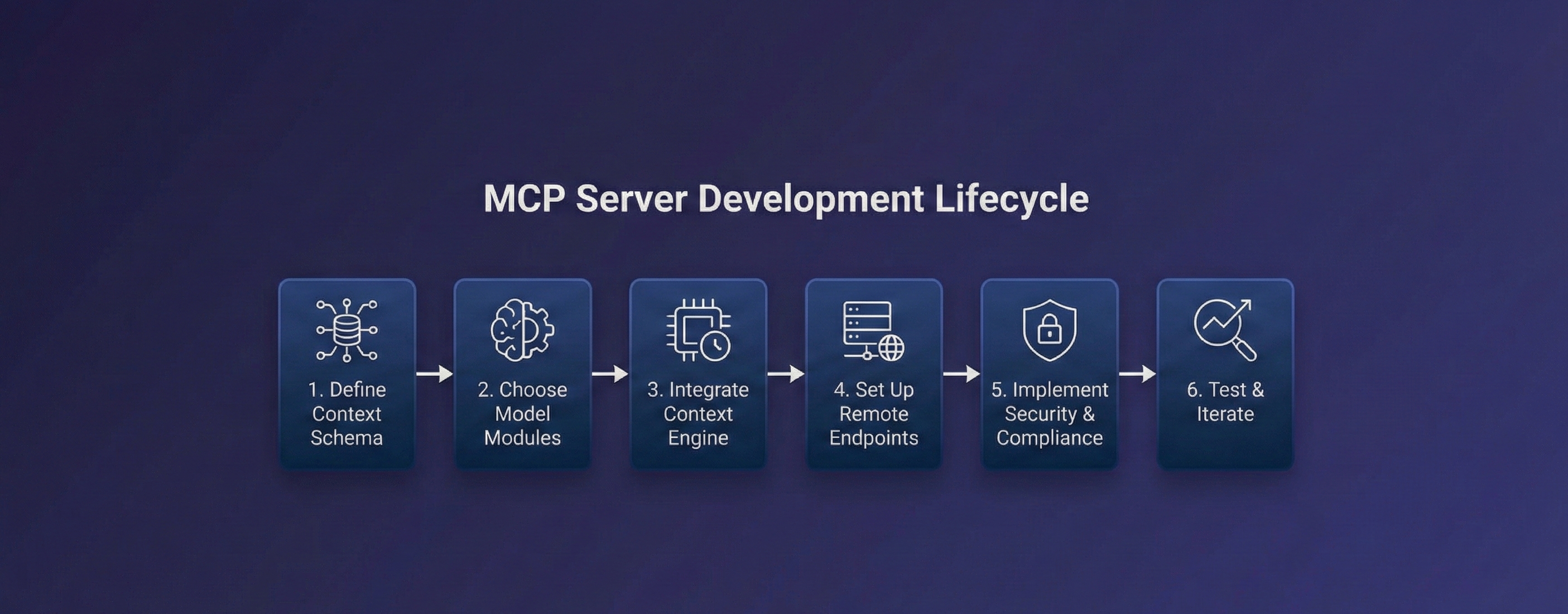
1. Define Your Enterprise Context Schema
Define your enterprise context schema first. This covers identifying the data points for accurate decision-making. The data points include user sessions, business rules, and more. A structured schema ensures that AI systems can operate with full awareness of the business logic.
2. Choose Your Model Modules
The next step is choosing the right AI model module. Analyze what your business needs: a natural language processing model, predictive analytics engine, or a recommendation system. It aligns the model with a specific use case, allowing the architecture to deliver efficient results.
3. Integrate Context Engine
After you choose the mode, integrating the context engine is the next vital step. This step manages and retrieves the contextual data in real-time. It ensures that AI responses are informed by past interactions and business conditions.
4. Set Up Remote Server Endpoints
It is time to set up remote server endpoints for linking the MCP system with tools like CRPs and ERPs. This setup enables seamless connectivity and acts as a communication channel. This allows AI models to collect data, trigger actions, and interact with multiple systems.
5. Implement Security & Compliance
Security and compliance are critical to embed at every layer of the MCP architecture. From implementing access control to encryption mechanisms and audit logs, AI interactions become secure and aligned with the regulatory needs. A robust governance framework is vital for businesses to adopt.
6. Test & Iterate
It is the last and final step in building the MCP server. This involves evaluating system performance, validating model outputs, and identifying the areas of improvement. With regular optimization, MCP remains scalable and reliable.
Challenges & Best Practices
|
Area |
Challenge |
Best Practice |
|
Data Privacy & Context |
Handling sensitive enterprise data while maintaining rich contextual awareness across systems can lead to security and compliance risks. |
Implement role-based access control (RBAC), data encryption, and context filtering to ensure that AI accesses only authorized and relevant data. |
|
Versioning for AI Models |
Frequent updates to AI models can cause inconsistencies, breaking workflows or affecting output reliability. |
Maintain proper version control, track model changes, and ensure backward compatibility to avoid disruptions in MCP workflows. |
|
Monitoring & Logging |
Limited visibility across distributed systems makes it difficult to track performance, debug issues, or ensure compliance. |
Use centralized monitoring systems with detailed logging and audit trails to track requests, outputs, and system behavior. |
|
Performance Optimization |
Scaling MCP across multiple servers can introduce latency, inefficient routing, and slower response times. |
Optimize model selection, use caching strategies, and balance workloads across servers to ensure fast and scalable performance. |
Why Businesses Need a Professional MCP Partner?
The model context protocol is an emerging foundational layer that enables businesses to move beyond isolated models towards a fully integrated and context-aware intelligent system. This standardization ensures real-time decision-making and scalable AI deployment.
As businesses are investing in AI, it is not just about what will give the competitive advantage, but also about these models and how they are integrated into the business ecosystems. MCP offers that connection and transforms AI into a core driver of business outcomes.
Businesses that adopt an MCP server-driven approach can reduce integration complexity, improve interoperability, and boost time-to-value while ensuring security and performance. To successfully implement advanced architectures, partnering with expert-led AI consulting services can help businesses design, develop, and deploy MCP-driven solutions.
Ready to Build Scalable, Context-Aware AI Systems?
Leverage expert-led MCP development to seamlessly connect AI to your business systems, streamline workflows, and unlock real-time intelligence across your enterprise.

Mangesh Gothankar


Ashwani Sharma
Achin Verma
Frequently Asked Questions
Have a question in mind? We are here to answer. If you don’t see your question here, drop us a line at our contact page.
How is MCP different from traditional API-based AI integrations?

Traditional API integrations connect systems in a fixed manner, often lacking context awareness. In contrast, MCP development enables structured, context-driven communication where AI systems understand business logic, maintain session state, and dynamically interact with multiple tools, making it more scalable.
What types of businesses can benefit from the MCP AI enterprise approach?
The MCP AI enterprise approach is valuable for any organization that relies on multiple systems and data sources. Industries such as finance, healthcare, retail, and logistics can leverage MCP to unify AI with their CRM, ERP, and analytics platforms, enabling real-time insights and automated workflows.
How complex is the integration of a Model Context Protocol server in existing AI models?
MCP server integration can vary based on system complexity, but MCP is designed to reduce the need for custom connectors. With a standardized framework, AI enables businesses to streamline integrations, making it easier to connect AI models with existing infrastructure while maintaining security.
How does the MCP help businesses integrate AI systems with internal and external tools?
The Model Context Protocol (MCP) enables seamless AI integration by connecting AI models and AI agents with internal systems, external data sources, and enterprise tools. By leveraging a standardized protocol, MCP ensures secure data access across remote servers, multiple platforms, and data stores, allowing AI applications to perform tasks, automate workflows, and retrieve relevant information in real time.
What tangible benefits do businesses gain by implementing MCP for AI technologies and AI applications?
Implementing AI technologies through the MCP ecosystem provides businesses with tangible benefits such as cost savings, improved customer engagement, and enhanced decision-making using real-world data and retrieval-augmented generation. MCP allows AI models to analyze data across external systems, data stores, and content repositories, perform routine tasks, and automate processes using function calling, helper functions, and access tokens.





.png?width=352&name=agentic-ai-strategy-for-enterprise-software%20(16).png)
-1.png?width=352&name=agentic-ai-strategy-for-enterprise-software%20(4)-1.png)