

.png?width=27&height=27&name=Group(1).png)

-1.svg)
-1.svg)


-2.svg)


%201-1.webp?width=148&height=74&name=our%20work%20(2)%201-1.webp)




.svg)





.png?width=670&height=445&name=agentic-ai-strategy-for-enterprise-software%20(10).png)
Every executive now faces the reality of digital disruption and fast-changing market dynamics. In 2025, a leading global survey found that 88 percent of enterprises use AI in at least one business function, up sharply from prior years. Yet only a small fraction of organizations see enterprise-level financial impact. This gap highlights a core problem. Many companies invest heavily in models and tools without aligning them with business needs or redesigning systems to deliver value.
.png?width=645&height=480&name=Untitled%20design%20(52).png)
Looking ahead to 2026, enterprises recognize that the ad hoc deployment of AI tools alone will not drive growth or competitiveness. Firms like Deloitte are integrating AI into strategic planning to guide long-term decisions, not just short-term pilots. It means organizations now expect AI-powered initiatives to reduce cycle times across core workflows.
Artificial intelligence can accelerate insight generation and improve decision-making when connected to real-world business operations. For instance, tasks like customer strategy, supply chain management, and risk management could be integrated with AI to yield desired outcomes.
Many executives now describe AI as central to modern business resilience. Investment in AI consulting services and enterprise AI platforms is growing rapidly as companies seek real value from scale.
Yet leaders must solve structural challenges. They need strong data practices, reliable governance, and a clear strategy. They need Enterprise AI to work with existing systems at scale. That is why the shift to enterprise AI is now a board-level priority in 2026.
 Generate
Key Takeaways
Generate
Key Takeaways

- Most enterprise AI failures stem from operating models, not from limitations in artificial intelligence.
- Boardrooms considering AI as capital infrastructure will outrank firms working on disconnected AI projects.
- Enterprise AI value will grow when decision rights are redesigned and not when models improve.
- Responsible AI accelerates adoption by reducing friction across business teams.
What Enterprise AI Really Means Inside Large Organizations?
Enterprise AI strategy refers to how artificial intelligence operates across the entire business. Isolated models or experiments do not define it.
It is defined by how AI systems support consistent decision-making across business operations. In large organizations, AI must function as shared infrastructure.
Enterprise AI vs Standalone AI Tools
|
Aspect |
Standalone AI Tools |
Enterprise AI |
|---|---|---|
|
Scope |
Solves narrow problems for individual teams |
Operates across business functions |
|
Data usage |
Uses limited or isolated datasets |
Connects enterprise-wide data sources |
|
Integration |
Works outside core business systems |
Integrates with enterprise software |
|
Governance |
Minimal or no oversight |
Built into governance and controls |
|
Business impact |
Improves local efficiency |
Drives sustained enterprise value |
|
Risk profile |
Increases technical debt over time |
Reduces operational and compliance risk |
AI tools help teams automate specific tasks. They improve local productivity. However, their impact stays limited.
On the other hand, Enterprise AI solutions work differently. They connect business systems and influence planning and execution. They support governance and long-term decision-making.
Example: A global manufacturing firm uses AI for predictive maintenance. One team deploys a model to monitor equipment health. The model performs well. However, it operates in isolation from the supply chain and service systems.
But when implemented as enterprise AI, the impact changes. The asset data connects with inventory planning and service delivery, allowing leaders to gain cross-regional visibility.
The Enterprise AI Technology Foundation Required for Scale
Many organizations adopt AI as a tool without working on their core readiness. Such execution causes stalled outcomes.
In enterprise environments, your technology choices determine speed and reliability.
Pretrained models offer speed but limit differentiation. Large organizations require custom AI models to reflect enterprise-specific data and workflows. Custom models can be trained to yield desired accuracy while cutting the bias. It means the outputs are driven as per business rules.
Core AI Technologies Powering Enterprise AI
1. Machine Learning & Deep Learning
When we talk about core technologies forming the backbone of enterprise AI strategy, Machine learning takes the primary spot.
Since machine learning models identify patterns across large datasets, they can support forecasting with better risk detection. While machine learning feeds on datasets, deep learning extends its capabilities. It works at processing complex data like establishing sequences.
Together, these approaches enable automation across distinct business operations.
2. Generative and Perceptive AI Capabilities
Generative AI and large language models support enterprise workflows through synthesis and reasoning.
At the same time, Natural language processing allows systems to understand and generate natural language. Its output extends beyond search with detailed document analysis and interpreting customer interactions.
Also, computer vision harnessed during the process enables enterprises to analyze visual data. It supports precise monitoring and safety use cases.
All in all, enterprises that scale AI treat these technologies as components of a unified system. Each capability reinforces the other. Together, they create a foundation that supports result-driven enterprise AI solutions.
3. Enterprise AI Platforms and Integration Architecture
An enterprise AI platform acts as the control panel for all AI systems. It means systems that standardize model training while deployed to work on process monitoring and overall governance.
Core components include model registries, feature stores, MLOps pipelines, and inference orchestration layers. Without such a platform layer, AI assets remain fragmented and unmanageable.
While core components are knitted closely, the AI consulting services driven to align with existing systems are non-negotiable.
It means enterprise AI use cases extend beyond ERP, CRM, data lakes, and operational databases. Customer data flows through secure APIs and event streams. This enables real-time inference inside business workflows. It also ensures AI outputs always remain auditable and explainable.
Such systems can also be called centralized platforms that simplify the management of AI models. They support versioning, rollback, performance tracking, and access control.
Recommended Read: Enterprise AI Assistant Challenges and Best Practices
Executive Roadmap for Implementing Enterprise AI
Enterprise AI execution fails when priorities are unclear. Leaders need to separate strategic decisions from operational actions. Therefore, our AI roadmap at Signity highlights the demands that require executive attention first.
Strategy, Governance, and Responsible AI
The strategic intent is always a priority. An enterprise AI strategy must answer the question of where AI changes outcomes. It should not describe tools or experiments but define business leverage points.
Next comes AI governance. At this stage, it is decided who approves models, who has the data access, and how deployments are handled. Governance also checks at escalation paths when AI outputs conflict with business judgment.
Responsible AI is not aspirational; it is operational. Enterprises should define acceptable use cases, explainability standards, and human override rules. Remember, trust collapses when AI decisions are unexplainable or unjustified.
Integrating AI into Business Operations
Integration is the most significant point to consider when it comes to preventing risks.
AI must sit inside existing business operations, as standalone AI systems rarely survive. Additionally, process automation should work for high-volume decisions with automation of repetitive tasks. It even creates early proof of value.
Remember, service delivery improves when AI supports frontline teams. AI should recommend actions, not replace accountability. In other words, productivity gains depend on the rate and scale of adoption, not model performance.
That being said, AI Operational priorities can be defined as:
-
Integrate AI into existing workflows and systems.
-
Automate routine tasks with clear success metrics
-
Support business functions with decision assistance
-
Scale only after usage stabilizes
Where Enterprise AI Creates Measurable Business Impact?
Enterprise AI unlocks value only when a measurable impact is gained. Here are a few areas AI investments hold extensive potential:
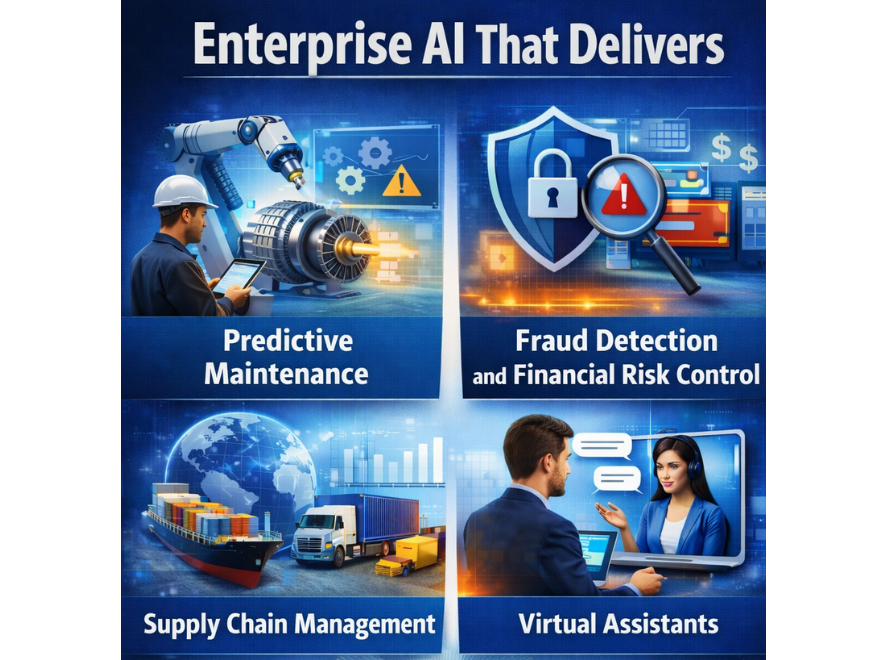
Operational Reliability with Predictive Maintenance
Predictive maintenance uses AI solutions to track equipment failures before they happen. AI insights not only reduce downtime but also help organizations to extend asset life. AI in operations holds the power to turn maintenance from a cost center to a performance lever.
For Example, Rolls-Royce uses predictive models to monitor engine health and reduce failures. Similarly, Siemens uses similar AI systems to cut machine downtime and improve uptime reliability. These systems have demonstrated operational cost reduction and dynamically extending asset lifetimes.
Fraud Detection and Financial Risk Control
AI systems analyze transaction patterns in real time to detect anomalies in context for fraud detection. These systems continually learn from new data.
For example, financial institutions such as HSBC use AI agents to monitor millions of transactions daily and reduce fraud-related losses. Here, AI-driven risk control reduces manual oversight and improves compliance.
Supply Chain Management and Resource Allocation
An enterprise AI strategy stabilizes supply chain planning and inventory optimization. It reduces logistic waste and improves fulfilment times.
For Example, Walmart uses AI for route planning, stock forecasting, and automated logistics management. Lenovo also applies AI to predict delivery delays and optimize supplier interactions.
Virtual Assistants Improving Customer Interactions
AI-powered virtual assistants handle routine queries around the clock.
For Example, Bank of America’s “Erica” and NatWest’s “Cora” process millions of customer interactions with high resolution rates. These bots lower support costs while improving satisfaction scores.
Scaling, Measuring, and Sustaining Enterprise AI
Scaling enterprise AI requires discipline beyond deployment. Most enterprises achieve early AI wins but fail to sustain value for a long duration. Such a gap is usually observed after pilots succeed.
Enterprise-scale AI is not about more models. It is about repeatable outcomes across business units. Leaders must shift focus from experimentation to operational consistency. This is where many programs stall.
KPIs
Traditional KPIs fail to measure the impact of AI. The usual output metrics, such as model accuracy, lack relevance to business.
This is why mature organizations work to track operational efficiency by measuring cycle time reduction and decision quality. These metrics connect AI systems to business performance
Continuous Learning
Enterprise AI systems must continuously analyze vast datasets. Sticking with the static data pipelines weakens model relevance, while continuous learning allows AI to adapt to dynamic factors like customer behavior and market conditions.
Here, data scientists play a vital role as they become model builders to system stewards. Data science teams are responsible for managing model performance, data drift, and governance with a focus on reliability with reuse.
In short, productivity can be multiplied by standardizing model deployment. Besides, teams working across shared platforms can easily resist duplicate work with centralized visibility, offering all the accountability.
Enterprise Scaling
AI systems improve only when learning connects to operations. Sustained enterprise AI maturity depends on feedback loops, which means business teams must validate outcomes regularly.
Enterprises that master the entire phase treat AI as a living capability. Others see a value plateau within eighteen months.
Conclusion: From AI Adoption to Enterprise Advantage
Enterprise AI is no longer about feasibility and therefore must be worked on to gain a long-term advantage. Therefore, organizations that use AI consulting services as an enterprise capability could gain clarity, even in the most uncertain markets.
Enterprise AI brings power to respond faster when conditions shift, offering more resilience to business systems. Thus, the future belongs to enterprises that connect all, strategy, platforms, and governance with intent.
When the right elements work together, AI strengthens decision-making, delivering foresight beyond dashboards. It allows teams to act with confidence instead of hesitation.
All in all, when enterprise AI is scaled correctly, it becomes self-reinforcing. Learning compounds. Decisions improve. Operations adapt without disruption. This is how AI moves from adoption to advantage.
Frequently Asked Questions
Have a question in mind? We are here to answer. If you don’t see your question here, drop us a line at our contact page.
What makes enterprise AI different from traditional AI projects?

How do large enterprises start implementing AI?
Large organizations start with a focused use case. They run controlled pilots tied to business outcomes.
After validation, AI integrates with existing systems with data pipelines and platforms standardized. Further, governance is defined before scaling with the help of an AI consulting firm.
Such a phased approach builds internal confidence as enterprises scale only after adoption stabilizes.
How can enterprises manage AI risks effectively?
Risk management starts with governance. Enterprises define ownership and approval processes.
Responsible AI policies guide usage and transparency. Continuous monitoring detects data drift and bias. Human oversight remains critical. Risks reduce when AI decisions are explainable. Trust improves when accountability is clear.
How long does it take to drive ROI from enterprise AI?
Timelines vary based on readiness. While early pilots can show value within months, scaling sustainable ROI takes longer.
Here, integration and adoption influence speed. It means only the enterprises with strong data foundations move faster.
Poor execution delays impact, and sustainable ROI depends on continuous focus on improvement with precise operational alignment.

Mangesh Gothankar


Ashwani Sharma
Achin Verma





.png?width=352&name=How%20to%20Build%20an%20AI%20Implementation%20Strategy%20That%20Delivers%20Business%20ROI%20(2).png)