




.png?width=27&height=27&name=Group(1).png)

-1.svg)
-1.svg)


-2.svg)


%201-1.webp?width=148&height=74&name=our%20work%20(2)%201-1.webp)




.svg)





AI agents are changing how businesses use automation and intelligent systems to improve productivity and streamline work. These AI agents are altering industries and even roles in many ways, while offering efficiency, innovation, and scalability.
Here’s something that might even surprise you. Enterprises that have AI-enabled workflows have tripled in profit contribution, improving operating profit by 3.6% in 2023 and 7.7% in 2024. Even top-performing organizations are seeing up to 18% ROI from their AI efforts.
 Generate
Key Takeaways
Generate
Key Takeaways

-
AI agents are no longer experimental. From automating customer support to optimizing supply chains, today’s AI agent use cases are directly linked to cost savings, efficiency, and revenue growth.
-
AI scheduling assistants can cut patient wait times, while virtual agents help clinicians with diagnosis insights. These examples show clear improvements in outcomes and compliance.
-
Companies that use AI agents in their business operations and IT become more flexible. Predictive maintenance, workflow automation, and self-healing IT systems are examples of how businesses can grow faster with less hassle.
-
Sales and marketing are becoming more effective with AI-driven personalization. An AI sales agent can nurture leads around the clock, or a marketing agent that adapts campaigns in real time.
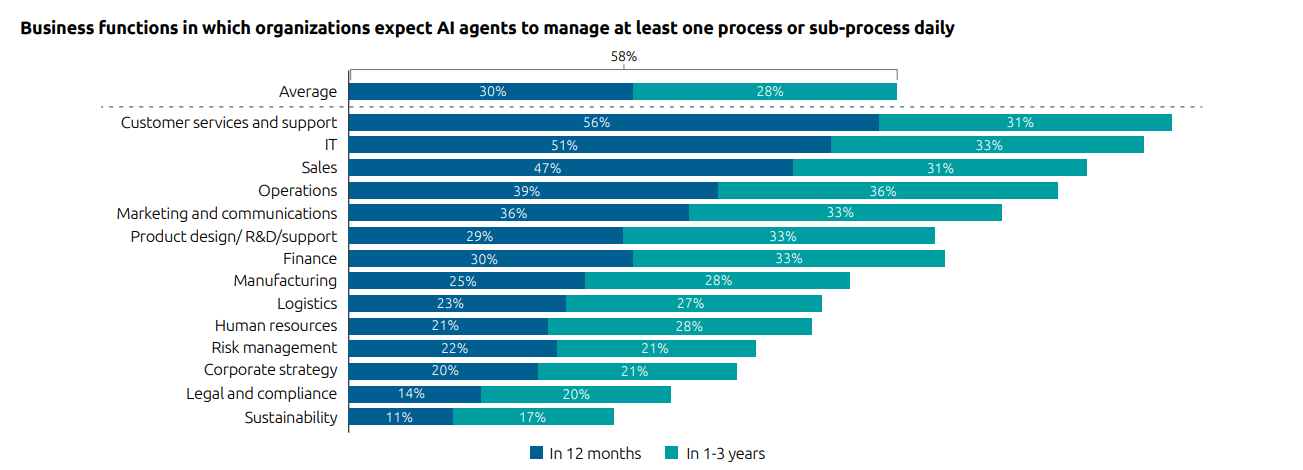
According to recent data, organizations expect AI agents to handle at least one task or part of a task every day in various business functions. Since business functions and industries differ, so do their use cases.
So, what exactly are these intelligent agents doing that is driving such incredible results? This article will highlight real-world examples to show practical & real-life AI agent use cases based on industries and roles.
20+ AI Agent Use Cases Across Industries
With countless potential AI agent applications, it is easy to get overwhelmed when deciding where to start. Should you focus on customer service, operations, finance, or another area entirely? The industry segregation and use cases can help you decide on which one could fit your business case.
Intelligent Agent Examples in Healthcare
The healthcare industry is experiencing quick AI adoption. The majority of hospitals are expected to adopt AI agents for improving predictive analytics and patient outcomes.
1. Patient Scheduling Agents
AI in healthcare optimizes appointment scheduling and manages complex scheduling requirements across multiple providers and specialties.
2. Medical Records Management Agents
Medical records management agents are goal-based agents who digitize, organize, and analyze patient records. These agents are automating data collection from multiple sources, which improves the efficiency and accuracy of medical record management. They ensure that these records comply with HIPAA regulations and give providers quick access to critical information.
3. Treatment Recommendation Agents
Recommendation agents analyze patient data and medical history to suggest personalized treatment plans.
4. Mental Health Support
AI agents can provide mental health support by delivering personalized responses to customer inquiries. Using natural language processing, these AI agents can understand user interactions and offer personalized treatment tailored to individual needs.
AI Agents Use Cases in Finance & Banking
5. Investment Advisory Agents
AI investment agents help people and organizations make informed decisions. They analyze market trends, individual goals, and risk levels. They offer personalized portfolio recommendations and often respond more quickly and cover more data than human advisors. This use of AI is becoming more common, especially in fintech and wealth management.
6. Fraud Detection Agents
AI in FinTech brings fraud detection agents that are increasingly being used for safety concerns. These AI agents scrutinize transactions in real-time, identify unusual patterns, and notify users of potential fraud before any damage occurs.
7. Regulatory Compliance Agents
AI agents in compliance departments help track and analyze financial activities to ensure compliance with Anti-Money Laundering and Know Your Customer regulations. They generate reports and alerts when necessary. As financial regulations become more restrictive, the use of AI becomes increasingly important for industries that are regulated.
8. Loan Processing Agents
Loan processing agents handle everything, from collecting documents to automatically scoring credit and making decisions. Such AI agents reduce processing times from several days to just minutes. This ensures a better experience for borrowers and increases efficiency for the business. Such use of AI agents is being commonly adopted in consumer lending and digital banking.
9. Financial Forecasting and Autonomous Scenario Planning
Finance teams spend a lot of time on what-if modeling, forecasts, and budgeting. Forecasting agents use past data, economic indicators, and market information to predict future scenarios. They also include external data, like market trends to improve forecasting accuracy and support better decision-making.
They use multi-modal input processing and NLP output, explaining variances and confidence intervals. This results in 60% faster planning cycles and a more agile financial strategy.
Recommended Read: A Guide to Agentic Process Automation
Intelligent Agents Examples in Customer Service
About 90% of organizations are exploring the implementation of AI agents that can work on tasks independently. Around 51% believe that AI agents could manage most customer interactions within the next five years.
10. Intelligent Customer Support Agents
Your customers don't work 9 to 5 schedules. So, why should your customer support team? AI in customer service can handle everything from basic inquiries to complex tasks, often through an AI help desk that automates responses and streamlines support workflows. They can provide instant answers and escalate only when human assistance is needed. These AI agents support or augment customer service representatives by delivering efficient and personalized support.
A report from IBM found that businesses using AI-powered virtual agents can cut customer service costs by up to 30%, while increasing customer satisfaction and loyalty.
Companies implementing AI chatbots report faster response times and better customer satisfaction. With these AI agents active 24/7, businesses can ensure that customers’ queries are handled effectively. This leads to improved customer satisfaction.
11. Multilingual Support Agents
Gone are the days of hiring support staff for every language market you serve. An intelligent agent coordinates in multiple languages to provide support without regional barriers. Multilingual virtual assistants understand cultural differences and respond in the local language. AI agents also help customer service representatives by enabling them to deliver consistent support across different languages.
12. Ticket Routing and Prioritization Agents
No more manual sorting through support tickets. Artificial intelligence agents analyze incoming requests, categorize them by urgency and topic, and route them to the most qualified team member. AI agents also help monitor and ensure compliance with service level agreements by tracking response and resolution times.
13. Follow-up and Retention Agents
These proactive virtual assistants reach out to customers after support interactions. This way, the intelligent agents can ensure that issues are fully resolved. AI models can also help identify opportunities to prevent churn before it happens.
AI Agent Examples in Operations & Supply Chain
14. Inventory Management Agents
Never run out of stock or overstock again. These intelligent inventory management agents predict the stocks appropriately. They share demand generation, optimize reorder points, and automatically manage inventory levels.
15. Supply Chain Monitoring Agents
Supply chain monitoring agents track shipments and predict delays. They identify bottlenecks and automatically adjust logistics plans to keep the supply chain running smoothly. AI agents are transforming supply chain management by optimizing logistics and improving the resilience of supply chains through real-time monitoring and automation.
16. Quality Control Agents
Agents use computer vision and data analysis to evaluate production quality as it happens. They find defects and ways to improve processes before products reach customers.
17. Maintenance Prediction Agents
Predictive maintenance systems help prevent costly equipment failures by analyzing sensor data, usage patterns, and maintenance history. AI agents predict when maintenance is needed and optimize planning by considering technician schedules and spare parts.
18. Vendor Management Agents
Management agents automatically evaluate vendor performance, negotiate contracts, and manage supplier relationships based on data-driven insights.
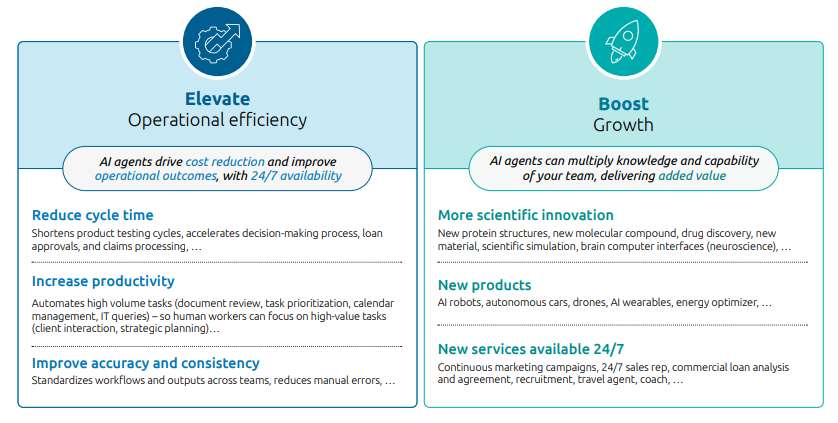
They also automate and optimize internal processes within operations and business functions, increasing efficiency and accuracy. And even the research suggests that, as shown in the image above.
19. Demand Forecasting
Imagine having the power to anticipate customer requirements beforehand. That is what artificial intelligence agents do! Businesses can forecast customer demand by examining previous sales data and present market trends. This enables them to modify inventory and production plans to meet customer needs and remain competitive.
AI Agent Use Cases in Real Estate
20. Virtual Tour Agents
In real estate, virtual tour agents help potential buyers explore property listings. They use chat, voice, or visual hints to guide buyers. These autonomous agents answer user queries in real-time, highlight key features & provide personalized suggestions based on user preferences. This approach enhances remote buying experiences in a competitive housing market.
21. Lead Qualification Agents
AI lead qualification agents help visitors on real estate websites figure out
- If they want to buy
- how much they can spend
- What type of property do they prefer?
These agents also manage and analyze client relationships to prioritize leads and tailor communications, improving conversion rates and customer engagement. After that, they send qualified leads to human agents or automatically suggest listings. This use of AI agents increases conversion rates and lessens the workload for sales teams.
Related Read : How to Create an AI Agent: A Step-by-Step Guide
AI Agents Use Cases in Sports & Entertainment
22. Game Strategy Agents
Game strategy agents are goal-based agents that help coaches and analysts by analyzing real-time data, player movements, and opponent behavior during a match. They suggest tactical changes when needed. These agents use advanced analytics to support quick decision-making.
23. Player Health Monitoring Agents
Player health monitoring agents use wearables to track biometric data like heart rate and hydration levels. They identify signs of fatigue or injury and recommend rest or adjusted training plans.
Retail & E-commerce AI Agent Use Cases
24. Personal Shopping Agents
AI agents help create shopping experiences that are tailored to each customer. They do this by looking at
- Customer preferences
- Search history
- Previous purchases
This information helps them suggest products that customers prefer.
25. Dynamic Pricing Agents
AI agents can adjust prices in real-time based on demand, competition, inventory levels, and market conditions.
AI Agent Use Cases By Roles
Now that we have explored the use cases of AI agents in various industries, it's time to look at some examples from a role perspective as well. Check out the common AI agent use cases by roles below.
AI Agents Use Cases for Marketing
AI tools help marketing teams make better decisions based on data. These AI tools analyze market trends, tailor customer interactions across various channels, and automate repetitive tasks to enhance efficiency. One-third (36%) of the respondents said they mainly use AI for insights, with humans making the final decisions. AI is especially helpful in customer service (55%), improving operational efficiency (49%), and in marketing and content creation (48%).
26. Improved Decision-Making
Intelligent agents help digital marketers make smart choices before spending money on costly campaigns. They can analyze large amounts of data from varied platforms, help identify new patterns, and even provide useful insights.
For instance, if a marketing team is uncertain about when to launch a new product. AI agents can help identify potential opportunities and give clear recommendations on what actions to take based on the current market conditions.
27. Precision Targeting
Customers respond better to personalized marketing messages. Machine learning technology tracks real-time data, customer behaviors, and browsing history to deliver tailored content that matches each customer’s interests. Brands like Netflix use AI to recommend content, improving user engagement and conversions by over 10%.
An intelligent system can find the best way to engage customers. This could mean offering a discount code through an app for regular in-store shoppers, sending special mail offers to loyalty program members, or even identifying high-value customers for exclusive VIP experiences. These strategies can enhance the overall user experience.
28. Task Automation
AI-powered agents make marketing tasks easier by automating repetitive and routine tasks. These agents can sort messages, write personalized emails, and improve pay-per-click (PPC) ads in real time.
For example, marketing teams looking for mentions in the press can ask, "Were we mentioned in the press this week?”. They will get an immediate answer with links, saving them time and effort.
In fact, Shopify is integrating autonomous AI agents across its marketing and operations to reduce human dependency and boost efficiency.
29. Content Automation
To stay competitive, businesses need flexible content solutions. AI-powered tools can help create and improve various types of content like emails, blog posts,website content, and product descriptions. So, rather than hiring more staff, businesses can use AI agents to produce product descriptions that match their brand at scale.
30. Conversational AI Chatbots
Conversational AI agents help customers by guiding them through product catalogs, answering questions quickly, and boosting their confidence to buy.
For instance, if a customer spends more time than usual on a product page. An AI assistant can pop up and say, “Hi! Do you need help finding the perfect footwear? I can run a quick test for you.”
This tailored approach reduces doubts, improves the shopping experience, and increases sales.
AI Agent Examples in Sales
31. Lead Qualification Agents
Stop wasting your sales team's time on unqualified leads. Intelligent agents also involve analyzing prospect behavior, company data, and interaction patterns to score and prioritize leads automatically. This ultimately allows sales teams to easily access customer data and automate routine sales tasks.
32. Sales Forecasting Agents
These autonomous agents use historical data, market trends, and pipeline analysis to provide accurate sales predictions. AI technologies in sales help businesses make informed decisions and allocate resources more effectively.
33. Customer Journey Mapping Agents
Track and analyze every touchpoint in your customer’s journey. Identify bottlenecks and optimize opportunities with the most effective conversion paths using autonomous agents.
34. Autonomous Sales Prospecting and Lead Nurturing
Manual sales outreach is time-consuming and often lacks personalization at scale. AI Sales Agents autonomously identify high-intent leads, draft tailored emails, automate and optimize follow-ups based on engagement, and hand over qualified leads to human sales teams.
AI Agents in Software Engineering and DevOps
Software development workflows are complex. They involve code generation, bug triaging, release coordination, and security scanning. AI agents work together to automate and coordinate these complex software development tasks, streamlining processes and reducing manual intervention.
Agentic AI can serve as Software Development Agents. An AI system or even multiple AI systems can autonomously manage code deployment, testing, and monitoring, improving efficiency and reliability. Recent advancements in gen AI enable more sophisticated and autonomous agentic capabilities in software engineering. This allows these intelligent agents to reason, interact, and execute tasks with greater autonomy. They can orchestrate everything from writing boilerplate code to reviewing pull requests, monitoring CI/CD pipelines, and even rolling back buggy releases autonomously.
AI Agents in IT and Process Automation
AI agents are transforming IT and business process automation by handling routine tasks with minimal human intervention. They use NLP to understand user interactions and provide personalized responses.
By automating monotonous and time-consuming tasks, AI agents free up human agents to focus on more complex and value-added work. In HR teams, AI agents can assist teams with the hiring process by screening resumes, interview scheduling and providing candidate feedback. Deploying AI agents for IT and process automation leads to faster workflows, reduced costs, and a more agile organization.
Also Read- Top AI Agent Frameworks in 2025
AI-Driven Enterprise Knowledge Management
Enterprises struggle with information silos. This fragmented information often leads to repeated work and slow onboarding. Knowledge Agents autonomously ingest, categorize, and retrieve enterprise knowledge across varied systems. They do so by using an internal knowledge base as a central repository to store and access organizational knowledge. These agents ensure employees can quickly access the relevant information needed for their tasks.
This implementation of AI agents and multi-agent systems can reduce time-to-information by 80%, while enabling faster decisions and employee self-service.
Conclusion
There are various types of AI agents. And some are far harder to build than other agents. But if you're looking to build an agentic chatbot. It's time to begin with your ideation and start implementation. Thinking of creating one for your business, but don't know how? We can help you out.
As a leading AI development company, using our top industry talent of AI developers, we help businesses build AI agents from scratch. Our programmers understand the uniqueness of every business. That is why we create tailored AI agents to help your business case thrive in the digital market. Get in touch today to discuss your project idea.
Frequently Asked Questions
Have a question in mind? We are here to answer. If you don’t see your question here, drop us a line at our contact page.
What are the real life examples of agents in AI?

AI agents are commonly used in everyday tools. They include virtual AI assistants like Siri and Alexa, recommendation systems on Netflix and Amazon, self-driving cars like Tesla, and customer support chatbots. These agents interact with users and systems to complete tasks and enhance the user experience.
What are the applications of an AI agent?
AI agents are used in many fields like healthcare, finance, manufacturing, customer service, and gaming. Their applications are rapidly expanding across numerous industries, automating complex workflows, enhancing decision-making, and improving customer experiences.
What does an AI agent do?
AI agents help computer users by using natural language to provide insights from different IT systems. They can also perform tasks automatically, which saves users time.
Is ChatGPT an AI agent?
No, the ChatGPT service from OpenAI is a chatbot that allows users to have typed conversations with the company’s language models. However, it does not take action for users on its own.
What are the 5 types of agents in AI?
There are five types of AI agents:
1. Simple Reflex Agents react only to current situations.
2. Model-Based Reflex Agents take their internal states into account.
3. Goal-Based Agents work towards specific goals.
4. Utility-Based Agents try to achieve the highest satisfaction.
5. Learning Agents improve by learning from their experiences.





.png?width=352&name=What%20are%20Multi-Agent%20Systems%20%20(1).png)
.png?width=352&name=Leading%20Agentic%20AI%20Tools%20%20(1).png)