










In the rapidly growing world of Artificial Intelligence, AI agents have emerged as game-changers for various industries. From virtual assistants streamlining daily tasks to autonomous robots redefining the manufacturing sector, Artificial Intelligence agents are reshaping businesses. Gartner predicts that 40% of enterprise applications will include task-specific AI agents by the end of 2026, up from less than 5% in 2025.
On the other hand, brands that do not make use of AI agents are losing great growth opportunities. For instance, different types of AI help achieve different tasks like enhancing customer experience, boosting productivity, and shifting heavy work on the machine. Adoption is still uneven: McKinsey found that 23% of organizations are scaling an agentic AI system and another 39% are experimenting, while Gartner expects over 40% of agentic AI projects to be canceled by the end of 2027 because of rising costs, unclear value, or weak risk controls.
As an AI Consulting Company, we ensure that we reach out to companies across the globe to help them get the best out of AI agents. This article will help you explore the types of agents in AI, its benefits, AI agent applications, and top examples of Intelligent agents. We help enterprises deploy AI agents that automate complex workflows. This article also answers what is AI agent technology and how it applies to business.
Key Takeaways
- AI agents automate complex tasks and enhance overall business productivity.
- Various AI agent types offer unique capabilities for smarter decision-making.
- AI agents drive value across industries like healthcare, finance, and retail.
- Real-world examples show how intelligent agents improve efficiency and customer experience.
- Adopting AI agents helps businesses scale, innovate, and stay competitive.
What are AI agents?
Artificial Intelligence agents or AI agents are software or hardware systems that use AI techniques like NLP, ML, and computer vision to interpret and respond to the information they receive. An AI agent independently chooses which steps to take, calls external systems such as APIs and databases, and uses large language models to interpret user requests and execute tasks. Unlike models built for specific tasks, agents use tools to perform tasks across systems and complete tasks end to end.
Unlike traditional bots or rule-based systems, agents in artificial intelligence operate autonomously, perceive environments, plan actions, and continuously learn from feedback, enabling intelligent agents in AI to make goal-driven decisions with minimal human intervention.
AI agents are designed to make decisions, learn from experience, and quickly adapt to new situations. Agents in AI are used in several applications like virtual assistants, autonomous vehicles, and industrial automation. Agents in artificial intelligence observe their environment, decide what to do, act, and learn from the result, and an intelligent agent in AI can be fully digital or embodied in a robot. Sophisticated AI agents can perform self-directed tasks across many steps, unlike reactive agents that only respond to the current input.
Agents in AI can interact with customers, answer their queries, and resolve issues with a personalized approach. The AI agents market is projected to grow from USD 7.84 billion in 2025 to USD 52.62 billion by 2030, a 46.3% CAGR.

These qualities make it extremely crucial for businesses to embed AI agents for better growth. However, there are various types of agents in AI, and the section below explains them one by one.
How Do AI Agents Work?
Most AI agents follow the same four-step loop:
- Collect data: The agent receives user requests and gathers context from documents, databases, APIs, or the web.
- Plan: The language model breaks the goal into steps. Agents evaluate possible actions and the future states each one leads to.
- Execute tasks: The agent calls tools and external systems, such as a CRM or a payment API, to carry out the plan.
- Learn: The agent stores the result and uses feedback and historical data to improve the next run.
Google Cloud lists four building blocks behind this loop: persona, memory, tools, and a model. The Model Context Protocol (MCP) standardizes how agents connect to tools, and the Agent2Agent (A2A) protocol lets agents from different vendors communicate. Anthropic donated MCP to the Linux Foundation's Agentic AI Foundation in December 2025.
AI Agents vs AI Assistants vs Chatbots
The three terms differ in autonomy and in who makes the decisions. Gartner calls the habit of labeling assistants as agents agentwashing.
| Feature | AI agent | AI assistant | Chatbot |
| Purpose | Completes multi-step goals on its own | Helps a user finish tasks | Answers questions or follows a script |
| Autonomy | High. Chooses its own actions | Medium. The user decides | Low. Follows rules |
| External systems | Calls APIs, databases, and apps | Limited to the host product | Usually none |
| Memory and learning | Keeps memory and adapts | Some memory per session | Little or none |
| Example | Support agent that issues a refund and updates the CRM | Siri or Alexa setting a reminder | Rule-based FAQ bot |
Based on Google Cloud's AI agents guide. See also our comparison of AI agents vs AI copilots.
These qualities make it extremely crucial for businesses to embed AI agents for better growth. However, there are various types of agents in AI, and the section below explains them one by one.
Types of Agents in AI
The different types of AI agents vary based on autonomy, memory, and decision complexity. Understanding types of AI agents with examples helps businesses choose the right intelligent agent model for automation, personalization, or strategic decision-making.
Each type of agent in AI offers a unique set of functionalities to the entire agentic AI system. These differences effectively modify how these AI agents work and serve different purposes. Let us explore the types of artificial intelligence agents below.

1. Simple Reflex Agents
Simple reflex agents are the most basic type of agent in AI that operate solely on condition-action rules triggered by the immediate environment. These agents lack memory or an internal world model, making them incapable of considering past actions or predicting future consequences. They are reactive agents that follow predefined rules. Example: a support bot that sends a password reset link when it detects the phrase "forgot password."
2. Model-Based Reflex Agents
Model-based reflex agents are AI agents that maintain an internal model of the world, combining it with current observations to make informed decisions. Model-based agents consider the unseen aspects of the environment and the potential consequences of their actions.
3. Goal-Based Agents
Goal-based agents are intelligent AI that aim to achieve specific objectives or goals by considering the future consequences of their actions with their environment. Unlike reflex agents, goal based agents can proactively plan and select actions that lead them closer to their desired outcomes. These agents evaluate future states before acting. Example: logistics routing agents that choose delivery routes to meet a delivery window.
4. Utility-Based Agents
Utility-based agents are types of agents in AI that choose actions based on a "utility function," which assigns a numerical value to each possible outcome. They strive to maximize this utility, considering not just goal achievement but also the quality of the achieved state. Example: resource allocation systems that balance cost, speed, and capacity.
5. Learning Agents
Learning agents are Artificial Intelligence agents that improve their performance over time by learning from experience and feedback. These agents adapt their behavior, knowledge, and models through interaction with the environment, making them versatile. A learning agent has four parts: a performance element, a critic, a learning element that updates behavior from historical data, and a problem generator, which makes learning agents useful in dynamic environments.
6. Hierarchical Agents
Hierarchical agents are types of intelligent agents in AI that are organized in a multi-level structure, where higher-level agents delegate tasks and provide guidance to lower-level agents. This hierarchical organization of advanced AI agents, combined with other agents, enables efficient problem-solving. Example: a manager agent splits a loan application into document checks, credit scoring, and compliance review. Together with other AI agents, these advanced AI systems handle large workflows.
7. Multi-Agent Systems
Multi-agent systems are a computational framework composed of multiple interacting autonomous agents, each with unique goals and capabilities. These multiple agents collaborate and compete to solve complex tasks that are beyond the capacity of individual agents. Multiple AI agents show cooperative and competitive behaviors, sharing information to reach a common goal or competing for limited resources. Gartner expects multiagent ecosystems by 2029.
Now that you know the different types of agents in AI, the next section will explain how AI agents can help businesses across various industries.
Benefits of AI Agents
Enterprise adoption of agents in AI has accelerated rapidly, with over half of mid-sized and large organizations now deploying intelligent agents in production, according to KPMG’s 2026 Global AI Quarterly Pulse Survey.
The use cases expand across customer service, operations, analytics, and workflow automation. Most importantly, they have enabled brands to yield dynamic productivity and responsiveness.
With technical advancement, it is important for businesses to adapt to the latest trends. Making the best use of Artificial Intelligence AI is one such factor to consider for business growth.
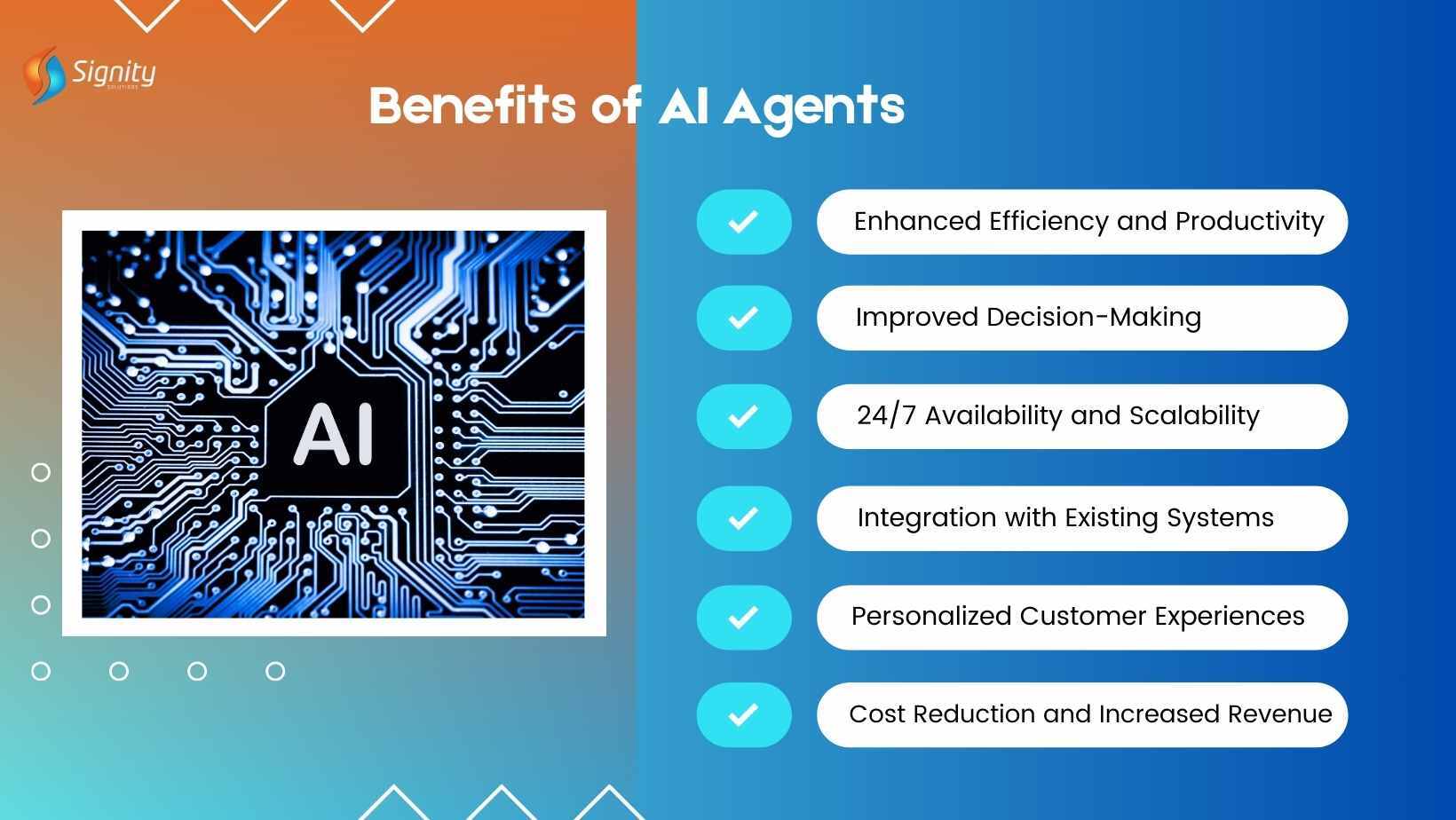
Several benefits of AI agents include:
-
Enhanced Efficiency and Productivity
One of the biggest advantages of Artificial Intelligence AI is its ability to revolutionize efficiency and productivity. It does so by automating repetitive, time-consuming routine tasks that traditionally require a lot of human effort. It helps businesses to focus their expertise and resources on strategic initiatives, complex problem-solving, and creative endeavors.
-
Improved Decision-Making
AI agents can significantly help businesses enhance decision-making by rapidly analyzing vast datasets, identifying patterns, and generating actionable insights. This data-driven approach reduces manual errors, although agents can inherit bias from their training data. Agents evaluate historical data and live data to recommend the next action. Further, AI agents continuously learn and adapt their models based on new data, ensuring that businesses remain updated with the evolving environments.
-
24/7 Availability and Scalability
Another major benefit of the intelligent agent for businesses is its unmatched 24/7 availability and scalability. Agents in AI function around the clock, consistently handle tasks and provide immediate response to the customers. Also, AI agents can scale to accommodate surges in workload as they can handle sudden spikes in online orders and manage a high volume of customer support requests.
-
Personalized Customer Experiences
Personalization is a key aspect of business growth. Salesforce research shows that 73% of customers say companies treat them as individuals rather than numbers, up from 39% in 2023. Intelligent agents in AI offer tailored product recommendations to human users and relevant content by analyzing past interactions and purchase history. AI agents like chatbots and recommendation engines enhance customer journeys by providing instant support and personalized suggestions.
-
Cost Reduction and Increased Revenue
Autonomous AI agents can save companies operating costs by automating repetitive tasks and streamlining complex workflows, freeing up important resources. AI agents boost engagement and conversion rates through targeted marketing, product recommendations, and proactive customer care, leading to increased sales and profitability. Gartner expects agentic AI to reduce customer service operational costs by 30% by 2029.
-
Innovation and New Opportunities
AI agents are the generators of innovation, opening doors for companies through data analysis, pattern recognition, and solution development. They make it possible for ground-breaking goods and services, improve client support, accelerate work, and transform transportation. Businesses can stay ahead of the curve and contribute to disruptive breakthroughs that influence the future with intelligent agents.
The benefits of AI agents are not limited to a single industry. The section below explains how AI agents can be used for businesses across various industries.
Challenges and Limitations of AI Agents
AI agents deliver strong returns, but they come with trade-offs. Businesses evaluating agents in AI should weigh these considerations alongside the benefits:
- Data Privacy and Security Risks
Agents that connect to business systems and customer data need strict access controls and monitoring, since a poorly governed agent can expose sensitive information or take unintended actions. - High Implementation and Computational Costs
Building and training high-performing AI agents demands significant computational resources and specialized talent, which can be a barrier for smaller organizations. - Risk of Errors in Complex Decisions
Agents can misinterpret ambiguous instructions or get stuck repeating the same action, so high-stakes tasks such as financial transactions or legal decisions still need human review. - Integration With Legacy Systems
Connecting AI agents to older infrastructure and siloed data sources can slow down deployment and requires careful planning to avoid workflow disruptions.
Real World AI Agent Applications
AI agent applications extend beyond chatbots and assistants. From fraud detection systems to predictive maintenance and workflow automation, agents in artificial intelligence are now embedded directly into enterprise software ecosystems.
As mentioned above, AI agents are used in companies across various industries to gain better sales, enhance customer experience, and make strategic decisions.
Applications of AI agents include:
a) Healthcare
In the healthcare industry, Artificial Intelligence agents help automate complex tasks like assisting surgeries with better accuracy, reduce infection risks, and minimize blood loss. It also helps organize and store medical records, simplifying access and enhancing work accuracy. Agents also handle appointment scheduling, prior-authorization checks, and post-discharge follow-up. Read how AI agents will transform healthcare.
b) Education
AI agents in the education sector help automate administrative tasks like grading, communication management, course administration, and personalized messaging. Further, it also enhances teaching by digitizing methods and content, helping create personalized learning experiences.
c) eCommerce and Retail
For the eCommerce and retail business, agents in AI help improve inventory management and supply chain optimization by predicting demand and ensuring optimal stocking levels. The use of AI agents also helps enhance customer experience by providing personalized product recommendations and marketing campaigns.
d) Logistics and Supply Chain
Logistics routing agents re-plan delivery routes when traffic, weather, or order volumes change. Resource allocation systems built on utility-based agents assign vehicles, staff, and inventory to the highest-value use. See agentic AI in logistics automation.
e) Finance
In the finance sector, AI agents help detect and prevent fraud by analyzing transaction data to identify risks and take proactive measures. It further enhances customer service by providing instant support, handling queries, and providing personalized financial suggestions, thus improving customer satisfaction. Financial portfolio management agents rebalance portfolios and flag risk using market data. Read our guide to AI fraud detection best practices.
f) Manufacturing
The applications of intelligent agents can be seen widely in the manufacturing sector as well, where they enhance efficiency and product quality through predictive maintenance and optimized business processes. It also analyzes equipment data to minimize downtime and optimize operations, enhancing quality control and reducing errors.
g) Marketing
AI agents improve targeting, increase ad inventiveness, and analyze consumer behavior to maximize advertising in marketing by increasing engagement and conversions. Through the extraction of insights from consumer data, it boosts customer satisfaction and marketing effectiveness through tailored interactions and effective methods.
h) Recruitment
In the recruitment field, AI agents enhance candidate selection through blind hiring, natural language processing, and machine learning techniques. They evaluate candidates without demographic bias, promoting diversity. Additionally, AI tools efficiently screen and filter resumes based on industry-specific keywords, streamlining the recruitment process and improving talent acquisition.
Customer Service
Customer service agents answer customer queries, check order data, issue refunds, and update the CRM without a handoff, and they escalate to human agents when a case needs judgment. Gartner predicts agentic AI will autonomously resolve 80% of common customer service issues by 2029. See our agentic AI for customer support service.
Automate business operations and unlock the best potential of AI agents with our AI development services. Get in touch with us.
Examples of Artificial Intelligence Agents
Discover the potential of intelligent automation and how businesses are using AI to improve efficiency and creativity. Here are some top AI agent examples:
Intelligent Personal Assistants
One of the most popular examples of Intelligent agents is the AI-powered agents. AI assistants act like virtual companions, helping users with various tasks like scheduling appointments, setting reminders, answering questions, and controlling smart home devices. Its greatest examples include Siri, Alexa, and Google Assistant.
Today’s intelligent agents in AI go beyond virtual assistants, powering enterprise automation platforms and autonomous research systems. There are code-generation tools and multi-agent ecosystems that collaborate to solve real-world problems. Notable examples include OpenAI’s ChatGPT Agent, Anthropic’s Claude, and autonomous coding agents like Devin.
AI Chatbots
Chatbots are another widely used agent in AI. These are AI-powered tools programmed to engage in conversations with users, mimicking human interactions. Chatbots are usually used in customer service areas to address inquiries, offer assistance, and provide personalized solutions. Businesses can use call recording tools to look back at past conversations and make chatbot responses better and overall service better. These can be seen on various platforms like websites and messaging apps. Rule-based chatbots are reactive agents, while chatbots built on large language models can reason over context and call tools.
Related Read: How To Build An AI Chatbot For Your Business?
Coding Agents
Coding agents such as Claude Code and GitHub Copilot's coding agent read a codebase, write changes, run tests, and open pull requests from a plain-language task.
Enterprise Workflow Agents
Platforms such as Salesforce Agentforce let companies build agents that resolve service cases and update CRM records.
Autonomous Robots
Autonomous robots are intelligent machines equipped with AI agent capabilities that enable them to function independently in real-world environments. They can execute various tasks, including manufacturing processes, logistics operations, and exploratory missions.
These robots utilize sensors to perceive their surroundings and employ algorithms to interpret the data, make decisions, and navigate their environment without human intervention.
Game Playing Agents
Game-playing agents are AI systems specifically designed to excel at playing games, generally outperforming human players. They utilize sophisticated algorithms and strategic decision-making processes to analyze game scenarios, anticipate opponent moves, and execute optimal actions to achieve victory.
Fraud Detection Agents
Fraud detection agents are AI-powered systems designed to identify and prevent fraudulent activities across various domains, such as finance, insurance, and eCommerce. By continuously monitoring transactions, user activities, and other relevant data points, these intelligent agents can swiftly help organizations mitigate financial losses and protect their customers.
Challenges and Risks of AI Agents
-
Cost and unclear value: Gartner expects over 40% of agentic AI projects to be canceled by the end of 2027 because of escalating costs, unclear business value, or inadequate risk controls.
-
Poor data quality: SAP says agent performance depends on complete, context-rich business data.
-
Security: An agent that calls external systems can also change data. Use least-privilege access and log every action. See MCP security best practices and agentic AI governance.
-
Sensitive work: Google Cloud lists tasks needing deep empathy, high-stakes ethical judgment, or unpredictable physical environments as weak spots. Keep human approval there.
How to Deploy AI Agents
- Pick one workflow with a measurable outcome, such as first-response time.
- Prepare data and connect external systems through APIs or MCP servers.
- Choose a framework: LangGraph, the OpenAI Agents SDK, Google ADK, CrewAI, or Microsoft Agent Framework. See our framework comparison.
- Add guardrails and human approval for refunds, payments, and deletions.
- Test and monitor accuracy and cost per task before you scale. See agentic AI evaluation metrics.
Read our guides to creating an AI agent, enterprise AI agent deployment, and AI agent development cost.
How Signity Can Help You Leverage the Power of AI Agents?
As a leading Generative AI Development Company, our AI experts can help businesses improve their customer experience, personalize interactions, and automate operations for better productivity.
Whether you run a business in the healthcare, finance, manufacturing, or education industry, we have just the right solutions to support your brand growth.
Get in touch with our team today and avail the best AI agent solutions. We also build custom AI solutions around your existing systems.
Frequently Asked Questions
Have a question in mind? We are here to answer. If you don’t see your question here, drop us a line at our contact page.
What are the different types of AI agents?

- Simple Reflex Agents: Operate solely on current percepts, without memory.
- Model-Based Reflex Agents: Maintain an internal model of the world to handle partially observable environments.
- Goal-Based Agents: Make decisions to achieve specific objectives.
- Utility-Based Agents: Optimize decisions based on a utility function, aiming for the most desirable outcome.
-
Learning Agents: Continuously improve their performance through experience and feedback.
- Multiple AI agents: Collaborate with other AI agents to perform tasks.
What are some examples and real-world applications of AI agents?
AI agents are widely used across various industries. Notable examples include:
-
ChatGPT and virtual assistants used in customer support and productivity tools.
-
Autonomous vehicles that perceive the environment and make driving decisions.
-
Robotic process automation (RPA) in enterprise software for task automation.
-
Recommendation engines on platforms like Netflix, YouTube, and Amazon. These agents enhance user experience, optimize operations, and enable intelligent automation.
What is the difference between an AI agent and an AI model?
An AI model is a mathematical or algorithmic representation trained to perform a specific task, such as classification or language generation. These AI models basically work on predefined rules to complete tasks. An AI agent, on the other hand, is an entity that perceives its environment, processes inputs (often using AI models), and makes autonomous decisions to achieve predefined goals. In essence, AI models are components within a broader AI agent system.
How do AI agents learn and adapt over time?
AI agents adapt through various learning methodologies, especially in dynamic environments including:
-
Supervised and unsupervised learning to extract patterns from data.
-
Reinforcement Learning is where agents learn optimal actions through trial-and-error interactions with their environment.
-
Online Learning, enabling agents to update their behavior in real time.
How can developers get started with building AI agents?
- Gain foundational knowledge in artificial intelligence, machine learning, and reinforcement learning.
- Use development tools such as OpenAI Gym, TensorFlow Agents, or Microsoft Project Bonsai.
- Start with simple agent simulations and gradually explore more complex environments.
- Leverage cloud platforms and open-source libraries to accelerate experimentation and deployment.
- Building AI agents is a progressive process that benefits from both theoretical understanding and hands-on experience.

Mangesh Gothankar


Ashwani Sharma
Achin Verma