










A retrieval-augmented generation prototype comes together in days, but a production system must answer accurately on enterprise data, pass an audit, and keep performing a year after launch. Thus, finding the best RAG development services companies is harder than building a demo.
SNS Insider projects the RAG market to reach USD 47.00 billion by 2035, a 37.58% CAGR. Deloitte's 2026 State of AI in the Enterprise reports that close to three-quarters of companies plan to deploy agentic AI within two years, while only 21% have a mature governance model for it.
That gap between ambition and control is where partner choice matters. This guide compares eight providers and sets out the architecture and compliance checks that separate production systems from pilots. It also covers cost and delivery models, and it explains how a scoped pilot reduces risk before you scale.
 Generate
Key Takeaways

- Hybrid retrieval with re-ranking and evaluation is what separates production RAG from impressive demos.
- Deloitte finds only 21% of companies planning agents have mature governance in place today.
- Choose partners that prove data integration depth and security credentials through documented evaluation results.
- Start with a scoped pilot to fix architecture and cost decisions before scaling enterprise-wide.
What do RAG development companies deliver?
A RAG development company builds retrieval augmented generation (RAG) systems that connect large language models to external knowledge sources and your knowledge base, so answers draw on relevant information instead of model memory.
The work starts with data. Providers audit your data sources, connect them through data integration pipelines, and index documents so document retrieval returns the right passages quickly. An advanced language model then generates the answer in natural language from those retrieved documents and cites them. The grounding lifts answer quality and produces context-aware responses that build trust with the people who rely on the output.
Demand concentrates in regulated sectors. SNS Insider reports that the healthcare sector led all industries in 2025 with about 29% of RAG market revenue. Those buyers need RAG development services that cover security, evaluation, and long-term operations across enterprise applications.
Related read: 8 High-Impact Use Cases of RAG in Enterprises
Which are the best RAG development services companies in 2026?
The best RAG development services companies pair deep technical expertise in retrieval engineering with security, evaluation, and delivery experience. The table compares eight providers by fit.
| Company | HQ | Founded | Best fit | RAG focus |
| Signity Solutions | India | 2009 | Enterprises that want strategy, build, and agentic automation from one team | RAG consulting, system integration, agentic RAG |
| Datavid | London, UK | 2018 | Organizations with fragmented or low-quality data | Knowledge graph-enhanced RAG and semantic search |
| Grid Dynamics | San Ramon, California | 2006 | Large platforms with high query volume | RAG-powered agentic commerce at enterprise scale |
| IBM Consulting | Armonk, New York | 1991 | Regulated enterprises with strict governance | Governance-first RAG in regulated hybrid cloud environments |
| LeewayHertz | San Francisco, California | 2007 | Teams that need a fast first release | Proprietary RAG platform acceleration through ZBrain |
| Master of Code Global | Redwood City, California | 2004 | Customer-facing conversational products | Conversational RAG and LLM orchestration |
| ScienceSoft | McKinney, Texas | 1989 | Compliance-heavy sectors | Enterprise RAG knowledge assistants in regulated industries |
| Vstorm | Wroclaw, Poland | 2016 | Teams that prefer open-source stacks | Open-source RAG engineering and LangChain integration |
The profiles below draw on each firm's website. The criteria in the next section apply to every firm on the list.
Company profiles
Each profile below follows the same structure: the firm's RAG focus, what it covers, key capabilities, technology and delivery details, published proof points, best fit, and what to check before shortlisting. Details come from each company's public service pages and case studies as of October 2026. Results quoted from case studies are the companies' own figures, so ask for the evaluation method behind any number.
Signity
Founded in 2009, Signity has 200+ certified experts and a 4.9 Clutch rating. It offers RAG consulting, integration, and agentic RAG, with role-based access and audit logging for BFSI, healthcare, retail, and legal clients.
RAG focus: End-to-end RAG consulting, build and managed optimization, extended into agentic RAG for data-heavy and regulated industries.
What they cover: Signity covers the full RAG lifecycle, from business knowledge mapping and a RAG architecture roadmap through development, integration, and managed services after launch. Beyond the BFSI, healthcare, retail, and legal clients above, it lists energy, insurance, logistics, and manufacturing work. Its case studies include a multi-agent system for a retail brand, a real estate intelligence platform, and a legal solution for a law firm.
Key capabilities:
- Business knowledge mapping to decide which sources and use cases come first
- Semantic search architecture across structured and unstructured data
- Enterprise system integration with dynamic data retrieval, so answers follow changing source content
- Prompt engineering and LLM integration, including GPT-4o, Claude, Llama-3, Gemini and Mistral
- Agentic RAG that plans retrieval steps, calls tools, and verifies answers
- Managed services for monitoring, optimization, and knowledge source updates.
Technology and delivery: Pinecone for vector storage, LangChain and LlamaIndex for orchestration, and Unstructured IO and Airbyte for data pipelines, on AWS, Azure, or Google Cloud. Engagements run through dedicated teams, offshore delivery, Global Capability Centres, or managed services. The company reports 100+ RAG implementations. Pricing is not published.
Best fit: Enterprises that want strategy, build, and operations from one team and expect to move from RAG into agentic automation.
Check before shortlisting: The published RAG page does not detail hybrid search, re-ranking, or an evaluation framework. Ask for these in scoping, along with a sample evaluation report.
Datavid
A London firm founded in 2018, Datavid specializes in GraphRAG and knowledge graphs for life sciences, publishing and banking. It holds Cyber Essentials Plus certification, and its team of about 120 suits focused projects more than large U.S. rollouts.
RAG focus: GraphRAG, knowledge graphs and semantic enrichment for organizations with fragmented, document-heavy data.
What they cover: Datavid is a data intelligence consultancy whose RAG work rests on its Datavid Rover accelerator, which combines named entity recognition, knowledge graph generation and cognitive search. Retrieval follows relationships between entities rather than text similarity alone. Clients come from life sciences, publishing, banking, standards bodies and the public sector.
Key capabilities:
- GraphRAG and ontology-based semantic data platforms
- Semantic enrichment and classification of PDFs, Office files, and SharePoint libraries
- Unified retrieval across structured and unstructured data
- Secure LLM integration with LangChain and agentic workflows on top of the graph
- Explainable, reproducible outputs for regulated review
- Governance aligned with FAIR data principles
Technology and delivery: MarkLogic and Progress Semaphore, Databricks, Snowflake and Microsoft Fabric. It lists a 45-day proof of concept, Rover prototypes in about eight weeks, and full platforms in eight to ten weeks. Case studies include a three-month MVP for clinical trial analytics at Roche and a 90-day launch at CAS covering 33 million documents. Pricing is not published.
Best fit: Life sciences, publishing, standards and financial services teams whose answers depend on relationships between documents, entities and terminology.
Check before shortlisting: The approach is tied to the knowledge graph and MarkLogic ecosystem, and it does not publish its vector database, LLM, or evaluation choices. Ask how it measures answer quality.
Grid Dynamics
Founded in 2006 and based in San Ramon, Grid Dynamics has roughly 3,000 employees and embeds forward-deployed engineers in client teams. Its GAIN platform targets agentic commerce for retail, finance, and pharma, though project minimums favor large enterprises.
RAG focus: Agentic RAG as a shared service inside enterprise AI platforms, strongest in commerce and large engineering organizations.
What they cover: Grid Dynamics delivers AI through GAIN platforms built per domain, including agentic commerce, AI-assisted software delivery and physical AI. Its Agentic AI Platform treats agentic RAG as a shared service alongside an agent orchestrator, a skills framework, and centralized governance. It serves retail, insurance, manufacturing, financial services, pharma, and wealth management.
Key capabilities:
- A reusable agentic RAG service, so each use case does not rebuild retrieval
- Semantic search ranked on relevance, recency, and user permissions, with permission-aware indexing
- Multi-agent orchestration with agent-to-agent collaboration and human review of system updates
- Enterprise search and product discovery for retail and e-commerce
- Workflow automation connected to systems such as Salesforce
Technology and delivery: AWS, Azure and Google Cloud, with Temporal as the workflow runtime. It is a Google Cloud Premier partner and an AWS and Microsoft partner. The company reports a 15x ROI for Mattress Firm's agentic commerce assistant. No pricing or pilot terms are published.
Best fit: Large retailers, insurers, and manufacturers that need RAG inside commerce, support, or engineering workflows and can support a long-running embedded team.
Check before shortlisting: RAG is a component of the platform, not a standalone service. No RAG-specific case study, named vector database, or evaluation method is published.
IBM Consulting
IBM Consulting pairs multi-year global deployments with a watsonx stack and hybrid cloud vector infrastructure for governments and regulated industries. Boards trust the brand, and buyers should plan for longer timelines, higher costs, and watsonx lock-in.
RAG focus: Governance-first RAG on the watsonx stack, deployable on public cloud, on-premises, or hybrid infrastructure.
What they cover: IBM Consulting builds generative AI and RAG systems on watsonx. watsonx.ai supplies the models and tuning tools, watsonx.data the retrieval layer, and watsonx.governance the risk controls. IBM also publishes a RAG Cookbook reference architecture that runs from ingestion and chunking through retrieval, generation, and evaluation.
Key capabilities:
- Hybrid vector and keyword retrieval through watsonx.data, which uses OpenSearch
- Automated RAG pattern optimization with AutoAI for RAG
- SaaS, self-managed, or bring-your-own-cloud deployment for data residency and air-gap needs
- Continuous monitoring and regulatory content for the EU AI Act, NIST AI, and ISO/IEC 42001
- Assistant and workflow layers through watsonx Assistant, Orchestrate, and Watson Discovery
Technology and delivery: IBM Granite models plus third-party options such as Llama. IBM Consulting Advantage, launched in 2024, gives IBM's consultants reusable assets and assistants for delivery. Engagements are scoped individually, and pricing is not published. A support assistant built with RAG on watsonx.ai saves about ten minutes per case in IBM's own use.
Best fit: Governments, banks, insurers and healthcare organizations that need audit trails, hybrid or on-premises deployment and a vendor the board already trusts.
Check before shortlisting: Most published RAG results are IBM internal deployments, and Consulting Advantage is a consultant tool, not a client RAG product.
LeewayHertz
LeewayHertz delivers from San Francisco and India, with its ZBrain platform offering 200+ data connectors, model-agnostic LLM support, guardrails, and built-in evaluation. Teams get fast agent prototypes, but time-zone coordination needs planning.
RAG focus: Platform-accelerated agentic RAG through ZBrain, a low-code platform for building and governing RAG applications and agents.
What they cover: LeewayHertz pairs custom AI builds with ZBrain, which handles knowledge base creation, retrieval configuration, an app builder, and workflow automation. Services include AI strategy, proof of concept and MVP development, integration and agent development for banking, retail, healthcare, supply chain, insurance, manufacturing and legal clients.
Key capabilities:
- Knowledge bases built from documents, databases and multimedia, with OCR in pre-processing
- Connectors for Salesforce, ServiceNow, SharePoint, Confluence, Slack and Teams
- Configurable chunking and embeddings, with dense, hybrid and multi-hop retrieval
- Vector storage choice: built-in, Pinecone, Chroma or OpenSearch
- Automated test suites, observability and human-in-the-loop feedback
- Governance policies with confidence thresholds, approval gates and audit trails
Technology and delivery: ZBrain runs cloud-agnostic on AWS, Azure or Google Cloud, or on-premises. LeewayHertz states HIPAA, GDPR, ISO/IEC 27001, ISO/IEC 42001, and SOC 2 Type II credentials and reports 30+ Fortune 500 clients. It works project-based, with dedicated teams or team extensions. Pricing is not published.
Best fit: Teams that want a fast first release on a ready platform and are comfortable building around ZBrain.
Check before shortlisting: There is no dedicated RAG service page, and its case-study metrics come without a stated method. Ask what moving off ZBrain would involve.
Master of Code Global
Founded in 2004, Master of Code Global has 200+ professionals, ISO 27001 certification, and an open-source LLM orchestration framework called LOFT. It suits customer-facing conversational products in finance, healthcare, and e-commerce more than back-office RAG.
RAG focus: Conversational AI and RAG for customer-facing products, supported by its open-source LOFT orchestration framework.
What they cover: Master of Code Global grew out of conversational AI and now builds custom LLM applications, RAG systems, enterprise search, and chatbots. Its published work centers on customer experience in e-commerce, banking, airports, and education, with healthcare prototypes such as clinical decision support over medical guidelines.
Key capabilities:
- RAG systems that ground chatbots and virtual assistants in company knowledge
- LLM orchestration through LOFT, with chat middleware, event detection, and dynamically computed prompts
- Queue-based, framework-agnostic design with rate limiting and horizontal scaling for high conversation volumes
- Enterprise search and internal knowledge tools for support teams
Technology and delivery: LOFT handles orchestration and is not itself a RAG platform, so ask which vector database and retrieval stack a project would use. A RAG conversational agent on a client site reported a 22% conversion increase, though the client is unnamed and the figure comes from the company blog. Engagement and pricing terms are not published.
Best fit: Brands and product teams building customer-facing assistants in finance, healthcare and e-commerce that need conversation design alongside retrieval.
Check before shortlisting: Request RAG-specific references and evaluation results, since chatbots remain the core of the business.
ScienceSoft
Founded in 1989 in McKinney, Texas, ScienceSoft has 750+ professionals plus ISO 9001 and 27001 certifications. It brings deep healthcare and fintech experience and publishes transparent pricing tiers, though its broad service range can make scoping less focused.
RAG focus: Compliance-aware enterprise RAG knowledge assistants delivered inside a broad generative AI practice.
What they cover: ScienceSoft offers RAG within its generative AI development service: knowledge search, document intelligence, legal archive assistants, and custom retrieval systems with quality optimization. It serves healthcare, insurance, investment, banking, lending, payments, manufacturing, retail, and telecom, and reports 1,500 clients and 4,300+ projects.
Key capabilities:
- Semantic and hybrid retrieval across policies, tickets, emails, databases, and business applications
- Data preparation: cleaning, deduplication, chunking, indexing, permissions, and refresh processes
- Graph RAG on Neo4j or Amazon Neptune where relationships matter
- Encryption, access controls, audit logging, prompt-injection protection, and masking of sensitive data
- Continuous monitoring, edge-case testing and cost and latency optimization
- Multi-agent orchestration with human oversight for claims and lending
Technology and delivery: Faiss, ChromaDB, Qdrant, Weaviate, OpenSearch and pgvector for vectors, with models from OpenAI, Azure OpenAI, Amazon Bedrock, Vertex AI and Claude, orchestrated with LangChain and LangGraph. It adds ISO 27701, Microsoft Solutions Partner status for Data and AI, and AWS Partner status since 2017. Published GenAI ranges run from $10,000+ for small features to $100,000 to $300,000 for custom assistants and $800,000+ for full products, with fixed price for proofs of concept.
Best fit: Healthcare, insurance, banking, and fintech organizations with compliance requirements that want a long delivery record and visible pricing.
Check before shortlisting: RAG is not a named service, and its strongest published results come from agent projects. Ask for a RAG-specific case study with retrieval quality results.
Vstorm
Vstorm, a Wroclaw firm with 25+ AI engineers, maintains open-source libraries used by 50k+ developers and has shipped 30+ production deployments. Engagements start with a 4- to 8-week advisory phase, and clients end up owning what runs.
RAG focus: Open-source-first RAG engineering with a measured advisory phase and full code ownership for the client.
What they cover: Vstorm runs a dedicated RAG development service covering consulting, system integration, fine-tuning, performance optimization, and ongoing support. It is an official Pydantic implementation partner and a LangChain partner. Clients span financial services, healthcare and life sciences, logistics, manufacturing, retail, SaaS, and print on demand.
Key capabilities:
- Ingestion from databases, CRMs, and APIs, with LlamaParse document parsing
- Semantic and hybrid search with re-ranking and chunking tuned per content type
- Recall and grounding benchmarks with regression test suites
- Query-time role-based access control, with on-premises or VPC deployment
- Source attribution, monitoring and index-refresh workflows
- Single and multi-agent systems built on the RAG layer
Technology and delivery: LangChain, LlamaIndex and LangGraph, with Milvus, Qdrant or pgvector for storage. Work moves from optional consulting to a proof of value on your own documents, then a build by the same team with full source code handed over. For Schmitt-Thompson, a guideline-grounded system lifted accuracy from 44% to 98%, per Vstorm's case study. Pricing is not published.
Best fit: Engineering-led teams that prefer open-source stacks, want to own what runs in production, and value a proof of value before a larger commitment.
Check before shortlisting: Capacity is limited at its size, and several case studies are agent-centric rather than pure RAG. No ISO or SOC 2 certification appears on its site, so request security evidence.
A firm that tops a retail search list often struggles with clinical records. Three things decide fit: your data, your risk profile, and your internal engineering depth. Shortlist two or three firms and run the same test on each.
The best test is a live demo on a sample of your own documents. Curated demo data hides edge cases, and your real documents surface them in the first hour.
How do you choose a RAG development partner?
Choosing the right RAG partner means testing six areas, and the table below turns each one into a question. Weakness in any one of them shows up in production.
| Area | Ask this | Red flag |
| Data integration | Which connectors and data management controls do you ship for our sources? | very source needs custom code |
| Retrieval design | Do you run hybrid search with re-ranking and tune chunking per content type? | Vector search only |
| Security and compliance | How do you enforce document-level access and log every retrieval? | Compliance answered with a slide and no design |
| Evaluation | Show us your test set and answer quality metrics. | Quality judged by demo impressions |
| Delivery model | Who owns the pipeline after launch? | Handover without documentation |
| Lifecycle management | What does constant maintenance cover: index refresh, model changes, cost? | No monitoring plan |
Evaluation carries the most weight in our view. A provider that cannot show an evaluation harness cannot prove answer quality, so every later claim rests on opinion.
The jump from pilot to production is the biggest challenge. Deloitte research shows that only 25% of surveyed leaders have moved 40% or more of their AI pilots into production. A partner that plans the pilot-to-production path from week one closes that gap. The RAG pipeline guide walks through those stages.
What does production RAG architecture look like?
Production RAG moves data through ingestion, indexing, hybrid retrieval, and re-ranking before context management and answer generation. Evaluation, monitoring, and access control apply at every stage.
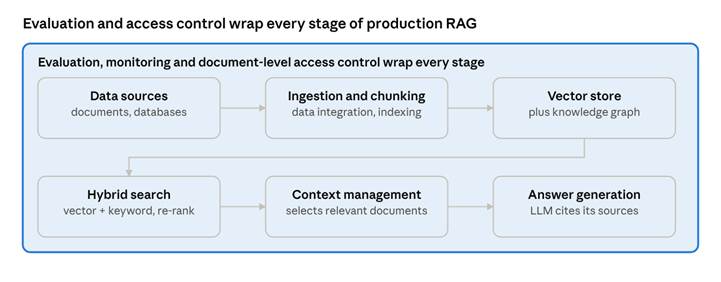
Knowledge retrieval quality sets the ceiling for answer quality. Hybrid search, the core of modern AI search, combines vector search for meaning with keyword search for exact terms such as part numbers and acronyms. A re-ranking step then orders the results before the model sees them. Hybrid retrieval with re-ranking delivers better performance on every enterprise knowledge base, because pure vector search misses the exact matches users expect to find.
A vector store (also called a vector DB) holds the embeddings. Add a knowledge graph when answers depend on relationships between entities, such as a drug and its interactions or a contract and its amendments. Managed services such as Amazon Bedrock Knowledge Bases handle ingestion and retrieval for teams that want less infrastructure to run.
Context management then decides which retrieved documents fit the model's context window and in what order. The step controls cost per query and keeps answers focused. Fine-tuning shapes a model's tone and format, while retrieval keeps its knowledge current as documents change. A shared retrieval layer also lets teams run different models side by side, so no project depends on a single LLM.
Agentic RAG and agent analytics
Agentic RAG lets autonomous agents plan their own retrieval steps. They call tools, re-query when results fall short, and verify each answer, which helps the system handle complex queries. Top RAG solutions with agent analytics make that behavior visible.
They report retrieval hit rate, answer quality, and cost per query, and they keep trace-level logs for every agent step. Without those traces, agent workflows cannot be debugged or audited. The agentic RAG guide covers the workflow patterns.
Which compliance and security requirements apply to RAG systems?
A RAG system inherits the compliance obligations of the data it retrieves. This usually means GDPR, HIPAA, SOC 2, and PCI DSS, plus ISO/IEC 42001 and the EU AI Act for governance of the AI itself.
Security risk is rising with adoption. IBM's 2026 Cost of a Data Breach Report puts the global average breach cost at USD 4.99 million, a record high and a 12% increase. The same report records a 56% surge in AI-driven attacks. Deloitte adds that only 21% of companies planning agent deployments have a mature governance model.
Build these controls into the architecture from the first sprint:
- Document-level access control, so retrieval respects each user's permissions
- PII redaction before indexing
- Audit logs for every retrieval and every answer
- Data residency settings that match where regulated data must stay
- Prompt-injection defenses on retrieved content
- Human review for high-risk answers
Healthcare and financial services carry the strictest requirements. Ask every provider for evidence of these controls, such as a SOC 2 report or a security architecture diagram, before the pilot starts.
Related read: Why Enterprise RAG Is the Future of AI
What does RAG development cost, and how long does it take?
RAG cost depends on data volume, number of sources, security requirements, and evaluation depth. A scoped pilot fixes those variables before you commit to a full build.
Price follows scope, so ask for a fixed-scope pilot with a defined success metric. A complete pilot covers a data audit, one use case, a working evaluation set, and a production readiness review. Quotes that skip evaluation look cheaper and cost more later, because every fix after launch lands on your team.
RAG as a service vs custom build
| Option | Control | Speed to launch | Best for |
| RAG as a service providers | Lower, since the provider owns the pipeline | Fastest | Standard documents and one or two sources |
| Managed cloud services, for example Amazon Bedrock Knowledge Bases | Medium, since you configure and the cloud runs it | Fast | Teams already building on AWS |
| Custom build | Full control over retrieval, data, and models | Slowest | Regulated data, many sources, strict security or latency needs |
Expect to customize. Deloitte found that 85% of companies expect to customize agents for their own business needs. It makes a case for custom retrieval layers once a use case goes beyond simple document search. Pick a vendor that can deliver both paths through broader generative AI development services.
Signity's approach to RAG development and architecture
Signity delivers RAG projects in six phases, from knowledge and data assessment to continuous optimization.
| Phase | What happens here? |
| Knowledge and data assessment | Review of data sources, document repositories, and knowledge bases for readiness |
| Use case prioritization | Workflow analysis to select the first initiatives |
| Solution architecture and blueprint | Design of the end-to-end retrieval syste |
| Development and integration | Production-ready RAG services that combine AI models, custom pipelines, and structured data integration |
| Deployment and scaling | Enterprise-wide access |
| Continuous optimization | Performance monitoring, model refinement, and knowledge source updates |
On the architecture side, Signity builds semantic search pipelines over structured and unstructured data. Its published stack lists Pinecone as the vector database. For data pipelines, it names LangChain and LlamaIndex, along with Unstructured IO and Airbyte. It supports GPT-4o and Claude as well as Llama-3, Gemini, and Mistral. Security covers role-based permissions, encryption, and audit logging.
Conclusion
The best RAG development services companies show their value after launch. Look for hybrid retrieval and a working evaluation harness. Expect document-level access control and a delivery model that keeps answers accurate as your data changes.
Match the vendor to your compliance and scale needs, then validate the choice with a scoped pilot. If you are comparing partners now, start with your data and one measurable use case.

Mangesh Gothankar


Ashwani Sharma
Achin Verma
Frequently Asked Questions
Have a question in mind? We are here to answer. If you don’t see your question here, drop us a line at our contact page.
What are the best RAG development services companies?

What is the difference between RAG and fine-tuning?
What are RAG as a service providers?
How does agentic RAG differ from standard RAG?
Does RAG meet GDPR and HIPAA requirements?