











Rising delinquency is putting additional pressure on already stretched collections teams.
The New York Fed reports that 4.7% of the $18.77 trillion in US household debt was delinquent in Q2 2026. Business receivables show similar strain. Atradius found that seven in ten North American companies face late payment, and overdue invoices average 23% of B2B receivables. Meanwhile, manual processes and static dialer queues cannot decide which overdue balances deserve attention first.
AI matters here because the core problem is one of decisions. AI-powered collections address this challenge by using predictive models to prioritize accounts and conversational AI to manage routine interactions. Automated workflows then execute approved actions within existing systems. However, results depend on more than the model. Recovery rises or falls with data quality and integration depth. It also depends on compliance controls that survive an audit.
This guide covers where AI-powered debt collection works and how to implement it compliantly.
 Generate
Key Takeaways

- AI debt collection ranks accounts by repayment likelihood and personalizes outreach using permitted data.
- Predictive models and conversational AI automate routine collections and escalate sensitive cases to humans.
- Effective implementations integrate legacy systems and payment platforms while enforcing compliance rules and auditability.
- Recovery gains depend on reliable data and clear baselines. Continuous model evaluation protects them.
What Is AI Debt Collection, and How Does It Work?
AI debt collection uses artificial intelligence and machine learning to prioritize delinquent accounts and personalize collection activity. It also supports repayment decisions and automates permitted recovery workflows through conversational systems.
Automated debt collection software has long handled letters and dialer queues. AI in finance changes the decision behind those actions. The system learns from payment history and customer responses. It then adjusts who it contacts and when. It also chooses the channel.
Consider two accounts that are both 30 days past due. One belongs to a cardholder who missed a payment after a payroll delay and has paid on time for two years. The other has two broken promises to pay and an open dispute. A rules engine queues both accounts the same way, whereas a predictive model separates them. The first customer then receives a text with a payment link, and the second goes to a specialist.
| Capability | Traditional automation | AI-powered collections |
| Account prioritization | Fixed rules and queues | Predictive risk and repayment signals |
| Customer outreach | Predefined reminders | Context-aware communication |
| Customer interactions | Scripted responses | Conversational understanding within defined limits |
| Repayment support | Standard payment options | Tailored options under approved policies |
| Performance improvement | Manual workflow adjustments | Monitoring and model-informed optimization |
Rule-based automation still suits deterministic work. AI adds value where a task needs pattern recognition or more context.
Three AI capabilities and what each one controls
Predictive models estimate repayment likelihood and delinquency risk. Conversational AI then handles customer conversations over voice and digital channels within approved scripts. Agentic AI goes a step further because AI agents plan and run multi-step tasks.
These tasks often involve multiple systems, including collections platforms, customer databases, and payment gateways. Since agents act on live accounts, they need explicit tool permissions and action limits. They also need a path to human escalation. Vendors package these capabilities as AI tools for a single task or as AI platforms that bundle them with compliance controls.
Market data supports the shift. Fortune Business Insights values the debt collection software market at $6.56 billion in 2026. Mordor Intelligence links part of the growth to self-learning models that replace static segmentation. It also cites stricter Regulation F contact-frequency rules.
Related Read: Finance AI: Transforming Financial Operations & Decision-Making
What Are the Most Valuable AI Debt Collection Use Cases?
The most valuable AI debt collection use cases are predictive account prioritization and personalized outreach. Conversational payment support and repayment arrangement help come next. Automated compliance monitoring completes the set. In practice, they follow the collections lifecycle from the first missed payment to resolution.
Early delinquency detection and account prioritization
Machine learning models score accounts using payment history and account history. They also use previous promises to pay and other permitted signals. As a result, teams can act on newly delinquent debts while a reminder still works. That makes decision-making faster and more consistent. In subscription services, a failed card renewal creates a small overdue balance, and an early text with a payment link suits it better than a call. Three outputs matter most:
- Early-warning flags for newly delinquent debts
- Repayment propensity segments that guide channel and timing
- Priority ranking by recovery potential within approved policy
Predictions remain estimates. Teams should validate accuracy and fairness before scores steer outreach.
Personalized outreach and conversational AI
Once accounts are ranked, conversational AI carries the routine contact. It runs multi-channel outreach and sends payment reminders over SMS and email. AI callers handle outbound calls and inbound voice contact. Both answer questions and write call summaries that save debt collection agents after-call work. They also schedule follow-ups.
Sentiment analysis adds another layer. It flags frustration or distress during a conversation so the system can soften its tone or escalate. AI callers must clear several gates first. These include right party contact and identity verification. They also include channel permissions and required disclosures. The FCC has ruled that AI-generated voices fall under the TCPA. Consent logic therefore belongs in the design from day one.
Customers also expect an exit. The 3,566-customer Gartner survey behind that 87% figure argues for a visible handoff rather than a dead-end bot.
Payment plans, self-service, and dispute resolution
Besides reminders, AI helps customers explore approved payment plans and use payment portals. It also lets them submit disputes at any hour. A Yale working paper on delinquent consumer loans found that AI callers recovered less than human callers. It also found that moving accounts to humans early narrowed the gap. Consequently, financial hardship cases and disputed balances should go to qualified collectors. AI will not replace human agents in hardship work. It can prepare the account history first so the handoff starts with full context.
Collections workflow orchestration
Agentic AI coordinates these activities across collections platforms, customer communication channels, and payment systems. Suppose an account turns overdue. The agent checks account status and contact eligibility. It then sends an approved reminder and records the response and any promise to pay. After that, it schedules a permitted follow-up. A dispute or hardship signal moves the case to a human at once. The log shows why.
What Are the Business Benefits of AI-Powered Debt Collection?
AI-powered debt collection improves operational efficiency by prioritizing accounts and reducing repetitive work. It also personalizes communication so teams can focus on recoveries that need human judgment.
| Business benefit | How AI contributes | KPI to track |
| Higher recovery rates | Prioritizes accounts and improves outreach timing | Recovery and liquidation rates by cohort |
| Lower cost to collect | Automates repetitive interactions and follow-ups | Cost per recovered account |
| Faster cash flow | Supports earlier intervention and convenient repayment | Days delinquent or days sales outstanding |
| Better customer experience | Enables relevant communication and self-service | Resolution rate; complaints; customer satisfaction |
| Greater agent productivity | Generates call summaries and prepares account context | Cases per agent; after-call time |
| Stronger operational control | Applies policy checks and records actions | Compliance exceptions; audit completeness |
Finance teams watch recovery rate and cost per recovered account because both connect directly to cash flow. Even so, a recovery gain that raises complaints will erode its own value. Automation also removes the human error that creeps into manual processes, such as a missed callback or a wrong contact time. Strong operational control becomes a competitive advantage as well. Lenders that log every decision can adopt new channels faster than peers.
How to measure whether AI is delivering ROI?
Start with a baseline for each delinquency cohort. Then run the AI workflow against a comparable control group. Liquidation rates show how much of each placed portfolio you actually recover. Count total cost in full. Integration and licensing belong in it. So do model inference and human review. Then compare cost per recovered account before and after.
McKinsey's 2026 analysis of agentic AI economics found that roughly 60% of an agent task's cost goes to checking and repairing answers. It also found that identical tasks varied in cost by as much as 30 times. This favors a design where deterministic code handles rule-based steps. The model then runs only where judgment adds value.
What Technical Architecture and Compliance Controls Does AI Debt Collection Require?
Enterprise AI debt collection requires secure account data and controlled integrations. It also needs policy enforcement and human escalation. Every consequential action must leave an auditable record.
Reference architecture for enterprise AI collections
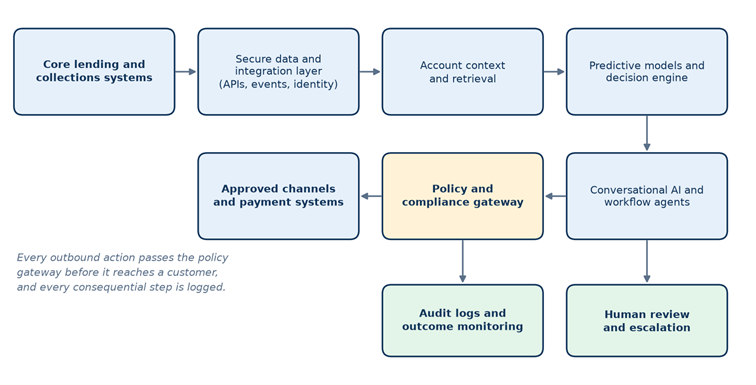
Figure 1. Reference architecture for enterprise AI debt collection
| Layer | Role | Typical components |
| Data and integration | Connects account and payment data securely | APIs and event streams; identity controls; legacy system connectors |
| AI services | Scores accounts and interprets intent | Machine learning and language models; approved-context retrieval; workflow engine |
| Action controls | Defines what the AI may do | Policy checks and authorization; channel and payment permissions; escalation rules |
| Observability | Records and evaluates consequential actions | Versioned decisions and audit trails; outcome tracking; incident handling |
Place the policy and compliance gateway between the AI services and every outbound channel. IBM's 2026 Cost of a Data Breach report puts the US average breach at $11.5 million. Collections systems hold exactly the identity and balance data attackers want. Teams should encrypt data and restrict retrieval to approved fields.
Debt collection compliance and human oversight
US collectors operate under the FDCPA and Regulation F (Reg F). The rule presumes a violation when a collector places more than seven calls to a person about one debt within seven days. State-level rules and TCPA consent add further regulatory requirements. Many operators also set an internal daily limit per channel below the legal threshold. Compliance violations carry penalties and customer complaints. A model cannot be trusted to remember every rule, so the system must enforce them. Build these controls in:
-
Contact frequency limits and timing rules on every channel
-
Accurate account information and required disclosures
-
Dispute handling with human review for hardship and sensitive cases
-
Blocks on unauthorized payment commitments and fabricated account details
-
Retained decision records with model versions and policy checks
Enforce these rules in the policy layer. A language model can misread an instruction under pressure. A gateway that blocks a non-compliant call behaves the same way every time. It also helps when regulations change, because you update one rule set instead of retraining a model. Governance practice still lags deployment, though. An IBM-commissioned survey of 3,221 EMEA executives in September 2026 found that 35% already run agentic AI in production and only 37% believe governance can scale with it. Gartner's August 2026 guidance adds that early agent pilots fail mainly from unclear controls.
How Should Businesses Implement AI Debt Collection?
Implement AI debt collection by selecting a defined workflow and validating the underlying data. Then integrate the necessary systems and enforce compliance controls. Further, you must measure results before expanding deployment.
1. Assess readiness: Review data quality and delinquency workflows alongside existing tools and legal obligations.
2. Select the initial workflow: Choose a bounded use case such as payment reminders or account prioritization.
3. Build and integrate: Connect approved data sources and decision services to channels and payment systems with access controls.
4. Validate and expand: Test model accuracy and compliance behavior before scaling.
Expect friction at the integration step. Account data usually sits in legacy systems with inconsistent histories. Large enterprises often run several such systems at once, which makes integration the longest phase. Gartner's March 2026 survey of 204 finance leaders found that 63% said AI implementation ran slower than expected in 2025. A bounded first workflow protects your timeline.
Buying an AI platform usually makes sense for standard dialing and compliance tooling. Building makes sense for the decision layer and integrations because your own data creates the advantage there.
So, how much does AI debt collection software cost?
Pricing depends on deployment scope and transaction volume. Data remediation and compliance testing are the biggest hidden drivers. Therefore, compare total cost with your baseline cost per recovered account. Then choose a development partner who can show integration and governance experience.
How Signity Approaches AI-Powered Debt Collection Projects
Most collections AI programs stall for three reasons. Account data sits in legacy systems with inconsistent histories. Compliance rules live inside prompts instead of enforceable code. Pilots also launch without a baseline that proves the result. It starts with a readiness audit through AI consulting that maps the workflow and the data. The decision layer comes next.
Signity builds it with machine learning development and MLOps so models ship with versioning and monitoring. Besides, the conversational components follow through AI agent development and AI voice agent development. Fintech AI development work then connects them to existing systems.
On top of that, a policy layer shaped with AI governance consulting gates every action. Finally, the outcome is a bounded pilot with a baseline and a control group, ensuring the finance leaders get evidence to expand.
Conclusion
AI debt collection pays off when intelligence and workflow execution operate together with compliance. Predictive models prioritize accounts, and conversational AI handles routine interactions. Controlled AI agents then coordinate approved actions.
However, scaling requires reliable account data and secure integrations. It also requires defined permissions and human oversight. Begin by assessing your collections workflow and its highest-value automation opportunity. Then define the technical and compliance requirements before you choose a platform or development partner.

Mangesh Gothankar


Ashwani Sharma
Achin Verma
Frequently Asked Questions
Have a question in mind? We are here to answer. If you don’t see your question here, drop us a line at our contact page.
What is AI debt collection?

How does AI improve debt recovery?
Can AI replace human agents in debt collection?
Is AI debt collection compliant with Regulation F?
How much does AI debt collection software cost?
How long does it take to implement AI for debt recovery?