


.png?width=27&height=27&name=Group(1).png)

-1.svg)
-1.svg)


-2.svg)


%201-1.webp?width=148&height=74&name=our%20work%20(2)%201-1.webp)




.svg)





Today, RAG has become a standard architecture for AI-driven decision systems. However, traditional RAG architectures rely on a single retrieval step. As a result, they struggle to support complex reasoning tasks.
The problem is that enterprise decisions delayed due to a lack of reasoning can be catastrophic. Since traditional RAG architectures cannot handle complex reasoning workflows, valuable insights are missed.
Nevertheless, enterprise queries often require additional operations such as query decomposition, structured database access, cross-source validation, or sequential information gathering.
To address all such requirements and gaps with conventional RAG, organizations are adopting Agentic RAG architectures.
These systems combine retrieval pipelines with autonomous AI agents that plan tasks and select tools. They refine search strategies and validate results before generating the final response, which is why the demand for such architectures is accelerating.
The global generative AI market is projected to exceed $699 billion by 2030, as enterprise knowledge systems increasingly rely on AI-driven automation.
Agentic RAG enables AI systems to function more like problem-solving agents rather than static text generators. Therefore, the technology is becoming foundational architecture for next-generation automation platforms.
In the following sections, we will explore the architecture, workflows, enterprise applications, and implementation strategies required to build production-ready Agentic RAG systems.
 Generate
Key Takeaways
Generate
Key Takeaways

- Agentic RAG combines autonomous AI agents with retrieval pipelines.
- Agents plan tasks, select tools, and perform iterative information retrieval.
- Validation loops improve factual grounding and reduce hallucinations.
- The architecture supports complex multi-step reasoning workflows.
- Enterprises use Agentic RAG for research assistants, developer copilots, and automation systems.
What Is Agentic RAG, and How Is It Different from Traditional RAG?
Retrieval-Augmented Generation (RAG) improves the reliability of large language models by allowing them to access external knowledge sources for response generation. Instead of relying solely on training data, RAG systems include relevant documents as contextual input for the model.
While this approach improves factual accuracy, traditional RAG pipelines primarily focus on document retrieval rather than reasoning. Agentic RAG extends the architecture by introducing AI agents capable of planning tasks and dynamically coordinating retrieval operations.
Traditional RAG Architecture
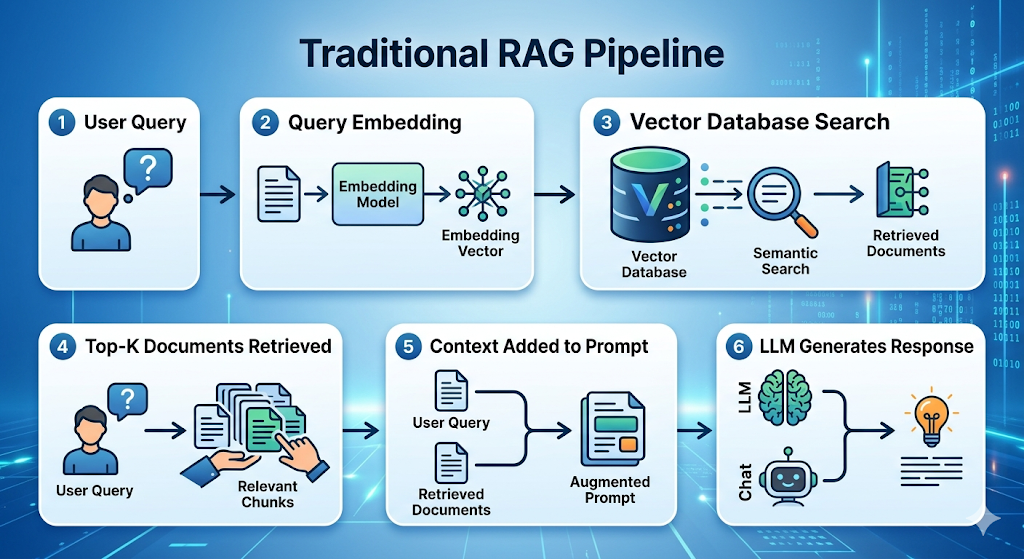
Traditional RAG systems follow a straightforward retrieval pipeline.
The system first converts the user query into a vector embedding. It is a numerical representation of semantic meaning. Modern embedding models map text to high-dimensional vector spaces where semantically similar phrases co-occur.
A vector database then performs semantic similarity search using algorithms such as cosine similarity or dot-product scoring. The most relevant documents are retrieved and injected into the model prompt as contextual information.
This approach provides stronger factual grounding than standalone language models.
Limitations of Traditional RA
| Limitation | Impact |
| Single retrieval step | Relevant context may be missed |
| No reasoning layer | Complex queries cannot be decomposed |
| No validation loop | Hallucination risk remains |
| Limited tool access | Cannot query APIs or structured databases |
For example, a query comparing industry trends may require multiple retrieval operations and data sources. Traditional pipelines cannot dynamically refine searches or perform additional analysis.
Agentic RAG Architecture
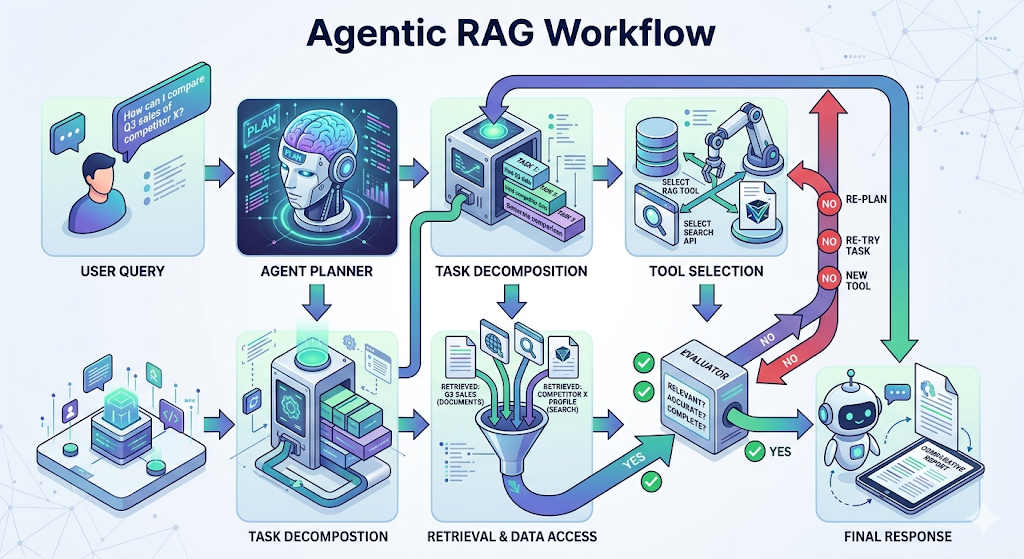
Agentic RAG introduces autonomous reasoning agents into the retrieval pipeline. These agents analyze the query, break it into tasks, choose tools, and retrieve information iteratively until sufficient evidence is gathered.
Traditional RAG vs Agentic RAG
| Capability | Traditional RAG | Agentic RAG |
| Retrieval | Single step | Iterative |
| Reasoning | Limited | Multi-step |
| Tool integration | Minimal | Dynamic |
| Validation | None | Self-evaluation |
| Automation | Low | High |
So, why do traditional RAGs fail?
Traditional RAG systems rely on a single retrieval step. They cannot break down complex queries. The architecture lacks reasoning and validation loops.
As a result, important context may be missed, and responses may remain incomplete or less reliable.
Core Architecture of an Agentic RAG System
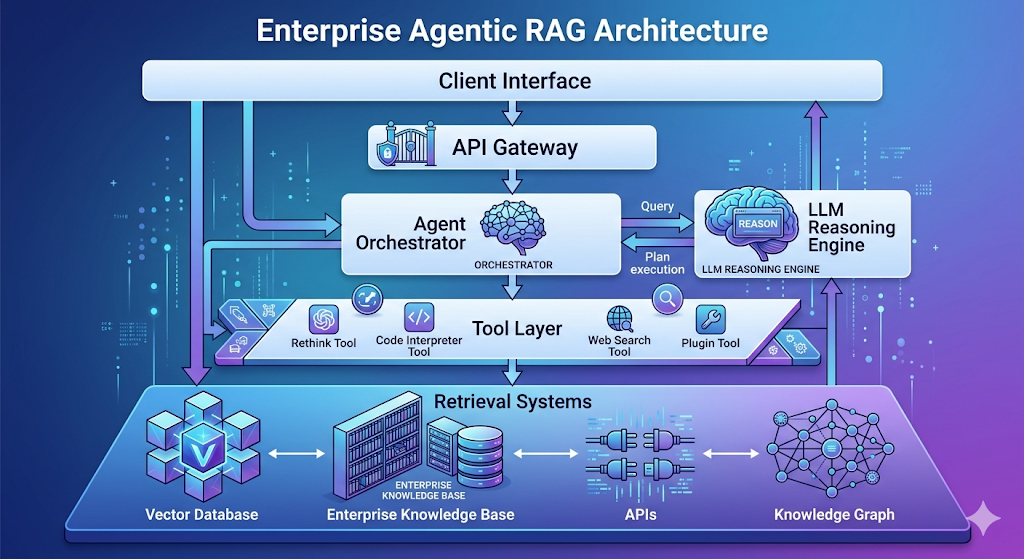
Agentic RAG platforms operate as multi-layered AI infrastructures that coordinate reasoning, retrieval, and tool execution.
Key System Components
| Component | Function |
| Agent planner | Breaks queries into structured tasks |
| Retrieval engine | Accesses knowledge sources |
| Tool layer | Executes APIs or database operations |
| Memory layer | Maintains context across interactions |
| LLM reasoning engine | Generates outputs and reasoning steps |
The Tech Stack Behind
In production environments, orchestration frameworks such as LangGraph or CrewAI coordinate agent workflows and reasoning loops. It enables task decomposition, active tool selection, and iterative reasoning loops.
Similarly, the retrieval layer often relies on vector databases such as Pinecone or Qdrant to perform high-performance semantic search across enterprise knowledge repositories.
These technologies enable Agentic RAG systems to quickly retrieve relevant documents while maintaining scalability across millions of records.
Tool Execution Example
tools = [
|
Memory Architecture
| Memory Type | Purpose |
| Short-term memory | Conversation context |
| Long-term memory | Persistent knowledge storage |
Operational Workflow of Agentic RAG for Complex Queries
Agentic systems process complex queries through structured reasoning workflows.
Agent Reasoning Workflow
.png?width=1672&height=434&name=9e6bfdc9-589b-4a0e-bd78-dfad2a5f1572%20(1).png)
Example for a Multi-Step Query
Example: “Compare AI adoption in retail and banking industries.”
Agent steps:
- Identify industries referenced
- Retrieve retail adoption data
- Retrieve banking industry metrics
- Extract relevant statistics
- Generate comparative insights
Iterative Retrieval Refinement
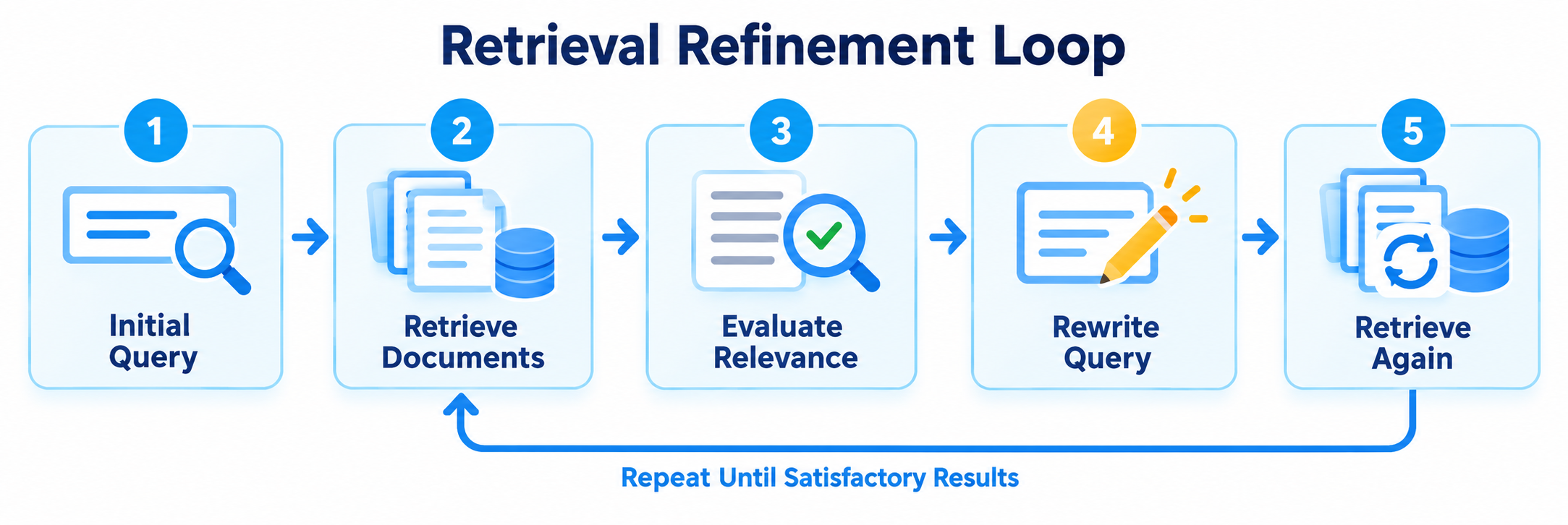
The loop allows the system to improve retrieval quality before producing the final response.
How Agentic RAG Reduces AI Hallucinations?
Hallucinations occur when language models generate information that is not grounded in reliable sources. Agentic RAG systems reduce this risk by introducing mechanisms for validating evidence.
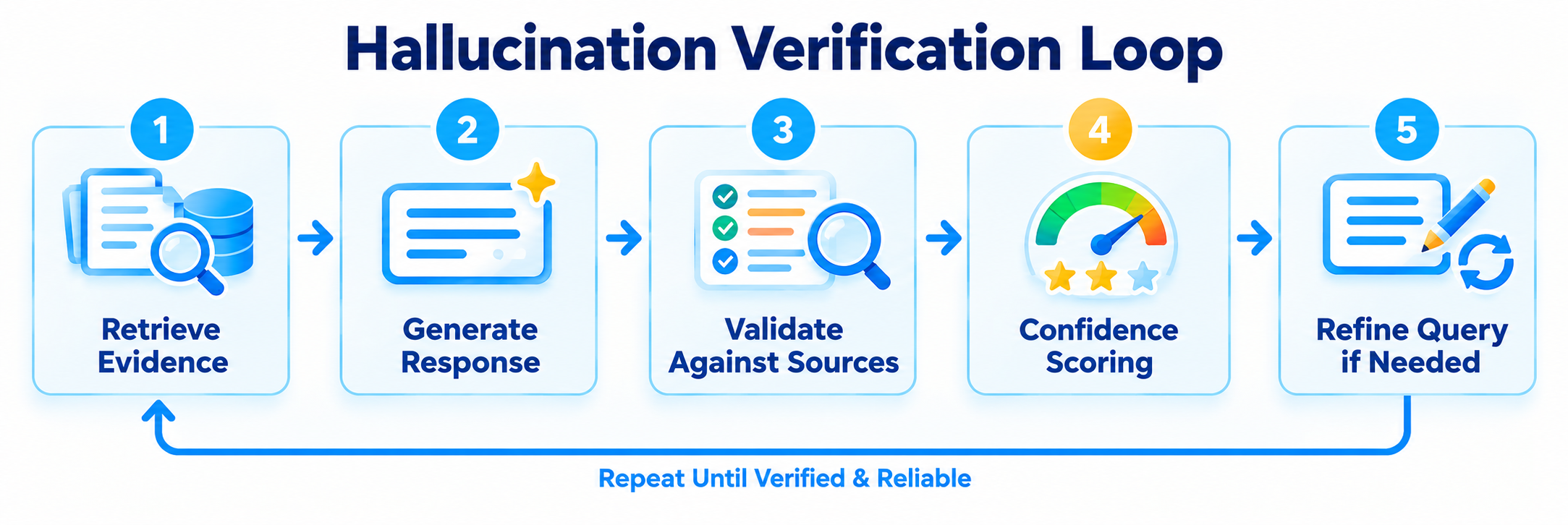
Hallucination Mitigation Techniques
1. Evidence Grounding
Agentic RAG systems generate responses only after retrieving supporting documents from trusted knowledge sources. The response is grounded in these retrieved documents rather than relying only on the model’s training data. Many implementations also include source references in the final output. This approach improves transparency and allows users to verify the origin of the information.
2. Multi-Source Validation
Agents retrieve information from multiple sources before producing a final response. The system compares facts across documents, databases, or APIs to ensure consistency. If conflicting information appears, the agent can perform additional retrieval steps. This cross-verification process helps reduce incorrect or fabricated outputs.
3. Self-Reflection
Agentic systems include evaluation steps where the model reviews its generated output. During this stage, the agent checks whether the response aligns with the original query intent. If inconsistencies are detected, the system can revise the response or retrieve additional evidence.
4. Query Refinement
If the retrieved results are not sufficiently relevant, the agent rewrites or expands the original query. The refined query improves semantic search accuracy and retrieves more relevant documents. The iterative retrieval process ensures that the context used for response generation remains accurate and comprehensive.
Example Evaluation Logic
|
|
Enterprise Applications and Agentic AI Use Cases
Agentic RAG enables advanced enterprise intelligent automation systems capable of performing knowledge discovery, analytics, and decision support.
Real-World Enterprise Examples For Agentic RAG
- Morgan Stanley’s Internal Research Assistant: Morgan Stanley built an AI assistant that helps financial advisors search internal research reports and investment documents. The system retrieves relevant knowledge from proprietary databases and generates contextual answers. It allows advisors to quickly access insights during client consultations.
- Google DeepMind’s Research Summarization Tools: Google DeepMind develops AI systems that analyze large volumes of technical research papers. Agentic retrieval methods help gather relevant studies, extract findings, and generate structured summaries. The process simplifies researchers' abilities to understand complex developments.
- GitHub Copilot Enterprise’s Repository-Aware Development Assistant: It retrieves context from internal code repositories and documentation. GitHub Copilot allows developers to understand codebases, generate code suggestions, and resolve issues while working within large enterprise development environments.
- Bloomberg L.P. Financial Data Intelligence Systems: Bloomberg uses AI systems that retrieve insights from financial news, reports, and market data. These tools help analysts and traders quickly analyze trends to generate data-driven insights.
Related Read: Agentic AI Use Cases For Business Success
Industries Benefiting Most With Agentic RAG
| Industry | Use Case | Explanation |
| Healthcare | Clinical research | Agentic RAG systems help researchers retrieve medical studies, clinical trial data, and treatment guidelines. This accelerates literature reviews and supports evidence-based medical insights. |
| Finance | Risk analysis | Financial institutions use Agentic RAG to analyze reports, regulatory filings, and market data. The system retrieves relevant information and generates insights for risk assessment and investment decisions. |
| Retail | Market intelligence | Retail organizations analyze customer behavior, product reviews, and sales data. Agentic systems retrieve insights that help businesses understand demand patterns and market trends. |
| Legal | Case research | Legal teams retrieve case laws, regulatory documents, and legal precedents. Agentic RAG helps summarize relevant cases and reduces the time required for legal research. |
| Technology | Developer productivity | Engineering teams use Agentic RAG to retrieve code documentation, repository knowledge, and technical references. This helps developers understand systems more quickly and resolve issues more efficiently. |
Implementation Guide: Building an Agentic RAG System
Production implementations require integrating large language models, orchestration frameworks, vector databases, and monitoring pipelines.
Technology Stack
| Layer | Tools |
| LLM models | GPT, Claude, Llama |
| Agent frameworks | LangGraph, CrewAI |
| Vector databases | Pinecone, Qdrant |
| Observability | LangSmith, Arize |
| Data pipelines | Kafka, Airflow |
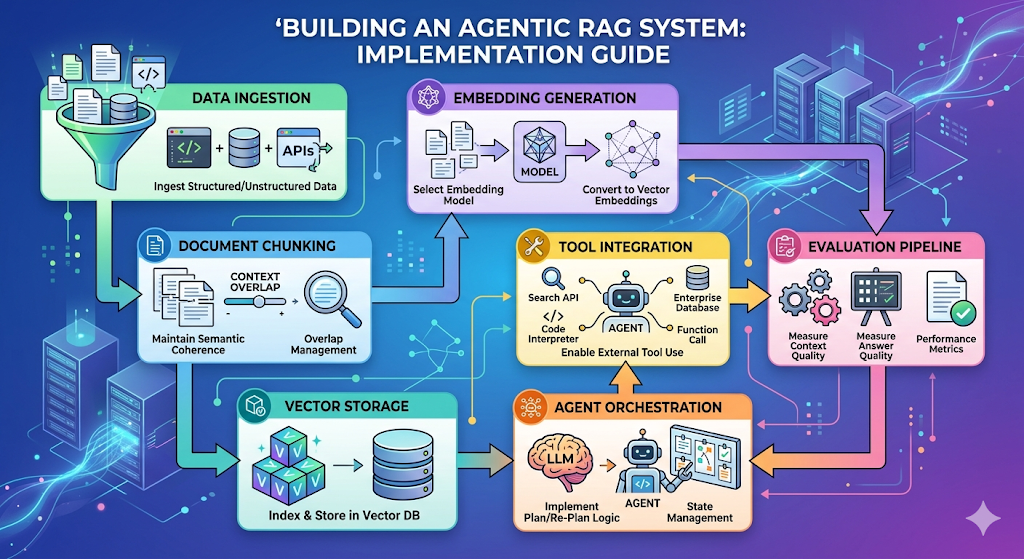
Example Agent Workflow Code
query = user_input()
|
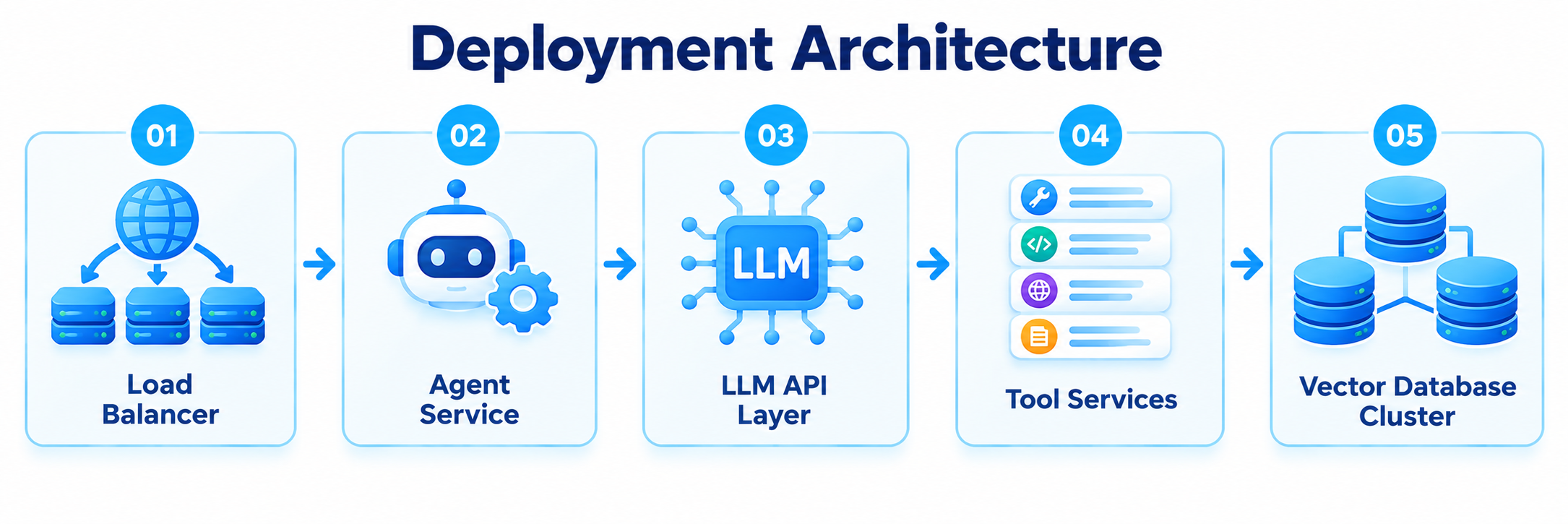
How Signity Enabled an Intelligent Financial Knowledge Assistant?
Signity Solutions helped a financial services organization implement a RAG-powered financial intelligence assistant to streamline access to enterprise knowledge. The system unified multiple internal data sources and enabled employees to retrieve insights through natural-language queries.
By integrating retrieval pipelines with structured reasoning workflows, the solution reduced query resolution time by 40% and improved operational efficiency by 35%. The architecture also introduced automated evidence retrieval and contextual response generation.
Explore Case Study: RAG-Powered Financial Intelligence Assistant
Operational Cost Comparison: Human-in-the-Loop vs Agentic RAG
Enterprises traditionally rely on human validation layers to ensure the reliability of AI outputs. However, agentic architectures automate many of these review processes through iterative reasoning and validation loops.
| Factor | Human-in-the-Loop AI Systems | Agentic RAG Systems |
| Validation process | Manual expert review | Automated evidence validation |
| Response speed | Minutes to hours | Seconds |
| Operational cost | High (human labor required) | Lower after deployment |
| Scalability | Limited by workforce availability | Scales with infrastructure |
| Error detection | Human dependent | Automated evaluation loops |
| Knowledge retrieval | Manual research | Automated multi-source retrieval |
| Long-term ROI | Higher operational cost | Higher automation efficiency |
Agentic RAG does not eliminate human oversight, but it reduces the need for manual validation in repetitive knowledge workflows. Ultimately, it significantly lowers operational costs for large-scale enterprise deployments.
Challenges and the Future of Agentic RAG
Despite its advantages, deploying Agentic RAG systems in production introduces several engineering challenges. Organizations must therefore design carefully for reliability and operational monitoring.
Key Challenges
1. Latency: Agentic RAG systems run several reasoning steps before producing an answer. Each step may involve retrieval, tool execution, or additional model inference. These stages increase response time compared with traditional RAG pipelines. Techniques such as caching, parallel retrieval, and response streaming help reduce latency in production environments.
2. Cost: Agentic workflows often require multiple LLM calls per user query. The agent may plan tasks, refine queries, retrieve evidence, and validate results. Each step adds additional compute usage. At enterprise scale, this can increase infrastructure and API costs. Efficient prompt design, model routing, and caching mechanisms are therefore essential.
3. Observability: Debugging an agentic system is more difficult than debugging static pipelines. Agents dynamically decide which tools to use and how to refine queries. This makes it harder to trace where failures occur. Observability platforms help track reasoning steps, tool calls, and decision paths. These tools allow engineers to diagnose errors and improve system performance.
4. Tool Reliability: Agentic RAG systems depend on external tools such as APIs, databases, and search services. If any tool fails, the reasoning chain may break. Network latency, rate limits, or data inconsistencies can also affect results. Production systems must include fallback mechanisms and retry strategies. These safeguards help maintain stability and reliability.
Future Innovations
Despite these challenges, Agentic RAG is evolving rapidly and is expected to power the next generation of enterprise AI solutions. Several innovations are already emerging in research and production environments.
- Autonomous research agents capable of conducting complex investigations across multiple knowledge sources.
- Knowledge graph integration to enable structured reasoning across interconnected enterprise datasets.
- Multimodal retrieval systems that retrieve and analyze text, images, audio, and structured data simultaneously.
- Adaptive retrieval strategies that dynamically adjust retrieval paths based on query complexity and available knowledge sources.
Future Agentic RAG systems will increasingly combine multimodal retrieval, reasoning agents, and intelligent automation frameworks. They are enabling organizations to deploy fully autonomous enterprise AI assistants capable of decision support and advanced knowledge discovery.
Conclusion
Agentic RAG represents a major shift in how enterprise AI systems are designed and deployed.
By combining autonomous agents with retrieval pipelines, organizations can build AI systems that gather evidence from multiple sources and validate outputs before generating responses. As enterprises continue investing in AI assistants and intelligent automation platforms, Agentic RAG is emerging as the core architectural pattern for production AI systems.
At Signity Solutions, we specialize in designing scalable Agentic AI solutions, including advanced retrieval architectures, agent orchestration frameworks, and enterprise knowledge integration pipelines.
If you are planning to work on an enterprise-grade Agentic RAG setup, we can help you yield sustainable success.

Mangesh Gothankar


Ashwani Sharma
Achin Verma
Frequently Asked Questions
Have a question in mind? We are here to answer. If you don’t see your question here, drop us a line at our contact page.
What is autonomous decision-making in Agentic RAG?

What are the advantages of Agentic RAG over standard RAG?
Can Agentic RAG handle multimodal data, such as images and audio?
What industries benefit most from Agentic RAG?





.png?width=352&name=agentic-ai-strategy-for-enterprise-software%20(4).png)
.png?width=352&name=Enterprise%20Agentic%20AI%20Architecture%20A%20Guide%20for%20Autonomous%20AI%20at%20Scale%20(1).png)