


.png?width=27&height=27&name=Group(1).png)

-1.svg)
-1.svg)


-2.svg)


%201-1.webp?width=148&height=74&name=our%20work%20(2)%201-1.webp)




.svg)






Introduction
What began as automating the answering of simple customer questions is now becoming a core part of the real estate business functions.
Currently, buyers expect quick responses from the realtors with relevant property recommendations, ensuring seamless digital experiences. On the other hand, sellers expect sharper pricing guidance and stronger visibility. Besides, investors and operators expect better forecasting and more efficient workflows.
That is why AI for real estate is gaining traction so quickly. According to the National Association of REALTORS, 92% of surveyed agents are already using AI or planning to use it, while 71% say time savings is the biggest benefit.
At the same time, Deloitte’s 2026 commercial real estate outlook shows adoption is broadening across investment, operations, and decision support. The benefits of AI in real estate are no longer theoretical.
In this blog, we will explore the benefits AI brings to real estate, focusing on how everything AI does is operational and increasingly competitive.
 Generate
Key Takeaways
Generate
Key Takeaways

- AI helps real estate teams qualify leads and close efficiently.
- AI-generated recommendations improve buyer experiences and engagement on listings.
- Predictive analytics for real estate enhances investment decisions by providing greater risk visibility.
- Strong governance ensures AI outputs comply with industry standards.
What Are the Benefits of AI in Real Estate?
AI in real estate improves speed without forcing businesses to compromise on relevance. More importantly, AI improves efficiency without removing the need for human judgment. In practice, AI creates value in real estate by complementing pricing decisions and improving lead qualification.
AI can be used to identify which prospects are most likely to convert. It can surface the right listings based on behavior and preferences to summarize contracts and lease documents. Moreover, it can help teams forecast where demand or pricing may shift next.
For brokerages and agents, that means more productive selling time. For property managers and investors, it means better operational visibility and smarter planning.
This shift matters because real estate remains both relationship-driven and data-heavy. AI performs best when it supports those relationships with more relevant insights and consistent execution.
NAR’s 2026 reporting also shows why this matters now: while agents are rapidly adopting AI, they still care deeply about output quality, accuracy, and compliance. In other words, the market is ready for AI, but only in ways that feel commercially reliable.
The table below highlights the 10 most important benefits real estate firms should prioritize first with the AI implementation:
| Benefit | What it improves | Example use case | Business outcome |
| Faster property valuation | Pricing speed | AVM-based listing support | Quicker go-to-market |
| Better pricing accuracy | Competitive pricing | Market trend analysis | Stronger seller confidence |
| 24/7 lead qualification | Response time | AI chat assistant | More booked appointments |
| Personalized recommendations | Buyer discovery | Preference-based matching | Higher engagement |
| Faster listing creation | Marketing output | Description and ad generation | Shorter launch cycles |
| Better sales follow-up | Pipeline consistency | CRM-triggered outreach | Improved conversion rates |
| Document automation | Admin efficiency | Lease and contract extraction | Fewer manual errors |
| Predictive analytics | Investment decisions | Rental yield forecasting | Smarter acquisitions |
| Smarter property management | Operations | Maintenance prediction | Lower service costs |
| Better compliance and risk control | Governance | Document checks and anomaly flags | Reduced operational risk |
AI Applications in Real Estate Across the Property Lifecycle
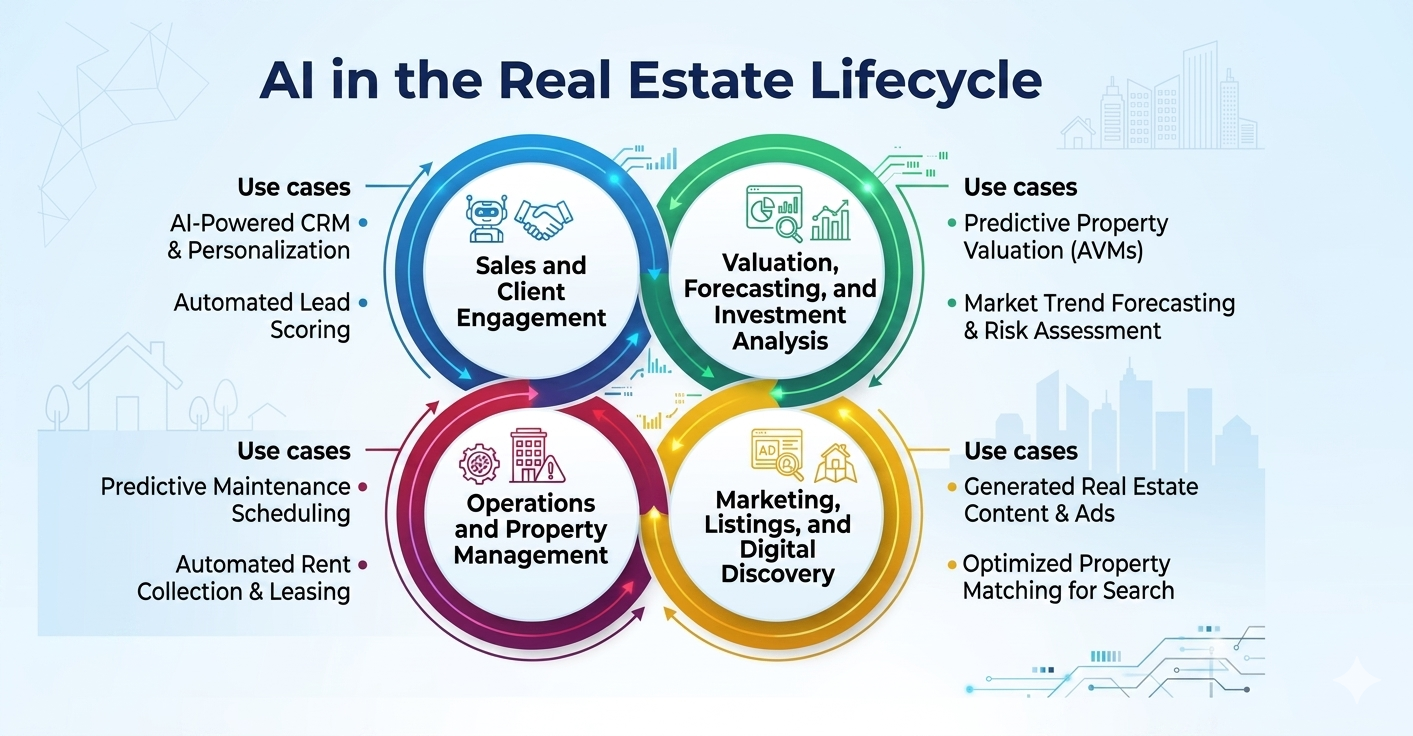
AI applications in real estate are broad, but the strongest content strategy is not to list dozens of disconnected tools. It is to show how AI creates value at each point in the property lifecycle, from first inquiry to post-sale operations. That makes the article easier to read, more useful for search intent, and more aligned with how decision-makers actually evaluate technology investments.
Sales and Client Engagement
One of the clearest uses of AI in real estate is lead engagement. Real estate businesses lose opportunities when inquiries go unanswered or follow-ups are delayed. It mostly occurs when sales teams spend too much time on low-intent prospects. AI works on these problems by boosting speed and prioritization at the top of the funnel.
Instead of treating every inquiry the same, AI can score them. It can track behavior, source, urgency, budget fit, and prior engagement, allowing agents to focus their attention where it is most likely to lead to a conversation.
AI assistants can also handle first-response workflows by answering questions about listings, collecting preference details, and suggesting next steps. This is especially useful outside working hours, when online discovery is high but agent availability is limited.
Ultimately, the experience feels more responsive for the customer. Simultaneously, for the client, the pipeline becomes more disciplined with AI.
Valuation, Forecasting, and Investment Analysis
Another major benefit of AI in real estate is better decision support. Since valuation always depends on data, AI can process variables faster.
It can analyze historical sales and neighborhood movement to define property characteristics. Further, AI can work on demand patterns based on broader market signals to support quicker pricing recommendations.
For investors and portfolio teams, AI can go further. It can help estimate yield potential, detect risk signals earlier, and identify which asset classes or micro-markets deserve closer attention. This does not remove the need for professional judgment. It strengthens the quality and speed of the analysis that professionals work from.
Deloitte’s 2026 commercial real estate outlook reflects this broader industry movement, with firms increasingly using AI to support smarter, more operationally embedded decisions rather than one-off experiments.
Marketing, Listings, and Digital Discovery
Marketing is another area where AI for real estate can produce immediate gains. Listing content, ad copy, landing page text, and follow-up emails can all be generated faster and tailored more precisely to audience intent. This helps teams reduce turnaround time without sacrificing consistency.
AI also improves discovery. Instead of depending only on filters, buyers can increasingly search with conversational intent, describing what they want in natural language. Recommendation engines can then interpret that intent and surface more relevant results.
This matters because digital discovery continues to shape transaction outcomes. NAR’s 2025 generational trends report shows that 52% of buyers found the home they purchased online, reinforcing how central search and listing experience have become.
Visual presentation is evolving too. AI-assisted image tagging, virtual staging, and 3D experience enhancement can all improve how listings perform without changing the property itself.
Operations and Property Management
Most use cases for AI in real estate focus only on sales, but using AI in real estate becomes far more valuable when it extends into operations. Property managers can use AI to classify service requests and detect recurring maintenance patterns in order to reduce response friction for tenants. Also, AI can do the lease review, contract analysis, and document extraction through natural language processing and OCR-based systems.
This is where AI starts to influence margin, not just lead flow. It reduces admin load, improves process visibility, and helps teams respond faster across portfolios. The firms likely to benefit most are those that connect sales, marketing, data, and operational workflows rather than treating each AI initiative as a separate purchase.
Related Read: 10 Practical Ways to Use AI in Real Estate
How Can AI Help in Real Estate Sales?
AI helps in real estate sales by removing friction at every stage of the buying and selling journey. The strongest impact is not that AI “sells” on behalf of agents. It is that AI sharpens timing, relevance, and consistency before the agent steps into the conversation.
Better Lead Qualification
Sales teams often spend valuable time sorting inquiries that are incomplete, low-intent, or poorly matched. AI improves this by identifying stronger signals earlier. It can interpret browsing patterns, budget inputs, repeat visits, location preferences, and engagement history to rank leads more intelligently. Such an approach can save time and improve the quality of follow-up, enabling teams to respond with more context.
Faster and More Consistent Follow-Up
In real estate sales, response speed matters. AI makes it easier to acknowledge inquiries instantly, draft personalized replies, and keep the next step moving. For many teams, that means fewer missed opportunities and a more reliable pipeline. It also reduces the pressure on agents to manually manage every early-stage touchpoint across email, website chat, messaging apps, and CRM tasks.
NAR’s February 12, 2026, reporting supports this direction by showing that agents already view time savings as the top benefit of AI adoption. In practice, those saved hours are often reclaimed from repetitive follow-up, content drafting, and administrative coordination.
Stronger Buyer and Seller Experience
AI for real estate agents also improves the client experience. Buyers get more relevant listings sooner, along with faster answers to common questions about neighborhoods, budgets, timelines, or availability.
Sellers benefit from more consistent communication and more data-backed pricing conversations. When AI handles repetitive front-end work, agents can devote more energy to trust, negotiation, and decision support.
A helpful way to think about this is as a connected sales flow. A prospect visits a listing page, shares preferences through a chat assistant, receives relevant matches, gets routed to the right agent, and is offered a showing or callback without waiting for manual intervention. The human relationship still drives the close. AI simply makes the path to that relationship shorter and smoother.
Using AI in Real Estate Successfully: Data, Compliance, and Technical Architecture
The companies that get real results from AI usually do one thing differently: they build around workflows, not just tools. That is especially important in real estate, where pricing, client communication, contracts, and operations all depend on accurate data and accountable decisions.
A Practical Architecture for Real Estate AI
A scalable AI setup in real estate usually begins with data, not prompts. Customer records, listing data, MLS feeds, transaction histories, marketing responses, lease documents, support tickets, and portfolio systems all contain useful signals. But those signals rarely sit in one clean place. They need to be collected, normalized, and structured before AI can be trusted to act on them.
Once the data layer is in place, AI models can support specific tasks such as valuation assistance, recommendation engines, lead scoring, document understanding, computer vision, or forecasting. The next layer is workflow integration. This is the part many firms underestimate. AI only becomes operationally useful when its outputs trigger something meaningful in the CRM, service system, dashboard, or approval flow.
| Layer | What it includes | Business purpose |
| Data sources | CRM, MLS, ERP, leasing systems, call logs, listings, documents | Centralize operational context |
| Data engineering layer | Ingestion, cleaning, normalization, enrichment | Improve data quality and consistency |
| AI and ML layer | Lead scoring, AVMs, recommendations, NLP, computer vision | Generate insights and automation |
| Workflow layer | CRM actions, alerts, chatbots, dashboards, approvals | Put outputs into daily operations |
| Governance layer | Access controls, audit logs, human review, bias checks | Keep AI secure and compliant |
This architecture also helps address multiple audiences at once. Sales teams need quicker qualification. Buyers need smoother discovery. Investors need better forecasting. Operations leaders need efficiency and control. A connected architecture allows one AI strategy to support all four without creating fragmented systems.
Why Governance Matters?
Trust is a major ranking and adoption signal. More importantly, a lack of trust fails the real decision-maker test.
NAR’s 2026 reporting shows that output accuracy and legal or compliance concerns remain top barriers for agents. That means businesses should position AI as a supervised capability, not an unsupervised replacement for professional judgment.
Property recommendations, pricing support, lease extraction, and client-facing content all benefit from review checkpoints, permission controls, and auditability.
Why Businesses Choose Signity for Real Estate AI Consulting and Development Services
Real estate companies need a partner that can identify the right use cases, design the architecture properly, and connect AI to business outcomes that matter. That is where Signity Solutions positions itself clearly.
The strongest differentiator is domain-aware execution. It means understanding how lead routing affects sales productivity, how listing enrichment affects digital discovery, how document intelligence affects turnaround time, and how portfolio analytics affects investment decisions.
It also means being able to integrate AI with the systems real estate firms already use, including CRM platforms, marketing tools, MLS-based workflows, document repositories, and operational systems.
Remember, your positioning should show that you support the full journey: strategy, use-case validation, data preparation, model integration, workflow deployment, governance, and optimization.
For brokerages and agents, that may mean lead scoring, search personalization, or AI sales assistants. While, for developers, investors, and property managers, it may mean forecasting, document intelligence, maintenance prediction, or operational automation.
Such combination of business understanding and technical depth is what makes any Real Estate AI Consulting and Development Services credible.
Conclusion
The benefits of AI in real estate are now too important to treat as a trend piece. AI helps businesses respond faster, price smarter, market more effectively, and operate with better visibility across the property lifecycle. It improves the customer experience while also making internal teams more productive and more data-driven.
The firms most likely to win with AI for real estate will not be the ones that adopt the most tools. They will be the ones that connect AI to meaningful workflows, reliable data, and strong human oversight. That is where lasting competitive advantage is built.

Mangesh Gothankar


Ashwani Sharma
Achin Verma
Frequently Asked Questions
Have a question in mind? We are here to answer. If you don’t see your question here, drop us a line at our contact page.
What are the benefits of AI in real estate?

What are the 10 benefits of AI?
How can AI help in real estate sales?
How are real estate agents using AI today?
What should companies consider before using AI in real estate?







.png?width=352&name=01-04-26(1).png)