

.png?width=27&height=27&name=Group(1).png)

-1.svg)
-1.svg)


-2.svg)


%201-1.webp?width=148&height=74&name=our%20work%20(2)%201-1.webp)




.svg)





.png?width=670&height=445&name=choose%20Agentic%20AI%20Framework%20(1).png)
Healthcare is one of the most dynamic industries, dealing with large volumes of data. Clinicians work through fragmented patient data, rising documentation demands, and growing patient expectations.
Hospitals are expected to improve care quality with constant checks on workforce shortages and operational costs. In such an environment, artificial intelligence has emerged as a promising and practical technology.
That is why the question of how AI in healthcare industry matters so much right now. AI in healthcare is no longer defined by experimental tools or innovation headlines. It is now shaping how healthcare providers manage diagnosis, administrative tasks, patient engagement, and health systems performance. At the same time, it is forcing the industry to think more carefully about data privacy to meet the ethical standards and ensure effective risk management.
In this blog, we will aim to underline the impact of AI in healthcare sector while working through the benefits it offers and the potential risks surrounding the landscape.
 Generate
Key Takeaways
Generate
Key Takeaways

- AI is improving workflow efficiency and patient care across healthcare settings.
- The biggest gains come from integrating AI systems into real-time workflows.
- Healthcare leaders are adopting AI quickly, but validation and oversight still determine success.
- Strong AI implementation depends on secure data, governance, and measurable business and clinical outcomes.
How Has AI Impacted the Health Industry?
AI has impacted the health industry by making healthcare more responsive. It helps providers identify early signs of disease while simultaneously working with health systems to streamline administrative tasks. Also, it allows clinicians to work through growing volumes of patient data faster than traditional processes do.
Recent data shows this shift clearly.
|
Numbers to Know |
What It Means |
Source |
|
81% of physicians surveyed said they use AI in practice in 2026, up from 38% in 2023 |
AI has become part of mainstream clinical work |
AMA, March 2026 |
|
85% of surveyed US healthcare leaders were exploring or had already adopted generative AI in 2025 |
AI adoption is moving from pilots to operational use |
McKinsey, March 2025 |
|
64% of organizations with implemented gen AI reported anticipated or already quantified positive ROI |
Leaders are expecting measurable returns, not just experimentation |
McKinsey, March 2025 |
|
46% of clinicians surveyed feared missed opportunities for early diagnosis and intervention if AI is not implemented |
AI is increasingly viewed as a care-enabling capability |
Philips Future Health Index 2025 |
These numbers matter because they show that AI adoption in healthcare is driven by pressure. Health systems need ways to improve care delivery without asking clinicians to absorb more work. Hospitals need AI tools that can help cut the friction to deliver care without running through more dashboards. After all, patients demand quicker access to personalized treatment journeys.
That is where AI has already made a real impact. It is helping hospitals use predictive analytics for staffing and capacity planning. It is helping care teams identify high-risk patients sooner. It is helping clinicians reduce time spent on documentation and routine tasks. It is also helping healthcare organizations build more consistent digital experiences around patient communication, triage, and follow-up.
Related Read : Your Complete Guide to Healthcare Software Development Success in 2026
How Does AI Help in Healthcare?
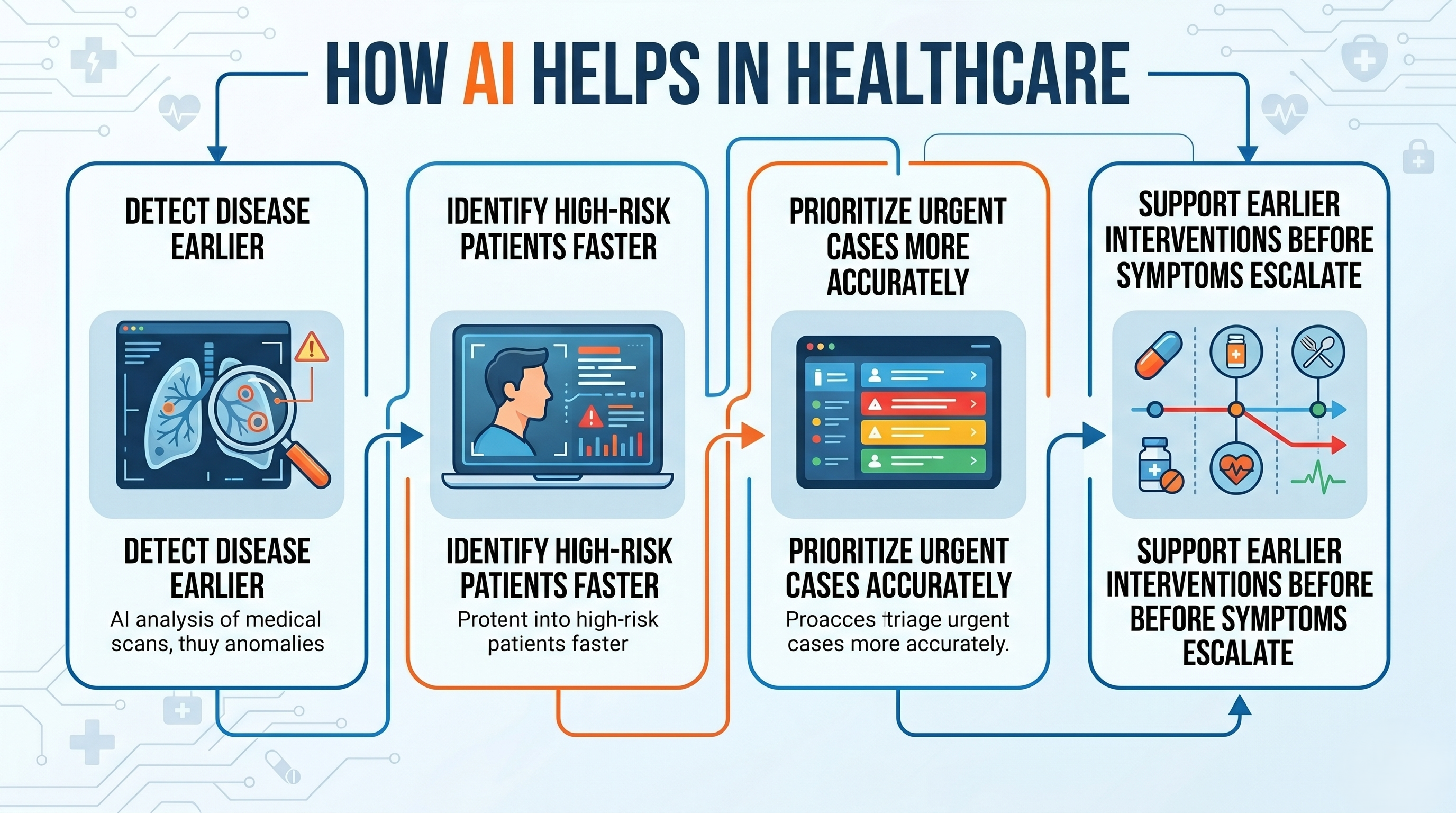
The best way to understand AI-driven healthcare is to identify areas where it can deliver value. Most successful AI use cases in the healthcare sector can be described as:
AI Improves Diagnosis and Early Detection
One of AI’s strongest roles in healthcare services is pattern recognition. AI algorithms can process imaging, lab values, clinical histories, and real-time monitoring data that would otherwise take far longer to review manually.
In practice, that means AI helps clinicians:
- Detect disease earlier
- Identify high-risk patients faster
- Prioritize urgent cases more accurately
- Support earlier interventions before symptoms escalate
This matters especially in conditions where timing shapes outcomes, including stroke, sepsis, breast cancer, and cardiovascular diseases. Instead of replacing medical judgment, AI systems work best as decision-support layers that help clinicians act with more speed and context.
AI Reduces Administrative Burden
A large portion of healthcare inefficiency has nothing to do with diagnosis. It comes from billing support, chart review, coding, patient scheduling, discharge summaries, and repetitive documentation. This is where AI-based software is showing immediate value.
A strong example comes from a JAMA Network Open study published in October 2025. After 30 days of using an ambient AI scribe, burnout among ambulatory clinicians dropped from 51.9% to 38.8%, alongside improvements in after-hours documentation time.
That kind of result is important as it links AI to workforce sustainability. In healthcare, reducing manual burden is not a soft benefit. It directly affects clinician capacity, patient attention, and the quality of clinical care.
AI Improves the Patient Experience
Patients often feel healthcare inefficiency long before they go through the diagnosis process. It happens at the wait times or fragmented communication, causing delayed follow-ups and confusing care instructions.
AI tools can help close those gaps by supporting digital triage through patient reminders, post-visit education, and personalized care communication. For healthcare providers, it can be continuity without adding more manual coordination work. For patients, it means a more responsive yet personalized and effective care experience.
AI Supports Scale Across Health Systems
AI also helps at the system level. According to McKinsey’s 2025 survey, healthcare leaders most often identified administrative efficiency and clinical productivity as the highest-potential areas for putting generative AI to use.
Though these points are completely valid, AI works best when it solves bottlenecks that affect many teams at once. It becomes much more valuable when it is treated as a workflow capability rather than a standalone tool.
Where AI Is Creating the Most Measurable Value
Not every AI use case creates the same level of impact. The highest-value use cases are usually the ones closest to cost pressure, patient flow, and clinician workload.
|
Use Case |
Business Value |
Clinical Value |
|
Ambient documentation and note generation |
Saves time, reduces admin burden |
Gives clinicians more attention for patients |
|
Predictive risk scoring |
Improves resource planning |
Supports earlier intervention for high-risk patients |
|
AI-assisted imaging and decision support |
Speeds case review |
Improves early detection and triage |
|
Patient engagement automation |
Reduces manual support load |
Improves follow-up and patient adherence |
|
Workflow automation for scheduling and summaries |
Cuts operational friction |
Improves access and continuity of care |
This is also where an AI development company can speak with authority. The strongest healthcare AI projects are usually not the broadest. They are the ones built around one measurable pain point first, then expanded once the workflow, compliance model, and performance thresholds are proven.
Pros and Cons of AI in Healthcare
Any strong article on AI in healthcare should answer both sides of the story. The benefits are real, but so are the concerns.
The Benefits of AI in Healthcare
AI helps healthcare providers make better use of patient data, reduce repetitive work, and improve the speed of clinical and operational decisions. That can lead to better health outcomes, lower administrative drag, and more scalable care delivery.
The biggest advantages usually show up in:
- early detection and diagnosis support
- predictive analytics for high-risk patients
- workflow automation for routine tasks
- better patient engagement and communication
- more efficient use of clinical and operational resources
In short, AI helps health systems do more with the resources they already have.
The Challenges of AI in Healthcare
The risks are just as important to discuss. AI models are only as reliable as the training data, validation process, and oversight behind them. Poor data quality can create inaccurate or biased outputs. Weak cybersecurity can expose sensitive patient data. Poor workflow design can create more confusion instead of less.
The most important risks include:
- biased training data
- data privacy and data breach concerns
- limited explainability in some AI models
- workflow disruption from poor implementation
- overreliance on AI without human oversight
The Philips Future Health Index 2025 also highlights a trust gap around the potential of healthcare AI. The data can be interpreted as a useful reminder that AI adoption is not just a technical issue, but a credibility issue too. Healthcare professionals need confidence that AI tools are built to ensure patient welfare as they are aligned with clinical reality.
Benefits vs Challenges at a Glance
|
Benefits |
Challenges |
|
Faster diagnosis support |
Data privacy and cybersecurity risks |
|
Reduced documentation burden |
Bias in training data |
|
Better predictive analytics |
Explainability concerns |
|
Improved patient experience |
Workflow integration complexity |
|
Greater operational efficiency |
Ongoing need for human oversight |
What Safe AI Implementation in Healthcare Actually Looks Like
This is where many blogs become too generic. Explaining what AI can do is useful. Explaining what it takes to implement AI safely is what makes the content valuable.
Healthcare AI does not succeed because a model is accurate in isolation. It succeeds because the surrounding system is reliable.
Start With the Workflow, Not the Model
The first question should never be, “Which AI tool should we use?” It should be, “Which healthcare workflow breaks today, and where can AI reduce friction without adding risk?”
That shift matters. It keeps AI implementation tied to outcomes such as faster triage, lower documentation time, reduced no-shows, better patient communication, or earlier disease detection.
Build on a Secure Data Foundation
Healthcare AI relies on patient data, and that means architecture matters. In production environments, the typical stack includes EHR data, imaging, labs, claims, devices, and patient-facing apps. Those sources then need secure integration through APIs, FHIR or HL7 connectors, access controls, consent-aware pipelines, and monitoring layers.
Without that foundation, even good AI tools struggle to scale.
Keep Human Oversight in the Loop
Human oversight remains one of the most important elements of AI in healthcare. AI can surface patterns, suggest actions, and reduce routine tasks, but clinicians still need the ability to review, override, and contextualize outputs.
That is especially important in diagnosis, treatment support, and any use case involving high-risk patients.
Measure What Matters
Safe AI implementation should be measured with practical performance indicators, not vague innovation goals.
The most useful measures often include:
- reduction in documentation time
- improved turnaround speed
- fewer missed high-risk cases
- better patient response rates
- clinician satisfaction and adoption
- lower operational costs or improved throughput
This is where case studies and ebooks can strengthen your company's POV. The market does not just want to know that you build AI solutions. It wants to know that you can connect AI models, workflow design, compliance, and measurable outcomes in real healthcare environments.
Signity’s Perspective: Building Healthcare AI That Works in the Real World
At Signity, our perspective is straightforward. Healthcare does not need more disconnected AI tools. It needs dependable AI solutions that fit clinical workflows, respect patient data, and create measurable outcomes for providers, patients, and health systems.
That perspective comes from treating healthcare AI as a delivery discipline, not just a model-building exercise. In real environments, success depends on how well AI software integrates with existing systems, how safely patient data moves through the architecture, how clearly risk is managed, and how naturally the solution fits into the day-to-day work of healthcare professionals.
This is where Signity can contribute meaningfully. We help organizations move from idea to implementation by aligning AI models with workflow logic, interoperability requirements, compliance expectations, and user adoption realities. That includes areas such as predictive analytics, AI-powered automation, patient engagement solutions, and intelligent healthcare software designed around real operational needs.
For clients, the value is not simply access to technical expertise. It is access to a partner that understands how to make AI useful in environments where reliability matters more than hype. In healthcare, that is the difference between a pilot that looks promising and a solution that actually improves care delivery.
If the goal is to build AI in healthcare that clinicians can trust, operations teams can support, and leadership teams can scale, the work has to be grounded in practicality from the start. That is the lens Signity brings to the table.
Conclusion
AI has impacted the health industry by improving diagnosis, reducing administrative burden, strengthening patient engagement, and helping health systems operate more intelligently. It is already influencing how clinicians work, how hospitals scale, and how patient care is delivered.
But the best outcomes do not come from AI adoption alone. They come from responsible AI implementation built on strong data architecture, human oversight, validated use cases, and clear operational goals.
Healthcare organizations do not need more disconnected tools. They need AI systems that solve real workflow problems, protect patient data, and create measurable impact. That is where AI in healthcare moves from hype to value.

Mangesh Gothankar


Ashwani Sharma
Achin Verma
Frequently Asked Questions
Have a question in mind? We are here to answer. If you don’t see your question here, drop us a line at our contact page.
How has AI impacted the health industry?

AI has impacted the health industry by improving diagnosis, automating routine administrative tasks, supporting predictive analytics, and enhancing patient care across hospitals, clinics, and health systems.
How does AI help in healthcare?
AI helps in healthcare by analyzing patient data, identifying risk patterns, supporting disease detection, streamlining clinical workflows, and improving patient communication and follow-up.
What are the pros and cons of AI in healthcare?
The main benefits include better efficiency, earlier detection, improved patient experience, and lower administrative burden. The main challenges include data privacy risks, biased training data, explainability issues, and the need for strong human oversight.
Can AI replace doctors in healthcare?
No. AI works best as a support layer for healthcare professionals. It can improve speed, pattern recognition, and workflow efficiency, but doctors and clinicians remain essential for judgment, safety, and patient trust.
What makes AI implementation successful in healthcare?
Successful AI implementation in healthcare depends on secure patient data handling, integration with clinical workflows, validated AI models, interoperability, ongoing monitoring, and clear clinician oversight.





.png?width=352&name=agentic-ai-infrastructure-trends%20(1).png)