

.png?width=27&height=27&name=Group(1).png)

-1.svg)
-1.svg)


-2.svg)


%201-1.webp?width=148&height=74&name=our%20work%20(2)%201-1.webp)




.svg)





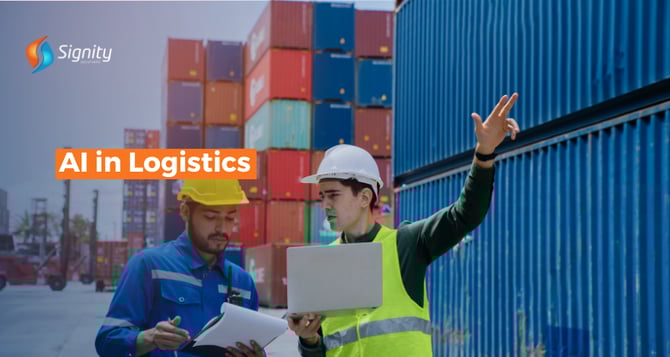
Managing logistics is a complex, resource-intensive process, with nearly two-thirds of warehouse activities, such as picking, packing, and shipping, still performed manually. This reliance on traditional methods often leads to operational inefficiencies, unexpected equipment failures, supply chain delays, rising fuel costs, and extended delivery timelines.
However, in 2026, AI in logistics is changing and reshaping how supply chains operate. Businesses are under immense pressure to boost their speed, accuracy, and resilience, and therefore, adopting AI in logistics remains one of the strategic choices, not a competitive advantage.
Integrating AI helps with seamless warehouse management, route optimization, predictive maintenance, and more. Automation of logistics operations enables faster, more accurate, and cost-effective solutions. This means an AI-driven supply chain reduces the logistics costs, lowers the inventory levels, and improves the service performance.
For businesses looking forward to scale, AI in supply chain management offers more visibility, agility, and automation that is a must to thrive in the competitive landscape.
 Generate
Key Takeaways
Generate
Key Takeaways

- AI in logistics automates operations, improving speed and accuracy.
- AI logistics solutions reduce costs through smarter routing and resource use.
- AI enhances demand forecasting and delivery planning.
- Real-time visibility improves shipment tracking and customer satisfaction.
- Logistics automation using AI strengthens supply chain resilience.
A warehouse with AI can reduce operations costs by 50% while increasing safety by 90%. And by 2035, AI is projected to increase logistics productivity by more than 40%.
This blog will provide you with a detailed understanding of AI services in the logistics industry, how they bring improvements to the industry, and how they can benefit your business.
Understanding AI in Logistics
AI is changing the way businesses operate, and the logistics industry is no different. From enhancing inventory handling to improving demand prediction strategies, AI incorporation in logistics is offering more efficient operations and increased adaptability.
A study by McKinsey & Company indicates that AI-powered logistic management systems can improve service levels by 65%, inventory levels by 35 percent and reduce logistics costs by 15%.
The power of AI equips companies with the ability to make more informed decisions about production plans, material procurement, and even optimizing inventory storage capabilities.
 In logistics, AI enables the optimal use of resources and minimizes costs. significantly contributes to the varied sub-tasks, like:
Route Optimization
AI employs algorithms to analyze varied factors like traffic patterns, delivery points, fuel consumption, and road conditions. Based on this, it generates efficient routes for delivery. Many logistics companies also use a route optimization tool to improve delivery planning and reduce transportation inefficiencies.
It can create dynamic routing that can adjust quickly to delays and disruptions. This efficiently results in reduced delivery times, improved overall logistics efficiency, and minimized transportation costs.
In 2026, AI-powered route planning is a core component of logistics automation using AI, which helps enable faster delivery and better efficiency of transportation.
Warehouse and Inventory Management
One of the key drivers of successful inventory planning is to order the right product amount to meet customer demand. It can clearly identify and resolve the overstocking and out-of-stock issues.
AI proficiently handles this concern. It precisely monitors the inventory levels, mitigates the stock shortage threat, and automates the replenishment protocols.
This way, the order-picking process can also be automated and streamlined.
This can result in minimized picking times, improved warehouse efficiency, and better space utilization.
Demand Forecasting
Accurate demand forecasting is crucial to creating effective ordering plans. Since AI can appropriately predict future trends and determine the risks associated, some AI-based solutions can also automatically update the ordering plan. It can also incorporate any number of supply and demand restrictions.
AI's predictive analytics is not limited to a few variables. It employs a vast array of factors, including regional events, weather patterns, and more, to provide a comprehensive and accurate demand forecast.
Can improve logistics customer satisfaction rates by up to 40% through enhanced service levels.
This facilitates businesses in accurate demand predictions, enhances customer satisfaction, optimizes their inventory levels, and minimizes stockouts.
Customized Logistics Solutions
Personalized solutions are the key to enhanced customer satisfaction. And when it comes to delivering personalized experiences to the customers, AI aces the race. While understanding the unique business requirements, AI analyzes the various data sources to understand customer preferences. It appropriately studies customer behavior, buying patterns, and choices to offer them more personalized solutions.
For logistics businesses, AI can help make customers happier by personalized delivery routes and prices. It also understands customer feedback and return patterns.
Chatbots and Virtual Assistants
As per an IBM study, CEOs are now giving top priority to using AI to enhance their customer services. By incorporating AI, decision-makers in the supply chain can engage in more intuitive interactions with virtual assistants.
This can result in making data-based, quick, and well-informed decisions. AI-driven chatbots and virtual assistants can improve customer service by offering real-time updates, addressing queries, and enhancing the overall customer experience.
Furthermore, they can also be used to gather and evaluate sentiment-based metrics driven by customer interactions.
Risk Management
AI helps in the logistics industry by using advanced tools to predict and manage potential risks and keep employees safe. These tools analyze the supply chain for unexpected events and quickly deal with any emerging issues.
By using AI, logistics companies can protect productivity and employee safety during disruptions.
Real-time Tracking and Visibility
By using data to track a shipment in real-time, AI can provide accurate and current information on the location and status of cargo. This enhanced visibility helps businesses:
- Make better decisions
- Provide more precise delivery estimates
- Increase customer satisfaction
Predictive Maintenance
AI can help logistics companies predict when vehicles and equipment will need maintenance. This allows them to schedule maintenance in advance, reducing downtime, extending the asset's lifespan, and cutting down unexpected costs. This reduces unplanned downtime, extends asset lifespan, lowers repair costs, and ensures uninterrupted logistics operations.
Impact on Operational Efficiency
AI in logistics helps boost the operational efficiency and performance across the supply chains. As per recent research, companies that adopt AI-enabled supply chain management and logistics aim to achieve lower costs and drive automation. Here is how it impacts the business's operational efficiency.
Autonomous Transportation in Logistics
AI helps the rise of autonomous transportation, such as self-driving trucks, drones, and more. These innovations are critical for reshaping the AI in supply chain management, as they enable safer and more efficient haul transportation. It also reduces the dependency on manual drivers and reduces downtime.
Smart Back-Office Automation
Generative AI helps streamline the administrative workload as it can help create reports and other text-related work. Whether it's invoice processing to automated bill of lading generation, AI helps eliminate the manual workloads and accelerate office workflow. This makes logistics automation using AI more efficient and reliable than ever.
Advanced Reverse Logistics Optimization
AI is transforming reverse logistics by analyzing return patterns, identifying root causes, and optimizing return flows. This helps businesses reduce operational waste, improve customer satisfaction, and recover value more effectively from returned goods.
AI-Driven Supply Chain Optimization
Modern AI for supply chain optimization enhances end-to-end visibility and decision-making. By combining AI demand forecasting in logistics with real-time analytics, businesses can better align supply with demand, reduce stock imbalances, and improve service reliability.
Cost Reduction Through AI in Logistics
It is one of the most impactful benefits of AI in logistics automation using AI. It seamlessly reduces the consumption of fuel, automates business operations, improves the accuracy of forecasting, and more. This helps ultimately reduce the operational expenses and boost efficiency.
How AI Reduces Logistics Costs
One of the critical advantages of AI in logistics is the ability to reduce operational costs. As the repetitive tasks are automated, the transportation routes are optimized, and resource allocation is improved, therefore, businesses can eliminate the inefficiencies that can be present in the supply chain.
The expenses are reduced as the routes are optimized, labor costs are reduced, and inventory management costs are reduced. It also prevents disruptions by enabling predictive maintenance and risk management proactively.
In addition to this, AI in the supply chain can improve the utilization of asset, reduces errors. And reduces the logistic costs. For the logistics companies that operate on tight margins, logistics automation using AI helps deliver measurable savings and improve quality.
Related Read : Rise of Personal Assistant Bots: How AI is Revolutionizing the Workspace
Key differences of AI in Logistics and Logistics without AI
By now, you must have understood how AI in Logistics enhances the overall functionalities by embracing it in different ways. Now, let’s have a quick glimpse of the logistics industry with and without AI.
|
Parameters |
Logistics Industry Without AI |
Logistics Industry With AI |
|
Efficiency |
Manual processes lead to inefficiencies and delays. |
AI automates processes, enhancing speed and efficiency |
|
Decision-Making |
Relies on historical data and intuition for decision-making. |
Data-driven insights from AI enable informed, real-time decisions |
|
Cost Management |
Higher operational costs due to inefficiencies and errors |
Optimized operations reduce costs through better resource allocation |
|
Inventory Management |
Manual tracking leads to overstocking or stockouts |
AI predicts demand accurately, improving inventory management |
|
Customer Experience |
Limited personalization; customer service is often reactive |
AI enables personalized interactions and proactive service |
|
Supply Chain Visibility |
Lack of real-time visibility leads to uncertainty and delays |
AI provides real-time tracking and visibility across the supply chain |
|
Risk Management |
Difficulty in identifying potential disruptions or risks |
AI anticipates risks and offers solutions to mitigate them |
|
Labor Requirements |
High labor costs due to manual processes and repetitive tasks |
AI reduces the need for manual labor, allowing staff to focus on higher-level tasks |
|
Scalability |
It is difficult to scale operations efficiently due to manual constraints |
AI systems can easily scale with growing business demands |
|
Innovation |
Limited to traditional methods and practices |
AI fosters innovation, leading to new logistics solutions and strategies |
Benefits of AI in Logistics
AI has significantly transformed the logistics industry, improving specific operations. Let's explore the benefits of using AI in logistics.
Enriched Data Quality
The use of AI in logistics brings improved data quality, which is one of its main benefits. AI's capabilities, such as machine learning (ML) and natural language processing (NLP), help me collect and organize the data and information that comes through logistics every day. NLP understands commonly used phrases, words, and jargon, while ML connects these important ideas to create context. When used together in logistics, AI enhances data utilization.
Reduced Operational Costs
AI can help to reduce operational costs significantly. It uses automated intelligent processes to replace manual processes, which helps to minimize errors. This reduces the risk of mistakes and workplace incidents, leading to faster, more accurate, and more productive operations, especially when integrated with a warehouse management system.
Timely Delivery
AI route optimization in logistics allows businesses to identify the fastest and most efficient delivery routes based on real-time traffic, weather, and road conditions. This also reduces the transit times, lowers the consumption of fuel, and boosts on-time delivery rates.
Improved Safety
AI offers intelligent planning and effective warehouse management that can enhance worker and material safety. It has the potential to examine the data on workplace safety and provide alerts to manufacturers for potential dangers.
Better Transportation Prediction
AI can help predict future shipping capacity needs. By using AI and ML algorithms, the logistics industry can forecast price changes in the current logistics market and predict future capacity. This can provide better insights into transportation information.
Challenges in the Adoption of AI in Logistics
Although AI offers significant benefits to the logistics industry, its adoption also comes with several challenges. Below are some of the challenges that businesses often face when implementing AI in logistics.
Cost
While the initial investment in systems can be significant, the potential for cost savings is equally substantial. The integration, purchase, and maintenance of AI can be costly, posing a financial challenge for businesses. However, the use of AI has the potential to reduce operating costs by 50%.
Finding the Right Talent
Since AI is an advanced technology, finding the right skilled developer in this area can be complicated. Logistics firms cannot hire AI developers just like that to implement solutions. However, to get access to the right AI talent, partnering with an AI development company can be beneficial.
Legacy System Integrations
Most logistics businesses have legacy IT systems. Integrating AI solutions into these legacy systems can be complicated and time-consuming. However, by tapping into the right level of development expertise, businesses can benefit from advanced system integration.
Real-life Examples of Companies Leveraging AI in Logistics
Amazon
Amazon is a global leader in e-commerce that has leveraged the capabilities of AI to enhance several aspects of its logistic operations. It has automated its warehousing systems using AI, where the robots pick, sort, and pack items. It has around 2,00,000 robots in its warehouses, which enhances its efficiency and reduces manual errors.
FedEx
FedEx is using AI to automate and improve parcel sorting in its hubs. The AI-powered robots can sort up to 1,200 parcels per hour, making the sorting process much faster. It also uses AI to predict delivery delays due to weather or traffic, which helps it provide better service to its customers.
Conclusion
AI can help businesses in the supply chain and logistics industry become more efficient and improve customer experiences. By using AI-driven solutions, companies can automate and optimize route planning, demand forecasting, inventory management, and real-time tracking processes.
This can result in cost savings, faster deliveries, better resource utilization, and higher customer satisfaction. Looking to transform your logistics business with the power of AI? Look no further!
At Signity Solutions, we specialize in advanced AI solutions that can drive the transformation of your logistics operations. Get in touch with us today to unlock the full potential of AI for your business!
Frequently Asked Questions
Have a question in mind? We are here to answer. If you don’t see your question here, drop us a line at our contact page.
How can Gen AI Drive Logistics Transformation?

Gen AI has the potential to transform logistics in several ways. It can make delivery times more efficient and reduce fuel consumption by optimizing routes and schedules. AI-powered chatbots can also improve customer service by quickly handling inquiries and resolving issues. Additionally, AI can help with advanced data analysis, automation, and decision-making to streamline traditional logistics operations.
Will AI Replace Manual Logistics Operations?
Not completely, but it automates some repetitive tasks. It won't replace the manual operations, but can augment the manual roles. This can shift the focus towards managing AI systems and interpreting data rather than just performing routine tasks.
How can we measure the Effectiveness of AI in Logistics?
You can measure the effectiveness of AI in logistics by tracking the improvements driven by AI implementations. You can evaluate metrics like error rates, delivery times, cost savings, and customer satisfaction; all of these can provide insights into the effectiveness of AI implementation in logistics.
How is AI transforming the logistics industry in 2026?
What are the best AI logistics solutions used in supply chain management?