


.png?width=27&height=27&name=Group(1).png)

-1.svg)
-1.svg)


-2.svg)


%201-1.webp?width=148&height=74&name=our%20work%20(2)%201-1.webp)




.svg)





Picture a portfolio manager responsible for 2,000 rental units who still tracks rent forecasting in Excel and schedules maintenance only after a tenant complaint arrives.
Every delayed work order compounds: a minor HVAC fault becomes an emergency repair, a vacant unit sits three weeks longer than it should, and a renewal opportunity slips past unnoticed. The financial drag is real, and it accumulates quietly.
AI for property management addresses exactly this gap. The goal isn't to replace experienced property managers. It's to give them systems that flag a likely compressor failure 30 days out, score each tenant's renewal probability before lease-end approaches, and route invoices without manual data entry.
But here's what most vendor conversations skip: the quality of your existing data is the actual ceiling on what AI tools can do for you. Industry estimates suggest that enterprises running disparate property systems spend the majority of their AI deployment budget on data alignment, before a single model runs in production.
This piece works through five specific areas: automation layers that handle high-volume, low-judgment tasks. These include predictive analytics engines built on machine learning algorithms and implementation architectures that enterprise real estate teams actually use. Also, we will work on addressing integration constraints that routinely add weeks to deployment timelines and ROI measurement that separates real operational gains from vanity metrics.
 Generate
Key Takeaways
Generate
Key Takeaways

-
Deploy workflow automation before any predictive model. Clean, labeled data is what prediction runs on.
-
Data heterogeneity across disparate property systems drives more deployment cost than model development does.
-
CEOs should track maintenance resolution time, lease renewal rate, and vacancy days per unit annually.
-
MLOps with drift detection is required; models trained on last year's occupancy patterns degrade without retraining.
SOC 2 and GDPR-aligned data residency controls must be scoped before tenant PII enters any cloud pipeline.
The Evolution of AI-Powered Property Management
The technology didn't arrive at machine learning overnight. It moved through three distinct generations, each one raising the baseline of what operators expected from their tools.
| Generation | Era | Core Capability |
| Basic digitization | 1990s-2000s | Digital records, spreadsheet-based reporting |
| Cloud PMS platforms | 2010s | Yardi, AppFolio, Rent Manager: centralized data, automated billing |
| AI inference layer | 2020s-present | Predictive models running on top of existing PMS data |
The third generation is where artificial intelligence in real estate gets genuinely useful - and genuinely misunderstood. Most enterprise real estate firms aren't replacing Yardi, AppFolio, or Rent Manager.
They're attaching AI inference layers via integration APIs that sit alongside those systems and read their data, since built-in AI features inside the core platform typically stop at basic automation. That distinction matters because it means your existing platform's data quality sets a hard ceiling on what any AI model can actually produce.
Rules-based automation - if a lease expires in 60 days, trigger a renewal notice - was the entry point for most teams. Machine learning algorithms go further. They update their own decision weights based on patterns in historical maintenance cost data and occupancy records, without a developer rewriting conditional logic each time market conditions shift.
Morgan Stanley Research estimates that AI could automate up to 37% of tasks across real estate operations, worth roughly $34 billion in efficiency gains industry-wide over the next five years.
And that 37% figure assumes the underlying data is clean enough to train on. In practice, it often isn't - which is the first constraint any honest implementation roadmap has to address.
Related read: AI in Real Estate: 10 Applications Driving Sales and Growth
Core Automation Capabilities: Streamlining Operations

Four automation categories drive measurable efficiency gains in AI property management automation, and each of these AI features targets a different failure point in traditional operations.
Start with lease management
Intelligent document processing (IDP), also known as lease abstraction, ingests lease PDFs, extracts clause-level data, and writes structured records directly into your property management platform. Renewal triggers fire automatically based on extracted end dates, freeing the leasing team from manual date-tracking. This cuts manual lease administration time by a meaningful margin in most deployments, based on typical project outcomes we've observed.
Robotic process automation
Robotic process automation handles accounts payable reconciliation and transaction categorization between vendor invoices and purchase orders without human review, unless an exception flag fires. The flag logic is the part most vendors skip in their demos. RPA without well-defined exception routing creates a backlog that's harder to clear than the manual process it replaced.
NLP Fine-tuning
And then there's the natural language processing (NLP) problem. Generic large language models will misclassify an urgent "water leaking into electrical panel" ticket as a routine maintenance request. That's not a hypothetical edge case. It's a maintenance triage failure, and it happens in production. Models need fine-tuning on your historical ticket data before going live, with priority labels your operations team has actually validated.
Here are the six automation use cases that directly move operational metrics:
- Automated lease clause extraction: reduces manual data entry errors in lease administration
- RPA-driven invoice reconciliation: cuts accounts payable cycle time for vendor payments
- NLP tenant chatbot lets tenants submit maintenance requests any time and lowers after-hours staffing costs per property
- Computer vision property inspection: flags property damage and other physical anomalies before onsite teams arrive
- Automated renewal notices: reduces lease lapse rate across the portfolio
- Compliance document routing: embeds regulatory checks into lease workflows without manual review steps
Predictive Analytics: Anticipating Market Trends and Tenant Behavior
Automation handles repetitive tasks. Prediction is where AI-powered property management starts generating real competitive separation, especially for tenant experience and retention.
Rent Forecasting
Models trained on micro-market supply-demand signals pull from listing velocity, local absorption rates, and macroeconomic indicators like employment data. Historical lease transaction data provides the baseline. The model updates pricing recommendations as conditions shift, giving portfolio managers forward guidance rather than backward-looking comparables, which helps teams price units to attract potential tenants faster.
Churn Prediction and Tenant Retention
Churn prediction algorithms score individual tenants on renewal probability by combining payment history, maintenance request frequency, and portal engagement patterns.
A tenant who files four maintenance tickets in 60 days and stops opening email communications is statistically more likely to leave. That signal, caught 90 days before lease-end, gives your team time to act and protect tenant satisfaction.
Vacancy Prediction
Models give portfolio managers a 60-to-90 day forward view of occupancy dips. But the data inputs matter enormously. In practice, vacancy prediction models relying solely on financial data often underperform compared to those incorporating multiple data types, though accuracy rates vary significantly depending on market conditions and model architecture.
Incorporating communication sentiment analysis and maintenance request patterns into vacancy prediction models can meaningfully improve accuracy and resident experience alike, though the magnitude of improvement varies based on data quality and local market characteristics. Most vendors won't tell you that distinction exists.
Energy Consumption Forecasting
IoT sensors, including smart thermostat data, feed HVAC load data into forecasting models alongside weather patterns and occupancy schedules. The output predicts peak consumption windows before they occur, which feeds directly into capital expenditure planning for building systems.
| Dimension | Reactive Management | Predictive Management |
| Maintenance | Responds after failure | Flags anomalies before failure |
| Vacancy | Lists unit after move-out | Activates retention 60-90 days early |
| Rent pricing | Annual manual review | Continuous micro-market signal updates |
| Energy | Fixed HVAC schedules | Consumption forecasts by occupancy pattern |
| Tenant retention | Renewal calls at lease-end | Churn scores trigger outreach proactively |
AI Property Management Automation: Real-World Implementation Patterns
Three deployment architectures separate teams that ship working AI systems from those that rebuild them six months later. Each pattern addresses a specific failure mode that generic vendor playbooks ignore.
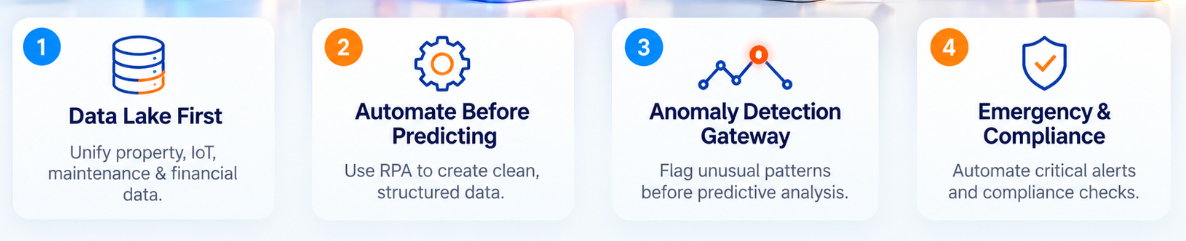
Pattern 1: Data Lake First
Before any model runs, aggregate IoT sensor readings, lease data, maintenance logs, and financial data into a unified cloud data store. Models trained on siloed data produce contradictory outputs: your financial system flags a unit as profitable while your maintenance model rates it a cost liability. Both are technically correct on their own data. Neither is useful.
Pattern 2: Automation Before Prediction
Deploy RPA for invoice reconciliation, lease renewal, and maintenance workflows before touching predictive models. This isn't a sequencing preference. Predictive models need clean, labeled, consistent data, and RPA generates exactly that as a byproduct of running. Skip this step, and your ML training set is dirty legacy records with inconsistent fields and missing timestamps.
Pattern 3: Anomaly Detection Gateway
Use anomaly detection as a first-pass filter on payment patterns, energy spikes, and maintenance frequency. Feed those flagged outliers into downstream models rather than training one monolithic model across all signal types. A single model trying to handle everything degrades faster and fails less visibly.
Emergency Response and Compliance Embedding
Critical building system alerts (fire suppression, elevator faults) route through automated dispatch workflows with escalation logic baked in. And GDPR compliance checks embed directly into lease workflow triggers.
Implementation sequencing your CTO can evaluate:
- Audit all source systems for schema consistency and completeness gaps
- Stand up the cloud data lake with role-based access controls and data residency rules configured
- Deploy RPA workflows on highest-volume processes to start generating labeled operational data
- Instrument anomaly detection across energy, payment, and maintenance data streams
- Begin predictive model training only after 12 months of clean, structured operational data exists in the lake
Integration Challenges and Enterprise Deployment Considerations
Vendors quote AI deployment timelines without including ETL alignment. That omission is expensive. In practice, multi-system schema reconciliation often extends vendor timelines significantly, as teams must map disparate data schemas before reliable model operation begins.
Enterprise real estate portfolios typically integrate multiple systems including property management platforms, financial ERPs, maintenance tools, building management infrastructure, and tenant portals, each with independent data schemas. Each uses a different data schema.
Before any model runs reliably, those schemas need mapping through integration APIs and ETL pipelines that connect your existing systems. This is the actual primary cost driver in AI property management automation deployments, and it's the line item most proposals leave blank.
Where Integrations Break?
Four integration failure points appear repeatedly in production:
Schema collision between the ERP and property management platform
Field-level mismatches (date formats, unit identifiers) cause silent data corruption that only surfaces after model training.
Mitigation: run a schema audit and build a canonical data model before any ETL pipeline goes live.
IoT sensor telemetry arriving without consistent timestamps
Models trained on time-series data from unsynchronized sensors produce unreliable anomaly detection outputs.
Mitigation: enforce UTC normalization at the ingestion layer.
Vendor invoice data locked in unstructured PDFs
RPA-driven reconciliation fails without a pre-processing step using intelligent document extraction.
Mitigation: add an IDP layer before the RPA workflow.
Tenant PII scattered across systems without a unified consent record
This creates GDPR and CCPA exposure simultaneously.
Mitigation: implement a consent management layer that maps data residency to cloud region configuration before deployment begins.
Governance, Explainability, and Compliance
On governance: explainability requirements directly affect model architecture choices. Gradient boosting models (like XGBoost) produce feature importance scores that regulators can audit. Deep learning neural networks don't.
For AI in property management, choose interpretable models wherever a human needs to justify the output, and reserve neural architectures for tasks where accuracy outweighs accountability, such as energy load forecasting with no direct tenant impact.
SOC 2 Type II and ISO/IEC 27001 controls aren't optional for portfolios handling tenant PII. Build them into the architecture specification, not the post-deployment security review.
ROI and Performance Metrics for AI Property Management Solutions
Most ROI frameworks built for AI property management projects measure the wrong things, tracking activity instead of what AI delivers to the bottom line. Dashboard uptime, model accuracy scores, and ticket volume processed are operational metrics. They don't tell a CEO whether the portfolio is more profitable than it was 12 months ago.
The metrics that actually move P&L are four: maintenance resolution time, lease renewal rate, vacancy days per unit annually, and energy cost per building.
Industry estimates put predictive maintenance scheduling at a 20-50% reduction in average resolution time, a direct gain in operational efficiency based on typical outcomes.
Retention programs that use churn prediction analytics have been shown to improve lease renewal outcomes, with early implementations reporting renewal-rate gains in the 3-7 percentage point range, according to McKinsey. IoT-driven energy controls commonly reduce utility costs by 12-20%, according to ENERGY STAR and U.S.
Benchmark Data by KPI
Department of Energy benchmarks for commercial buildings.
| KPI | Baseline Benchmark | AI-Enhanced Range | Measurement Method |
| Maintenance resolution time | 4-7 days average | 2-4 days | Work order close timestamps |
| Lease renewal rate | 55-65% | 68-78% | Signed renewals vs. expiring leases |
| Vacancy days per unit/year | 28-45 days | 14-22 days | Unit-level occupancy logs |
| Energy cost per building | Baseline utility spend | 12-20% reduction | Monthly utility invoices vs. prior year |
| Invoice processing cycle time | 8-12 days | 2-4 days | AP system timestamps |
| Tenant escalation rate | 18-25% of tickets | 8-12% | Tier-2 routing logs in ticketing system |
Running the 90-Day Pilot
Structure your 90-day pilot around one goal: generating clean baseline data, not demonstrating AI capability. Deploy automation on a single workflow (maintenance intake works well) and measure resolution time before any predictive layer goes live. Pilots that skip this produce comparison data that's too dirty to trust when budget reviews arrive.
The Year-Two ROI Curve
And here's an ROI dynamic that most calculators miss entirely. Automation savings in year one reduce labor costs, yes. But the labeled transactional data those workflows generate is what makes your churn and vacancy models meaningfully more accurate in year two. It's a non-linear return curve.
The year-two margin improvement is often larger than year one, yet it won't appear in any initial business case.
Executive Dashboards
Executive dashboards should surface four numbers: renewal rate trend, open vacancy count, energy spend vs. forecast, and maintenance backlog age, so leadership can make informed decisions without waiting on a monthly export. Operations teams need unit-level drill-downs on the same signals. The data is identical; the aggregation level is different.
Build role-based views from the start, or you will spend post-launch engineering cycles rebuilding what the initial spec should have included.
Getting Started: Strategic Roadmap for Real Estate Enterprises
Six phases separate a failed AI pilot from a production system property management teams actually trust.
The Six-Phase Roadmap
- Data audit and quality scoring: Map every source system and score each dataset on completeness, schema consistency, and timestamp reliability. Deliverable: a data readiness report. Success criterion: no dataset scores below 70% completeness before phase two begins.
- Automation-first deployment: Target lease renewals and maintenance ticket routing. Deliverable: RPA workflows live on two high-volume processes. Success criterion: clean labeled transaction records accumulating for at least six months.
- IoT sensor integration: It must be routed into a unified cloud data store with UTC-normalized timestamps. Deliverable: real-time telemetry feed. Success criterion: sensor uptime above 95% with no schema drift against the canonical data model.
- Predictive model training: It should be done on 12-24 months of cleaned historical data. Deliverable: churn and vacancy models in staging. Success criterion: holdout set accuracy above the 80% threshold your operations team pre-approves as actionable.
- Real-time monitoring: dashboard deployment with role-based views. Deliverable: executive and operations-level views live. Success criterion: zero raw data tables visible to the executive layer.
- Continuous MLOps cycle: Worked with model drift detection and scheduled retraining triggers. Deliverable: automated retraining pipeline. Success criterion: model performance deviation alerts fire within 48 hours of drift crossing the defined threshold.
When to Start with Data Infrastructure First
Enterprises with fewer than 12 months of structured historical data should run a data infrastructure sprint before touching model development. Skipping it produces pilots that can't scale past the proof-of-concept stage, and that pattern repeats across deployments regardless of vendor or budget size.
Why Signity for AI in Property Management?
Real estate AI projects fail for a specific reason: vendors scope the model and forget the data infrastructure that makes it run. Signity's work starts at the other end.
Before any model gets trained, our team runs a structured data audit across your property management platform, ERP, maintenance ticketing system, and IoT feeds. The audit determines which AI capabilities are actually achievable. Most engagements reveal schema gaps that would have silently corrupted churn and vacancy predictions if skipped.
Our certified experts have shipped automated lease management pipelines, NLP-based tenant communication systems fine-tuned on domain-specific ticket data, and anomaly detection gateways feeding downstream predictive models. And the compliance layer gets built in at step one, covering SOC 2, GDPR, and CCPA simultaneously, because retrofitting it later costs more than building it correctly from the start.
Signity's real estate AI engagements run across fintech-adjacent property funds, mid-market residential portfolios, and commercial real estate operators, regardless of portfolio size. The pattern we see clearly: clients who engage us post-failed-pilot almost always skipped the automation-before-prediction sequence covered earlier in this piece.
Conclusion
The maturity arc here is real, and the sequence is fixed. Workflow automation comes first, producing the clean labeled data that predictive models actually need. Churn scoring, vacancy forecasting, and energy consumption prediction follow.
Agentic systems that autonomously draft renewal terms and dispatch maintenance crews are arriving now, with early enterprise deployments already running, though the human touch still matters most for exceptions the model wasn't trained to see. But none of that matters if your source data is unreliable.
Before any vendor conversation, run a structured audit of every property management system you own. Score each dataset on completeness and schema consistency. That audit determines which AI capabilities are achievable within a 12-month window, and which ones require an infrastructure sprint first.
Skipping it is the one decision that makes every subsequent investment less effective.
AI for property management is a structural competitive advantage for property management companies, not a software upgrade. Vacancy days and maintenance costs are where profitable portfolios separate from underperforming ones, and those numbers are now variables your systems can influence before problems materialize.

Mangesh Gothankar


Ashwani Sharma
Achin Verma
Frequently Asked Questions
Have a question in mind? We are here to answer. If you don’t see your question here, drop us a line at our contact page.
What data does an AI property management system need for accurate rent forecasts?

How long does AI automation implementation take for a mid-size property portfolio?
Portfolios with fragmented legacy records should expect the timeline to extend by 6-10 weeks for ETL alignment before either phase begins.
Can these tools integrate with existing platforms like Yardi or AppFolio?
How do AI systems handle tenant data privacy across multiple jurisdictions?
What separates predictive maintenance from preventive maintenance in real estate AI?