


.png?width=27&height=27&name=Group(1).png)

-1.svg)
-1.svg)


-2.svg)


%201-1.webp?width=148&height=74&name=our%20work%20(2)%201-1.webp)




.svg)





A radiologist reviewing 400 images per shift can't catch every subtle density variance buried in a chest CT. A trained generative model flags that anomaly in milliseconds.
That gap between human cognitive limits and machine pattern recognition is where generative AI in healthcare is now operating. It's doing so under FDA oversight, inside production EHR environments and across real clinical workflows.
This isn't experimental territory anymore. Market research firms project significant growth in generative AI healthcare applications in the coming years, with estimates ranging across multiple billion-dollar scenarios by the early 2030s.
What follows covers the clinical and operational use cases of AI in healthcare carrying genuine ROI. We will underline the implementation friction that derails most deployments. Also, we will run through a phased roadmap built for decision-making.
 Generate
Key Takeaways
Generate
Key Takeaways

- Validate clinical AI models against prospective data before deployment.
- Synthetic patient data can reduce reliance on real protected health information when training models, while supporting privacy-conscious AI development.
- Clinical documentation automation delivers the fastest, lowest-risk ROI entry point for most health systems.
- Define your model drift detection threshold at go-live. Patient population shifts will expose gaps quickly.
- Synthetic cohorts representing underrepresented demographics can help improve population representation in predictive risk model training and evaluation.
Understanding Generative AI in Healthcare
Generative AI in healthcare refers to a class of models that produce new clinical content rather than classify existing data - the distinction matters enormously when you are choosing architecture for a regulated deployment.
A predictive model tells you whether an MRI scan is malignant. A generative model drafts the radiology report. It works by synthesizing a realistic patient record for model training, or proposing a molecular structure for a novel drug candidate. The output is structured and clinically consequential.
Three architectures currently drive most production deployments:
Large language models (LLMs) fine-tuned on medical corpora such as PubMed abstracts, clinical trial registries, and de-identified EHR notes. GPT-4-class models are the common baseline. Domain-specific variants like Med-PaLM 2 are built for clinical question-answering.
Diffusion models are applied to medical image generation and augmentation, including in pathology. These models learn the statistical distribution of tissue morphology and generate realistic synthetic images or augment existing datasets to help address data and label scarcity.
Retrieval-augmented generation (RAG) architectures pair an LLM with a live knowledge base. These now power clinical decision support systems by pulling real-time drug interaction data to ground each response.
Here's what vendor materials consistently omit:
Foundation models trained on general internet data produce outputs that reflect general internet knowledge. Before any output meets FDA-regulated AI deployment standards, the model requires domain-specific fine-tuning and formal clinical AI validation.
The FDA's action plan for AI/ML-based software as a medical device makes clear that predetermined change control plans and prospective performance monitoring are both required.
Skipping fine-tuning and treating an off-the-shelf LLM as production-ready is the single most expensive mistake we see in early-stage healthcare AI programs.
Related Read: AI in Healthcare Market Size: Trends, Growth & Future Insights
Key Use Cases for GenAI in Healthcare
GenAI in healthcare covers a wide span of clinical and operational workflows. The highest-value deployments share one trait: the model output passes through a clinician before it acts on a patient.
- Radiology report automation tools like Nuance DAX cut dictation time by an estimated 50-70% in production environments, based on published deployment data. The detail most teams miss: these systems require department-specific "normal findings" libraries built from your own radiologists' phrasing conventions. Generic templates produce outputs that radiologists spend more time editing than dictating.
- Clinical documentation generation via ambient voice capture addresses the administrative burden that drives physician burnout. A study of 1,800 clinicians across five academic medical centers found that AI scribes saved 16 minutes of documentation time per eight-hour shift. That's EHR automation ROI with a measurable, auditable baseline.
- Medical imaging analysis using diffusion models for pathology image recognition has shown measurable gains in diagnostic accuracy. Germany's PRAIM study of 463,094 women found AI-supported screening detected breast cancer at a rate 17.6% higher than standard double reading.
- Drug discovery acceleration is where generative molecular design produces its clearest proof point. Insilico Medicine's INS018_055, a generative-AI-designed drug candidate for idiopathic pulmonary fibrosis, reached Phase II clinical trials, making it one of the first fully AI-designed molecules to achieve that milestone.
- Clinical trial matching uses natural language processing in healthcare to automatically map patient records against eligibility criteria. Manual chart review for trial matching typically takes 30 minutes per patient, based on industry estimates from clinical research operations teams.
- Patient data synthesis lets your teams train downstream models on HIPAA-compliant cohorts without exposing real PHI. The critical validation step that gets skipped: check synthetic data fidelity against real cohort statistical distributions before any model trained on it enters production.
- Medical coding automation reduces claim denial rates by flagging ICD code mismatches before submission. Skip human review on edge cases, and your denial rate climbs back up within 90 days.
Benefits of Generative AI in Healthcare
The organizational value from GenAI deployment spans clinical quality, workforce capacity, and patient equity. The C-suite case for each is stronger than most vendor briefings suggest.
Physician administrative burden is the most quantifiable entry point. Physician surveys have consistently documented that administrative tasks and EHR-related work consume substantial portions of physician time, often cited as competing significantly with direct patient care hours.
The ratio drives burnout, attrition, and downstream hiring costs your finance team can model directly. Automated clinical documentation, as covered above, directly attacks this ratio with auditable time savings.
The five benefits of generative AI in healthcare below move from operational efficiency toward clinical impact, ending with one that boards are starting to care about considerably more than they did two years ago.
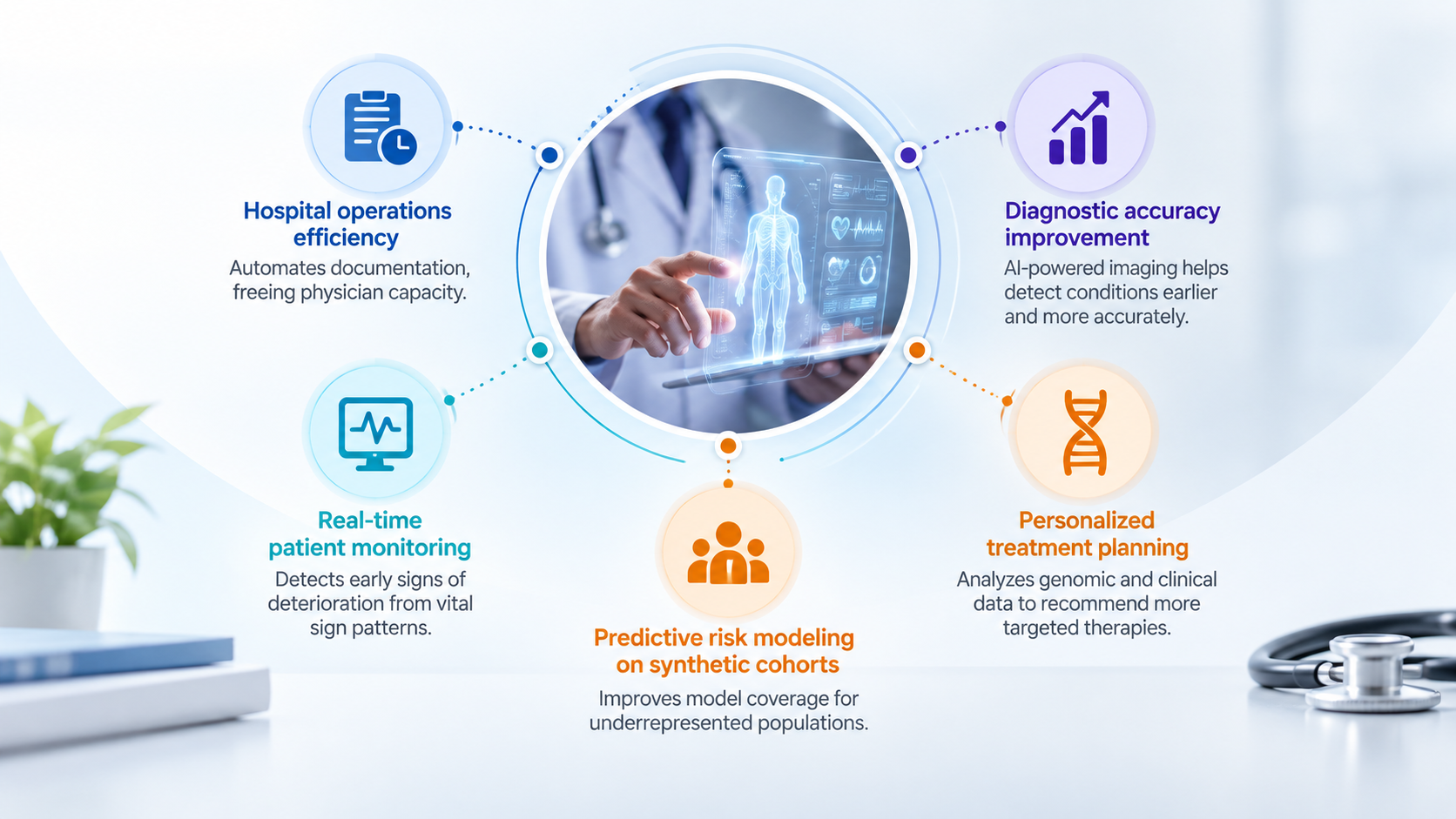
- Hospital operations efficiency: Automating documentation frees physician capacity without adding headcount, and the ROI baseline is measurable in shift-level minutes recovered per clinician, not abstract productivity scores.
- Diagnostic accuracy improvement: AI-powered diagnostics on medical imaging have shown detection gains over standard clinical review in peer-reviewed settings, including the PRAIM breast cancer screening study cited earlier, where the gap was 17.6% above double-reading rates.
- Personalized treatment planning: Genomic sequence analysis models can correlate a patient's molecular profile against published treatment response data at a scale no clinical team can replicate manually, which improves patient outcome prediction accuracy for oncology and rare disease cohorts.
- Real-time patient monitoring: Generative models trained on ICU telemetry data can surface deterioration signals earlier than threshold-based alert systems, because they model the trajectory of vital sign patterns, not just whether a single value crossed a line.
- Predictive patient risk modeling on synthetic cohorts: This is the benefit most competitors skip entirely. Training risk models on synthetic data built to match underrepresented demographic distributions gives your predictive models coverage over populations where real labeled data is historically sparse. It is a health equity argument, and hospital system boards are hearing it from regulators and accreditation bodies with increasing frequency.
Medical literature summarization sits adjacent to these five. Generative models can compress hours of literature review into structured clinical briefs, which matters most for specialist teams managing fast-moving evidence bases in oncology or infectious disease, where a 45-minute manual review cycle per query is a real workflow tax.
Implementation Challenges and Solutions
Most healthcare organizations walking into a GenAI deployment underestimate one thing above everything else: the validation burden.
The FDA's 510(k) pathway for AI-based diagnostic software doesn't accept retrospective benchmark accuracy as proof of clinical readiness. It requires prospective clinical studies conducted on patient populations that reflect your actual deployment environment.
Skipping this step creates regulatory exposure your legal team can't resolve after the fact. You'd be surprised how many organizations reach pilot completion before anyone asks whether their model qualifies as a Software as a Medical Device (SaMD) under current FDA guidance.
Here's where the real friction lives, paired with what actually helps:
- Clinical AI validation gap: Prospective studies take months and require IRB approval at most institutions. Start the validation protocol design in parallel with your proof-of-concept build. Teams that sequence these in parallel reach production deployment measurably faster.
- Healthcare data privacy: A Business Associate Agreement (BAA) with your cloud AI provider is an important contractual safeguard, but it does not address every infrastructure risk. Evaluate where and how PHI is stored and processed, confirm encryption and access controls, and assess whether the provider's data residency practices align with your organization's security, regulatory, and risk-management requirements.
- Adversarial robustness in healthcare AI: Small, imperceptible perturbations in medical imaging inputs can flip model predictions with high confidence. Defend against the issue by including adversarial test sets in your validation suite.
- Interpretable AI diagnostics: A clinician can't document a treatment decision justified by a black-box probability score. Explainability outputs, whether attention maps or SHAP values, are what let your clinical staff defend the model's recommendation in a chart audit.
- EHR integration friction: HL7 FHIR APIs are the standard answer. But most legacy EHR environments need custom middleware before FHIR queries return data in a structure your model can actually consume.
Form your clinical AI governance committee before you select a vendor. Organizations that reverse this order spend months retrofitting approval workflows around a contract they've already signed.
Related Read: AI in Healthcare: Use Cases, Real-Life Examples, Benefits, and Trends
Strategic Roadmap for Healthcare Organizations
A healthcare AI implementation roadmap succeeds or fails at the planning stage, well before a single model touches patient data. Most organizations skip directly to vendor selection, then spend months retrofitting data governance and compliance controls around a contract they have already signed. The three phases below sequence those decisions in the order that actually works.
Phase 1 (0-3 months): Data Readiness Audit
- Assess EHR data completeness across your active clinical units. Incomplete or inconsistently coded records will degrade model outputs regardless of model quality.
- Establish a data governance charter that defines PHI handling, access controls, and audit logging before any external vendor receives a data sample.
- Confirm HIPAA-compliant cloud infrastructure with explicit data residency terms, not just a signed BAA.
- Map clinical workflows with documented inefficiencies. Clinical documentation generation and medical coding automation are the lowest-risk starting points because their outputs carry clinician review as a built-in quality gate.
Phase 2 (3-9 months): Pilot Deployment
- Select one use case where model output passes through a clinician before any action is taken. Radiology report automation fits the criterion. So does ambient documentation capture.
- Run the pilot against your own patient population, not a benchmark dataset from another institution. Population-level differences in diagnosis mix will surface quickly in a real deployment.
- Begin IRB approval and prospective study design in parallel with the build phase.
Phase 3 (9-18 months): Validated Scale-Out
- Following clinical AI validation on pilot data, expand into AI-powered diagnostics and clinical decision support systems.
- Define your model drift detection threshold before go-live. Clinical AI models trained on pre-pandemic patient populations have shown measurable accuracy degradation when deployed into post-pandemic case mixes, because the underlying distribution of diagnoses shifted. Setting your drift alert threshold after the fact means you're already operating a degraded model before anyone notices.
- Establish a quarterly monitoring cadence that checks prediction distribution against your live patient cohort.
Most roadmap articles skip the drift threshold question entirely. It is the detail that separates a pilot that scales from one that quietly erodes clinical trust over 18 months.
Signity & Its Proficiency with AI in Healthcare
Signity Solutions works with healthcare organizations at the exact friction points covered above. From EHR integration to HIPAA-compliant data architecture, we work at clinical AI validation scoping before any model touches production.
Where most vendors hand off a pre-built solution, Signity's team maps your specific clinical workflows first. It means identifying whether your EHR environment needs custom HL7 FHIR middleware before recommending any model architecture.
Our healthcare AI engagements start with a data governance review, which is the step that most programs skip and later retrofit under regulatory pressure. The sequencing difference is what separates pilots that reach clinical deployment from those that stall at the proof-of-concept stage.
Conclusion
The case for generative AI in healthcare is built on measurable outcomes, not vendor promises. Organizations that reach production do one thing differently. They treat governance, validation, and phased deployment as prerequisites, not afterthoughts added once a contract is signed.
Your next step isn't a vendor demo. Identify one clinical workflow with documented, auditable inefficiency. Clinical documentation is the lowest-risk starting point because every output passes through a clinician before it touches a patient decision.
Assess your data governance posture against HIPAA requirements at the architectural level, not just the contractual one. Then establish your clinical AI validation framework before any vendor conversation begins.
As FDA guidance on AI/ML-based Software as a Medical Device matures through 2026 and beyond, the regulatory bar will rise, and organizations with governance infrastructure already in place will adapt faster than those still catching up.

Mangesh Gothankar


Ashwani Sharma
Achin Verma
Frequently Asked Questions
Have a question in mind? We are here to answer. If you don’t see your question here, drop us a line at our contact page.
How does generative AI differ from traditional predictive AI in clinical settings?

What does HIPAA compliance require specifically when deploying a large language model on patient data?
HIPAA compliance for LLM deployment requires a signed Business Associate Agreement with your cloud provider, documented data minimization policies, audit logging for every PHI access event, and a breach notification protocol. Encryption at rest and in transit is mandatory, and your model training pipeline must either de-identify data to Safe Harbor standards or use a Limited Data Set with a formal data use agreement.
How long does clinical AI validation typically take under FDA guidelines?
Which EHR platforms currently have documented generative AI integrations?
What metrics should a CTO use to evaluate ROI from a GenAI pilot deployment?