




.png?width=27&height=27&name=Group(1).png)

-1.svg)
-1.svg)


-2.svg)


%201-1.webp?width=148&height=74&name=our%20work%20(2)%201-1.webp)




.svg)





AI cost optimization has quietly become a board-level priority, yet the root cause isn't insufficient budget. It is architectural undiscipline at scale.
The global AI market is valued at $900 billion in 2026, growing at a CAGR of 18.73% through 2035, says Precedence Research. The reality is spending is accelerating fast. But GPU utilization rates at many organizations sit between 30 and 45 percent, meaning more than half of provisioned compute sits idle during a typical workday.
It is the unwanted costs associated with idling where real AI cost management work happens. Speed of adoption and financial discipline are pulling in opposite directions right now. Teams race to ship models; finance teams chase bills they can't attribute to specific products or teams.
This guide addresses that tension directly through AI architecture, quantization techniques, auto-scaling policies, chargeback models, and multi-layer architecture decisions that reduce waste without slowing your AI roadmap.
 Generate
Key Takeaways
Generate
Key Takeaways

- GPU utilization below 50 percent signals an architecture problem, not a capacity shortage.
- Apply quantization techniques to your highest-volume inference endpoints before provisioning any additional compute.
- AI frameworks only deliver real savings when chargeback models create genuine internal accountability.
- Spot instances need checkpointing logic in place before they're viable for AI training workloads.
- Cost anomaly detection fails without consistent resource tagging established from day one.
Why AI Cost Optimization Matters in 2026?
Enterprise AI budgets are scaling faster than the business value they return.
Gartner projected that through 2025, 85% of AI projects would deliver below-expected ROI, largely because infrastructure spend ran ahead of architectural discipline.
In 2026, the AI adoption and scaling pressure compounded.
Distributed training workloads and real-time inference deployments now share the same cloud accounts. That coexistence makes multi-cloud cost visibility nearly impossible without deliberate architecture choices from day one. Traditional IT cost controls weren't built for this pattern.
When we talk about web app traffic, it can be somewhat predicted. But the same does not work for AI workloads. A spot instance interruption that slows a web server by seconds can corrupt a six-hour training run entirely. Batch processing optimization requires different scheduling logic, different checkpointing, and different cost models than anything most IT teams have managed before.
Unmanaged or unmonitored AI spend produces five specific business consequences:
- Budget overruns that aren't visible until the monthly cloud invoice arrives.
- Shadow IT proliferation as teams provision their own compute to bypass slow procurement.
- Delayed model deployment cycles caused by resource contention across shared accounts.
- Vendor lock-in acceleration when teams default to proprietary managed services without a portability plan.
- Team burnout from constant infrastructure firefighting instead of model development.
Some companies wonder whether spending more could fix these issues. However, it is spending wisely that is required.
Related Read: How Much Does AI Development Cost in 2026? A Complete Breakdown
AI Cost Management: Assessing Your Current Infrastructure
Effective AI cost management starts with a baseline. Before your team can act on any optimization strategy, you need four measurements:
- GPU utilization rates per workload type
- Idle compute time between training jobs
- Token throughput efficiency at inference endpoints
- Cloud spend attribution by team or product line.
A pattern worth naming from production environments: organizations typically discover during this baseline review that 20 to 40 percent of their reserved instances are sized for peak loads that occur fewer than five days per month. That finding alone justifies a hybrid reserved-plus-spot architecture before any model-level work begins.
Your four-step audit checklist:
- Inventory every active model and its serving endpoint
- Map each workload to a compute tier based on latency requirements
- Calculate per-inference cost across your highest-volume endpoints
- Identify orphaned containerized workloads consuming GPU memory with no active consumers
| Compute Option | Cost Profile | Reliability | Best Workload Fit |
| Reserved instances | Predictable, discounted | High | Steady-state inference |
| Spot instances | 60-90% cheaper | Interruptible | Batch training jobs |
| Serverless AI deployment | Pay-per-request | Managed | Low-volume, spiky inference |
An effective AI cost spending plan converts this audit from a one-time exercise into a continuous discipline. Without it, tagging gaps and team attribution failures resurface within one planning cycle.
Core AI Cost Optimization Strategies for Enterprise Scaling
Six strategies separate teams that control AI spend from teams that chase it. Each one targets a specific waste pattern, and choosing the wrong one for your workload type will cost you more than doing nothing.
- Model pruning and quantization: INT8 quantization cuts inference compute by 30 to 70 percent on classification workloads without meaningful accuracy loss, according to MLCommons benchmarking data. Skip validation before applying it to generative models, though, and you will ship silent regressions that don't surface until business metrics drop.
- Batch processing consolidation: It groups low-latency-tolerant requests into larger inference calls, pushing GPU utilization rates above the 50 percent floor where unit economics actually improve.
- Auto-scaling policies: These should trigger on token throughput thresholds, not CPU metrics. CPU is the wrong signal for GPU-bound inference workloads. Most teams learn this after their first runaway compute bill.
- Workload consolidation across containerized workloads uses Kubernetes-based GPU scheduling to eliminate idle compute between jobs. Bin-packing policies on node pools recover 15 to 25 percent of previously wasted capacity in typical deployments.
- Spot instance strategies: When paired with checkpointing logic, this makes interruptible compute viable for training jobs. Without checkpointing, a single interruption erases hours of gradient computation. With it, spot instances cut training costs by 60 to 80 percent versus on-demand pricing (industry estimates based on published AWS and Google Cloud spot pricing data).
- Multi-cloud abstraction layers: These prevent vendor lock-in from narrowing your cost-negotiating leverage. Portability keeps renewal conversations honest.
Architecting for Efficiency: The Multi-Layer Approach
Sustainable AI cost optimization strategies don't live in a single config file or a cloud dashboard setting. They're built across three distinct architectural layers, each controlling a different category of waste.
| Layer | Key Decisions | Cost Levers |
| Compute | GPU vs. purpose-built inference chips | Instance type selection, utilization thresholds |
| Data | Storage tiering, distributed training patterns | Hot/cold/archival splits, egress reduction |
| Governance | Spend attribution, chargeback models | Team accountability, anomaly detection |
-
At the compute layer, defaulting to GPUs for every inference workload is one of the most expensive mistakes teams make.
AWS Inferentia and Google TPUs handle high-volume, fixed-architecture inference at 40 to 60 percent lower cost than general-purpose GPUs, based on published AWS and Google Cloud pricing comparisons.
The catch: purpose-built chips require model compilation steps that add engineering overhead, so they're worth it only above roughly 10 million daily inference requests.
- At the data layer, most teams don't notice storage costs until they exceed compute costs on data-heavy pipelines. Moving cold training datasets to archival tiers and keeping only active model versions in hot storage typically cuts storage spend by 30 to 50 percent, based on typical cloud tiering implementations.
- At the governance layer, chargeback models surface waste faster than any automated tool because they create real budget consequences.
How to Calculate ROI on AI Implementation?
Most AI ROI calculations are wrong before they are finished. Teams count compute costs and call it done, missing three cost categories that routinely exceed the GPU bill in mature deployments.
- Data egress fees accumulate silently when inference endpoints and training pipelines span multiple cloud regions.
- Human review labor for model output validation rarely appears in any infrastructure budget, yet it's a real operating cost tied directly to model accuracy thresholds.
- Technical debt from unoptimized model versions left in production compounds monthly, as each stale version consumes memory, storage, and sometimes active inference budget with no business return.
A practical FinOps framework for AI adoption keeps this honest: define cost per inference at model launch, track it weekly, and trigger an optimization review when it drifts more than 15 percent from baseline.
AWS Cost Anomaly Detection and Google Cloud's Recommender API can flag spend spikes within hours, but only if your resource tagging is consistent from day one. Retroactive tagging almost never works cleanly.
Besides, token throughput inefficiency is the most overlooked cost lever in LLM deployments. Poorly constructed prompts can triple inference cost without any infrastructure change at all.
Five Hidden Cost Pitfalls To Track With AI Adoption 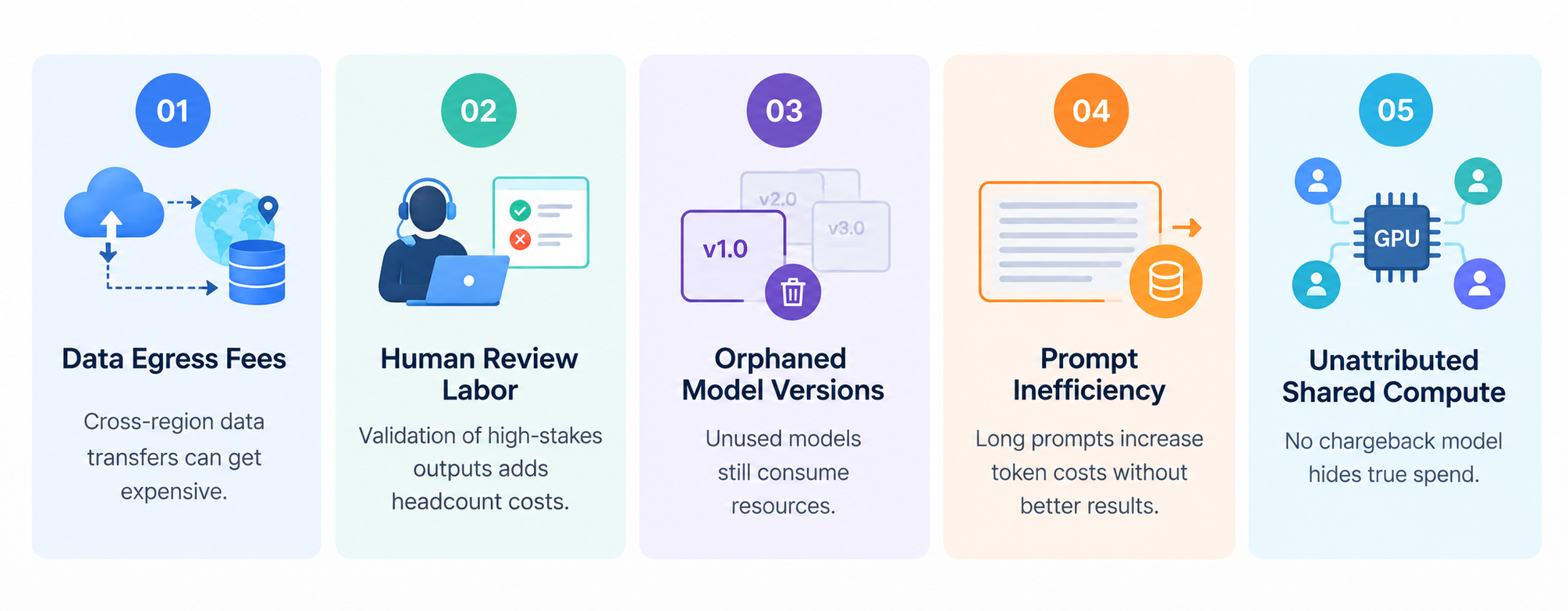
Data Egress Fees
Cross-region traffic between your model serving layer and your data tier adds up fast. Architects who co-locate inference endpoints with their primary data stores cut this category significantly.
Human Review Labor
Validation pipelines for high-stakes model outputs carry headcount costs. Budget them explicitly or they surface as surprise operational spend.
Orphaned Model Versions
Stale production models consume active resources. A monthly model inventory review is the fix.
Prompt Inefficiency
Verbose system prompts on high-volume endpoints inflate token counts without improving output quality. Audit your top three endpoints first.
Unattributed Shared Compute
Shared GPU pools without chargeback models hide true per-team spend. Without attribution, no team has an incentive to reduce consumption.
Implementation Roadmap: From Assessment to Optimization
Attempting every optimization at once is how teams lose the ability to attribute cost changes to specific interventions. A phased approach solves that. It also prevents the most common practitioner mistake: applying quantization before establishing a performance baseline, which makes silent accuracy regressions nearly impossible to detect until business metrics drop.
Phase 1: Complete the infrastructure audit, establish resource tagging standards across every active workload, and deploy cost anomaly detection. The milestone is a documented cost-per-inference figure for your top five endpoints. This phase isn't administrative overhead. It's the risk-control foundation everything else depends on.
Phase 2: Apply model quantization to your three highest-volume inference endpoints, configure auto-scaling policies tied to token throughput thresholds, and pilot spot instances on non-critical training jobs with checkpointing enabled. The milestone is measurable GPU utilization improvement above the 50 percent floor on at least one endpoint.
Phase 3: Implement chargeback models by business unit, evaluate multi-cloud cost visibility tooling, and consolidate containerized workloads onto a unified Kubernetes scheduling layer. The milestone is a live attribution dashboard with named team owners for every significant spend line.
Skip phase one, and phase two introduces risk you can't measure. Besides, the timeline to harness and master the various tasks listed across each phase may vary for every organization depending on the workforce and expertise.
How Signity Builds Cost-Efficient Enterprise AI Systems?
Signity's AI practice is organized across three disciplines, each addressing a distinct layer of the cost and capability problem that enterprise teams face at scale.
Enterprise AI Architecture
Architecture decisions made early determine your cost trajectory for years. Signity's team works across AI strategy, scalable system design, and technology selection to ensure your infrastructure matches actual workload patterns, not anticipated ones. Choosing the wrong compute tier at the design stage is far more expensive than any runtime inefficiency you'll face later.
AI Engineering and Implementation
On the implementation side, the practice covers generative AI, RAG (retrieval-augmented generation), AI agents, workflow automation, and enterprise integrations. Most teams underestimate integration complexity. That's where cost surprises typically appear, not in model training.
Infrastructure, Governance and Optimization
This is where AI cost management becomes a continuous practice rather than a one-time project. Signity covers cloud architecture, AI observability, security, compliance, production readiness, and ongoing optimization. Observability is the piece most teams skip until something breaks in production, and skipping it makes cost anomaly detection almost useless.
Learn how we we helped streamline AI governance while cutting review effort by 68% and making risk evaluations 4.2× faster. Read the case study
Conclusion
AI infrastructure cost is a function of architectural discipline, not budget size. Teams that treat AI cost management as a continuous practice, not a quarterly audit, scale without the burnout that breaks less structured programs.
Your next step is concrete. Start with the four-step infrastructure audit checklist: inventory active models, map workloads to compute tiers, calculate per-inference cost, and flag orphaned containerized workloads. Then prioritize your single highest-spend inference endpoint for quantization.
Assign a named owner to AI governance before your next planning cycle. Ownership without a name attached is just intent.
Overall, the organizations that lead on AI capability in 2026 won't be the ones spending the most. They will be the ones spending with the most precision.

Mangesh Gothankar


Ashwani Sharma
Achin Verma
Frequently Asked Questions
Have a question in mind? We are here to answer. If you don’t see your question here, drop us a line at our contact page.
What is a realistic GPU utilization target for enterprise AI workloads?

How does model quantization affect production accuracy?
When should an enterprise adopt a FinOps framework for AI?
What's the difference between workload consolidation and workload migration?
How do chargeback models differ from showback models in AI cost governance?