


.png?width=27&height=27&name=Group(1).png)

-1.svg)
-1.svg)


-2.svg)


%201-1.webp?width=148&height=74&name=our%20work%20(2)%201-1.webp)




.svg)






AI adoption across enterprises has moved far beyond experimentation; however, production is where most of the initiatives get delayed. Teams dedicate their most critical resources and time to choose the right model, only to watch the system buckle under the real -world load, compliance needs, scalability demand, and more.
As per a report from Gartner, by 2027, half of the AI initiatives will fail to reach production, and the reason is that the foundational architecture simply isn’t there. Despite the technology's proven potential, only about 2% of organizations have actually deployed AI agents at full scale.
The gap isn't intelligence; it's design. A well-planned AI model architecture is what separates a lasting operational asset from a pilot that never leaves the sandbox. This piece breaks down the components, patterns, and governance practices enterprises need to build AI systems that actually last. Also, understand how consulting an AI development company can help enterprises avoid the architectural gaps that stall most projects before they ever reach production.
 Generate
Key Takeaways
Generate
Key Takeaways

- AI model architecture is a system around the model, not the model choice.
- AI projects generally fail because of architecture, not the weak model
- There are five core layers, and those are data, model, orchestration, serving, and governance.
- Modern and federated patterns can better scale than centralized ones.
What Is AI Model Architecture in an Enterprise Context?
AI model architecture is a structural framework that helps support an AI system in production. It is basically a structured blueprint that defines how models are selected, connected, and governed within the organization’s IT ecosystem.
In an enterprise setting, this typically spans a model registry for tracking versions, an orchestration layer that coordinates workflows and agent behavior, and an inference layer that serves predictions at scale with acceptable latency.
This distinction matters because most enterprises still confuse "AI strategy" with "model selection." Choosing GPT or Claude, or an open-source model, is one decision among dozens. The architecture is what determines whether that model can actually operate reliably, securely, and cost-effectively once it's handling real traffic, real data, and real compliance requirements.
Why Most Enterprise AI Projects Fail to Scale
The reasons rarely have much to do with the model itself. About 60% of enterprises say the ROI on their AI investments has fallen short of expectations, and in most cases the models are performing fine. What's missing is everything around them.
1. Data Governance Treated as an Afterthought
Pipelines stay inconsistent or siloed because nobody owns the data quality problem until it's already causing trouble. Gartner expects 60% of agentic AI initiatives to stall in 2026 for exactly the reason that data is not ready even when the model is.
2. Model Drift Nobody's Watching For
A model trained on last year's patterns makes decisions on this year's data. This can be so frustrating, and it degrades quietly. Without monitoring in place, teams usually don't notice until outputs are already unreliable and someone downstream flags it.
3. Tools Bought before a Strategy Exists
Teams adopt platforms in whatever order budget allows, not in the order a coherent architecture would call for. The result is disconnected systems that get more expensive to maintain every quarter, with nobody able to explain why three teams are running three separate versions of the same workflow.
4. Technical Debt from Pilot Shortcuts
Shortcuts that get a pilot across the finish line rarely hold up once someone tries to scale it past one team. What worked for 50 users a week starts breaking in ways nobody planned for at 5,000.
None of this is a technology problem. It's an architecture problem, and it's why the next section is worth reading closely.
Core Components of a Production-Ready AI Architecture
Every enterprise AI system that actually survives contact with production has the same five pieces underneath it, whether the team building it called them that or not.
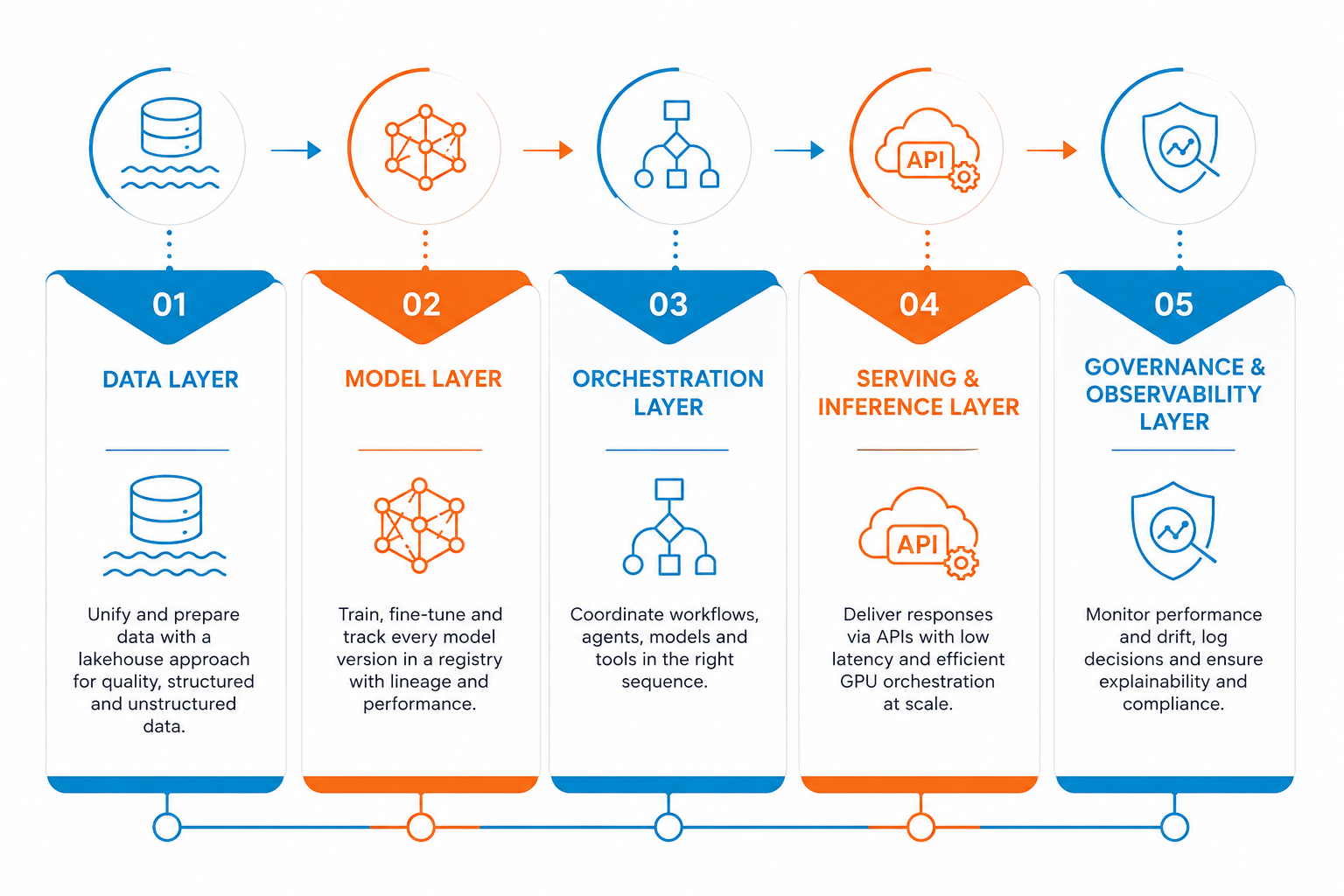
Data layer
Raw information has to get turned into something a model can use, and that's what is what the data layer helps with. The data lakehouse blends both the flexibility of a data lake and warehouse structure. This is vital because enterprise data is often too messy for a warehouse and too unstructured for a lake on its own. Skip this layer or build it badly, and every model downstream becomes a mess.
Model layer
Training and fine-tuning happen here, along with the job of knowing which version of a model is actually running in production right now. A model registry keeps a record of every version, what data trained it, and how it performed, so six months from now when something breaks, there's a trail to follow instead of a guess.
With fine-tuning, companies can use a general-purpose model like GPT-5 that adapts to the company's data. So there is no need to train the model from scratch, which is rarely worth the cost for enterprise use cases.
Orchestration layer
This is the layer getting the most attention right now, largely because agentic systems lean on it so much harder than older AI setups did. AI orchestration is the part that decides what happens first, second, and the entire sequence, also when a task involves multiple models, agents, or tools. Get it wrong, and a simple task like checking inventory before confirming a price can happen out of order, and nobody notices until a customer complains.
Serving and Inference layer
This is what actually puts a prediction or response in front of a user, usually through an API, in an amount of time people will tolerate. GPU orchestration lives here because inference is expensive to run at scale, and a serving layer that isn't planned properly either burns budget on GPUs sitting idle or makes users wait ten seconds for an answer that should take one.
Governance and observability layer
Most of the pilots do skip this layer, and that is the reason they don’t make it past pilot stages. It's what watches for model drift, keeps a log of the decisions an AI system makes, and lets someone explain why a model produced a specific output. Regulated industries can't deploy without it. Everyone else needs it too, usually right after the first time something goes wrong in production and there's no record of what happened.
Architecture Patterns to Choose From
There is no one correct way to structure the enterprise AI system. The right pattern depends on the access, department autonomy, and sensitivity of the data.
Centralized Architecture
Puts one AI platform at the center, serving every department from a single system. IT keeps full control, and there's one place to manage governance, but every team is waiting on the same roadmap, and a bottleneck in one place slows everyone down.
Modular architecture
Breaks the system into independent components, such as a data layer, a model layer, and an orchestration layer. These layers can be swapped or upgraded without rebuilding everything else. This is usually the best fit for enterprises planning to scale across multiple departments over time.
Federated architecture
Lets different departments or business units manage their own AI capabilities while still connecting to shared infrastructure. Federated learning, where models train across distributed data sources without that data ever leaving its original location, fits well here, particularly in industries like healthcare or finance where data can't be centralized for regulatory reasons.
| Pattern | Best for | Trade-off |
| Centralized | Smaller orgs, single use case, tight governance needs | Slower to scale, single point of failure |
| Modular | Enterprises scaling across departments | More upfront design work |
| Federated | Regulated industries, distributed data | Harder to maintain consistency across units |
Governance, Security, and Compliance by Design
Governance bolted on after a system is already live tends to be theater. It looks fine in a slide deck and does almost nothing when an auditor actually starts asking questions. The systems that pass real scrutiny built governance in from day one.
An AI gateway as the control point
Most AI models have no built-in concept of access control or identity management. An AI gateway sits between agents and internal systems and acts as the enforcement point. It actually decides who can touch what, gets out sensitive data before a model ever sees it, and keeps a record of every action. If you skip this, there's no single place to check what an AI system actually did last working day.
Human oversight where it actually matters
Not every decision needs a person watching. A recommendation for which article to read next doesn't. A six-figure transaction, or a decision that changes someone's healthcare coverage, does. Human-in-the-loop checkpoints let the low-stakes stuff run on autopilot while routing anything with real consequences to a person before it goes through.
Compliance you can't bolt on later
The EU AI Act requires an audit trail for AI-driven decisions, and that's one of those things that's nearly impossible to fake retroactively. Either the system was logging reasoning steps and outputs from the day it launched, or there's a gap in the record that shows up the moment a regulator asks for one.
Common Pitfalls in Enterprise AI Architecture
A few mistakes show up across almost every failed rollout, regardless of industry or company size.
Picking a model before the data is ready
Teams get excited about a model's capabilities and skip the less exciting work of checking whether their data can actually support it. The model isn't the problem later on. The data was never in shape to begin with.
Scaling the pilot instead of rebuilding for production
What works for 50 users in a controlled test rarely holds at 5,000 users with real data and real deadlines. Teams that try to stretch a pilot's architecture into a production system usually end up rebuilding it anyway, just later and under more pressure.
Recommended Post: Scaling AI for Enterprise: Your Executive Roadmap For 2026
Treating architecture as a one-time setup
Some teams build the system once and assume it'll hold. There is a shift in model performance, data sources, and new regulations can show up anytime. So if the architecture is not built in a way that it adapts, it will be of no use.
No clear owner for the system once it's live
A pilot has a champion pushing it forward. Production doesn't always have one. When nobody owns monitoring, retraining, or incident response after launch, small issues sit unresolved until they become big ones.
Underestimating what compliance will actually require
Teams often treat governance as a checklist to satisfy before launch rather than something that has to run continuously. Then a regulator or a customer asks for an audit trail that was never being kept.
Conclusion
Most of the AI projects generally fail, not because the model was wrong, but because nobody could build the layer underneath it to hold it for actual use. And that is where most of the time is spent. The data pipelines, orchestration that coordinates rather than doing guesswork, governance that is part of the system, and more.
The enterprises still running their AI systems years from now will be the ones that treated architecture as the foundation, not an afterthought. If your team is planning an AI rollout, get the architecture right before you get attached to a specific model. Reach out to Signity and let's map out what that architecture should look like for your business.

Mangesh Gothankar


Ashwani Sharma
Achin Verma
Frequently Asked Questions
Have a question in mind? We are here to answer. If you don’t see your question here, drop us a line at our contact page.
What is AI model architecture?

How is AI model architecture different from MLOps?
What makes an AI model production-ready?
Does agentic AI need a different architecture than traditional AI systems?





.png?width=352&name=Enterprise%20Agentic%20AI%20Architecture%20A%20Guide%20for%20Autonomous%20AI%20at%20Scale%20(1).png)
.png?width=352&name=agentic-ai-strategy-for-enterprise-software%20(4).png)