

.png?width=27&height=27&name=Group(1).png)

-1.svg)
-1.svg)


-2.svg)


%201-1.webp?width=148&height=74&name=our%20work%20(2)%201-1.webp)




.svg)





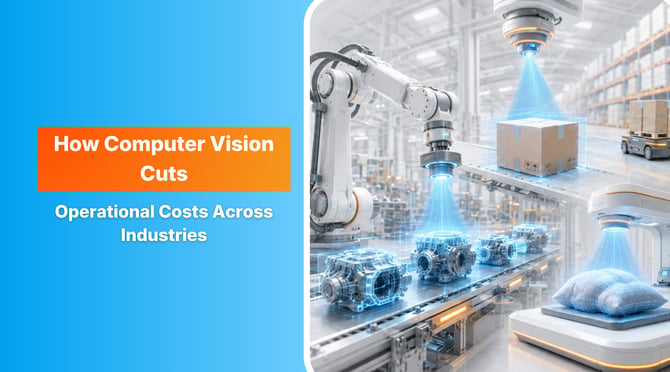
Computer vision used to be a demo shown once in an innovation lab and then forgotten. Now it runs the actual operation. Cameras and edge devices handle quality control and safety monitoring. Multimodal AI checks assets and flags compliance issues as the work happens, not after someone reviews the footage later.
Gallagher's 2026 AI survey, reported by TechRadar, found 86% of organizations say AI has improved productivity, but 43% still have no structured AI risk management framework in place. The gap shows up elsewhere too. A separate 2026 industrial adoption study found just one of twelve companies had reached multi-agent orchestration, with seven still stuck at the assistant level.
That gap matters. Having the models isn't enough. What separates the teams that benefit is governance, video and image data quality, and how well the tool fits their existing process. Various vision language models push this further. They combine visual and linguistic information, so a team can ask a plain question about an image or video instead of reviewing every frame by hand. Most organizations have already decided to adopt computer vision. What's left is figuring out where it pays off fastest.
 Generate
Key Takeaways
Generate
Key Takeaways

- Computer vision automates inspections and monitoring. It means people spend less time on manual reviews that used to be slow and error-prone.
- Vision language models add contextual reasoning, enabling natural language questions over visual evidence directly.
- Industries improve compliance, uptime, and throughput when visual AI is deployed with governance controls.
- Enterprise success depends on training data quality, architecture choices, integration, and partner capability discipline.
What Are Computer Vision Solutions?
Computer vision solutions use artificial intelligence to read image data and video. The system spots relevant objects and makes the kind of visual judgment call that used to need a person watching.
They typically combine:
- Artificial intelligence models for pattern detection
- Image classification for labeling what is present
- Object recognition and object localization for finding specific items
- Visual data interpretation for turning camera feeds into action
| Traditional Monitoring | Computer Vision |
| Human observation | Automated detection |
| Periodic checks | Continuous monitoring |
| Reactive actions | Predictive insights |
| Higher error rates | Improved accuracy |
The business value is simple. Cutting manual steps speeds up response times and gives teams tighter operational control.
How are vision language models expanding computer vision capabilities?
Vision language models combine visual and linguistic information, so an AI system reads an image, a video, and a text prompt as one input instead of three separate ones.
What Are VLMs?
VLMs, or vision language models, combine a vision encoder with large language models to understand visual and textual input within a workflow. They are also referred to as visual language models or vision language models VLMs.
In practical terms, VLMs let an AI system answer questions about an input image, describe scenes, and reason over what it sees. That is why search interest is rising around what VLMs are, LLM vision, and visual language models.
Key building blocks:
- Image encoder
- Vision encoder
- Language models
- Shared embedding space
- Text embeddings
- Image tokens
How VLM Architecture Works?
VLM architecture typically connects visual inputs to language outputs through a shared representation.
| Component | Function |
| Vision backbone | Extracts visual features |
| Pretrained vision encoder | Processes image input |
| Cross-attention layers | Align visual and text information |
| Text embeddings | Adds language context |
| Shared embedding space | Connects both modalities |
| Output layer | Generates answers or actions |
This is why modern systems can work on images interleaved with text, understand natural language prompts, and support more specific downstream tasks without separate pipelines.
Why VLMs Matter For Operations?
VLMs extend computer vision beyond detection into reasoning capabilities. They support visual question answering, image captioning, science question answering, and visual mathematical reasoning.
That matters because operations teams do not just need to know what is in an image. They need to know what it means, whether it is normal, and what to do next.
A 2026 industrial GenAI study reported 3-8x efficiency gains with SDPA attention on commodity GPUs for long-form video reasoning, showing that architecture choices directly influence cost and latency.
Related Read: Multimodal vs Standard LLM: Architecture Choice Drives Business AI ROI
How does computer vision improve operational efficiency?
Manual intervention and delays go down, and decisions happen faster since the system already has the intelligence it needs in real time.
| Business Function | Computer Vision Impact |
| Quality control | Automated inspections |
| Inventory management | Real-time tracking |
| Security | Continuous monitoring |
| Logistics | Faster processing |
| Maintenance | Predictive alerts |
| Compliance | Automated auditing |
Automating quality inspection
Computer vision catches defects on the line through image classification and object recognition. Factors like detecting the spatial features and semantic meaning of images allow fewer defects to slip through, and the product moves faster with less rework behind it.
Real-time monitoring and incident detection
Visual AI keeps watching video and image feeds without a break. When something deviates from expected behavior, it flags the object and sends an alert, cutting response time before an issue spreads across a plant or warehouse floor.
Faster operational decision-making
Visual reasoning takes teams out of the feed-scanning business. A manager gets a structured alert with a summary and a recommended action instead of watching a screen and hoping to catch the moment something goes wrong.
Predictive maintenance and asset reliability
Computer vision keeps an eye on equipment and catches wear, leaks, or misalignment before any of it turns into a failure. Downtime drops, and maintenance gets easier to plan around.
Industry Applications Driving Measurable Results
Computer vision improves efficiency differently by sector, but the pattern is the same: less manual work, more consistency, and better control.
Manufacturing
Computer vision enables assembly verification, defect detection, and robotics guidance. It improves output quality and reduces production line interruptions.
Logistics And Supply Chain
It supports warehouse monitoring, parcel identification, and inventory accuracy. That speeds fulfillment and reduces shrinkage.
Financial Services And Banking
This is one of the highest-value use cases because compliance pressure is constant. Computer vision enables KYC verification, document validation, fraud detection, transaction verification, audit trails, and regulatory readiness. For finance teams, the real value is not only speed. It is explainability, data governance, and traceability.
Healthcare
It improves medical imaging workflows, patient monitoring, and clinical review speed. That helps teams focus on high-risk cases sooner.
Retail
It enables shelf monitoring, customer flow analysis, and inventory visibility. That improves product availability and store execution.
| Industry | Primary Efficiency Gain |
| Manufacturing | Reduced defects |
| Logistics | Faster fulfillment |
| Finance | Compliance automation |
| Healthcare | Faster diagnostics |
| Retail | Inventory optimization |
Technical Architecture Behind Enterprise Computer Vision Solutions
Enterprise computer vision works best when data capture, model inference, and business action are designed as one system.
| Layer | Technologies |
| Data capture | Cameras, IoT sensors |
| Vision processing | Vision transformer, image encoder |
| Intelligence | VLMs, machine learning models |
| Action | Alerts, automation, dashboards |
| Enterprise systems | ERP, CRM, MES |
A strong architecture should support high-quality training data worked through large-scale datasets. It should harness robust model training that is fine-tuned for domain-specific tasks. More importantly, the system must aid model end-to-end deployment with low-latency processing for operational use
All in all, the right architecture can help reduce the cost of scaling from pilot to production.
Challenges Organizations Must Address Before Deployment
Computer vision delivers value faster when teams solve the right blockers early.
High-Quality Training Data
Training data quality drives performance. Public model dataset coverage is helpful, but enterprise use cases usually require image-text pairs, domain-specific image data, and robust annotation standards.
Model Complexity And Cost
More model complexity can improve capability, but it can also increase compute cost and latency. That is where fine-tuning and end-to-end model choices matter.
Security And Compliance
For finance and other regulated industries, deployment must account for data privacy, auditability, governance, and explainability. A 2026 trust-governance survey argues that industrial AI must be judged across quality, security, privacy, fairness, and explainability, not just accuracy.
Integration With Existing Systems
Computer vision only creates value when it fits into ERP, CRM, MES, and workflow platforms. Without integration, teams get alerts but not action.
How To Select The Right Computer Vision Development Partner?
A computer vision partner should be evaluated on the execution depth. Therefore, it is important to look for:
- AI expertise: hands-on experience with computer vision and VLMs, not just familiarity with the concepts
- Industry knowledge: domain-specific understanding of how the technology applies to your sector
- Architecture skills: the ability to deliver end-to-end, not just prototype
- Compliance experience: readiness for the regulatory requirements your industry actually enforces
- Scalability: a track record of enterprise-grade delivery, not pilot-scale projects
A strong partner should also help with implementation planning, cost estimation, and architecture decisions before any code gets written.
Why Signity's Proficiency in LLMs Matters?
Signity brings a strategic delivery advantage by combining engineering depth with enterprise execution. The strongest teams bring:
- Computer vision and machine learning capability
- VLM implementation experience
- Enterprise-ready delivery models
- Scalable architecture design
- Governance and compliance focus
- Faster time-to-value through tight iteration
The goal is not just to build a model. It is to build a production system that integrates and supports business control.
Conclusion
Computer vision has moved beyond automation into operational intelligence. When paired with vision language models, it enables contextual understanding, faster decisions, and stronger control across industries. The biggest gains come when organizations align data, architecture, compliance, and business workflows from the start.
For finance, the priority is clear: compliance, auditability, and explainability must be built in. For operations teams, the opportunity is equally clear: reduce manual work, improve quality, and accelerate decisions. Enterprises that treat computer vision as a governed system, not a point solution, will create the most durable efficiency gains.

Mangesh Gothankar


Ashwani Sharma
Achin Verma
Frequently Asked Questions
Have a question in mind? We are here to answer. If you don’t see your question here, drop us a line at our contact page.
What are vision language models?

How do vision language models differ from traditional AI models?
What are the most common computer vision use cases?
Can computer vision improve compliance in financial services?
How much training data is required for computer vision models?
What industries benefit most from LLM vision applications?
Are vision language models suitable for real-time operations?
How do organizations measure ROI from computer vision solutions?