


.png?width=27&height=27&name=Group(1).png)

-1.svg)
-1.svg)


-2.svg)


%201-1.webp?width=148&height=74&name=our%20work%20(2)%201-1.webp)




.svg)





Businesses are no longer asking whether to use AI. Most already have a pilot running somewhere inside their systems. What they are asking now is how to connect that pilot to the systems that carry revenue, customer data, and daily operations without breaking compliance or blowing the budget in the process. It is something that AI integration services cover.
Gartner's survey of infrastructure and operations leaders found that 48% cite integration difficulty as a top barrier to AI adoption. It is the second only to budget constraints. So, it is not about whether businesses want AI. Nearly all of them do. It is about the specific point where AI projects get stuck: connecting a model to the systems, permissions, and data that already run the business.
A model performing well in a sandbox and a model performing well inside a live CRM, ERP, or claims system are two different engineering problems. AI integration services address the second one, which is the one enterprises actually get paid on.
For this, most businesses start with AI consulting before committing any budget. Scoping the work properly costs less than fixing it after a failed rollout. Let’s check on what AI integration services cost. Why do most pilots stall before reaching production? And what separates the organizations seeing ROI from the ones still waiting?
 Generate
Key Takeaways
Generate
Key Takeaways

- Integration, not adoption, is the real barrier. Gartner ranks it second only to budget.
- A model performing well in testing differs from one performing well in production.
- IDC found only four of 33 AI proofs of concept reach production.
- Real costs sit in data readiness, integration, and governance, not the model fee.
- Governance built in from day one costs less than fixing it after an incident.
- Scoping a narrow workflow first produces a more accurate budget than pricing the model alone.
What AI Integration Services Actually Include
AI integration means wiring a model into the systems a business already runs on, not building something new next to them. The model itself, an LLM, a machine learning pipeline, or an agent, is rarely the hard part. Getting it to read from a CRM, write back to an ERP, or act inside a claims platform without breaking existing permissions is where most of the engineering work sits.
A few things fall under this work in almost every engagement:
-
Connecting the model to core systems, CRM, ERP, ticketing, or a claims platform, through APIs or custom middleware where no clean API exists
-
Access control. The model should only reach the data and actions it is cleared for, and that has to be enforced at the system level, not assumed
-
Cleaning and structuring internal data well enough that a model can actually use it, since most enterprise data was never built with this in mind
-
Putting the output somewhere a team already looks, inside the CRM or the ticketing queue, rather than a separate dashboard nobody checks after week two
This is also where artificial intelligence integration services differ from buying an off-the-shelf AI tool. A subscription tool comes preconfigured and rarely touches internal systems at all. An integration project starts with what already exists, the data, the permissions, the workflow, and builds around it. That difference is usually what decides whether a pilot survives contact with production.
Why Most AI Pilots Never Reach Production
MIT's research on enterprise generative AI found that 95 percent of pilots produced no measurable impact on profit or loss last year. Researchers traced most of that failure to tools that performed fine in testing but were never properly connected to the data, permissions, and workflows they were meant to run inside.
IDC's research, done with Lenovo, found that out of every 33 AI proofs of concept a company launches, only four reach production, and it named the cause as low organizational readiness across data, processes, and IT infrastructure, not the model itself.
Two conditions show up in nearly every stalled pilot. First, the pilots run on small, curated datasets built to make the demo work. While production data is duplicated, inconsistent, and full of gaps, nobody was looking for it at pilot scale.
And once the demo gets its applause, no one inside the business is usually responsible for the system. So, the errors accumulate quietly until finance or operations asks why the numbers look wrong. This is where most AI budgets go sideways. A pilot is scoped to prove an idea works. A production system has to survive real data, real users, and a compliance review it was never built to pass. Pricing one like the other is the most common mistake enterprises make, and it is where the cost breakdown needs to begin.
The Real Cost Drivers Behind AI Integration Services
The global AI integration platform market is projected to grow up to 88.3 billion dollars by 2033. That growth is not being driven by model prices going up. It is being driven by everything around the model that a pricing page never shows. Most AI implementation cost estimates start and stop at the model or API fee because it is the only number a technology partner can quote before scoping the actual work. In practice, that fee is usually the smallest line item on the invoice. Here is where the rest of the budget actually goes.
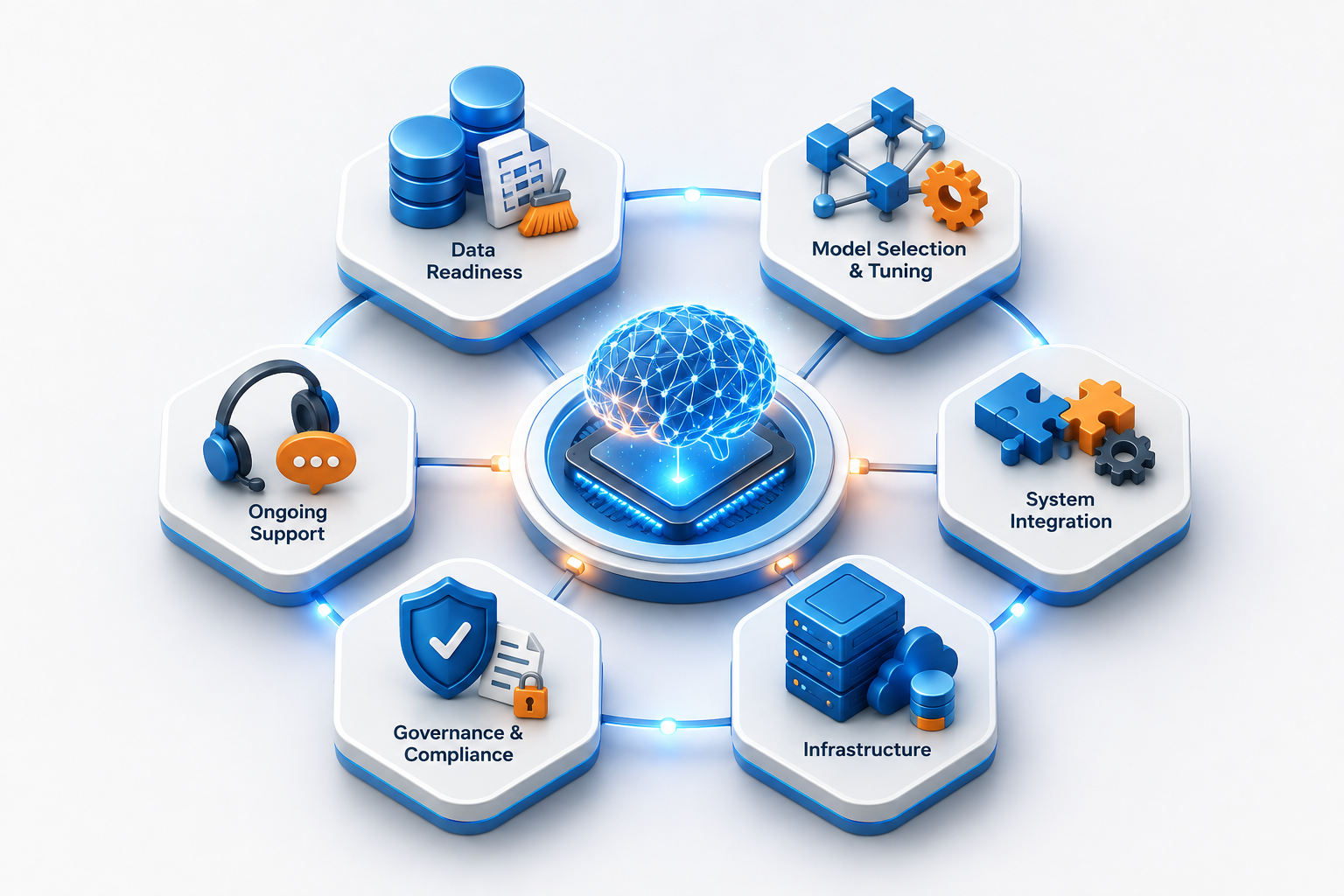
Data readiness
Most enterprise data was never built for a model to read. It sits duplicated across a CRM, half-updated in an ERP, and buried in spreadsheets someone maintains manually. Auditing and structuring all of that takes real time, and it gets missed in early budgets because the pilot ran on a clean, cherry-picked dataset that looked nothing like what production actually holds.
Model selection and tuning
This is not just picking whichever model scores highest on a public benchmark. It means testing candidates against the company's own data, building retrieval that actually pulls the right context, and fine-tuning until output is consistent, not just occasionally impressive. Solution providers just price the model. The iteration work to make it reliable is a separate cost nobody quotes upfront.
System integration
Legacy systems without modern APIs are where budgets get hit hardest. Every system without a clean interface needs middleware built from scratch, and each one has to be tested individually before anything touches production. Teams routinely underestimate how many systems end up in scope once integration work actually starts.
Infrastructure
A pilot running for a dozen test users tells you almost nothing about what compute, storage, and monitoring a production system needs under real concurrent load. Vector databases in particular are sized wrong more often than not, because nobody stress tests a demo. This line item grows after launch, not before it, and by then it is harder to negotiate.
Governance and compliance
Access controls, audit logs, explainability documentation, regulatory alignment, none of this is optional once a system touches real customer data, but proof of concept work is usually exempt from formal review. So it gets skipped, quietly, until legal or security asks a question nobody has an answer for.
Ongoing support
The build is not the end of the cost. Models drift as data and business context shift, prompts need retuning, pipelines need monitoring. Most of this cost shows up three or four months after a project has already been marked complete and taken off the budget sheet.
Of these six, three are where budgets most consistently blow past the original estimate: data readiness, system integration, and governance. Model tuning and infrastructure costs are comparatively easier to forecast, since they scale in fairly predictable ways once a workflow is scoped.
Data readiness and system integration are harder to predict upfront because they depend on the actual condition of a company's existing systems, which is rarely known in detail before the work starts. Governance is different again. It is not hard to predict, it is just routinely left out of the first conversation entirely, and it is the one most likely to resurface later as a compliance finding rather than a budget line.
Where AI Integration Services Deliver Measurable ROI
Return on AI integration services is easiest to prove where the workflow is high volume, repetitive, and already measured. Harder to prove, at least in year one, is anything touching decision support or customer experience, where the baseline itself is difficult to define. Enterprises that structure ROI conversations around business function, rather than around the technology itself, tend to set more realistic expectations with finance and leadership.
-
Document and claims processing: Structured extraction and classification reduce manual review time on high-volume paperwork. In one claims processing engagement, we built an AI system that automated document intake and eligibility checks for an insurance client, keeping a human reviewer in the loop for exceptions, as detailed in this case study.
-
Tier one support: AI assistants resolve routine queries without escalation, freeing support teams for cases that need judgment.
-
Internal knowledge retrieval: Employees get answers from internal documentation and policy without searching across disconnected systems.
-
Agentic workflows: Multi-step tasks, such as routing an approval or verifying a compliance condition before triggering a downstream update, run with less manual handoff. A closer look at where this applies is covered in this breakdown of AI integration use cases across functions.
Organizations that struggle to prove ROI are usually the ones that measured only the model's output quality and never tracked the operational metric it was meant to move, such as resolution time, error rate, or throughput.
Compliance and Security Now Shape the AI Integration Budget
Governance used to be a final review before launch. In regulated and data-sensitive industries, it now shapes the architecture from day one, and it is the cost category most often missing from an initial quote.
| Governance Area | What It Requires | Business Risk If Skipped |
| Access and permissions | Role-based access limits on every connected system | Data exposure across departments |
| Audit logging | A record of every AI request and action taken | No way to trace decisions during an incident |
| Explainability | Documentation behind regulated outputs | Regulatory exposure in finance, healthcare, insurance |
| Data privacy boundaries | Defined limits on what data AI can access or move | GDPR, HIPAA, or sector violations |
| Vendor and model risk review | Vetting third-party models before deployment | Dependency on an unvetted provider |
Building these controls in from the start costs less than retrofitting them after a security review flags a gap, and far less than the cost of an actual incident. For enterprises in finance, healthcare, and insurance, this layer decides whether a provider ships a working system or just a working demo.
A Practical Framework for Budgeting AI Integration Services
Enterprises that get their AI implementation cost estimate closest to reality tend to follow a similar sequence, regardless of industry or use case.
1. Scope the narrowest useful workflow first
A single process, one data source, and a contained integration surface keep every cost category smaller and easier to validate.
2. Audit data readiness before selecting a model
Data quality problems discovered mid-build are the most expensive to fix. Assess this first, even partially, before model work begins.
3. Budget build and run separately
The cost to implement AI in business does not end at launch. Monitoring, retraining, and support are recurring costs that belong in the same conversation as the initial build.
4. Assign ownership before go-live
Systems without a named internal owner accumulate drift, ungoverned changes, and deferred maintenance faster than systems with one.
5. Treat governance as a line item, not an afterthought
Compliance and security work is cheaper when it shapes the architecture from the start rather than getting added after a review.
This sequence will not produce an exact number before a project is scoped, but it consistently produces a more defensible one than estimating from a model's pricing page alone.
How Signity Solutions Builds AI Integration Differently
Signity Solutions works from an AI-first development method, meaning AI is designed into the product, workflow, and engineering process from the beginning rather than bolted onto a finished system afterward.
For enterprise and mid-market teams, this changes what the first few weeks of a project actually look like. Data audit and architecture planning happen before model selection, not after it.
That approach carries through to how compliance and security get built, not added:
-
Data governance, access control, and audit requirements are scoped as part of the architecture from day one, not handed off as a separate workstream once the build is underway
-
The same team that scopes the workflow also builds the integration layer, the security controls, and the ongoing monitoring, so nothing gets lost handing a project between vendors mid-build.
-
Services coverage spans AI development, agentic AI systems, generative AI, AI consulting, data engineering, and cloud infrastructure, which keeps ownership with one team instead of splitting it across specialists who never talk to each other
If your organization is scoping an AI integration project or trying to figure out why an existing one has not moved past the pilot stage, a direct conversation is worth more than another tech provider deck.
Our Chief AI Innovation Officer works one on one with enterprise and mid-market leaders on exactly this problem, having spent years helping businesses move AI from a demo that impressed a room to a system that actually runs the business.
Book a session before you finalize next quarter's AI budget, not after.

Mangesh Gothankar


Ashwani Sharma
Achin Verma
Frequently Asked Questions
Have a question in mind? We are here to answer. If you don’t see your question here, drop us a line at our contact page.
What is included in AI integration services?

How much do AI integration services cost?
Why do most AI integration projects fail to scale?
What is the difference between AI integration and AI development?
Is AI integration worth the investment for mid-market companies?





.png?width=352&name=Enterprise%20Agentic%20AI%20Architecture%20A%20Guide%20for%20Autonomous%20AI%20at%20Scale%20(1).png)
.png?width=352&name=How%20Much%20Does%20AI%20Development%20Cost%20(1).png)