


.png?width=27&height=27&name=Group(1).png)

-1.svg)
-1.svg)


-2.svg)


%201-1.webp?width=148&height=74&name=our%20work%20(2)%201-1.webp)




.svg)





.png?width=670&height=445&name=Enterprise%20Agentic%20AI%20Architecture%20A%20Guide%20for%20Autonomous%20AI%20at%20Scale%20(1).png)
Enterprise agentic AI architecture rarely fails in the early deployment. It fails once the demo needs to talk to the ERP, or the CRM, or whatever else already runs the business. As none of it gets built with an AI agent in mind.
A 2026 Forrester study found only 26% of enterprises have actually operationalized AI, and integration complexity was the single most common reason cited. Most of that complexity exists in the architecture. Depending on which existing systems an agent needs to touch, what access it needs, and what has to be rebuilt before it can touch those systems safely.
This guide covers that build in order, the same sequence enterprises work through when scoping agentic AI services for a first deployment.
 Generate
Key Takeaways
Generate
Key Takeaways

-
Agentic AI architecture usually breaks once agents must reach existing enterprise systems.
-
Four layers, memory, reasoning, tools, and orchestration, structure every enterprise agent.
-
Governance rests on four checks: autonomy limits, human sign-off, audit trails, monitoring.
-
Staged builds validate each layer before the next stage adds complexity.
-
Only 21% of enterprises run a mature governance model for agentic AI.
What Enterprise Agentic AI Architecture Means and How It Differs From Traditional AI Architecture
Enterprise agentic AI architecture is the technical structure that allows AI agents to observe a task, decide a course of action, execute that action across enterprise systems, and adjust based on the outcome. All without a person issuing each individual instruction. It sits above the data, AI model, and compute layers already present in most enterprise AI environments and adds components those environments were not originally built to support. It includes persistent memory, multi-step reasoning, tool invocation, and coordination across more than one agent.
Contrarily, a generative AI application produces content or a recommendation and stops, leaving a person to decide what happens next. An AI agent takes that same output and acts on it directly inside a business system, which is why enterprise agentic AI architecture carries governance requirements that a standalone generative AI deployment does not.
Traditional IT infrastructure and traditional AI architecture are both built to answer a request. A transactional system processes an input against fixed business rules, and a machine learning model receives an input and returns a prediction or a generated response, with the interaction ending there.
Enterprise agentic AI architecture is built to complete a business process end to end. An agent handling invoice reconciliation reads data from an ERP system, checks it against a vendor record, flags a discrepancy, and routes an approval, all without a person prompting each step along the way. This difference of a single-turn response from a multi-step execution changes what the surrounding AI infrastructure has to provide across every layer of the stack.
Three requirements follow from this shift.
- The architecture needs state that persists between steps, so an agent resuming a task after an interruption picks up where it left off instead of restarting the workflow.
- It needs access controls that scope what an agent can touch across existing systems, limiting a customer service agent to read access on order records rather than write access to payment systems.
- It needs continuous monitoring that tracks what an agent actually did against defined business objectives, since the gap between instruction and action is where most production incidents originate.
Agents that reason across multiple steps and call external tools also consume more compute resources per task than a single inference call against a large language model. Enterprises that do not plan for this during infrastructure management typically discover the gap once agent usage scales past a pilot group.
Businesses that have already mapped their AI enterprise architecture, the data, model, and governance layers covered in this guide on how to build enterprise AI architecture, are typically better positioned to add this agentic layer without redesigning the foundation underneath it.
The Key Components of Enterprise Agentic AI Architecture
Enterprise agentic AI architecture breaks down into four components. Each one does a different job. From moving an agent from a task assignment to a finished action inside a live business system, each comes with its own engineering and governance needs.
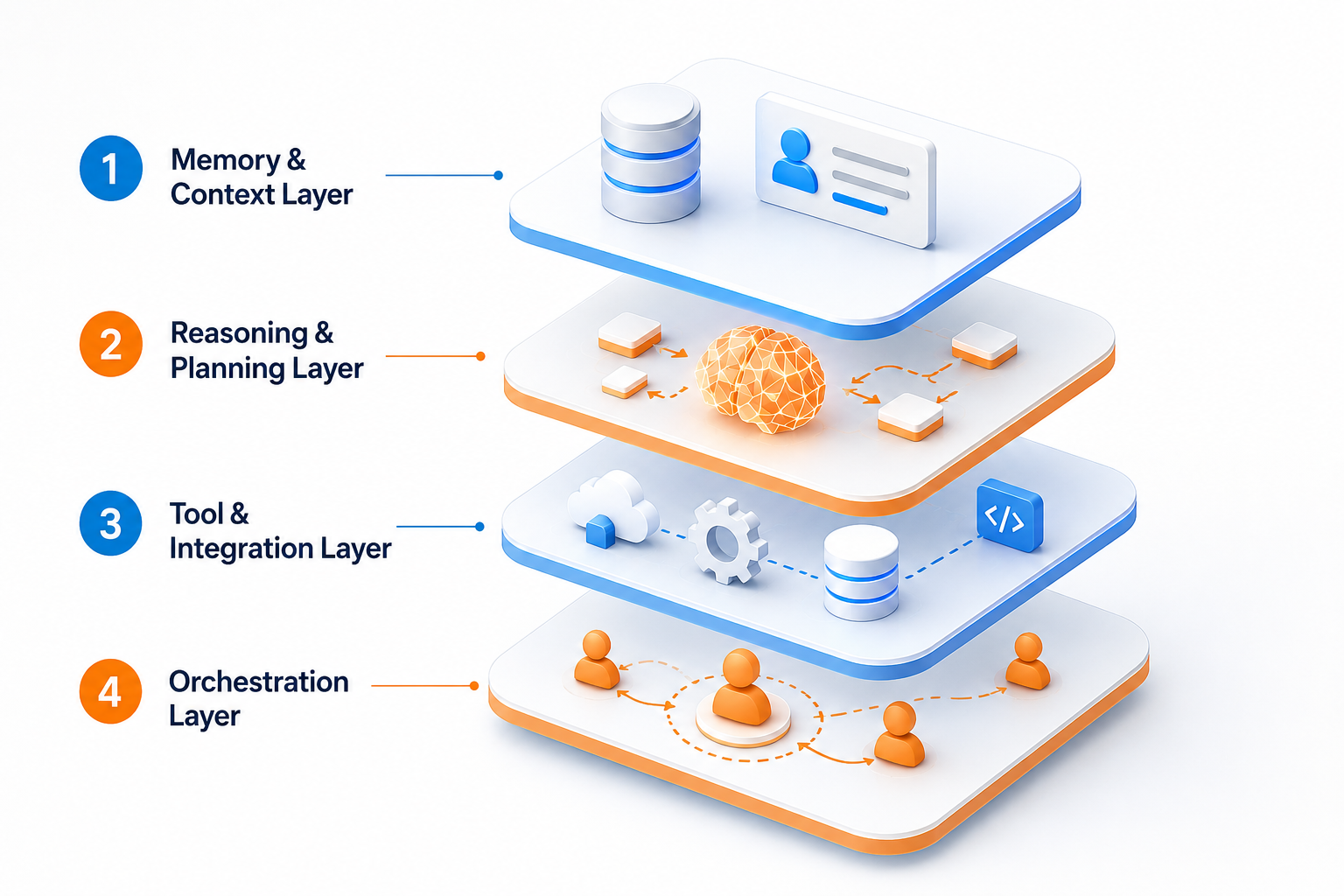
Layer 1: Memory and context layer
Stores short-term task state and longer-term interaction history, so an agent can resume work across sessions instead of starting cold every time it's invoked.
Layer 2: Reasoning and planning layer
Takes a stated goal and turns it into an ordered set of steps the agent can run and revise as conditions change, usually drawing on the same large language models already deployed for other generative AI applications.
Layer 3: Tool and integration layer
Connects the agent to enterprise systems such as CRM, ERP, ticketing platforms, and internal APIs, increasingly through model context protocol connectors that give agents a consistent way to access data and call these systems instead of requiring a custom integration for every tool.
Layer 4: Orchestration layer
Sequences multiple agents, manages handoffs between them, and resolves conflicts when two agents act on the same resource at the same time.
Enterprises standardizing on a smaller set of AI tools across these integrations generally spend less time maintaining custom connectors as their agent portfolio grows. Machine learning operations and prompt management practices typically sit alongside these four layers, tracking how agent instructions change over time and flagging when a modification affects downstream behavior across a live business process.
Autonomy and Governance Decisions Enterprise Agentic AI Architecture Must Address
Every enterprise agentic AI architecture has to answer a specific question before an agent goes into production: which decisions can this agent make on its own, and which ones require a person to confirm first.
Deloitte's 2026 State of AI in the Enterprise report found that only 21% of enterprises currently operate a mature governance model for agentic AI. The difference between deployment ambition and governance readiness shows up most often at four specific points in the architecture.
- Autonomy boundaries, a defined set of actions an agent can execute without approval, such as read access to a CRM system paired with no write access to a payment or billing system
- Human checkpoints, mandatory sign-off before an agent commits an action with financial, legal, or customer-facing consequences, built into the workflow rather than left to the agent's discretion
- Audit trails, a record of every decision, input, and action an agent takes, structured in a format compliance and regulatory teams can review after the fact
- Real-time monitoring, continuous tracking of agent behavior against expected patterns, so a deviation triggers a review before it reaches a customer or a system of record
Security controls and data security measures applied at this stage also determine how agent activity is treated during a regulatory audit, since auditors increasingly expect the same documentation trail already required for other automated financial or clinical decision systems. Enterprises that skip this step often discover the difference only after an agent takes an action outside its intended scope. At this point the fix requires redesigning the architecture rather than adjusting a policy document.
Enterprises operating in regulated industries, financial services and healthcare among them, generally build architecture security into enterprise agentic AI architecture before the first agent is deployed, treating governance as an architecture requirement rather than a compliance step added once an incident has occurred.
How to Build Enterprise Agentic AI Architecture in Stages
Enterprises that scale enterprise agentic AI architecture successfully tend to follow a staged build sequence instead of deploying several agents at once. Bain's 2025 Technology Report, one of the more widely referenced enterprise AI architecture frameworks for sequencing this build, found that AI leaders following a staged approach recorded EBITDA gains between 10% and 25% from early agent deployments before expanding further.
Stage 1: Information retrieval
The agent answers questions by pulling and summarizing information that already sits inside enterprise systems, nothing it wasn't already permitted to see. This stage runs on a data layer connected to a large language model through retrieval-augmented generation, so responses stay grounded in actual company data rather than general knowledge.
The most common first deployment here is an agent that answers policy or process questions from an internal knowledge base, cutting repetitive tickets to IT or HR without touching any system that could cause damage if something went wrong.
Stage 2: Single-task workflow
The agent completes one task end to end, without a person handing off each step along the way. This requires a tool and integration layer with access controls scoped tightly enough that the agent can act. But only within a defined boundary, such as reading a ticket, categorizing it, and routing it, without touching billing or account settings. Support ticket processing is the standard Stage 2 use case, since the task is well-defined, volume is high, and the cost of an error is low.
Stage 3: Cross-system orchestration
The agent now coordinates a workflow across more than one system, pulling data from an ERP, checking it against a vendor record, and flagging discrepancies for approval. This stage needs an orchestration layer built on top of the integration work from Stage 2, plus an audit trail and monitoring that can trace exactly what the agent did and why. Invoice reconciliation across ERP and vendor systems is the typical example, where the value comes from eliminating manual cross-referencing, not from any single system connection.
Stage 4: Multi-agent coordination
Multiple agents now work on interdependent parts of the same process with minimal human routing between them. This is where the full governance layer matters most: autonomy boundaries for each agent and a way to resolve conflict when two agents need the same resource at the same time. Insurance claims processing is a clear example, one agent handles intake, another verifies coverage, a third calculates payout, and the architecture has to keep their outputs consistent without a person manually passing the file between them.
We've deployed agentic systems across finance, healthcare, and retail clients, and most of these engagements begin at Stage 2 rather than attempting Stage 3 or Stage 4 on a first release. Well-scoped single-agent projects typically move from initial scoping to production in 8 to 14 weeks, a pattern we've broken down in our guide to enterprise AI agent deployment.
Enterprises that attempt Stage 3 orchestration before Stage 2 architecture has run in production for several months tend to spend that time debugging integration failures instead of adding new capability. Each stage validates a specific part of the architecture: Stage 2 confirms that access controls and monitoring work correctly for one agent before Stage 3 asks the same architecture to coordinate several agents across shared data pipelines. Enterprises that document these validation checkpoints as part of their build plan give engineering and compliance teams a shared reference for when a project is ready to advance to the next stage.
How Signity Solutions Supports Enterprise Agentic AI Architecture Delivery
We have been building enterprise agentic AI architecture for mid-market and enterprise organizations that need agents operating inside regulated, compliance-heavy environments without disrupting existing systems.
Our teams have delivered more than 120 enterprise AI projects, working with CTOs, CIOs, and product leaders who need measurable business outcomes without adding technology complexity to their existing stack. Across these engagements, the architecture decisions made in the first several weeks of a project tend to determine how much of that complexity gets absorbed by the platform rather than passed on to internal teams.
- Fit-for-purpose builds, matching the architecture stage, from single-task agents through multi-agent orchestration, to what a client's existing systems and internal team can realistically support and maintain
- Compliance-ready delivery, building autonomy boundaries, audit trails, and access controls into the architecture from the first release, rather than retrofitting them after a regulatory review
- Enterprise-grade data security, applying the same security controls to agent-accessed data as to any other production system handling customer or financial information, including encryption and access logging
For enterprises automating decision-heavy workflows with coordinated agents, Signity's enterprise AI automation services extend this architecture into live business operations, covering workflow execution and cross-system coordination beyond a single department.

Mangesh Gothankar


Ashwani Sharma
Achin Verma
Frequently Asked Questions
Have a question in mind? We are here to answer. If you don’t see your question here, drop us a line at our contact page.
What data foundation does enterprise agentic AI architecture need?

How do enterprises move data into an agentic AI system safely?
What compute and model infrastructure does enterprise agentic AI architecture run on?
What governance standards apply to enterprise agentic AI architecture?
What business outcome does enterprise agentic AI architecture actually deliver?






.png?width=352&name=Enterprise%20AI%20Agent%20Deployment%20A%20Production%20Ready%20Guide%20(2).png)