


.png?width=27&height=27&name=Group(1).png)

-1.svg)
-1.svg)


-2.svg)


%201-1.webp?width=148&height=74&name=our%20work%20(2)%201-1.webp)




.svg)





McKinsey's State of AI research puts adoption at nearly 90% of enterprises using AI in at least one business function. So running a single model inside a single workflow was never going to be the finish line.
Most organizations are already juggling multiple large language models and several specialized agents. However, only a few have wired these pieces into one coherent system. This is where AI orchestration platforms come in.
Gartner's numbers make the scale problem obvious. The average Fortune 500 enterprise is expected to run more than 150,000 AI agents by 2028, up from fewer than 15 in 2025. At that point, the question isn't whether a business can build an agent anymore. It is whether it can govern and monitor hundreds of them without losing coordination and control.
Fragmented pilots don't scale on their own. They need routing logic, shared context, audit trails, and a way to fail safely. That's the gap AI orchestration platforms fill. Models and agents run through one control layer. Workflows and enterprise data flow through it too. Governance sits on top, and business outcomes are what it's all measured against.
This guide covers how that layer is architected. Besides, we will talk about features that separate production-ready platforms from prototypes. On top of that, we will find out how leading orchestration tools compare in 2026.
 Generate
Key Takeaways
Generate
Key Takeaways

- AI orchestration platforms coordinate models and agents. Workflows, tools, and enterprise data all run through the same central layer.
- Enterprise orchestration improves governance and scalability. It also brings visibility and operational consistency to production systems.
- Multi-agent systems need orchestration layers for delegation and monitoring. Context sharing and decision-making depend on that same layer.
- Platform selection comes down to architecture and integrations. Compliance requirements and deployment flexibility matter just as much.
What Are AI Orchestration Platforms?
AI orchestration platforms are software systems. They coordinate AI models and agents and workflows and tools and enterprise data sources through a centralized orchestration layer. They manage execution and governance. They handle context sharing, monitoring, and automation across complex AI workflows. The result turns isolated AI components into one auditable system.
The term covers a range of activity. AI workflow orchestration handles the sequencing of tasks across models and tools. AI agent orchestration coordinates autonomous agents that plan and decide and hand off work to each other. Enterprise AI orchestration adds the governance layer on top of both. That means identity and access. It means budgets and audit trails across every model call. A single AI model completing one task independently is the simple case. Multi-agent systems are different. Several specialized agents collaborate toward one goal. That's where orchestration stops being optional.
| Without Orchestration | With Orchestration |
| Isolated models | Connected AI systems |
| Manual workflows | Automated workflows |
| Limited visibility | End-to-end observability |
| Fragmented governance | Centralized governance |
| Higher costs | Optimized resource usage |
Why AI Orchestration Has Become Essential in 2026?
AI orchestration enables enterprises to scale AI systems beyond isolated pilots into production-ready business operations.
Agent Explosion Is Creating Operational Complexity
Gartner's 2026 research puts a number on this shift. The average global Fortune 500 enterprise will run more than 150000 AI agents by 2028. That's up from fewer than 15 in 2025. This is not a gradual increase. It outpaces how most IT organizations manage software today. Left ungoverned, this growth produces agent sprawl. Different teams build duplicate agents. Permissions turn inconsistent. No single inventory tracks what is running where. Only 13% of organizations believe they have the right governance in place to manage it, according to the same research.
Enterprises Need Connected AI Systems
Analyst firms including IDC frame this around five moving parts. Agents, data flow, governance, applications, and a central control plane all have to work together. Silos break that. When these pieces sit apart, teams end up rebuilding the same authentication, logging, and routing logic inside every new workflow. A shared orchestration layer removes that duplication. Every application gets the same rules instead: for tool management, data access, and agent performance monitoring.
Governance Is Becoming a Business Requirement
Deloitte's 2026 State of AI in the Enterprise survey covers 3235 leaders across 24 countries. It found that 74% of organizations expect to use agentic AI at least moderately within two years. Only 21% currently have a mature governance model for autonomous agents. And 73% name data privacy and security as their top AI risk.
Gartner projects the fallout directly. More than 40% of agentic AI projects will be canceled by the end of 2027. The reasons come down largely to unclear ROI and weak governance. Compliance and audit trails are part of what separates a pilot that survives procurement from one that gets shut down. So are access controls and human intervention points.
Related Read: 30+ AI Agent Use Cases for Business Success
AI Orchestration Platform Architecture Explained
An AI orchestration architecture connects AI models, agents, enterprise systems, governance controls, and execution workflows through a centralized coordination layer.
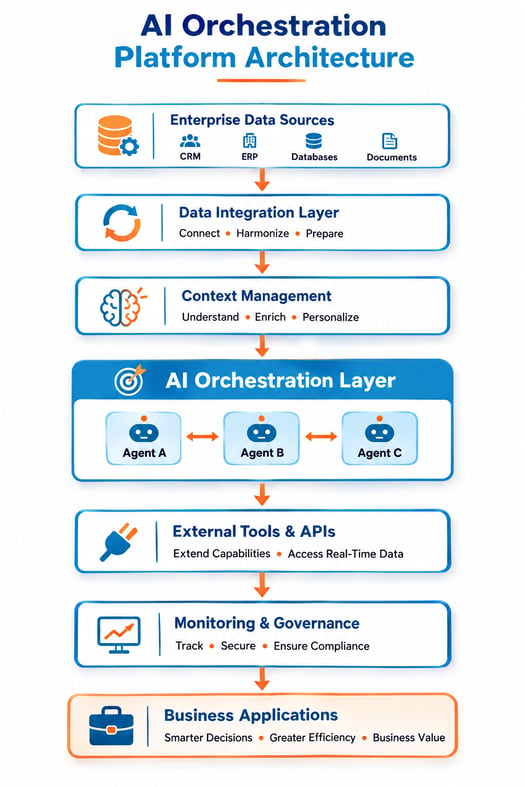
Data Integration Layer
This layer connects enterprise data sources, including CRM records, ERP systems, databases, and unstructured documents, into a format agents can use. For unstructured data sources like PDFs and knowledge bases, retrieval augmented generation lets agents pull relevant context without retraining a model on every update, keeping responses grounded in current data rather than a fixed knowledge cutoff.
Context Management Layer
Multi-agent systems fail quietly when agents lose shared context between steps. This layer maintains that context through shared memory and active context windows. An agent picking up a task mid-workflow gets the same information as the agent that started it. Without this layer handoffs turn into information loss. Agents end up repeating work. Or they decide based on outdated data.
Orchestration Layer
This is where task decomposition happens. One objective gets broken into steps. Each step gets routed to the right agent or tool. What happens next depends on the result. Agent logic lives here too. That includes retry rules for when an agent fails. It also includes fallback paths that keep a workflow moving instead of stalling.
Agent Execution Layer
Multiple specialized agents execute here, each scoped to a narrow set of tasks rather than one generalist model doing everything. Autonomous agents call external tools through function calling. They query databases. They trigger actions in other systems. Multi-agent workflows route work by task type. One agent classifies. Another drafts. A third validates before output reaches a human or downstream system.
Governance & Observability Layer
Every action in the layers below gets logged here: audit trails, model calls, tool usage, cost per task, and latency. Monitoring and data governance controls sit alongside compliance checks and role-based access, and human intervention points trigger automatically when confidence drops below a set threshold or a decision carries enough risk to require sign-off.
Must-Have Features in Enterprise AI Orchestration Platforms
Enterprise orchestration platforms have to manage scale, governance, integrations, and operational visibility at the same time, not as separate add-ons bolted on later.
| Feature | Why It Matters |
| Multi-agent orchestration | Coordinates specialized agents toward one goal |
| Workflow management | Automates execution across multiple steps |
| Context management | Keeps agent decisions consistent across a workflow |
| Tool management | Connects external tools and APIs safely |
| Function calling | Lets agents execute real actions, not just generate text |
| Governance controls | Reduces compliance and regulatory risk |
| Audit trails | Improves accountability for every agent action |
| Lifecycle management | Supports scaling from pilot to production |
| Data governance | Protects enterprise data across every workflow |
| Monitoring | Tracks agent performance and flags failures early |
Multi-agent coordination. Specialized agents need to hand off work, share results, and resolve conflicts without a human stepping in for every handoff.
Workflow automation. DAG-based and cyclical workflows both need retries, timeouts, and circuit breakers built in for when a tool call fails.
Human-in-the-loop approvals. High-risk decisions should pause for review automatically, based on configurable confidence thresholds, not blanket rules that slow every task.
Security controls. Identity-based access, encrypted credentials, and least-privilege permissions keep agents from reaching data or tools outside their scope.
Cost optimization. Token usage and infrastructure spend need visibility per agent and per workflow, not one aggregate bill at month's end.
Observability. Teams need to see why an agent made a decision, not just that it made one, especially when debugging a production failure.
Best AI Orchestration Platforms Compared (2026)
The best AI orchestration platform depends on technical complexity, governance requirements, deployment flexibility, and enterprise scale, not on a single "best overall" pick.
These platforms solve orchestration from different layers of the stack: some are developer frameworks for building agent logic, others are managed infrastructure, memory layers, or governance platforms that sit above those frameworks. A useful comparison has to account for that difference, since a framework and a platform are not competing for the same job.
| Platform | Best For | Strength |
| LangGraph | Complex, stateful agent systems | Durable execution with branching and cycles |
| CrewAI | Multi-agent collaboration | Role-based agent teams |
| Microsoft Copilot Studio | Microsoft-standardized enterprises | Native Azure and 365 integrations |
| Kestra | Workflow orchestration | Declarative, event-driven automation |
| TrueFoundry | Production AI operations | Combines MLOps with governed orchestration |
| Domo AI | Business intelligence workflows | Orchestration tied to governed analytics data |
| Redis | Agent memory management | High-performance context and state retrieval |
| Salesforce Agentforce | Customer operations | CRM-native agent orchestration |
LangGraph and CrewAI define how agents execute; they do not govern what those agents can access once deployed. Governance-focused platforms like TrueFoundry sit above frameworks such as these, adding identity, budgets, and audit trails without rewriting agent logic.
Cloud-native options like Microsoft Copilot Studio and Salesforce Agentforce trade framework flexibility for tight integration inside an existing ecosystem, which works well when an organization is already standardized on one cloud or CRM. Redis fills a narrower gap: sub-millisecond memory and context retrieval for agents coordinating in real time. Domo AI approaches orchestration from the analytics side, connecting agents to governed business intelligence data rather than starting from agent logic.
Evaluate each option against:
- Architecture flexibility
- Governance capabilities
- Integration depth
- Monitoring and observability
- Scalability under production load
- Overall enterprise readiness.
How to Choose the Right AI Orchestration Platform?
Choose an AI orchestration platform based on architecture requirements, compliance obligations, deployment model, integration complexity, and long-term scalability goals, not on a feature checklist alone.
| Requirement | Recommended Focus |
| Multi-agent systems | Agent orchestration frameworks |
| Regulated industry | Governance and compliance capabilities |
| Large enterprise | Centralized enterprise orchestration |
| Existing cloud ecosystem | Native integrations over best-of-breed |
| Cost optimization | Resource and token usage management |
| Maturing AI operations | Lifecycle management tooling |
Architecture decisions made early are expensive to undo later. A platform chosen for a quick pilot rarely holds up once agent count and data sensitivity increase, so it is worth evaluating compliance and security requirements before the first production workflow ships. Cost considerations matter just as much: token-based pricing that looks reasonable at pilot scale can turn unpredictable at thousands of tasks a day. Vendor lock-in is the risk most often underweighted here. A platform that ties workflows to one model provider or one cloud removes the flexibility to swap components as pricing and capabilities shift.
Why Enterprises Choose Signity for AI Orchestration Implementation?
Platform selection is one part of the equation. Getting an orchestration architecture into production, and keeping it governed as it scales, depends on staying current with how the underlying technology and best practices actually move.
Signity works with organizations to:
- Design enterprise AI architecture around real workflow requirements
- Build multi-agent systems that hold up under production traffic
- Implement AI workflow orchestration across existing tools and data
- Deploy retrieval augmented generation grounded in an organization's own data
- Integrate enterprise data sources without duplicating pipelines
- Establish governance frameworks with audit trails built in from day one
- Enable human-in-the-loop approvals where they actually reduce risk
- Scale AI workloads securely as agent count and data sensitivity grow.
That work draws on expertise across generative AI, agentic AI, computer vision, natural language processing, and enterprise automation, kept current as the orchestration landscape shifts. Successful orchestration is not determined by the platform alone; it depends on architecture, governance, integrations, and operational design working together.
Conclusion
AI models are moving closer to a commodity. What still separates a production-ready AI system from a stalled pilot is orchestration: the architecture, governance, and integration work that connects models, agents, and enterprise data into something that runs reliably.
Multi-agent systems raise the stakes further, since governance has to scale at the same pace as agent count, not catch up to it afterward. The platform comparison matters, but it is one input among several. Architecture decisions, compliance requirements, and long-term scalability goals matter just as much, and enterprises that treat them as part of platform selection are the ones positioned to move from AI pilots to AI-run operations without losing control along the way.

Mangesh Gothankar


Ashwani Sharma
Achin Verma
Frequently Asked Questions
Have a question in mind? We are here to answer. If you don’t see your question here, drop us a line at our contact page.
What is an AI orchestration platform?

What is the difference between AI workflow orchestration and AI agent orchestration?
Why is enterprise AI orchestration important?
Which AI orchestration platform is best for multi-agent systems?
How do AI orchestration platforms support compliance and governance?
What role does orchestration play in retrieval augmented generation (RAG)?





.png?width=352&name=agentic-ai-strategy-for-enterprise-software%20(4).png)
.png?width=352&name=Enterprise%20Agentic%20AI%20Architecture%20A%20Guide%20for%20Autonomous%20AI%20at%20Scale%20(1).png)