

.png?width=27&height=27&name=Group(1).png)

-1.svg)
-1.svg)


-2.svg)


%201-1.webp?width=148&height=74&name=our%20work%20(2)%201-1.webp)




.svg)





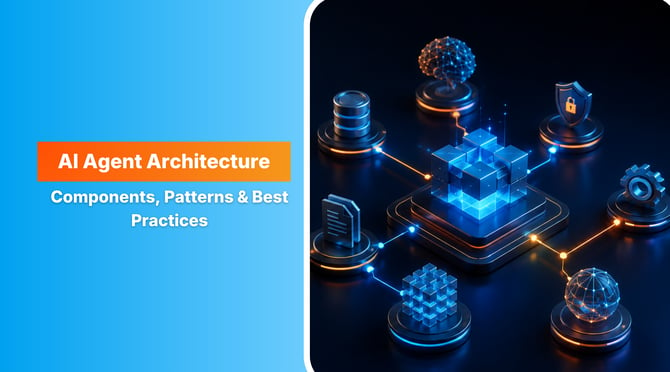
Most companies experimenting with intelligent agents hit the same wall. The prototype works in a demo. Then real users, real data, and real edge cases show up, and it breaks. The gap in implementing multiple specialized agents often comes down to architecture. AI agent architecture defines how an agent perceives its environment and decides what to do next. It also governs how the agent executes that decision safely inside your systems.
Get it wrong, and you end up with a chatbot that occasionally takes actions. Get it right, and you get a system that plans, delegates, and recovers from errors as it scales with your business. Gartner surveyed IT application leaders and found that only 13% strongly agreed they had the right governance structures in place to manage their AI agents, even as 74% see agents as a new attack vector into the organization. Architecture is where that gap closes.
This piece walks through what production-ready AI agent development architecture actually requires, from single-agent basics to multi-agent orchestration.
 Generate
Key Takeaways
Generate
Key Takeaways

- Single agents handle well-defined tasks; multi-agent systems earn their cost on complex, parallel work.
- Context and memory management determine whether agents stay coherent across long sessions.
- Supervisor and collaborative patterns solve different coordination problems in production.
- Governance, observability, and cost control decide if an agent survives past the pilot.
What Is AI Agent Architecture?
AI agent architecture is the structural design behind an autonomous system. It governs how the system senses its environment, reasons about a goal, and acts through tools and external systems. It is the difference between a model that answers a question and an agent that solves a problem end to end.
At the center of every agent sits a reasoning engine, almost always one of today's large language models. This language model interprets a task and decides what to do next.
Around that core sits an orchestration layer. This includes memory, tool access, retrieval, and a security boundary that keeps the agent inside its intended scope.
It usually runs in a loop where an agent evaluates by following a process that involves thinking, acting, observing, and adjusting. The loop repeats until the goal is met or the agent hits a condition that calls for human review.
This is what separates agents from traditional automation. A scripted workflow follows a path someone wrote in advance. An agent works out its own path through task decomposition. It chooses which tool to call and when, based on what it learns as it goes.
Related Read: AI Agents Examples Transforming Modern Businesses
Core Components of a Production-Ready Agent
A single AI agent is not just a model with a system prompt. Production systems share a consistent set of components. Each one has a job that a demo build can skip, but a live system cannot.
| Component | What it does | Why it matters in production |
| Reasoning engine | The LLM that interprets tasks and plans next steps | Sets the ceiling on task complexity the agent can handle |
| Tool-calling layer | Connects the agent to APIs, databases, and external systems | Turns reasoning into real-world action |
| Memory system | Session state for the current task, persistent memory across sessions | Keeps agents from repeating mistakes or forgetting context |
| Model Context Protocol (MCP) | A standardized way to connect agents to external data and tools | Replaces one-off integrations with a shared interface |
| Guardrails and permissions | Defines what the agent can and cannot do without approval | Contains the impact of an incorrect decision |
| Observability layer | Logs reasoning steps, tool calls, and outcomes | Makes non-deterministic behavior debuggable |
Skills add another layer on top of these components. Instead of cramming every piece of domain-specialized knowledge into a prompt, teams package workflows and compliance rules into reusable modules. An agent calls on these as needed.
A single agent equipped with the right skills can often handle complex tasks that would otherwise need a full multi-agent system with several specialized agents. That is worth testing in this agent-based approach before you add coordination complexity you may not actually need.
Single-Agent vs. Multi-Agent Architecture
The first real architecture decision is scope: one agent or several. Only 17% of organizations have deployed AI agents to date, though more than 60% expect to within two years, says Gartner.
Most of that adoption stalls before it reaches real coordination. Forrester's 2026 research found that three-quarters of enterprise leaders are already adopting agentic AI, yet only a small minority have it running in meaningful production, and true scaled multi-agent systems remain rarer still.
That gap has a real cost behind it: Gartner predicts that by 2027, 40% of enterprises will demote or decommission autonomous agents after governance gaps surface only once the system is already in production.
| Factor | Single-agent architecture | Multi-agent architecture |
| Best for | Well-defined, single-domain tasks | Open-ended, multi-domain, parallel work |
| Compute and cost | Lower, one reasoning trace running | Meaningfully higher, scales with agent count |
| Debugging complexity | Lower, one reasoning trace running | Higher, requires tracing agent-to-agent interaction |
| Time to deploy | Weeks | Months |
| Failure mode | Task fails outright | Coordination breaks down between agents |
When One Agent Is Enough?
A single agent handles document processing, routine customer queries, and code review well. If the task has a clear scope, and one domain of expertise covers it, a single agent is usually the better starting point. It costs less, ships faster, and gives you a clean baseline before you add complexity.
When Multi-Agent Architecture Earns Its Keep?
Multi-agent systems make sense once a single agent hits a real ceiling, no matter how many other agents it tries to simulate on its own. That happens when a task spans multiple domains, or when parallel processing meaningfully cuts response time.
It also happens when a problem is too open-ended to map out in advance. Real-world examples include research, competitive intelligence gathering, and data analysis that pulls from several sources at once. Financial risk analysis that spans credit, market, and compliance review is another. In these cases, the coordination overhead pays for itself.
Fundamental Orchestration Patterns
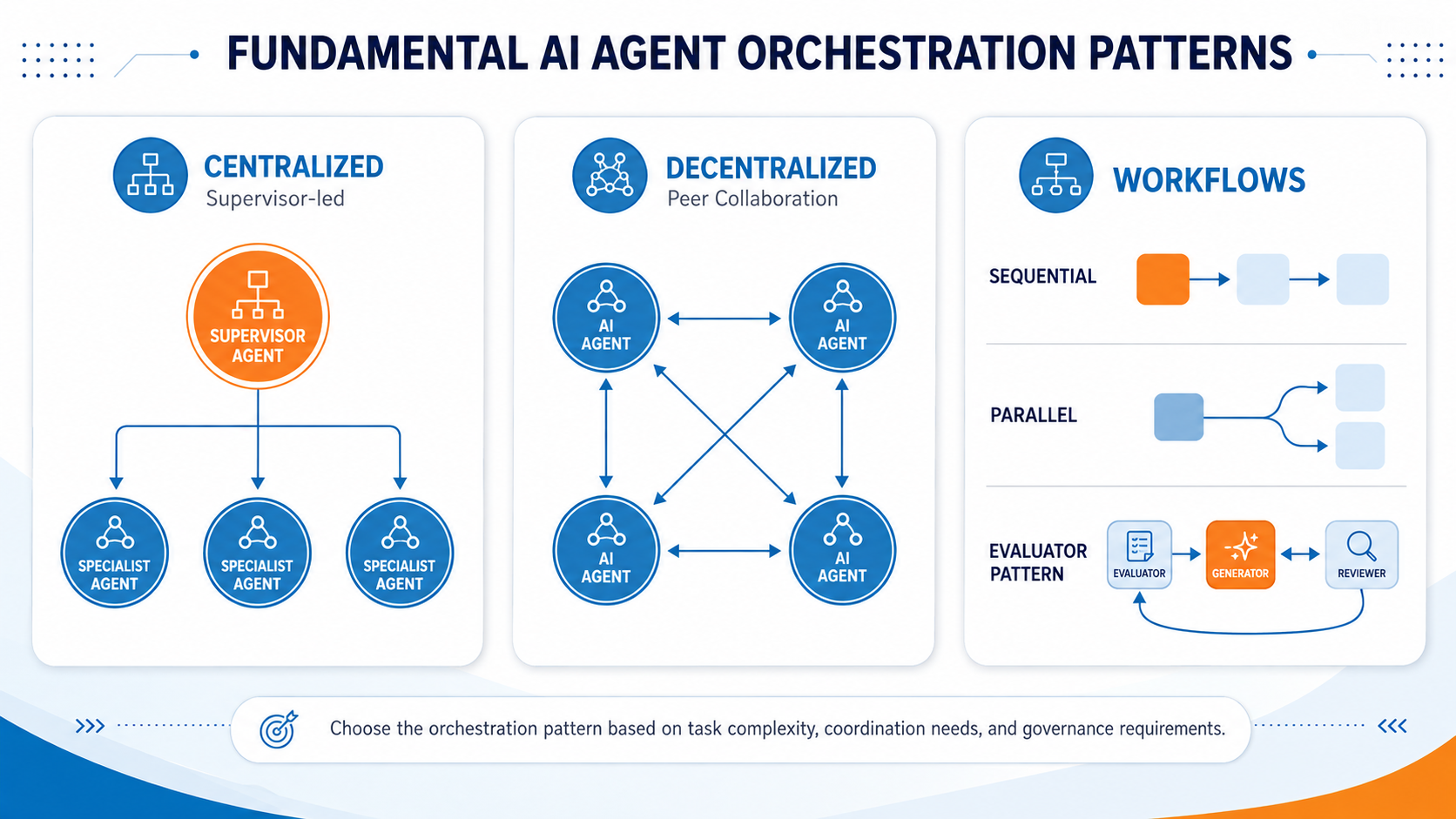
Once you commit to multiple agents, the next decision is how they coordinate. There are two broad agent architectures, centralized and decentralized, each relying on different communication protocols to structure how agents hand off work.
Centralized Patterns: Supervisor and Manager Agents
In a centralized system, a supervisor agent receives the request. Sometimes called a manager or lead agent, it delegates pieces of the work to specialized subagents. Each subagent acts like a tool the supervisor can call. The supervisor reviews what comes back, resolves conflicts, and assembles the final output.
This mirrors how a well-run team works. Specialists focus on their domain while a coordinator handles delegation and integration. Full orchestration, routing-only, and hybrid setups all fall under this pattern. They differ mainly in how much control the supervisor keeps over the final response.
Decentralized Patterns: Collaborative and Peer-to-Peer Systems
Decentralized systems drop the central authority. Agents communicate directly, negotiate roles, and solve problems together. They do this through group discussion, shared event streams, or a shared knowledge repository that acts as collective memory.
This pattern suits research work, where multiple perspectives cross-checking each other in real time adds real value. It also introduces a genuine challenge: emergent behavior. A small change in one agent's output can ripple unpredictably through the group. Teams need clear rules for effort budgets and conflict resolution here, not rigid step-by-step instructions.
Sequential, Parallel, and Evaluator-Optimizer Workflows
Below both approaches sit three workflow patterns worth knowing by name. Sequential workflows pass work down a fixed chain. They suit approval processes and document pipelines, where traceability matters more than flexibility. Parallel workflows fan a task out to multiple agents at once and merge the results.
This fits risk assessments that need several independent viewpoints. Evaluator-optimizer workflows pair a generator agent with a critic agent that reviews the output and sends it back for revision. This usually runs two to four cycles before publishing. It works especially well for content and documentation, where quality and consistency matter more than raw speed.
State Management and Context Engineering
Context is where most multi-agent systems actually break in production, not the reasoning itself. Every agent works inside separate context windows, holding conversation history and the results of each function calling step. As tool outputs pile up, that window fills. When it overflows, agents lose track of earlier decisions across their context windows. They repeat work or contradict a previous agent's output.
Two practices keep this under control. Context editing clears stale tool calls and results automatically as an agent nears its token limit. The thread of the conversation stays intact. Memory tools let agents store information outside the active context window. This usually happens in file-based systems that persist across sessions. The agent retrieves what it needs instead of holding everything in memory at once.
The Model Context Protocol plays a direct role here too. Instead of building a custom connector for every data source, MCP gives agents one standardized interface. Agents use it to retrieve information and call tools. That consistency makes context easier to manage, because the agent is not reinventing how it talks to each system. Teams that skip this step tend to learn the lesson the hard way. An agent three steps into a complex workflow can no longer see a constraint a teammate agent set earlier.
Architecture Decisions That Determine Production Readiness
Getting an agent to work once is not the same as getting it to work reliably at scale. A handful of decisions consistently separate systems that survive contact with production from ones that stay stuck in pilot.
Cost Discipline
More than 80% of enterprises are already piloting agentic AI, but far fewer have moved past the pilot to a scaled, cost-justified deployment. The smartest teams start with a single agent, prove the business value, and add coordination only when the data justifies it. Running every request through a premium multi-agent workflow when a lighter setup would do the job is not a safety margin. It is wasted spend that compounds fast.
Observability
Traditional application monitoring was not built for systems that make non-deterministic decisions. Production agents need tracing that captures the full reasoning path. That way, a failure gets diagnosed by looking at what the agent actually thought, not guessed at from a stack trace. A support agent that escalates a refund request, for example, needs a trace showing which policy it checked and why it decided escalation was the right call, not just the final message it sent.
Staged Rollout
Sandbox testing, a canary release to a limited audience, then full production: this sequence catches failures before they touch your whole user base. This single practice prevents more embarrassing incidents than almost any other architectural choice.
Compliance and Governance
Role-based permissions, audit logs, and human approval checkpoints for high-consequence actions are not extras bolted on after launch. Only about one-third of organizations report mature governance practices for agentic AI, according to McKinsey's 2026 AI Trust Maturity Survey, which is exactly why these need to be architectural decisions made before the agent ever touches production data.
This matters most in regulated industries, where every autonomous action needs to be explainable after the fact. A lending agent that approves credit lines, for instance, needs a human checkpoint before final approval, not just an audit log after the fact.
These decisions rarely come down to one engineer's judgment call. They require weighing cost against capability, and speed against control. That is precisely where an experienced development partner earns their fee. The right partner helps you avoid two common failure modes. One is over-engineering a simple use case. The other is under-building a system that needed governance from day one.
Where Signity Fits In AI Agent Architectures?
Signity has spent years building agentic and generative AI systems for enterprise clients. That experience shapes how we approach architecture decisions, rather than defaulting to the most complex pattern available.
Our team designs single-agent and multi-agent systems using the MCP (Model Context Protocol). We set up the observability and guardrails that regulated industries require. We also build the staged rollout process that gets an agent from sandbox to production without surprises.
Our work spans the full stack, from choosing the right orchestration pattern to implementing the memory and context management that keeps long-running agents coherent. If your team is weighing whether a use case needs one agent or several, that is exactly the conversation we have with clients first.
Conclusion
The organizations getting real value from AI agents are not chasing the most sophisticated architecture on paper. They match the architectural complexity of an active agent to the business problem in front of them. They start with a single well-scoped agent and add coordination only when the data proves it is worth the cost.
Architecture is not a one-time decision either. The right pattern today may need to evolve as your use case grows. That is exactly why building with modularity and observability from the start pays off months down the line.

Mangesh Gothankar


Ashwani Sharma
Achin Verma
Frequently Asked Questions
Have a question in mind? We are here to answer. If you don’t see your question here, drop us a line at our contact page.
What is the difference between AI agent architecture and a chatbot?

When should a business choose multi-agent architecture over a single agent?
What is the Model Context Protocol and why does it matter for agent development?
How much more expensive is a multi-agent system than a single agent?
What causes most AI agent production failures?
Context and state management failures are among the most common causes. A common pattern: an agent three steps into a workflow loses sight of a constraint a teammate agent set earlier, then delivers an answer that technically completes the task but contradicts an earlier decision. Missing observability and unclear approval workflows for high-consequence actions follow close behind. Architecture decisions made before launch tend to determine which systems make it to production.