

.png?width=27&height=27&name=Group(1).png)

-1.svg)
-1.svg)


-2.svg)


%201-1.webp?width=148&height=74&name=our%20work%20(2)%201-1.webp)




.svg)





.png?width=670&height=445&name=Enterprise%20AI%20Agent%20Deployment%20A%20Production%20Ready%20Guide%20(2).png)
Most enterprise AI agent programs don't fail in the demo. They fail in the six months after it. That's when a working prototype runs into production data. It also runs into legacy APIs and a compliance team that was never in the room to begin with.
By the end of 2026, Gartner expects 40% of enterprise applications to ship with task-specific AI agents. Under 5% did in 2025. Only 23% of organizations report they are actually scaling an agentic system anywhere in the business.
That gap, between building one agent and running the business on it, is what enterprise AI agent deployment is meant to close.
This guide walks through that lifecycle. It starts with scoping the right workflow and designing the architecture. Then it moves into governance, testing, and keeping the thing running well past launch day.
 Generate
Key Takeaways
Generate
Key Takeaways

- Enterprise pilots fail from missing governance and integration readiness. Weak model performance is rarely the actual cause.
- A structured five-phase framework moves workflows from scoping through governance, testing, rollout, and monitoring. Each phase builds on the one before it.
- Production architecture requires defined topology, model strategy, fallback behavior, memory design and orchestration logic. Skipping any one of these tends to show up later as a production problem.
- Staged rollouts gated by accuracy and escalation metrics prevent underperforming agents from reaching scale. The gate catches problems before they become expensive.
What Is Enterprise AI Agent Deployment?
Enterprise AI agent deployment is the process of moving an AI agent out of a testing environment and into real business operations. Once there, it's connected to live systems and handling real data. It also becomes accountable to production-grade monitoring and governance.
This is distinct from development. Development is about building and validating an agent's capabilities inside a controlled environment. Deployment starts once that validation work is done. From there it covers everything from infrastructure selection through ongoing performance management.
The most common planning mistake is treating deployment as a launch-day event. It's an operating discipline, not a one-time milestone. Programs that define "done" as go-live tend to underestimate how much governance, integration and change-management work still lies ahead. That work is usually what decides whether the agent survives its first ninety days.
Why Enterprise AI Agent Pilots Stall Before Production
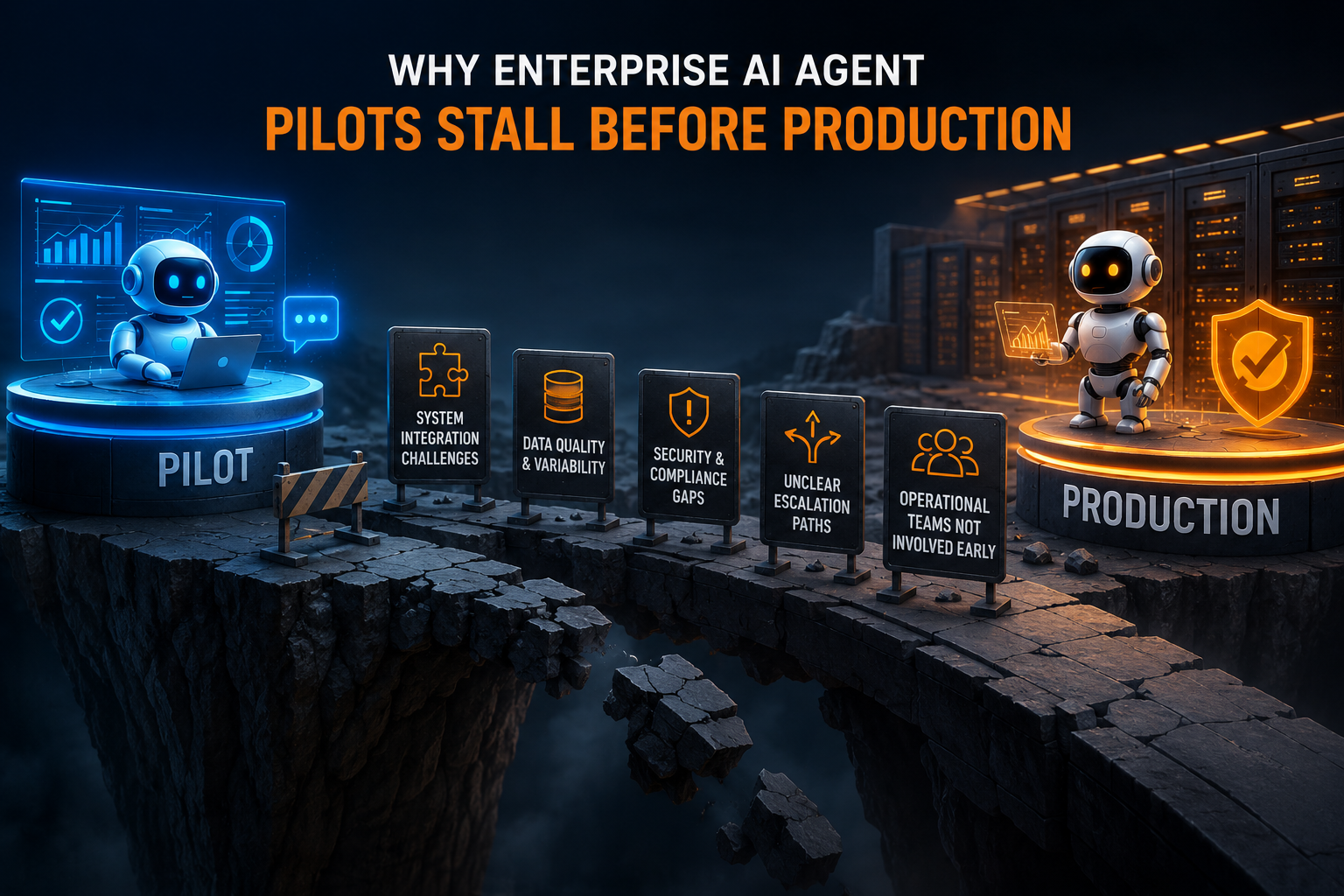
Pilots typically run on clean, hand-picked data with a narrow set of test cases. Production doesn't work that way. Inconsistently formatted inputs from legacy systems, exception cases the pilot never saw, and compliance requirements that only apply at scale all surface for the first time after launch is approved, not before.
The adoption data reflects this split. KPMG's Q1 2026 AI Pulse survey covered U.S. organizations with revenue above $1 billion. It found 54% now actively deploying AI agents, up sharply from just 12% two years earlier. Deployment is concentrated in operations (79%) and technology (78%) functions.
The same survey put banking-sector deployment at 47%, ahead of the broader sample. That's worth noting. Regulated industries aren't necessarily slower to adopt agents. They're just slower to do it without guardrails in place first.
Most stalled programs trace back to the same three gaps. APIs sit behind firewalls or through undocumented endpoints, out of easy reach. Escalation logic was never defined or tested in the first place. Operational teams learn about the agent at launch instead of during design, which is usually too late to fix anything cheaply.
Related Read: How to Create an AI Agent: A Step-by-Step Guide
The Enterprise AI Agent Deployment Framework: Five Phases
A production deployment follows the same rigor as any mission-critical system rollout. Compressing or skipping a phase doesn't save time. It moves the cost downstream into rework, compliance gaps, and post-launch failures.
| Phase | Core Focus | What It Delivers |
| Workflow Scoping & Business Case | Selecting the right first workflow | Documented baseline, projected improvement range, cost model, payback timeline |
| Readiness Assessment | Data, systems, and organizational readiness | API accessibility audit, data quality report, IAM provisioning plan, change-management plan |
| Build & Integration | Framework, model, and integration architecture | Integration layer, authority boundaries, error handling and retry logic |
| Governance, Testing & Validation | Six-part testing suite and sign-off | Security, compliance, operations, and architecture approval; go/no-go decision |
| Production Rollout & Monitoring | Staged launch and operational monitoring | Phased volume ramp, accuracy/escalation dashboards, continuous improvement cycle |
Phase 1 starts with workflow selection. A workflow is ready to scope once it clears five criteria.
- First, there has to be enough volume to justify the investment.
- Second, the inputs need to be fully digital, not paper or manual entry hiding somewhere in the process.
- Third, a measurable baseline needs to exist already, covering things like processing time, error rate, and cost per transaction.
- Fourth, the exception rate should sit under roughly 40%.
- Fifth, the operational team involved needs to actually understand its role once the agent goes live.
Phase 2 is where most timeline overruns start. A structured data quality audit across several hundred representative cases needs to begin here, not later. So does an API accessibility review covering every connected system. IAM provisioning belongs here too, and in large enterprises it alone can eat four to eight weeks.
Phase 3 turns the readiness findings into an actual system. A dedicated integration layer isolates agent logic from API changes, so upstream changes don't break the agent directly. Credentials get pulled from a Secrets Manager at runtime rather than hard-coded anywhere. Authority boundaries are hard-coded instead, spelling out exactly what the agent can read, write, and approve.
Phase 4 is where enterprise agent testing pulls away from traditional QA. The suite covers unit testing of individual tool calls and integration testing against staging systems. It also covers load testing at twice expected peak volume and adversarial testing of the authority boundaries themselves.
Shadow-mode validation runs the agent alongside the existing human workflow for at least two weeks. Every defined escalation trigger gets tested on its own path. None of it counts as done until security, compliance, operations, and architecture sign off in writing.
Phase 5 sequences the rollout to limit blast radius. A restricted launch opens at roughly 5 to 10% of volume. An expanded stage follows at 30 to 50%, then full deployment. Each stage is gated by accuracy and escalation metrics, not by the calendar. Google Cloud describes essentially the same pattern as sandbox, canary, and full production staging, with each step validating a different dimension of agent behavior before wider exposure.
Production-Ready Architecture: Core Components and Design Decisions
An AI agent runs on a repeating loop: it perceives its environment, plans a response, and acts through tools, refining its approach as results come in as per Google Cloud Update from 2026. Four capabilities determine what an agent can actually do in production.
It needs reflection, the ability to evaluate and correct its own output, and tool use, so it can act through external APIs rather than just describe what it would do. Planning breaks a goal into sequenced steps. And in more complex builds, multi-agent collaboration lets specialized agents hand pieces of a task off to each other.
Turning that loop into a production system requires explicit decisions across seven areas: agent topology (single agent or multi-agent), model strategy (one model or several, matched to task complexity), fallback behavior when a tool or data source is unavailable, state management (stateless or persistent memory), orchestration strategy for coordinating multi-step actions, routing logic across models or tools, and retrieval architecture for how the agent accesses current information.
Interoperability standards matter here too. Anthropic's Model Context Protocol (MCP) standardizes how agents connect to external tools and data sources, while Google's Agent2Agent (A2A) protocol lets agents discover and coordinate with each other across frameworks.
| Architecture Pattern | Complexity | Best Fit | Typical Build Time |
| Single-agent, single-task | Low | Well-defined, repetitive workflows | 4–8 weeks |
| Single-agent, multi-step | Medium | End-to-end automation with decision branches | 8–14 weeks |
| Multi-agent orchestration | High | Cross-functional workflows spanning systems | 14–24 weeks |
| Human-in-the-loop | Variable | Regulated processes, high-stakes decisions | 2–4 weeks to any pattern |
| Fully autonomous enterprise agent | Very high | Mature orgs with strong monitoring and governance | 6+ months |
Infrastructure decisions follow architecture, not the other way around: cloud, private, or hybrid environments; containerized or serverless deployment; and Kubernetes or similar orchestration for larger workloads. Environment parity between development, testing, and production cuts down on the "it worked in staging" failures that plague late-stage rollouts.
Governance, Security, and Compliance Requirements
Agents introduce risk vectors traditional software governance doesn't fully cover. Unlike a static model, an agent can take action, moving data and triggering transactions on its own. Least-privilege access is the baseline control: agents reach only the systems and data required for their specific task, with read-only access wherever retrieval alone is needed.
Auditability is non-negotiable in regulated industries. Every decision, tool call, and output should log in a format traceable back to the prompt and context that produced it. Input and output guardrails add a second layer: filtering out-of-scope prompts before they reach the agent, and screening for PII exposure before a response is delivered. Every production agent should also have a kill switch, a controlled way to disable it immediately if behavior drifts outside defined boundaries.
The stakes are rising in dollar terms too. IBM's 2026 Cost of a Data Breach research put the average cost of an AI model inversion attack at $6 million per incident, a hard number to justify skipping a security review for. The regulatory side varies by sector and geography, but it usually means mapping SOC 2, HIPAA, PCI DSS, GDPR, or EU AI Act requirements into the audit trail and escalation design before build starts, not bolting on a compliance review at the end.
Common Enterprise AI Agent Deployment Challenges
| Challenge | Root Cause | Mitigation |
| Data silos and API inaccessibility | No integration layer between legacy and modern systems | API accessibility audit and integration layer scoped in Phase 2 |
| Inconsistent data quality at scale | No enforced schema on legacy systems | Structured data audit and normalization pipeline with per-error logging |
| Escalation rate exceeds tolerance | Workflow selected included too many exception-heavy cases | Exception rate measured at scoping; threshold tested in shadow mode |
| Governance sign-off delayed | Audit trail and regulatory mapping done after build | Compliance approval obtained before a line of agent code is written |
| Change resistance from operations teams | Teams uninformed until launch | Operational team engaged from Phase 1; training delivered pre-launch |
| Model drift post-launch | Production data distribution shifts over time | Accuracy monitoring with a defined threshold triggering diagnostic review |
Related Read: 30+ AI Agent Use Cases for Business Success
Cost, Timeline, and ROI Benchmarks
Timeline and cost track most closely to integration complexity, not model choice. In practice, a well-scoped single-agent deployment on systems with clean APIs typically runs 8 to 14 weeks from scoping to rollout, while multi-agent systems or projects needing data infrastructure work commonly run 16 to 28 weeks.
Budget is rarely the constraint: U.S. organizations now project average AI spending of $207 million over the next 12 months, nearly double the year before, according to KPMG's Q1 2026 AI Pulse survey. Execution is the harder problem.
Returns still lag that spending at the leadership level. Only 12% of CEOs report both revenue gain and cost reduction from AI, according to PwC's 29th Global CEO Survey of 4,454 executives across 95 countries.
Gartner separately expects more than 40% of agentic AI projects to be canceled by the end of 2027 over escalating costs, unclear business value, or inadequate risk controls. Organizations closing that gap treat the business case, meaning baseline, improvement range, cost model, and payback timeline, as a Phase 1 deliverable rather than a retrospective justification.
Signity's Enterprise AI Agent Deployment Expertise
Enterprise AI agent deployment succeeds or fails in the phases most vendors skip: the readiness assessment that determines whether a program starts on solid ground, and the governance, testing, and monitoring work that keeps it reliable after launch.
Signity approaches deployment as an end-to-end engagement rather than a model integration project, starting with workflow scoping and a documented business case, and carrying through architecture, governance sign-off, and the staged rollout most in-house teams underestimate.
That full-lifecycle involvement resolves data-silo and API challenges during readiness assessment, satisfies compliance and security requirements during governance sign-off, and builds the monitoring that catches model drift before it becomes a business problem.
Conclusion
Enterprise AI agent deployment isn't a single launch decision. It's an operating capability that compounds. Every workflow deployed through a structured five-phase process strengthens an organization's governance architecture, integration muscle, and monitoring infrastructure, which makes the next deployment faster and less risky than the last.
The enterprises pulling ahead in 2026 aren't necessarily the ones with the most advanced models. They're the ones treating readiness, architecture, and governance as sequential, non-negotiable phases instead of boxes to check on the way to a launch date.

Mangesh Gothankar


Ashwani Sharma
Achin Verma
Frequently Asked Questions
Have a question in mind? We are here to answer. If you don’t see your question here, drop us a line at our contact page.
How long does enterprise AI agent deployment typically take?

When should we select our AI agent framework?
What is shadow-mode validation and how long should it run?
What's the single biggest driver of deployment cost?
What triggers a production rollback?
Do AI agents replace human decision-making in the enterprise?





.png?width=352&name=Enterprise%20Generative%20AI%20Services%20(4).png)