


.png?width=27&height=27&name=Group(1).png)

-1.svg)
-1.svg)


-2.svg)


%201-1.webp?width=148&height=74&name=our%20work%20(2)%201-1.webp)




.svg)





Budget for AI implementation is no longer a constraint for most of the businesses. But what is missing, at a large share of them, is a documented plan connecting that budget to a specific outcome.
A survey of 500-plus technology leaders stated that just 14% of enterprises deploying AI have a strategy with clearly defined goals. And 71% describe their current approach as incomplete or still taking shape.
It is the reason so many AI pilots stay pilots and never reach a second business unit. A working AI roadmap starts before any development work. It initiates with a readiness assessment covering data, infrastructure, talent, and governance.
Some enterprises run this internally. Others bring in an AI consulting partner to run the assessment and keep it independent of the team that will later build the solution. What follows is the framework, checklist, and six-step process for turning that assessment into an AI roadmap that produces results your finance team can actually verify.
 Generate
Key Takeaways
Generate
Key Takeaways

- Business alignment, data, workforce skills, and governance belong in one assessment, not four.
- AI roadmap readiness runs across six pillars, business alignment through change management.
- Gartner's research found 63% of organizations still lack proven AI data practices.
- Executives treat AI a priority far more than they can prove its return.
- Redesigning workflows produces more measurable ROI than simply adding more AI pilots.
What Enterprise AI Readiness Means Before You Build an AI Roadmap
Enterprise AI readiness describes an organization's actual capacity to deploy, operate, and scale AI systems within its existing data infrastructure, governance policies, and workforce capability. A proof of concept only confirms that a model performs in isolation. A use case list identifies where AI could apply, without confirming the organization can actually support it in production.
Neither replaces a readiness assessment. It is the formal process that measures data maturity, integration constraints, skill gaps, and compliance requirements before an AI roadmap decision gets finalized. The findings from that assessment determine which use cases move forward and in what sequence.
AI readiness assessment usually looks at four areas, and each one answers a different question.
1. Business alignment
Does the proposed AI use case tie back to something the business already tracks, like faster processing time or lower support costs? In case, nobody can name that metric, the use case is not ready to move forward.
2. Data infrastructure
Can teams actually get to the data this use case needs? And is it clean enough to use? Plenty of use cases fail this check because the data lives across three different systems that were never built to talk to each other.
3. Workforce capability
Do the people who will build, monitor, and maintain this system already have the right skills? Or does someone need to be hired or trained first?
4. Governance and compliance
Are there existing policies for data privacy, model risk, and the regulatory requirements specific to this industry? Or is this the first AI project the compliance team has had to review?
These four checks rarely stay separate in practice. A use case can clear the business alignment question easily and still stall for months, because the data behind it sits scattered across systems nobody thought to connect when they were first built.
A Readiness Framework and Checklist for Your AI Implementation Roadmap
The output of that assessment needs a home. A readiness framework gives it one, by sorting findings into pillars that a CIO or a steering committee can track individually, quarter over quarter, instead of reducing readiness to a single yes or no answer at the start of a project.
Six pillars cover most of what enterprise teams need to check before committing an AI implementation roadmap to a specific timeline. Each pillar below is paired with an indicator, a specific and checkable fact, not a general impression, that confirms the organization has actually cleared that bar.
| Framework Pillar | What It Evaluates | Readiness Indicator |
| Business Alignment | Whether use cases map to real business priorities | Every use case has a KPI attached, like cost per ticket or turnaround time |
| Data Readiness | Data quality and access across systems | Key datasets are clean, labeled, and reachable through an API |
| Technology Infrastructure | Compute, cloud capacity, and system fit | Current systems can run the model without a rebuild |
| Talent and Ownership | Who owns what, and whether skills exist in-house | Every live AI initiative has one named owner and a review cadence |
| Security and Compliance | Data privacy, risk, and regulatory exposure | Compliance sign-off happens before deployment, every time |
| Change Management | How ready employees are for the new workflow | Frontline staff are trained and know exactly who to flag issues to |
Data readiness is frequently the weakest pillar on this list. Gartner found that 63% of organizations either lack established data management practices for AI or are unsure whether their existing practices meet AI requirements.
This number lines up with what shows up in most enterprise assessments. Data readiness is usually where the majority of open items get logged, well ahead of talent or governance findings.
Turning this framework into a working checklist means confirming six things before a use case moves off the AI roadmap and into a sprint plan.
-
Documented business case: The initiative has a written objective, an expected outcome, and one named budget owner who signs off before a developer opens a ticket.
-
Data audit completed: A data engineer or governance lead has checked the source systems for this specific use case, covering completeness, accuracy, and access permissions against what the project actually needs.
-
Integration path confirmed: The technical team has mapped exactly how the AI system connects into existing applications, which APIs already exist, and which ones still need to be built.
-
Skills gap addressed: Internal teams have the AI development and MLOps skills the project needs, or leadership has already lined up an external partner, such as an AI development company, to fill that gap before the project starts.
-
Compliance review conducted: Legal and security teams have signed off on the use case against the data privacy regulations that apply in the relevant industry and region, including any cross-border data transfer restrictions.
-
Use case category classified: Initiatives are grouped by complexity, from straightforward rule-based automation up to agentic AI systems that can take action without a human in the loop and therefore need a higher level of governance review before launch.
In several enterprise engagements, this last step alone changes the roadmap sequence. A use case that looked simple on paper gets pushed back a phase once the team realizes it involves an agentic component, and agentic systems carry a different risk profile than a static prediction model.
How to Build an AI Adoption Roadmap For Your Business
A readiness assessment tells you where the organization stands currently. Now turning that into a roadmap means putting it in order, who does what, when, and in what sequence. It ensures that the engineering, security, and business all read from the same plan instead of three different versions of it.
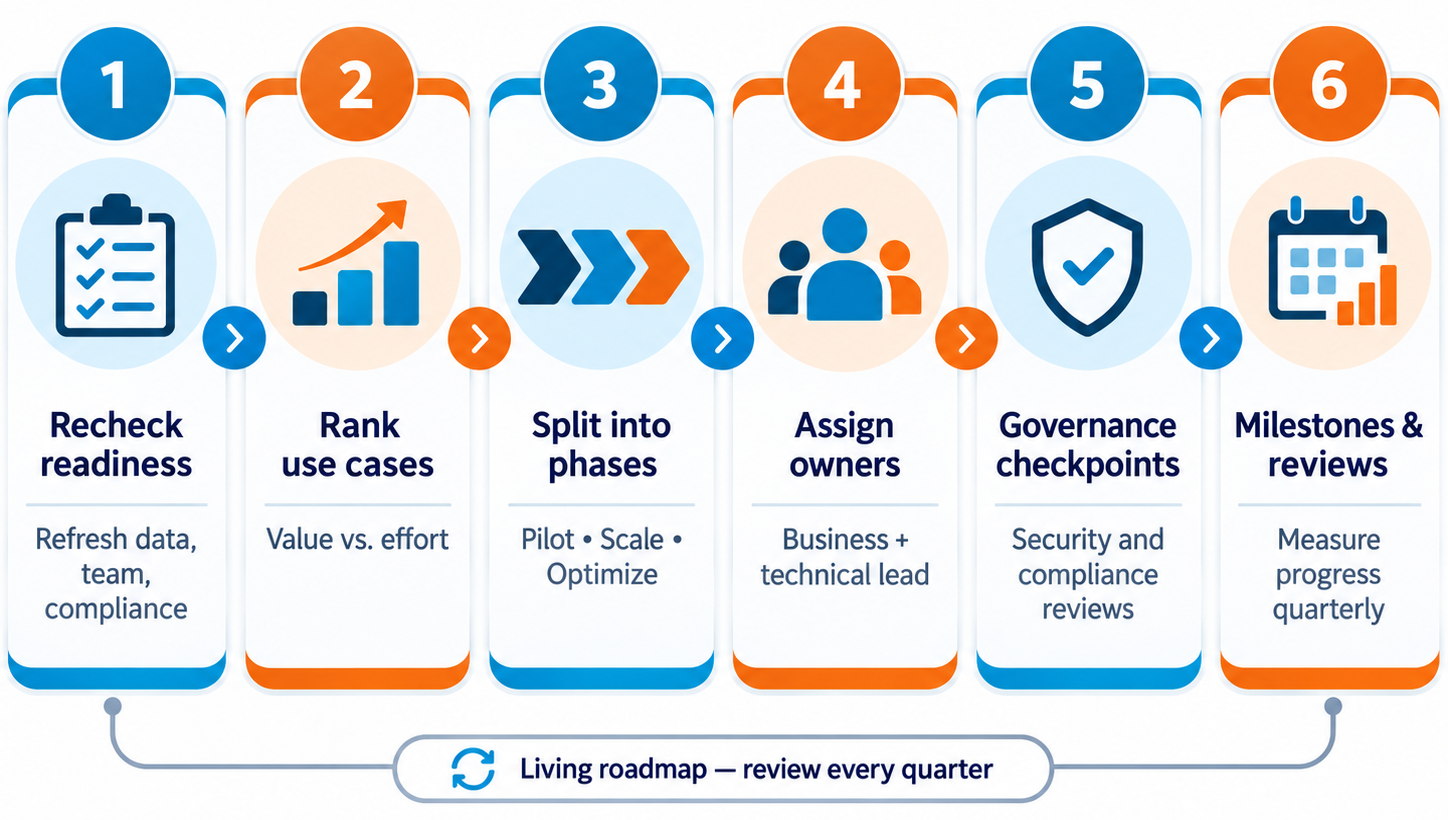
- Recheck the readiness numbers: Data access, headcount, and compliance rules do not stay fixed for long. And a roadmap built on assessment findings from six months ago usually needs rework the moment development actually begins. So, pull the numbers again before locking the sequence.
- Rank the use cases honestly: These are two things that will decide the order. How much business value a use case delivers and how hard it actually is to build. A use case that sounds valuable but depends on pulling data out of a fifteen-year-old mainframe belongs in a later phase, not the first release. Regardless of how loudly someone in the room argues for it.
- Split the work into phases: Most roadmaps hold up better in three stages. A pilot to prove the concept, a scale stage for whatever the pilot proves out, and an optimization stage once the system is actually running in production.
Give each phase a start date and a clear exit condition. Teams that skip this step almost always hit a wall moving from pilot to full rollout. Probably, because the infrastructure and governance work the pilot never touched suddenly becomes unavoidable. More on that in this guide to scaling AI across the enterprise. - Assign cross functional ownership: Every phase needs one named business owner and one named technical owner, both accountable in writing. Without this, AI initiatives commonly stall in the handoff between departments, right after the initial development work wraps up and before the business side has adopted the output.
- Build in governance checkpoints: Add a compliance and security review at the end of each phase, not only at kickoff. This catches problems introduced mid-project, such as a new data source added in week six that was never part of the original privacy review.
- Set milestones and review cadence: Define specific, measurable milestones for each phase and put a formal review on the calendar. This can be done typically quarterly to update the AI roadmap against actual results and any change in business priorities.
Also, it is worth understanding that these six steps are not a one-time exercise. Enterprises need to treat their AI roadmap as a living document. The one that is revisited every quarter alongside the readiness framework. As this practice tends to catch scope changes and new compliance requirements long before they turn into a stalled project.
How to Measure ROI and Success on Your AI Roadmap
Don’t confuse counting live use cases with the ROI of an AI roadmap. Bain and Company's executive survey stated 74% of executives call AI a top three strategic priority. But only 23% can point to one AI initiative and connect it to actual revenue or cost savings.
And the reason for this difference is usually timing. Teams pick their metrics after a project ships, not before it starts, so the baseline data needed to prove impact was never captured in the first place.
Hence, set the metrics at the roadmap stage instead, before a single line of code gets written. This helps the finance team get a real answer instead of a guess when they ask what the investment returned.
- Cost impact per use case, measured against the exact process the AI system replaced or supported, not the department's overall budget
- Cycle time reduction, tracked before and after deployment for the same workflow, using the same data source both times
- Model accuracy and reliability, monitored on a recurring schedule, weekly or monthly depending on the use case, rather than checked only at launch
- Adoption rate among intended users, not just technical deployment completion, since an unused system generates no return regardless of build quality
- Revenue or productivity impact, attributed to the specific AI initiative rather than folded into a broader digital transformation number
- Support ticket or error rate change, for use cases tied to customer service or operations, since this metric is often the fastest to move and the easiest to verify
These metrics matter because most organizations struggle to convert AI activity into financial results that hold up under scrutiny. McKinsey's State of AI research puts real numbers behind this. Only 6% of companies qualify as high performers, meaning AI accounts for 5% or more of their EBIT, and that small group redesigns core workflows around AI almost three times as often as everyone else in the same survey.
Redesigning a workflow is real work. It means changing how a process actually runs, tearing out manual steps and rebuilding the sequence around what the AI system can now do automatically.
Running a higher volume of pilots in parallel does not produce the same financial result. Enterprises tracking the metrics above from the start of their AI roadmap have a clearer basis for that kind of rebuild, and a more specific answer ready when a board member asks what the AI budget actually produced.
Why Enterprises Partner With Signity Solutions on Their AI Roadmap
Enterprises evaluating a technology partner for their AI roadmap typically look for a combination of technical depth and operational discipline around governance and security. Signity Solutions works with startups, scale-ups, and enterprise teams to build, modernize, and scale AI systems using an AI first development approach, where AI capabilities are embedded into products, workflows, and engineering processes from the earliest stage of a project.
Compliance built into the architecture from day one
Security, privacy, and regulatory requirements get addressed at the design stage, so a compliance review does not turn into a rebuild six weeks before launch.
Data security that holds up under audit
Access controls and secure architecture are part of every engagement, protecting business and customer data at the level enterprises actually require.
A single team across the stack
AI development, data engineering, cloud, and automation sit under one engagement, cutting out the coordination tax that comes from managing separate vendors for each piece.
Outcomes defined upfront
Every engagement ties to specific business metrics agreed during the readiness and planning phase, before development work begins.
Pair a structured readiness assessment with a team that has actually built and shipped these systems, and initiatives stop stalling between phases, because someone owns each one from start to finish. If your organization needs an AI roadmap built around your existing data, systems, and compliance requirements, let's connect.

Mangesh Gothankar


Ashwani Sharma
Achin Verma
Frequently Asked Questions
Have a question in mind? We are here to answer. If you don’t see your question here, drop us a line at our contact page.
What happens if an enterprise skips an AI roadmap?

Who should own an AI roadmap inside an enterprise?
How much does an AI roadmap cost to build?
Does an AI roadmap look different across industries?
What tools do enterprises use to track an AI roadmap?