


.png?width=27&height=27&name=Group(1).png)

-1.svg)
-1.svg)


-2.svg)


%201-1.webp?width=148&height=74&name=our%20work%20(2)%201-1.webp)




.svg)






Speed without preparation has become an expensive habit in 2026.
McKinsey's most recent State of AI survey found that 88% of organizations now use AI in at least one business function. But only 7% say AI has been fully scaled across the organization.
In short, most companies have a pilot running somewhere. Few have a real rollout coming through systematic evaluation.
Readiness explains that gap better than anything else. Teams that invest before governing their data, naming a real use case, and securing executive ownership tend to land in the same place: a stalled pilot and no clear answer for what the AI capabilities actually delivered.
This guide covers ten signs your business is ready for AI adoption and five signs there is groundwork left to do first. If you have been asking whether your business is ready for AI, start here.
 Generate
Key Takeaways
Generate
Key Takeaways

- AI adoption succeeds when strategy, data, governance, and technology align early.
- Data quality remains the single biggest blocker to AI implementation today.
- Governance, security vulnerabilities, and compliance decide whether AI scales or quietly stalls.
- Businesses that complete a readiness assessment first reach ROI measurably faster.
What Does AI Readiness Actually Mean?
AI readiness means an organization can deploy, govern, and scale an AI initiative without leaning on luck. The data holds up under scrutiny. The business processes are documented well enough that someone other than the original architect can run them. Leadership has signed off on what success looks like, and compliance has already seen the plan.
Most leadership teams treat readiness as a shopping decision: which model, which vendor, which platform. That instinct gets the order backward. A business running an unremarkable AI tool on governed, trustworthy data will consistently beat a business running a cutting-edge model on data nobody trusts. We have watched this play out enough times to call it a rule rather than a tendency.
| AI Readiness Area | What It Evaluates |
| Data Readiness | Data quality, structure, and accessibility |
| Governance | Policies, ownership, and AI oversight |
| Infrastructure | Cloud architecture, APIs, integration capacity |
| Leadership | Strategic alignment and budget ownership |
| Compliance | Regulatory and audit preparedness |
| Workforce | Skills gaps and change-readines |
Every useful AI readiness checklist we have built traces back to these six areas in some form. The ten signs below walk through what each one looks like once you stop describing it and start testing for it.
10 Signs Your Business Is Ready for AI Adoption
The businesses that get the organizational readiness right share a pattern: leadership owns the outcome, the data has been governed before deployment rather than during it, the infrastructure can actually connect to new tools, and someone agreed in advance on what a win looks like. Enthusiasm for AI programs is common, but the pattern with intelligent systems is not.
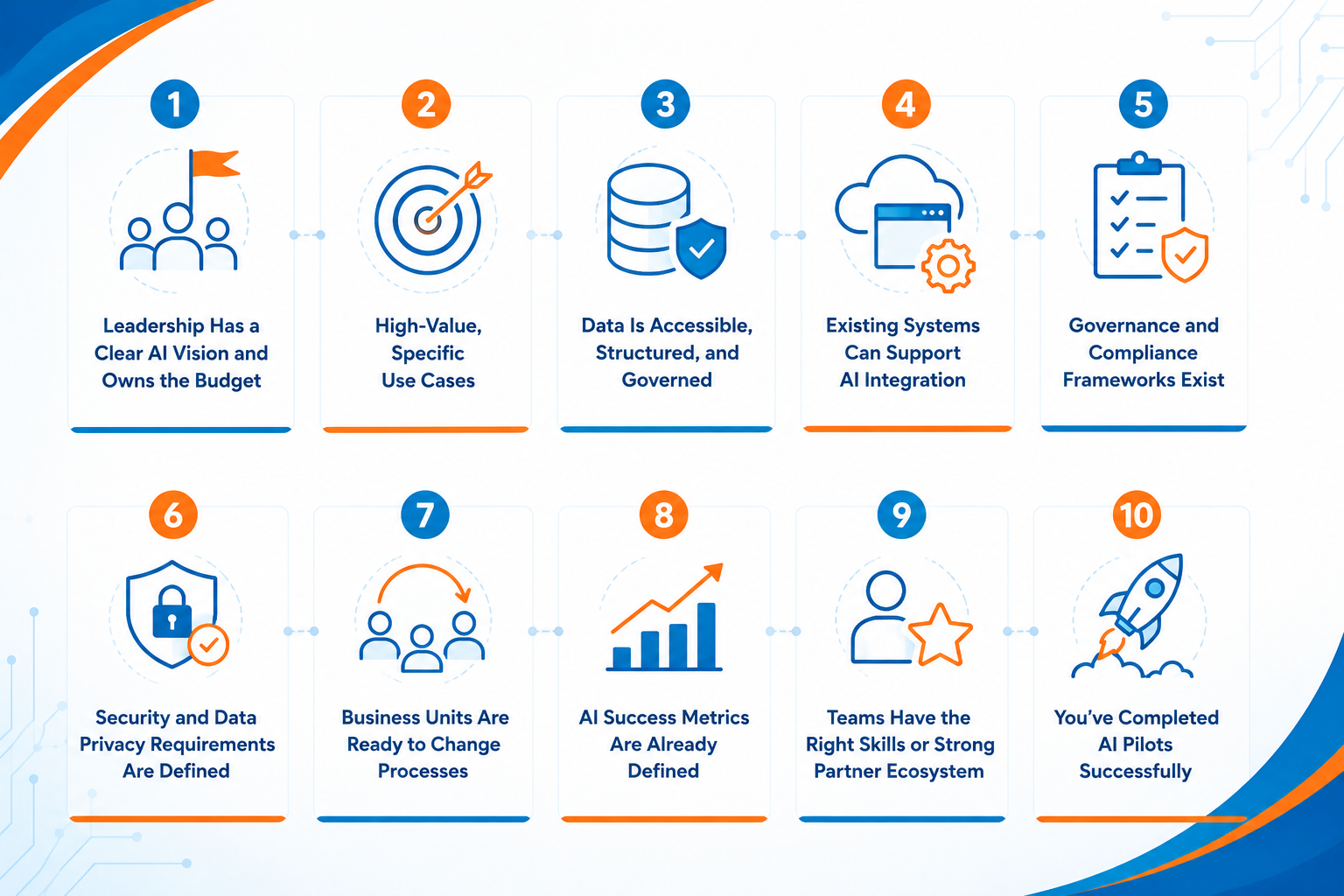
1. Leadership Has a Clear AI Vision and Owns the Budget
AI initiatives rarely die because the technology underperforms. They die because no one above the project level owns the outcome. McKinsey's State of Organizations 2026 research found that 23% of leaders belong to a group it calls AI Pioneers, who understand specifically how artificial intelligence will reshape their workforce and are already running it across most departments rather than one.
What separates Pioneers from everyone else is clarity, not budget size. Ask your executive team what AI is supposed to achieve this year and who is in charge of it. A fast, specific answer means you have already cleared the hardest hurdle on this list.
2. You've Identified High-Value, Specific Use Cases
Readiness sounds specific when you hear it out loud. “We should use AI” tells you nothing useful. “Our fraud team reviews 400 flagged transactions a day by hand and misses the deadline twice a week,” tells you exactly where to point a pilot.
| Common Use Case | Business Function |
| Fraud detection | Risk management and compliance |
| AI-powered chatbots | Customer service |
| Compliance monitoring | Legal and audit |
| Predictive analytics | Operations and finance |
Attach a dollar figure to a named bottleneck, and the project survives past the first budget review. Vague ambition rarely does; it tends to produce a demo, a round of applause, and nothing that ships true business value.
3. Your Data Is Accessible, Structured, and Governed
Most AI initiatives die quietly here, long before anyone notices the model was never the problem. Cambridge's 2026 Global AI in Financial Services report found that data availability and quality remain the leading barrier to AI adoption, cited by 66% of AI vendors and 40% of industry respondents. That finding has barely moved since 2020.
A separate 2026 banking compliance survey from Wolters Kluwer found that just 9.5% of financial institutions call themselves “very prepared” on data infrastructure. Fragmented records and inconsistent data formats eventually surface as unreliable model output, because no model outperforms the data underneath it. Get a single source of truth for your core records, and you are already ahead of most organizations attempting AI solutions right now.
Related Read: How Is AI Transforming Financial Technology?
4. Existing Systems Can Support AI Integration
To embrace AI does not require a clean slate. Rather, it requires systems willing to talk to one another. A CRM, an ERP, and a handful of core platforms that expose proper APIs and run on modern cloud infrastructure will let new AI tools plug in cleanly. Audit your stack for actual connection points before you worry about how old anything looks.
5. Governance and Compliance Frameworks Already Exist
Readiness and risk intersect directly here. Wolters Kluwer's Q1 2026 report found that only 35.8% of financial institutions have a working policy for ethical AI use, with another 33.8% still drafting one. Roughly a third of the industry has no policy and no draft.
Grant Thornton's 2026 AI Impact Survey of 950 senior leaders puts a number on what that costs: 78% lack the confidence to pass an independent AI governance audit within 90 days. Teams that already keep audit trails move faster, because each new initiative inherits the trust the last one built instead of starting the argument from scratch.
6. Security and Data Privacy Requirements Are Defined
For any business touching sensitive customer data, security and AI governance are the same conversation. The CCAF's 2026 global survey found data privacy ranked as the top risk by 65% of AI vendors, 74% of industry respondents, and 80% of regulators, ahead of every other concern measured. Ready businesses have already worked out where sensitive data lives, who can touch it, and what happens the moment an AI system gets near it.
7. Business Units Are Ready to Change Processes
AI changes how work gets done, not just which software does it. A team that fights every change to its routine will fight an AI rollout for the same reason, no matter how capable the tool is. How the team handled the last software migration predicts the next one far better than any vendor's sales deck.
8. AI Success Metrics Are Already Defined
Say what success looks like before you deploy, or you will spend the post-launch review arguing about it instead of proving it.
| AI Initiative | Success Metric |
| Fraud detection | Fraud reduction rate |
| Customer support | Average resolution time |
| Compliance monitoring | Review cycle reduction |
| Operations automation | Cost savings per process |
Teams skip this step constantly, usually because it feels obvious enough to assume. It is also why pilots quietly stall: nobody picked a number in advance, so nobody can say with confidence whether the thing worked.
9. Teams Possess the Right Skills or a Strong Partner Ecosystem
Nobody needs an entire department of data scientists to run AI well. They need one capable owner inside the business and a partner who can fill the technical gaps that owners cannot. Skills shortages remain a common reason enterprise deployments stall, and the teams that get past it rarely try to build every capability internally. An experienced internal owner paired with the right outside partner beats either one working alone, almost every time we have seen it tested.
10. You've Completed AI Pilots Successfully
A pilot that produces a number of leadership trusts is the strongest readiness signal on this list. Grant Thornton's 2026 data backs this with a hard figure: organizations running fully integrated AI are nearly four times more likely to report significant revenue growth than those still piloting, 58% against 15%. That gap has little to do with the AI itself. It comes down to everything else on this list, already solved, before the organization scaled.
5 Signs Your Business Is Not Ready for AI Yet
Plenty of organizations spend on AI before resolving the basics underneath it. Governance stays informal, data stays scattered, nobody owns the outcome, and the investment keeps growing anyway, halting what successful AI implementation looks like.
| Warning Sign | Why It Matters |
| No AI strategy | Initiatives lack direction and an accountable owner |
| Fragmented data | Models produce unreliable, inconsistent outputs |
| Weak governance | Compliance and audit risk increase sharply |
| Legacy systems constraints | Integration becomes slow and expensive |
| No measurable business goals | ROI becomes difficult to prove or defend |
1. No AI Strategy Exists Beyond “We Should Use AI”
Enthusiasm for AI is not an enterprise strategy. If nobody in the room can name the business outcome AI development is supposed to drive, every dollar spent afterward goes out without direction. We see this gap most often, and fixing it costs nothing more than an honest conversation before the next purchase order goes out.
2. Your Data Is Fragmented Across Disconnected Systems
Customer records in one system, transaction history in another, neither one talking to the other: that fragmentation becomes the model's problem the moment you deploy it. Connecting the data is not a box you check once before launch. It is the foundation that the entire program stands on for as long as it runs.
3. Governance Is Informal or Nonexistent
An AI decision nobody can explain or trace back to a responsible owner is already a compliance problem today, regardless of whether a regulator has noticed yet. Weak governance also taxes every initiative that comes after it, because each new project has to rebuild trust that the last one never established.
4. Legacy Technology Limits What's Actually Possible
A system with no API access and no realistic upgrade path will cap what AI can do before the project even starts. That does not mean tearing out every core system this quarter. It means being straight with yourself about which platforms can support real AI integration today and which ones need work first.
5. There's No Way to Measure Whether AI Worked
Skip the metric, and every AI initiative gets judged on vibes: did it feel successful? That is a rough position to defend in front of a board, and an even rougher one to defend in front of a regulator.
AI Readiness Checklist for Any Industry
Compliance rules shift from one industry to the next, but the underlying readiness questions barely change. A hospital, a retailer, a manufacturer, and a bank are all answering the same five questions: is the data trustworthy, who governs it, is it secure, who is accountable, and who is watching it run.
Grant Thornton's 2026 AI Impact Survey covered ten industries and found the identical gap in every one: 78% of leaders could not confidently pass an independent AI governance audit within 90 days.
McKinsey's organizational research reaches a similar conclusion that says an organization is not actually prepared to run AI in daily operations, whether that organization runs a hospital, a factory floor, or a call center.
| Area | Readiness Question |
| Data Governance | Is the data accurate, accessible, and traceable to its source? |
| Regulatory Compliance | Which industry-specific rules apply, and who tracks changes to them? |
| Explainability | Can every AI-assisted decision be explained to a customer or auditor? |
| Data Privacy | Are access controls, consent, and data residency clearly defined? |
| Accountability | Is there a named executive owner for AI outcomes and risk? |
| Human Oversight | Can a person intervene before an AI decision takes effect? |
| Continuous Monitoring | Are AI systems checked regularly for drift, bias, or error? |
Each industry weighs these differently. A hospital cares most about patient privacy and clinical liability. A retailer cares most about consumer protection and pricing fairness. A manufacturer cares most about safety certification and supply chain accountability. Strip away the industry-specific language and the seven questions above sit underneath all of it.
Why AI Adoption Fails Even After Strong Investment?
This pattern repeats across enough industries to trust it: AI adoption rarely fails because the technology underperforms. It fails because a gap in governance, data, or ownership sat there visibly from day one, and nobody closed it before launch.
McKinsey's 2025 State of AI survey found that 51% of organizations using AI have experienced at least one negative consequence, with inaccuracy the most common culprit at roughly 30%. Grant Thornton calls this the “proof gap”: organizations scaling AI that they cannot explain, measure, or defend when someone finally asks. Their survey also found a real internal disconnect. More than half of COOs worry about regulatory uncertainty tied to agentic AI adoption, against just 20% of CIOs and CTOs asked the same question.
| Failure Driver | What It Looks Like in Practice |
| Technology-first mindset | Tools purchased before problems are defined |
| Poor data foundation | Fragmented, unreliable inputs produce unreliable outputs |
| Governance gaps | No audit trail when scrutiny eventually arrives |
| No business ownership | Pilots stall with no one accountable to scale them |
| No pilot-to-production roadmap | Successful pilots never reach deployment at scale |
Look closely at any row in that table, and the technology is never the actual cause. These are organizational failures wearing a technical disguise, which is why a readiness assessment run before implementation catches them for a fraction of what a failed rollout costs to unwind.
How Signity helps enterprises prepare for AI Adoption?
No single team gets to AI readiness by itself. We work alongside enterprise clients through the full AI lifecycle, starting long before anyone deploys a model.
Readiness assessment
We look at data quality, infrastructure, governance maturity, and workforce capability. Then we tell clients what's actually missing, before they've committed a budget around the wrong assumptions.
Architecture evaluation
Some existing systems can already support AI integration. Others need work first. We rank that work by cost and impact, so the spend goes where it changes something.
Governance and compliance
For regulated clients, this runs next to the build, starting on day one. We map controls against NIST AI RMF, ISO 42001, and the EU AI Act depending on where the client operates and how the system gets classified. We also build the audit trails and explainability documentation the build will eventually need anyway.
Development and integration
Our developers connect generative AI models, custom agents, and the client's existing software through APIs already in use. Nobody has to migrate to a new platform to get there.
Pilot to production
Pilots tend to die at one specific point: the move into production. We build with that move in mind from the first sprint. A pilot that succeeds should have somewhere to go afterward.
Conclusion
The technology was never really the bottleneck in 2026; it was the readiness. The organizations seeing genuine return on AI investment are rarely running the most advanced models or spending the biggest budgets. They did the unglamorous work first: governed their data, gave someone real ownership of the outcome, documented their compliance framework, and agreed on a metric before deployment instead of after.
The ten signs in this guide are not a scorecard you pass or fail. Think of them as a map of where the real risk sits inside any successful AI adoption initiative. The five warning signs serve the same purpose from the opposite direction: catching a governance gap or a data problem before deployment costs a fraction of catching it once a rollout has already failed in front of customers or the board.
The organizations creating durable AI value in 2026 are rarely the ones that adopted first. They are the ones who prepared better before they did.

Mangesh Gothankar


Ashwani Sharma
Achin Verma
Frequently Asked Questions
Have a question in mind? We are here to answer. If you don’t see your question here, drop us a line at our contact page.
How to check AI readiness of a business?

What is an AI readiness assessment?
What are the most important AI adoption prerequisites?
When should an enterprise adopt AI?
Why do AI projects fail?
How long does AI implementation typically take?