


.png?width=27&height=27&name=Group(1).png)

-1.svg)
-1.svg)


-2.svg)


%201-1.webp?width=148&height=74&name=our%20work%20(2)%201-1.webp)




.svg)





Organizations of every size, from startups to government agencies, are using AI today.The industry size does not matter here. Whether it is automating customer support or generating marketing campaigns, AI has become embedded in how modern businesses operate.
And, still, most of the organizations have no clear plan for how to actually govern it. Well, it's not an exaggeration, but it is an actual thing. Walk into any company, and you will find AI tools, but who is actually responsible for what the tools actually do? That’s where things get quiet.
This silence is no longer acceptable in 2026. You can easily buy and deploy AI tools and plugins, but what remains the difficult part is what separates businesses that thrive with AI from those that stumble is actually knowing how to govern it.
That's exactly what an AI governance framework is built to do.
There are popular complementary frameworks like NIST AI RMF and ISO IEC 42001, that helps with AI governance. And regulators, customers, and employees alike have lost patience with organizations that treat AI ethics as an afterthought.
This blog is your practical guide to building responsible AI governance, not just on paper, but in practice.
 Generate
Key Takeaways
Generate
Key Takeaways

- Governance builds long-term trust with customers, regulators, and employees.
- Every system needs a named, accountable human owner.
- NIST AI RMF, EU AI Act, and ISO IEC 42001 are roadmaps, use them.
- The AI governance future belongs to organizations that ask hard questions early.
What is an AI Governance Framework?
An AI governance framework is generally a structured set of policies that are used by businesses to develop and deploy AI. It helps ensure that AI systems can operate safely. It also ensures compliance with law, and mitigates the risks like bias and security threats.
It helps answer most of the queries that companies skip like, who owns it? What are the circumstances if things go wrong.
So, AI governance standards can be a game-changer. It covers how the risks are managed across the AI lifecycle, what boundaries the system operates within and how to actually stay compliant.
It covers how risks are managed across the AI lifecycle, what ethical boundaries your systems operate within, and how you stay compliant with today's regulatory landscape. Think of it as the operating system behind your entire approach to responsible AI ethical development, not a checkbox, but a genuine commitment.
And right now, it matters more than ever. AI is making real decisions that affect real people, such as loan approvals, hiring calls, and medical recommendations. When that kind of weight sits behind an algorithm, having a solid risk management framework in place stops being optional.
Three questions drive everything:
- What could go wrong? Bias in training data, privacy violations, and unexpected behavior, good governance catches these early through proper risk assessment.
- Who is accountable? A named, real person, not a vendor, owns each system. That's what genuine human oversight looks like.
- How do we fix problems fast? Continuous monitoring, audit trails, and clear incident response protocols turn a potential crisis into a manageable one.
AI Governance Trends in 2026: Best Practices
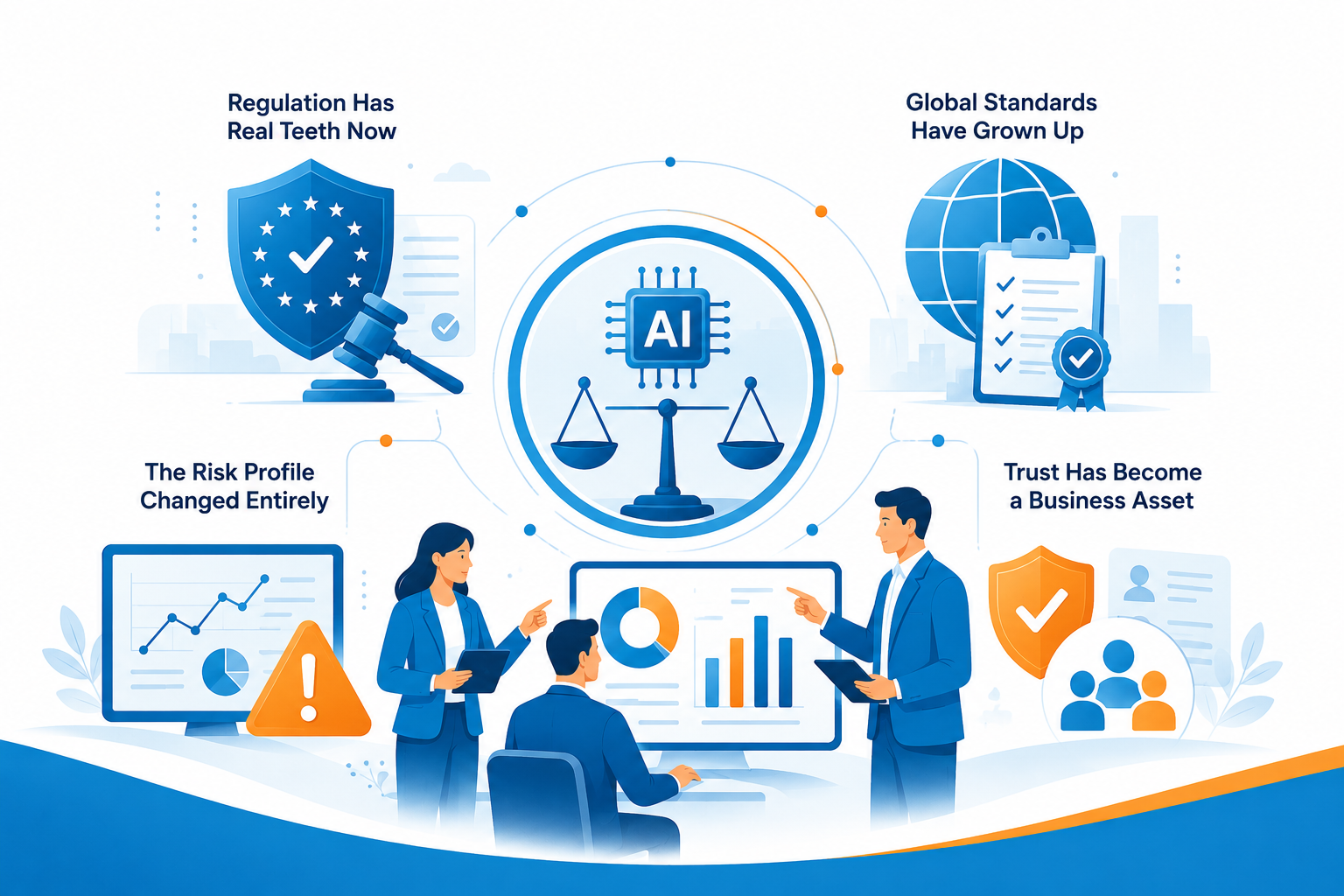
Earlier organizations treated governance like a suggestion, not a mandatory practice to integrate. However, the regulatory environment shifted dramatically, and AI governance best practices have now matured. As the technology becomes more robust, customers and investors are not looking the other way. Here are the latest AI governance trends that help drive this shift.
Regulation Has Real Teeth Now
The EU AI act does not act as a proposal to be debated around. Rather it has become live and enforceable. It does come with with real consequences now. Well, if your business is around European market, compliance is not a choice, but is a mandatory responsible AI practice.
Global Standards Have Grown Up
There are frameworks like NIST AI RMF and more that move beyond the theoretical guidelines into the benchmarks. Businesses are actively measured against these frameworks. Enterprise clients and government bodies expect alignment with these standards before signing contractors.
The Risk Profile Changed Entirely
The rise of generative AI has introduced different challenges that the traditional governance models were not built for. There are unreliable outputs, misinformation, copyright concerns and more that are difficult to predict and contain.
Trust Has Become a Business Asset
Customers want clarity on how their data gets used. Partners want assurance that your systems are reliable. Employees want to work somewhere with clear values around technology. Organizations that can back up their claims with real governance structures are winning on all three fronts.
Core Principles of Responsible Governance
Before you build any framework, you need to get clear on what values will actually guide your decisions. Policies change. Regulations evolve. Technology shifts. But strong principles give your organization a consistent foundation to stand on regardless of what changes around you. These are the ones that matter most:
Transparency
People deserve to know when automated systems are influencing decisions that affect them. Not every technical detail, but enough to understand what's happening and why. Organizations that operate in the dark on this don't just face regulatory risk. They lose trust, and trust is very hard to earn back once it's gone.
Accountability
Every system your organization runs needs a named human owner. Someone who can answer for what it does, who gets called when something goes wrong, and who has the authority to pull the plug if needed. Shared responsibility almost always means no responsibility. Make it specific.
Fairness
Systems learn from historical data, and history is full of bias. Without deliberate effort to identify and correct for this, you end up automating inequality at scale. Fairness requires ongoing testing, diverse data sources, and a genuine willingness to fix what you find even when it's inconvenient.
Data Protection
How you collect, store, and use data matters enormously, both legally and ethically. Frameworks like the General Data Protection Regulation set clear expectations, and your governance structure needs to reflect them. Strong data governance practices aren't separate from responsible technology use. They're central to it.
Recommended Post: Global AI Regulations for Secure and Compliant Autonomous Agents
Safety
Systems fail. The question is whether your organization is ready when they do. Proper testing before deployment, clear monitoring after it, and documented response processes for when things break, these aren't nice-to-haves. They're the baseline.
Ethics
Rules tell you what you're allowed to do. Ethics push you to ask whether you should. The organizations getting this right aren't just checking legal boxes, they're asking harder questions about impact, intent, and the kind of company they want to be.
Building Your Framework: A Step-by-Step Approach
Knowing you need a governance structure and actually building one are two very different things. Here's how to approach it without having to face any complexity.
1. Start with an Inventory
Map every tool, system, or automated process your organization currently runs. Who brought it in? What decisions does it influence and what data does it touch? This exercise alone surprise people, tools bought by one team, systems inherited from old vendors, automations quietly running in the background. Get them all on paper first.
2. Assess Risk Levels
Not everything carries the same weight. A grammar checker is very different from a credit scoring tool. Categorize each system by its potential impact on people, your business, and your legal standing. Ensure to remain deliberate about the difference rather than treating everything the same way.
3. Assign Clear Ownership
For every system on your list, one named person needs to be accountable. Not a department. Not a committee. Someone responsible, monitors performance, and has the authority to escalate or shut things down if needed.
4. Write a Governance Policy
Document how decisions get made. What gets approved and by whom? What testing happens before anything goes live? What counts as an incident and how does it get handled? Keep it clear and practical, a policy nobody understands helps no one.
5. Build Governance in Early
Governance that only kicks in after deployment arrives too late. Raise ethical and risk questions during the build process, not after. The earlier problems get spotted, the cheaper they are to fix.
Governance Standards Worth Knowing
The good news? You don't have to figure this out alone. Several well-tested references exist that organizations worldwide are already using as their starting point.
NIST Risk Management Framework
Built by the National Institute of Standards and Technology, this framework breaks things down into four straightforward functions, Govern, Map, Measure, and Manage. What makes it stand out is that it doesn't force a one-size-fits-all approach. A hospital and a retail startup can both use it and apply it differently based on their own context and risk exposure. For anyone building a governance structure from the ground up, this is genuinely one of the most useful places to start.
ISO IEC 42001
This is the international certification standard for responsible technology management. Getting certified signals to clients, partners, and regulators that your organization takes this seriously, with documented processes to back it up. Organizations competing for enterprise contracts are finding that alignment with ISO IEC 42001 is increasingly something buyers expect to see before they sign.
The EU AI Act
Arguably the most significant technology regulation passed anywhere in the world in recent years. It sorts systems into risk categories and sets specific obligations for each, with the strictest regulatory requirements reserved for tools used in hiring, healthcare, finance, and public services. Worth studying carefully regardless of where your business operates.
OECD Principles
Adopted by over 40 countries, these principles push organizations to think beyond legal minimums and consider the broader human impact of the technology they deploy. They form the foundation of many national regulatory approaches and serve as a useful ethical compass when the rulebook alone doesn't give you a clear answer.
Understanding Risk Levels
Not every system your organization runs carries the same level of responsibility. Treating a spell-checker the same way you treat a hiring algorithm wastes resources and misses the point entirely. Categorizing by risk helps you focus the right amount of attention in the right places.
| Risk Level | Examples | Governance Requirement |
| Critical | Healthcare decisions, enforcement tools, credit scoring | Full risk assessment, human oversight, regular audits, incident response protocols |
| High | Customer profiling, fraud detection, performance monitoring | Documented risk management, ongoing continuous monitoring, bias testing |
| Medium | Recommendation engines, moderation, scheduling tools | Basic documentation, periodic reviews, clear escalation paths |
| Low | Grammar checkers, search filters | Minimal oversight, standard data protection practices |
Final Thoughts
Governance structure is build it because running powerful technology without accountability, and without a plan for when things go wrong is far more painful in the long run.
The organizations that get the most out of their technology investments won't be the ones that moved fastest. They'll be the ones that moved thoughtfully, asking hard questions early and building real accountability into how they operate.
The roadmaps exist. The EU AI Act, NIST AI RMF, and more frameworks can be used. And if you're not sure where to start, start small. Do the inventory. Assign ownership. Write down your principles. Build from there. The AI governance future will reward organizations that invested early, in structure, in accountability, and in doing things the right way.
At Signity Solutions, we help organizations at every stage of this journey. If you want practical help building something that actually works, let's talk.

Mangesh Gothankar


Ashwani Sharma
Achin Verma
Frequently Asked Questions
Have a question in mind? We are here to answer. If you don’t see your question here, drop us a line at our contact page.
1. How is an AI governance framework different from a data governance policy?

2. Does a small business really need AI governance programs best practices?
3. How often should implementing AI governance framework be reviewed?
4. What's the first sign governance is actually working?






.png?width=352&name=Enterprise%20Agentic%20AI%20Architecture%20A%20Guide%20for%20Autonomous%20AI%20at%20Scale%20(1).png)