

.png?width=27&height=27&name=Group(1).png)

-1.svg)
-1.svg)


-2.svg)


%201-1.webp?width=148&height=74&name=our%20work%20(2)%201-1.webp)




.svg)





Automation has been a boardroom priority for years. Yet most enterprises are still stuck with half-built solutions, bots that handle the easy stuff and break the moment anything changes.
The issue isn't automation itself. It's the approach.
RPA without AI is just a faster way to follow instructions. It works beautifully on structured, predictable tasks. But the moment a document arrives in a new format, an email needs interpreting, or a decision requires context, the bot stalls. Someone has to step in.
This is where the intelligent automation changes the entire game.
When the RPA and AI work collaboratively, they automate judgment. AI in this scenario handles the variable and unstructured parts, and RPA handles the execution part. Together, they automate end-to-end enterprise tasks that otherwise could not be managed alone.
The business case is hard to ignore. According to Deloitte, 85% of organizations that implemented intelligent automation reported improved process efficiency, with many seeing full ROI within the first year of deployment.
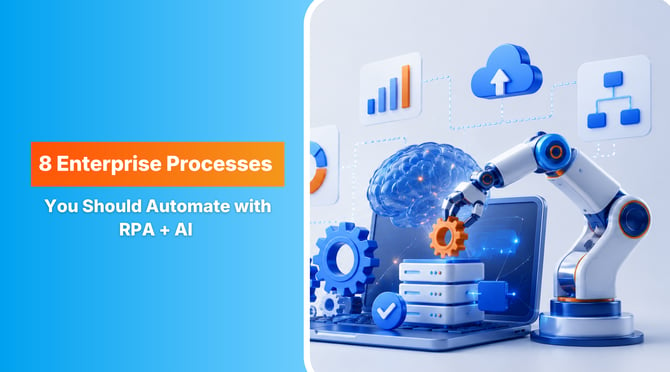
In this blog, we break down the 8 best processes for RPA and AI, the ones where this combination delivers real, measurable results. Not theory. Not hype. Just the processes where RPA AI process automation actually moves the needle.
 Generate
Key Takeaways
Generate
Key Takeaways

- RPA executes, and AI decides. Together, they automate processes that neither can handle alone.
- High-volume, document-heavy workflows deliver the fastest intelligent automation ROI by process.
- Understanding where RPA fails and AI helps is what separates a successful rollout from one that stalls.
- The best processes to automate with RPA and AI are the ones where manual effort is high and business impact is higher.
What is RPA + AI
Most people generally think RPA and AI are the same thing. However, they are different.
RPA relies on virtual bots to perform repetitive and rule-based tasks. Whether it is copying data, filling forms, or logging into systems, RPA automates the repetitive, rule-based work that generally takes hours to complete. Even a single change in a variable or an unexpected variable breaks the dots and brings the workflows to a halt.
AI offers a different capability altogether and adds intelligence to these monotonous processes. Technologies like ML, natural language processing, and others allow these bots to read unstructured data and adapt to system changes.
Putting both these together, you get something that one cannot deliver alone.
AI is the brain, RPA is the hands. AI figures out what needs to happen. RPA goes and does it. One interprets a vendor invoice that arrived as a scanned PDF. The other posts it to your ERP, matches it to the purchase order, and triggers the payment without anyone touching a keyboard.
This is what intelligent automation actually means in practice. Not bots running in the background on simple tasks. Full process automation, from the unstructured input at the start to the completed action at the end.
8 Enterprise Processes to Automate with RPA and AI
Well, choosing the right process to automate with RPA and AI is only part of the challenge.Below are the most automation-friendly processes where RPA and AI work well and can handle them. Here are intelligent automation use cases worth evaluating.
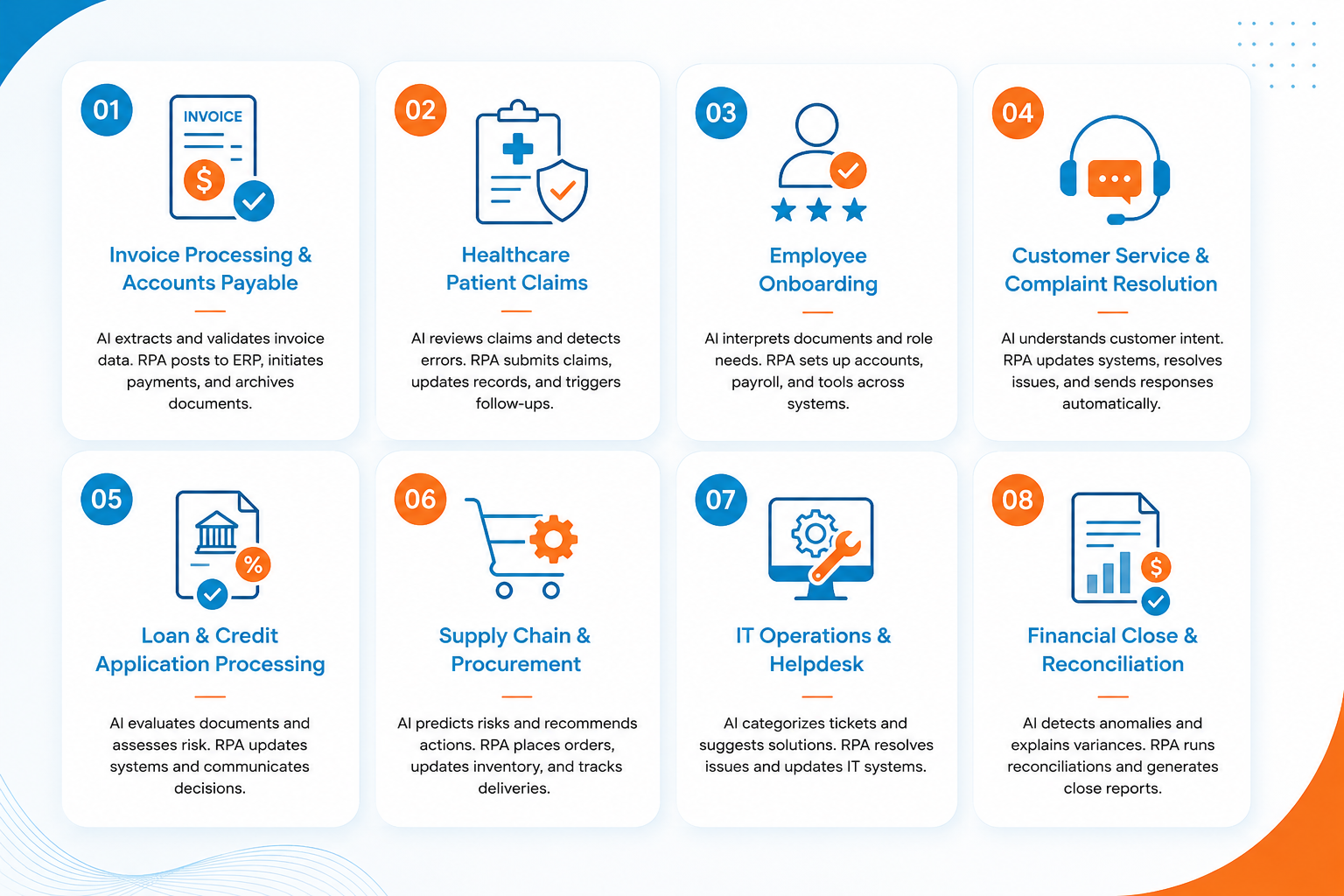
1. Invoice Processing & Accounts Payable
Account teams have to deal with document-heavy data. There are different invoices from vendors, PDFs, emails, and more. Everything needs to be validated, matched, and approved properly.
However, RPA in accounts payable alone can not perform this. Suppose you built a bot for an invoice template, and it falls apart on the next step. Now, if the vendor changes the layout, the workflow stalls, and it then requires manual intervention.
This is where RPA needs to be combined with AI. The smart document processes read the invoices without caring about the structure. From pulling out critical fields like tax breakdown, payment terms, vendor name, and more, it takes care of all the fields. Mismatched and duplicates are flagged. Basically, the process of execution takes place prior to the things becoming a problem.
RPA then takes over the execution. It posts validated entries into the ERP, initiates payment runs, archives the document, and sends confirmation notifications, without anyone performing these tasks manually.
2. Healthcare Patient Claims
Medical claims processing is an error-prone and time-consuming workflow. One missing code, one mismatched field, and the entire claim gets rejected. Staff then spend hours reworking and resubmitting, time that should be going toward patient care.
RPA alone cannot solve this. Claims arrive in varied formats, contain unstructured clinical notes, and require genuine judgment to catch errors or spot inconsistencies before submission. A bot that cannot read context will miss what matters most.
This is where RPA and AI process automation reshape the entire claims lifecycle. As per a report from McKinsey, healthcare providers who adopted intelligent automation were able to reduce the administrative costs by upto 30%.
AI reviews the incoming claims end-to-end, cross-checks the diagnostic code, and patient data eligibility. From identifying the errors in billing to flagging anomalies and catching the mismatch between clinical documentation and the actually submitted, it takes care of every detail.
So once AI validates and approves the claim, RPA comes in. It then submits the claims to the insurer, updates EMR records, and triggers the follow-up workflow without any manual intervention. Now the claim process is much faster and less dependent on manual oversight.
At Signity Solutions, we have done exactly this. Our Healthcare Revenue Intelligence System helped a healthcare provider transform their entire claims and denial management workflow, cutting processing time and turning a reactive AR process into a proactive revenue engine.
Recommended Post: RPA In Healthcare: Benefits & Use-Cases
3. Employee Onboarding
Starting a new job should feel smooth. But behind the scenes, onboarding is one of the most chaotic workflows in any enterprise. HR coordinating with the teams, payroll chasing the documents, and a new hire sitting without a system in hand, there are hundreds of tasks to be performed.
The root problem is that onboarding is not one process. It is ten processes running at the same time across departments that do not always talk to each other. According to a report, companies that brought automation into their onboarding process reduce administrative time by 80% while creating experiences.
AI reads the new hire intake forms, offer letters, and role details to figure out exactly what needs to happen and for whom. It handles the variability; different roles need different access, and different locations follow different compliance rules. Once that thinking is done, RPA gets to work. Robotic process automation sets up the account, payroll, and enrolls employees. Basically, it helps complete all the onboarding tasks without having to manually trigger each step.
4. Customer Service & Complaint Resolution
Customer expectations continue to rise. People want fast responses and proper resolutions. What they usually get is a ticket number and a waiting period.
Support teams handle hundreds of queries a day across email, chat, and phone. Every message is different. And the backend work to resolve an issue cuts across multiple systems that rarely talk to each other. A standalone bot cannot read customer intent. It can answer an FAQ, but falls apart the moment a query gets complex.
According to Salesforce, 83% of customers expect a quick response when they reach out to a company.
AI helps read the messages, understands customer needs, and decides what the right path is. Once that is finished, RPA pulls up the account data, processes whether there are any refunds, updates the CRM automatically, and sends a response without the involvement of an agent.
Complex queries still reach agents, but arrive pre-summarized with context already pulled. Agents stop doing repetitive lookups and start handling what actually needs a human.
5. Loan and Credit Application Processing
Loan applications are document-heavy and judgment-intensive. There are different processes to be handled, like bank statements, tax returns, ID proofs, and more. Doing through every document in detail, cross-verifying the numbers and more, consumes a lot of time.
Financial institutions using intelligent automation in lending have cut application-to-decision time by up to 70%. Underwriters get their time back for cases that actually need a closer look.
Bringing RPA and AI into this process changes how the work gets done. The AI integration reads submitted documents, checks figures for consistency, runs fraud detection, and produces a risk score. Once that assessment is ready, RPA moves the process forward. It connects with bureau APIs, fills in the loan management system, generates offer letters, and keeps applicants informed at every stage.
6. Supply Chain and Procurement
Supply chain teams remain under immense pressure. There is a constant shift in demand that may further delay the shipments. There may be a change in the supplier prices overnight. All these problems could have been detected earlier.
The volume of data involved here makes manual checks difficult. So by the time the procurement manager finds out a risk in supply risk, the damage is done.
And this is where RPA and AI step in and bring a real operational value. AI keeps an eye on demand patterns, supplier performance, and more. It automatically flags the early risks and offers sourcing decisions as per the actual data.
According to a report, companies that brought intelligent automation into supply chain operations cut procurement costs by up to 20-30%.
RPA then acts on those recommendations. Purchase orders go out. Inventory systems get updated. Supplier communications are sent. Deliveries can be tracked without having to follow up manually. Procurement teams can start making decisions that actually move the business forward.
At Signity Solutions, we have seen this play out firsthand. For Velura Logistics, we built WareMind AI, a warehouse management platform that brought computer vision, predictive analytics, and autonomous workflows together under one system. Inventory errors dropped by , order processing time reduced by, and night shift efficiency improved by, all within six months.
7. IT Operations and Helpdesk
IT helpdesks run on volume. Password resets, access requests, software issues, system outages, the tickets never stop. And most of them follow the same pattern everytime.
AI reads the tickets, understands the issue, work as per ticket urgency, and identifies resolution paths based on historical data. It also spots when multiple tickets point to the same underlying problem before it becomes a wider outage.
RPA handles the resolution. It resets passwords, provisions access, restarts services, deploys patches, and updates the ITSM tool at every step. IT teams stop spending their day on repetitive requests and get back to infrastructure work that actually needs their expertise.
8. Financial Close and Reconciliation
Month end close is one of the most stressful periods in any finance department. Transactions need to be matched. Variances need to be explained and journal entries need to be posted. The process may take weeks when it should be finished in a few days.
According to BlackLine, companies using intelligent automation in financial close reduce their close cycle by up to 50%.
AI goes through the entire transaction data and detect errors. It then flag the entries that needs a close look before becoming an audit problem at the end. RPA pulls data from ERP and banking systems, runs reconciliations, and offers a close status report.
Conclusion
The gap between RPA alone and RPA combined with AI is where most enterprises are leaving money on the table. Understanding where RPA fails and AI helps is what turns a basic automation project into a competitive advantage. Every process covered in this blog has a clear intelligent automation ROI by process, faster cycles, fewer errors, and teams that finally get to focus on work that matters.
At Signity we help businesses identify, design and deploy RPA and AI solutions that can deliver accurate results from the bery beginning. So, no matter you are starting out or looking to scale existing automation, we help bring the best technical depth and industry expertise to make it right.
Let us help you find the best processes for RPA and AI in your organization. Get in touch with us today.

Mangesh Gothankar


Ashwani Sharma
Achin Verma
Frequently Asked Questions
Have a question in mind? We are here to answer. If you don’t see your question here, drop us a line at our contact page.
Q1. What is the difference between RPA and intelligent automation?

Q2. Which industries benefit most from RPA AI process automation?
Q3. How long does it take to see intelligent automation ROI by process?
Q4. How do I know where RPA fails, and AI helps in my organization?