


.png?width=27&height=27&name=Group(1).png)

-1.svg)
-1.svg)


-2.svg)


%201-1.webp?width=148&height=74&name=our%20work%20(2)%201-1.webp)




.svg)





Every enterprise claims to be AI-first but a very few are actually AI-ready. Only 26% of enterprises have operationalized AI at scale, according to Forrester's 2026 research into enterprise AI operations. So, enterprises are still stuck in pilot mode, with 41% citing integration complexity as a major barrier.
These two numbers help you understand what actually blocks an AI program. These are generally the systems that were never connected to the data a model needs. And no governance framework was in place before the model started making decisions. Let’s map out both problems in detail, along with the AI consulting steps that move a program from pilot to production.
 Generate
Key Takeaways
Generate
Key Takeaways

- AI implementation challenges generally surface first at the data readiness stage.
- Legacy systems block real-time AI integration because they rely on batch-based data exports.
- Governance built after deployment costs more in audits, rework, and compliance delays.
- Having a documented AI implementation strategy for every use case leads to measurable business outcomes.
- Putting data, integration, and governance together reduces the pilot-to-production timeline.
Why AI Implementation Challenges Are Holding Enterprises Back
AI implementation challenges rarely surface during a demo. They surface weeks later, once a pilot has to run against live data, connect to systems already in production, and pass an internal audit it was never built for. Enterprise teams across regulated industries, including healthcare, banking, retail, and manufacturing, report the same five breakdowns once a pilot moves toward production.
Data readiness gaps
Enterprise customer and transaction data typically spans Salesforce, SAP, and several spreadsheets maintained independently by regional teams, often without documentation shared across departments. These sources rarely use consistent field names, which requires weeks of schema reconciliation before model training can begin.
Legacy system constraints
Many enterprise systems still process data in scheduled batches, while AI applications depend on continuous data flows. Connecting the two can become a complex engineering effort with its own timeline and dependencies.
Governance & Compliance Gaps
Regulatory compliance includes legal, security, data, and business teams. If roles and approvals are not clear from the start, issues around data access, system permissions, and accountability can appear later.
Ownership & Execution Gaps
Enterprise projects rarely sit within a single function. IT, data, security, and business teams may each own part of the work, but fragmented accountability can slow decisions and create handoff issues. Clear ownership is essential to keep delivery moving.
Scaling & Budget Gaps
There is one cost that goes ignored usually. It is about moving from a controlled pilot to a production environment. Infrastructure, security, monitoring, support, and operational change, all these introduce additional requirements that initial budgets may not cover.
Data readiness tends to surface first, and it causes the most downstream damage, since model training, integration testing, and compliance review all depend on it. The next section covers what data readiness requires in practice and what breaks when enterprises skip it.
How Poor Data Readiness Becomes a Challenge for Enterprises
Data readiness means having accurate, well-organized, accessible information that supports everyday business processes without constant manual fixes. For many enterprises, reaching this level of data quality is still a challenge.
The reason being, customer records may sit across three different CRM platforms with inconsistent field names. Financial data may update on a 24-hour batch cycle, while downstream applications require near real-time information. Product data may be maintained in spreadsheets by regional teams, each using different formats and definitions.
The problem is widespread. Gartner found that 63% of organizations either lack the right data management practices for AI or are unsure whether they have them. Gartner also estimates that 60% of AI projects without a strong data foundation will be abandoned through 2026.
These problems often appear when a project moves from testing to real business data. A pilot may work well with clean, selected datasets. But once it connects to production systems, teams may find duplicate records, missing information, different data definitions, or outdated records.
This is particularly difficult in regulated sectors such as healthcare and financial services. As here, the information is often distributed across systems and introduced at different points over many years. Before claims, patient, or transaction data can support a new application, organizations may need to reconcile field definitions, resolve duplicate records, establish ownership, and verify data lineage.
Treating this work as part of the initial project plan changes the delivery equation. Data audits, integration mapping, quality checks, and governance reviews can be addressed before development begins rather than becoming remediation work after a pilot exposes the gaps.
The objective is not to create another data cleanup project. It is to establish enough consistency, access, and control for the intended business use case to move into production with fewer surprises.
The next challenge is closely related but distinct: legacy infrastructure. Our breakdown of building a successful AI strategy covers how to sequence data audits, integration mapping, and governance review before development starts. Legacy systems create a related but separate set of problems, covered next.
Overcoming Legacy System and Integration Barriers in AI Deployment
Core banking systems, Epic and Cerner EHR platforms, and ERP software installed a decade or more ago share a common limitation. These systems were configured for scheduled reporting and manual data exports, not for serving data to an external AI pipeline. IDC's 2025 research, conducted with Lenovo and published in the Lenovo CIO Playbook, quantifies the resulting outcome. Of every 33 AI proof-of-concept projects launched, only four reach production.
Four consistent problems surface once integration work begins.
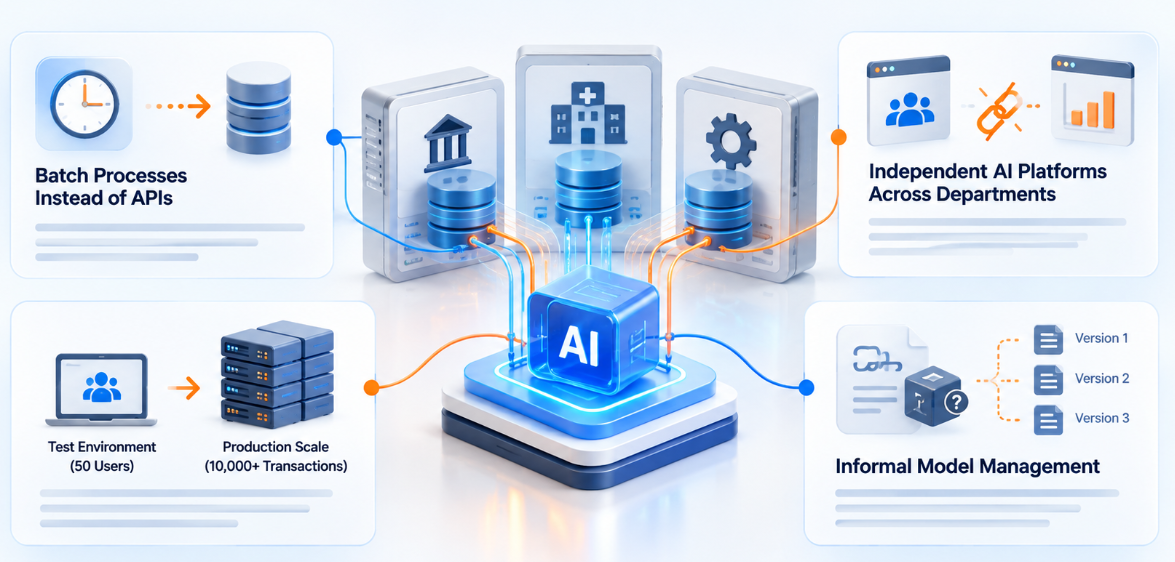
Data moves through batch processes rather than APIs
Most legacy platforms were configured to generate a report overnight, not to respond to a live query from a model requiring a response in milliseconds. Building the API layer required to bridge this gap typically becomes a separate engineering initiative outside the original project scope.
Departments select AI platforms independently
A marketing function adopts one AI platform and an operations function adopts another. Within months, neither system can produce a unified view, since the two platforms were never designed to exchange data with each other.
Pilot environments are sized for testing, not production
Fifty test users represent a manageable load for most infrastructure. Ten thousand daily transactions do not, and the difference between the two frequently requires a rebuild that exceeds the cost of the original pilot.
Model management remains informal in most organizations
Few enterprises maintain a repeatable process for tracking which model version is active, identifying performance drift, or reverting a deployment when it fails.
Enterprises that resolve these barriers apply the same discipline used in any infrastructure migration, including staged rollouts, phase-based testing, and monitoring activated before launch. Our enterprise AI agent deployment guide outlines a five-phase framework for this process. Once systems are connected, enterprises must still determine who is authorized to approve, monitor, and audit the AI system's actions once it is in production.
Why Security, Governance, and Compliance Matter in Enterprise Implementation
Systems processing customer information, finance records, or health data are subjected to regulatory and security requirements. This includes GDPR, HIPAA, and ISO 27001 where applicable. In cases where governance is addressed after deployment, gaps often surface during audits or operational reviews, creating additional rework, cost, and delays.
Our team recently supported a UK-based fintech lender in establishing a compliant operations center to manage credit risk and lending analytics data across two regulatory jurisdictions. The engagement involved encryption standards, network segmentation, and governance controls aligned with GDPR and ISO 27001 before analytics operations went live. The team achieved full regulatory compliance within 60 days and reduced compliance reporting time by 60%, enabling the lender to expand its analytics operations without creating a parallel compliance backlog.
- Data privacy: Regulatory requirements continue to apply when customer or financial information is processed by new systems.
- Model risk: Bias, inaccurate outputs, and limited explainability cause additional risk when systems influence high-stakes decisions.
- Shadow systems: Unapproved tools can lead to data exposure without the visibility or controls expected by IT and security teams.
- Accountability: Clear ownership is required to respond quickly when a system produces an error or requires intervention.
Governance is most effective when established alongside the technical architecture rather than added after implementation. Data access, security controls, accountability, and regulatory requirements should be considered during the same planning process as integration and deployment decisions.
The next section examines how enterprises can address data, integration, and governance gaps as part of a structured implementation strategy.
How Enterprises Can Overcome AI Adoption and Integration Challenges
Data readiness, legacy integration, and governance—all three need different fixes. Enterprises moving from pilot to production successfully address these constraints in sequence. Starting with a scoped audit, clear ownership, and a measurable checkpoint before moving to the next phase.
The table below summarizes what happens when each challenge remains unresolved and the action required to address it.
| Challenge | Impact | Where It Surfaces | Enterprise Response |
| Data readiness gaps | Poor performance with incomplete or inconsistent production data | Data ingestion and model training | Audit data and reconcile schemas before development |
| Legacy system constraints | Limited access to real-time production data | System integration and production rollout | Add an API layer and test integrations in stages |
| Governance & compliance gaps | Late-stage compliance issues and rework | Legal, security, and compliance review | Define controls alongside the technical architecture |
| Unclear ownership | Decisions stall across IT, data, and business teams | Pilot-to-production transition | Assign one executive sponsor and delivery owner |
| Scaling & budget gaps | Production costs exceed initial pilot funding | Production deployment | Budget for infrastructure, monitoring, and change management |
Enterprises following this sequence reduce the delays and rework that often extend the pilot-to-production cycle. Also, the order can vary as per the regulatory, technical, or business requirements. But the principle remains the same. Each issue needs a defined owner, business outcome, and path to resolution.
This approach creates the basis of a structured AI strategy that connects implementation decisions with broader business priorities.
What an Enterprise AI Implementation Strategy Needs to Scale
Scaling beyond a single use case calls for a documented strategy. It connects each initiative to a measurable business outcome. Enterprises scaling establish this direction before development begins. It includes prioritizing use cases based on business value and technical feasibility rather than departmental demand.
Organizations that remain stuck in pilot mode often have a similar operating model. No single team owns the path from use case selection through production and ongoing monitoring. Data science owns the model, IT manages infrastructure, and the business unit controls the budget, but accountability for the overall outcome remains fragmented.
- Define success metrics tied to revenue, cost, or cycle time.
- Prioritize use cases by business value and technical feasibility.
- Assign one funded owner accountable through deployment.
- Build monitoring and rollback processes into the architecture.
Our detailed AI implementation strategy and ROI guide covers how to establish leading and lagging indicators and measure performance beyond the pilot stage. At this point, enterprises must also decide whether to build the required capabilities internally or work with a partner that already has the relevant expertise and delivery infrastructure.
How Signity Helps Enterprises Overcome AI Implementation Challenges
Signity Solutions works with mid-market and enterprise teams across the core challenges discussed in this piece: data readiness, legacy integration, governance, and execution. Our approach brings these considerations into the planning and development process, rather than addressing them after a pilot has been completed.
- Structured implementation approach. Data architecture, security, and compliance requirements are addressed from the start.
- Enterprise-grade data security. Encryption, network segmentation, and access controls support complex and regulated environments.
- Compliance-ready delivery. Governance requirements are aligned with GDPR, HIPAA, and ISO 27001 where applicable.
- Measurable outcomes. Projects are evaluated against defined business outcomes, not delivery milestones alone.
In one recent healthcare engagement, our AI governance platform reduced compliance review time by 68% and made AI risk assessments 4.2 times faster, giving the compliance team visibility across active initiatives.
Addressing data, integration, governance, and execution together gives enterprises a clearer path from pilot to production. The starting point is understanding which constraints are affecting your organization and what needs to be addressed first.

Mangesh Gothankar


Ashwani Sharma
Achin Verma
Frequently Asked Questions
Have a question in mind? We are here to answer. If you don’t see your question here, drop us a line at our contact page.
What are the biggest AI implementation challenges enterprises face today?

Why do most enterprise AI pilots fail to reach production?
How long does enterprise AI implementation typically take?
What does AI governance include for enterprise deployments?
What is the difference between AI adoption and AI implementation?