

.png?width=27&height=27&name=Group(1).png)

-1.svg)
-1.svg)


-2.svg)


%201-1.webp?width=148&height=74&name=our%20work%20(2)%201-1.webp)




.svg)





Rule-based workflow automation grew inside most large enterprises without much planning. Teams added a bot whenever a task became repetitive, until finance, HR, and operations were each running dozens of scripts that nobody could fully account for. That setup held together only because existing business processes rarely changed. By 2026, they change constantly, and automation built for stillness is struggling to keep pace.
Only 21% of organizations now run AI workflows at true enterprise scale, and the other 79% are stuck somewhere between pilot and production, according to Stonebranch's 2026 Global State of IT Automation Report. The gap is not a technology shortage. It's a design problem: RPA was built to follow steps, not to understand them.
AI workflow automation through intelligent process automation closes that gap. Rather than scripting every exception in advance, it works from unstructured data and applies judgment inside guardrails a human has set, adjusting as the underlying process shifts.
The sections ahead cover why rule-based workflow automation stalls in complex enterprises and what an AI workflow optimization architecture looks like in practice. Also, we will work on where the return shows up first and what compliance controls now demand.
 Generate
Key Takeaways
Generate
Key Takeaways

- RPA automates fixed rules only. AI workflow optimization reads context, exceptions, and unstructured data.
- Nearly half of all RPA deployments fail to scale in complex business processes.
- Enterprise workflow optimization unites process intelligence and machine learning. Governance is built into the same system.
- The EU AI Act mandates audit trails and human oversight from August 2026.
What Is AI Workflow Optimization?
AI workflow optimization is the practice of using machine learning, natural language processing, and process intelligence to plan and execute business workflows for continuous improvement, rather than just running automated workflows.
Where traditional workflow automation follows a rule someone wrote once, AI workflow optimization reads the current state of a process, an invoice missing a field or a claim with ambiguous wording. This support ticket doesn't match any known category, and decides what to do next inside guardrails a human has defined.
The distinction matters because most enterprise business processes were never actually uniform. A "standard" procurement approval might follow one path 70% of the time and branch into a dozen edge cases the rest of the time. Robotic process automation handles the 70%. AI workflow optimization is built for the rest, and it keeps learning as new exceptions appear instead of waiting for a developer to rewrite the script.
Related Read: An Ultimate Guide To RPA (Robotic Process Automation)
Why Rule-Based RPA Hits A Wall In Complex Enterprises?
Rule-based RPA or traditional automation breaks down whenever a process has more exceptions than rules, and that describes most workflows inside a large, multi-system enterprise. A bot built to extract three fields from a vendor invoice fails the moment a vendor changes its template. A bot that routes support tickets by keyword fails the moment a customer phrases the same problem differently.
The numbers back this up. The data these bots are supposed to process keeps getting messier: enterprises are now storing 57% more unstructured data than they were in 2024, with 74% managing more than 5PB of it, according to Komprise's 2026 State of Unstructured Data Management report. Emails, contracts, claims notes, and chat transcripts don't fit the rows and columns RPA was designed for.
None of this makes RPA worthless. It's still the right tool for genuinely stable, high-volume, rule-bound complex processes like reconciling two systems of record. The problem is enterprises stretching it to cover judgment calls it was never built to make.
| Dimension | Rule-Based RPA | AI Workflow Optimization |
| Data it handles | Structured, template-based inputs | Structured and unstructured data (documents, emails, chat, images) |
| Response to change | Breaks when the process or UI changes | Adapts using context and learned patterns |
| Exception handling | Routes exceptions to a human queue | Resolves many exceptions automatically, inside guardrails |
| Maintenance | Requires a developer to rewrite scripts | Retrains on new patterns with less manual tasks or rework |
| Best fit | Stable, high-volume, rule-bound tasks | Judgment-heavy, cross-system, exception-rich processes |
Inside The Architecture: How Intelligent Workflow Automation Actually Works?
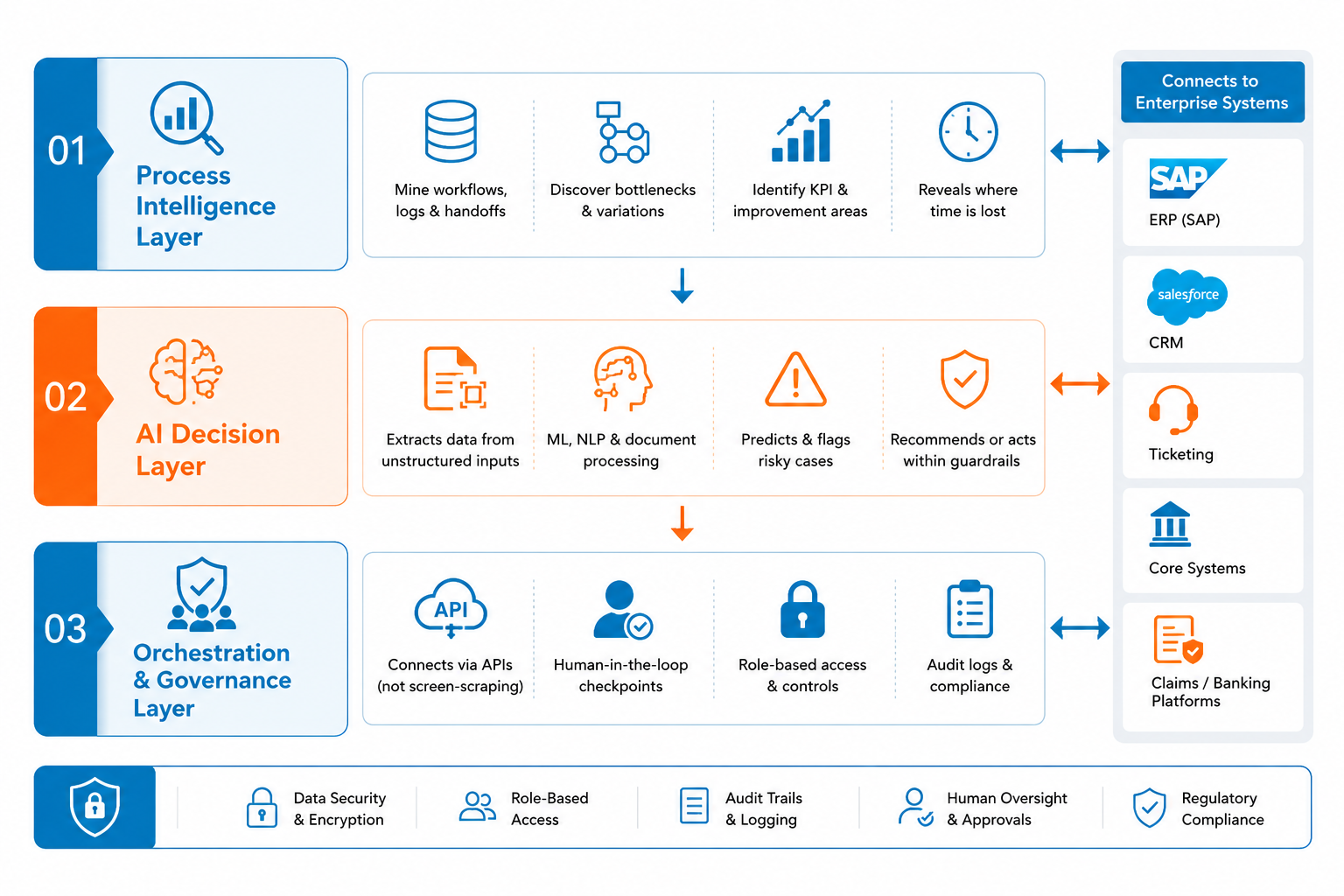
An AI workflow optimization system is built in layers where each layer performs distinct time-consuming tasks as it protects sensitive data. Understanding these layers matters before any implementation conversation. This is because most stalled automation projects skip straight to the AI layer and bolt it onto an unmapped process.
Process intelligence layer
This layer sets the foundation where it mines existing workflows, system logs, task timestamps, and handoff data to pinpoint where time is genuinely being lost. The findings frequently contradict what stakeholders assume. Process mining surfaces the real bottlenecks the actual variation in how a "standard" process runs, and the key performance indicators worth automating around. Skipping this step is the single most common reason end-to-end automation projects target the wrong process, irrespective of the system's core capabilities.
AI decision layer
This is where machine learning, along with natural language processing and document processing, does the interpretive work. Intelligent document processing extracts data from unstructured inputs like invoices, claims, contracts, and ID documents. Predictive analytics flags cases likely to need escalation before they reach that point. The system rarely delivers a final answer on its own. More often it produces a recommendation or takes an action within pre-approved boundaries.
Orchestration and governance layer
This layer connects the AI decision layer to existing systems such as ERP, CRM, ticketing and core banking or claims platforms. It works through APIs rather than screen-scraping for cross system processes, giving a more stable and easier approach to secure. Regulators and auditors will ask about role-based access controls, audit logs, and human-in-the-loop checkpoints for anything high-risk. This layer actually carries those controls.
Programs built to integrate with the existing tech stack tend to scale past pilot, unlike those built to replace it. If your team wants a second opinion on where a specific process fits in this architecture, that's worth a conversation with your technical lead.
Where AI Workflow Optimization Delivers Measurable ROI?
AI workflow optimization pays back fastest in functions that combine high transaction volume with high exception rates, exactly the profile RPA struggles with. Across sectors, the median first-year ROI on workflow automation investment ranges between 200% and 400%, with most enterprises reaching breakeven in two to four months. Four functions consistently lead:
Finance and accounts payable:
AI document processing reads invoices in any format and matches them against purchase orders. It even routes only genuine exceptions to a human. It means cutting manual data entry for administrative tasks and shrinking the close cycle with higher workflow efficiency.
Claims and underwriting:
Natural language processing reads adjuster notes and claim narratives. It flags likely fraud patterns for automating routine tasks such as speeding routine claims for rapid settlement. Besides, the AI workflow automation can be configured to route complex ones to the specialists.
Supply chain and procurement:
Predictive analytics forecasts disruption risk from supplier data. It routes purchase approvals dynamically instead of using one fixed chain to offer maximum operational efficiency.
Customer service and back-office support:
AI agents handle routine requests end-to-end and escalate only when a case falls outside a set confidence threshold. Ultimately, it helps improve customer satisfaction while reducing pressure on tier-one queues.
The pattern across all four: Artificial intelligence workflow optimization doesn't just automate complex tasks. It identifies bottlenecks the business didn't know it had. This is because the process intelligence layer is watching the whole workflow for effective service management.
Governance and Compliance: What the EU AI Act Means for Automated Workflows?
The EU AI Act's high-risk obligations take effect on August 2, 2026. They apply to any organization whose automated systems affect people inside the EU. Company headquarters location makes no difference. Workflows touching credit decisions, employment screening, insurance underwriting or regulatory reporting fall squarely into the high-risk category.
For enterprises running AI workflow optimization at scale, this changes the build requirements. High-risk systems now need documented risk management for systematic processes and data governance for every input the model touches. Further, it requires automatic record-keeping and human oversight built into the workflow. Penalties are not symbolic: violations can reach €35 million or 7% of global annual turnover, whichever is higher.
This is why the orchestration and governance layer described above isn't optional infrastructure. Audit logs, access controls, and human-in-the-loop checkpoints have to be part of the architecture from day one. Retrofitting compliance into a workflow designed without it costs far more than designing for it upfront, and it's the single most common reason AI automation timelines slip in regulated industries.
Choosing the Right AI Workflow Optimization Partner
Most AI workflow optimization projects don't fail on the model. They fail on scoping, integration, or governance, which means the partner selection decision matters more than the platform selection decision. A vendor who leads with the AI layer before mapping your actual process is a signal to slow down, not speed up.
Three things separate a partner worth hiring from a reseller with a demo.
- First, they scope from the process intelligence layer outward. It helps map how work actually moves through your systems before recommending anything.
- Second, they build for your existing tech stack instead of asking you to rip it out. The seamless integration with your ERP, CRM, and legacy systems is the difference between a six-week pilot and an eighteen-month failed migration.
- Third, they treat coding expertise, governance, audit logs, access controls, and compliance documentation as a build requirement.
Cost conversations should follow the same order. A partner who can't explain where your automation spend goes, engineering, integration, ongoing model tuning, governance, before quoting a number is optimizing for the sale, not for your ROI.
The Signity Advantage: RPA and AI Automation Built for Complex Enterprises
Everything above describes what a modern automation architecture demands to meet business needs. Here's what that looks like when Signity builds it.
RPA that doesn't stop at task automation
Signity's RPA consulting and integration practice spans UiPath, Zoho, HubSpot and open-source RPA tooling. The work goes well beyond bots that click buttons in a fixed sequence. Every engagement is scoped through hyperautomation, which merges RPA with AI and machine learning. That combination keeps a process running even after the underlying rules change.
Agentic automation for the judgment-heavy work
Where a process needs planning and decision-making instead of a fixed script, Signity's agentic AI and agentic process automation team builds multi-agent systems that plan, act, and adapt inside defined guardrails. One production deployment runs a fully autonomous multi-agent system that manages an entire e-commerce operation. From trend detection through inventory decisions, without a human triggering each step, it works on data collection to optimize workflows. That's the same architecture this piece describes, process intelligence, an AI decision layer, and orchestration, running in production, not a lab demo.
Built on what you already run, not instead of it
Signity's automation work integrates with the ERP, CRM, and legacy systems already running the business rather than asking a client to replace them. Recent projects have automated web-form processing and demand-driven inventory management, work that used to need rule-based scripts covering only a fraction of the real-world cases a business actually hits.
A decade of production work, not a pitch deck
Signity has delivered more than 1,000 projects since 2009, across finance, healthcare, legal, retail, and education, industries where a broken workflow carries real compliance and revenue consequences. That range is why the architecture described in this piece isn't theoretical inside Signity's engineering teams. It's the shape of the work they've been doing for over a decade.
Conclusion
RPA isn't going away, and it shouldn't. It's still the right choice for stable, high-volume, rule-bound work. But complex enterprises running dozens of interconnected workflows related to finance, claims, procurement, and service need something that understands context.
That's what AI workflow optimization is built for: a system that process unstructured data, makes decisions inside real guardrails, and adapts as the business changes around it instead of breaking every time it does.
The enterprises pulling ahead in 2026 aren't the ones with the most bots. They are the ones who mapped their business rules and processes honestly, measured efficiency metrics continuously, built governance in from the start, and picked a partner who could do both. All in all, the architecture decisions made this quarter will determine which group a company is in next year.

Mangesh Gothankar


Ashwani Sharma
Achin Verma
Frequently Asked Questions
Have a question in mind? We are here to answer. If you don’t see your question here, drop us a line at our contact page.
What is the difference between RPA and AI workflow optimization?

Is AI workflow optimization the same as intelligent process automation?
How long does it take to see ROI from AI workflow optimization?
Does AI workflow optimization require replacing our existing systems?
What compliance requirements apply to AI-driven workflows in 2026?
Which enterprise functions see the fastest results from AI workflow optimization?