

.png?width=27&height=27&name=Group(1).png)

-1.svg)
-1.svg)


-2.svg)


%201-1.webp?width=148&height=74&name=our%20work%20(2)%201-1.webp)




.svg)






Phishing used to leave fingerprints. Awkward grammar, a generic greeting, a link that didn't quite match the sender's domain. Security teams built entire detection stacks around spotting those fingerprints, and for two decades that approach mostly held up.
It stopped holding up around 2024. Generative AI lets attackers write phishing emails that read like a native speaker with real knowledge of the target, and produce them in minutes instead of hours.
The FBI's IC3 Internet Crime Report logged 22,364 complaints with a confirmed AI component and $893 million in associated losses, while business email compromise alone accounted for $3.046 billion in reported losses last year. Microsoft Threat Intelligence recorded 8.3 billion email-based phishing threats across Q1 2026, with 10.7 million of those tied to business email compromise.
This is the environment any new phishing detection system has to be built for. This guide covers what that architecture actually looks like. Also, we will understand how large language models evaluate intent. Further, we will work on how URL and domain analysis still fit in and what it takes to deploy the system end-to-end.
 Generate
Key Takeaways
Generate
Key Takeaways

- Rule-based filters miss AI-written phishing because the content itself has no detectable flaws to catch.
- Effective systems fuse language models, sender verification, URL analysis, and real-time risk scoring.
- Independent research has measured LLM-based phishing detection accuracy above 99 percent under test conditions.
- Architecture choice matters more than model size in detecting novel AI-generated attack variants.
What Is an AI-Powered Phishing Detection System?
AI phishing detection runs on machine learning paired with natural language processing and behavioral analytics. It catches phishing attempts across online interactions run through emails or web activity before anyone clicks.
It doesn't match against known-bad signatures. Instead, it looks at language, sender identity, URL structure and page design together and boils all of that down to a single risk score.
Phishing detection and phishing filtering aren't the same task anymore, and that difference matters. A filter blocks what it already recognizes. A detection system asks whether a message actually fits this sender, this recipient, this context. Once phishing emails are grammatically clean and contextually convincing, that's really the only thing left that works.
Why Traditional Phishing Detection Is Failing in 2026?
Rule-based and signature-based filters were built to catch human-written phishing, which carried a fairly consistent profile of awkward phrasing and recognizable templates. Generative AI removed that profile.
An attacker can now produce a spear phishing email tailored to a specific executive's writing style and travel schedule in minutes, at a cost that used to require a trained human operator working for hours.
The scale shows up clearly in current threat intelligence. Microsoft Threat Intelligence detected roughly 8.3 billion email-based phishing threats in Q1 2026, and recorded a 146 percent increase in QR-code phishing (quishing) over the quarter as attackers shifted toward formats that bypass text-based link scanning. Rexxfield in 2026 recorded $3.046 billion in business email compromise losses from 24,768 complaints.
| Detection Generation | What It Catches | Why It Fails Against AI Phishing |
| Reputation-based (blocklists) | Known-bad IPs and domains | Attackers register clean domains and rotate infrastructure faster than lists update |
| Content-scanning (keyword/template matching) | Urgency language, known templates, grammar errors | AI-generated content has no template and no grammar errors to flag |
| Behavioral baseline (anomaly detection) | Deviations from normal communication patterns | Slow-burn campaigns build a relationship that makes the baseline itself look normal |
| Intent-based reasoning (LLM + context) | Whether a message makes sense for this sender, recipient, and moment | Current standard; requires organizational context modeling to work |
Related Read: AI Data Security Platform: Securing Enterprise AI, Data and Compliance
Core Architecture of an AI-Powered Phishing Detection System
A production-grade system isn't one model. It's a pipeline of specialized components, each one reading a different signal, and those outputs get fused into a single risk score. That architecture has to satisfy two very different people: an engineer who needs it solid enough to build, and a security lead who needs it clear enough to actually trust the verdict.
Data Ingestion and Feature Engineering
The pipeline opens with a stream-ingestion layer, usually Kafka or something similar. It catches emails, URLs, and attachments as they land, then pulls out structured features before any of it reaches a model.
A message breaks down into headers, routing paths, and authentication results (SPF, DKIM, DMARC) plus timestamps. URLs get split differently: lexical signals like string length, character entropy, subdomain count and shortener use, and domain-level signals like WHOIS registration age, certificate issuance date and DNS resolution patterns.
Domains registered in the previous 24 to 72 hours are treated as elevated risk by default, since that window covers most infrastructure built for a specific campaign.
LLM-Based Language and Intent Analysis
This is where LLM phishing detection does the real work. Message text gets converted into semantic embeddings and checked against known social-engineering patterns using cosine similarity. That's what catches manipulation intent even after the wording's been rewritten or translated.
A fine-tuned transformer model, whether that's a BERT-family encoder or a hosted LLM API, reads the tone, checks how urgency is being framed, and looks at what action the message is asking for. It outputs an intent classification with a confidence score.
Research on LLM-based phishing classifiers has recorded detection accuracy above 99 percent under controlled test conditions, well above what static, rule-based classifiers hit on the same datasets. Worth noting that's a lab number, not a guarantee of what happens once real inboxes and real attackers get involved.
Sender, URL, and Visual Verification Layer
Sender verification builds an identity graph for each user: who they usually talk to, how often, in what tone. If a message claims to be from someone but breaks that pattern, it gets flagged.
URL verification takes each link apart. Redirect chains, parameter structure, destination domain, all checked against known brand-impersonation targets.
If the phishing content includes a webpage, a computer vision model steps in. It's usually a CNN or vision transformer trained on real login-page screenshots. The model compares layout, font weight, and logo placement against known templates. Spoofed login portals built to steal credentials mostly get caught right there.
Real-Time Risk Scoring and Automated Response
The outputs from language analysis, sender verification, URL analysis, and visual analysis feed into a fusion layer that produces one normalized risk score. A message scoring above a defined threshold, commonly around 0.65 to 0.7 in published enterprise implementations, triggers an automated response of block, quarantine, or analyst review.
This layer has to run in sub-second time. That's why real-time pipelines are typically backed by Redis or something similar, sitting next to the Kafka ingestion layer. The payoff is it keeps latency low enough that the message never reaches an inbox.
| Layer | Purpose | Example Technologies |
| Stream ingestion | Capture and route incoming messages at scale | Apache Kafka, Redis |
| NLP/LLM inference | Semantic and intent analysis | Hugging Face Transformers, spaCy, hosted LLM APIs |
| Computer vision | Detect spoofed login pages and brand impersonation | OpenCV, Vision Transformers |
| Structured feature models | URL, domain, and metadata classification | XGBoost, CatBoost |
| Data storage | Store training data, alerts, and telemetry | PostgreSQL, MongoDB |
| Deployment/scaling | Run and scale the detection service | Docker, Kubernetes |
How to Build an AI-Powered Phishing Detection System
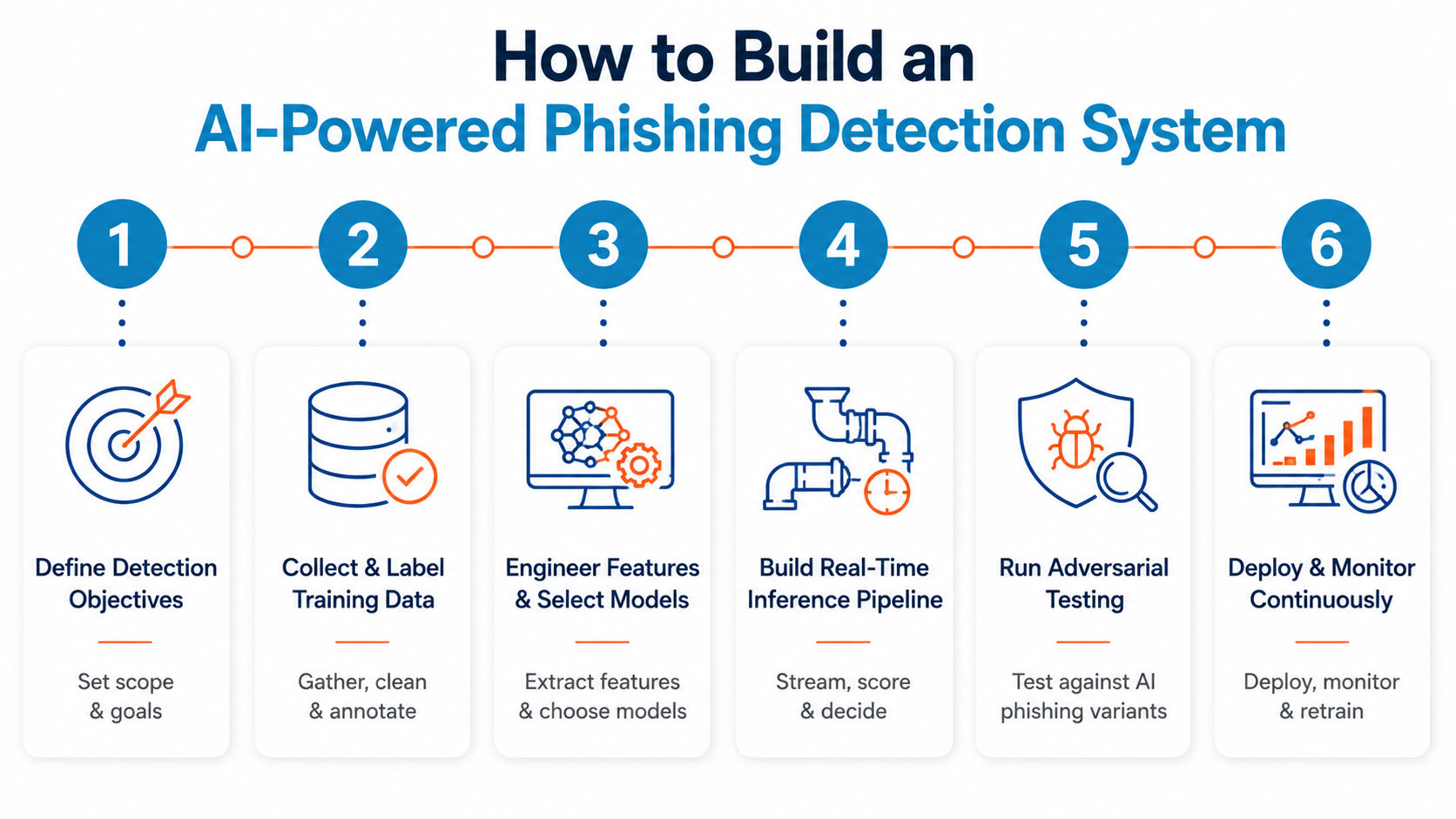
1. Define detection objectives and data readiness
Scope which channels (email, SMS, web) the system needs to cover and confirm you have or can source labeled phishing and legitimate samples before any model work starts.
2. Collect and label training data
Pull phishing URLs and messages from threat intelligence feeds and open-source repositories, and legitimate samples from verified organizational archives, then normalize and label both sets.
3. Engineer features and select models
Build the lexical, domain, and behavioral features described above. Gradient-boosted trees like CatBoost or XGBoost tend to beat simpler models on structured URL and domain features. Transformer-based models handle language intent.
4. Build the real-time inference pipeline
Integrate the trained models into a streaming pipeline that scores messages, URLs, and attachments as they arrive, fast enough to act before delivery.
5. Run adversarial testing
Generate synthetic phishing variants, including AI-written ones, and test detection accuracy against them specifically. A model trained only on historical phishing data will miss what attackers are doing now.
6. Deploy and monitor continuously
Integrate with existing mail gateways or security tools via API. Track precision, recall, and false-positive rate against live traffic, and retrain on a defined cadence.
Model selection and adversarial testing are the two stages that make or break detection accuracy. They're also where an experienced development partner saves the most time.
Model selection and adversarial testing are usually where an implementation either earns its detection accuracy or falls short of it, and they're the two stages where an experienced development partner shortens the timeline the most.
What Detection Accuracy and ROI Actually Look Like
The numbers back up the shift toward AI-based detection. The global AI phishing detection market was worth $1.7 billion in 2024, on track to hit $8.2 billion by 2033 at an 18.9 percent CAGR.
Regulated industries are moving fast too. By 2025, 87 percent of financial institutions were using AI-based fraud detection, up from 72 percent in early 2024.
The accuracy gains are real. McKinsey's research on fraud detection found AI-based approaches catch 53 percent more fraud than rule-based methods do. And Gartner expects 17 percent of all cyberattacks to involve generative AI by 2027, the top emerging risk category security leaders are watching.
Intent-based detection reduces investigation time for security teams and drives measurable ROI by cutting the analyst hours spent chasing false positives, which is where most of the operational cost of a legacy filter actually sits.
Compliance and Governance Considerations
An AI phishing detection system processes message content that frequently includes login credentials, financial details, and other sensitive information, which puts data handling at the center of the architecture rather than at the edge of it.
Systems built for regulated sectors need audit logging on every model decision, defined data retention limits for scanned content, and a documented basis for how flagged messages are stored and who can access them.
Model auditability matters just as much: a risk score without a reasoning trace is difficult to defend in a compliance review, which is why enterprise-grade systems increasingly pair the score with a plain-language explanation of which signals drove it.
Common Build Challenges (and What They Actually Require)
- False positives are the most common failure mode in early deployments. Fixing them requires precision-focused threshold tuning, not simply lowering detection sensitivity, since that just reopens the door to the attacks the system was built to stop.
- Noisy training data, fragmented formatting, mislabeled samples, inconsistent headers, requires a dedicated normalization and validation pipeline before any model sees the data.
- Latency at scale is the third recurring issue: an enterprise deployment processing thousands of messages per second needs a stream-based architecture from day one, since retrofitting real-time performance onto a batch-oriented system costs significantly more than designing for it up front.
Signity's Approach to AI-Powered Phishing Detection
Building a detection system that holds up against 2026-level phishing takes the same discipline as any production ML system: clean data pipelines, models matched to the right task, and infrastructure that can score messages in real time without breaking mail flow.
Signity's engineering teams work across this stack, from feature engineering and model selection through real-time pipeline integration and deployment on existing security infrastructure.
The decisions that separate a working system from a research prototype, such as which model handles language intent versus structured URL features, how the fusion layer weighs conflicting signals, and where the false-positive threshold sits, are worth scoping with an experienced partner before development starts.
Conclusion
Phishing detection in 2026 is not a filtering problem. It is a reasoning problem. The content of an AI-written phishing email can be grammatically perfect and contextually accurate, which means the signal a system needs to catch isn't in the text itself. It's in whether the message makes sense for this sender, this recipient, and this moment.
That shift separates detection architecture built for 2020 from architecture built for 2026: asking not "have I seen this before" but "does this make sense." Organizations building or adopting systems around that question are the ones keeping pace with attackers who no longer need sixteen hours and native fluency to run a convincing campaign, just a browser and a few dollars of AI tooling.
Frequently Asked Questions
Have a question in mind? We are here to answer. If you don’t see your question here, drop us a line at our contact page.
What is the difference between AI phishing detection and traditional phishing detection?

How accurate is AI-powered phishing detection?
Does an AI phishing detection system work with Microsoft 365 and Google Workspace?
What data does an AI phishing detection system need to get started?
How long does it take to build and deploy an AI phishing detection system?
Can AI-generated phishing attacks bypass AI-powered detection systems?
Why are phishing websites considered a significant cybersecurity threat?
How does phishing protection actually stop these attacks?





.png?width=352&name=Real-Time%20Payment%20Intelligence%20Systems%20AI%20Architecture%20and%20Implementation%20Guide%20(1).png)