

.png?width=27&height=27&name=Group(1).png)

-1.svg)
-1.svg)


-2.svg)


%201-1.webp?width=148&height=74&name=our%20work%20(2)%201-1.webp)




.svg)





Every enterprise runs on systems that were cutting-edge once. Some still are. Most aren't anymore.
By 2026, the gap between what legacy infrastructure can do and what the business needs has become a measurable liability. Deloitte's 2026 Global Technology Leadership Study measured the gap in dollars. Technical debt now consumes 21 to 40 percent of the average organization's IT spending. The spending keeps old systems alive instead of funding the work that grows revenue.
Legacy system modernization updates old software while fixing outdated infrastructure. It helps to meet current integration standards for maximum performance and security. It is not always one fixed job. Some systems need a straightforward lift to the cloud while others need a full rebuild. The right call depends on the system's role in critical business processes and the technical debt built up around it.
This guide covers the real challenges, the actual costs, and the modernization strategies enterprises are using in 2026 to get out from under legacy systems without breaking the business running on them.
 Generate
Key Takeaways
Generate
Key Takeaways

- Technical debt now consumes 21 to 40 percent of enterprise IT spending, Deloitte's 2026 study finds.
- Six proven modernization strategies exist; picking the right one per system beats a rewrite.
- The application modernization services market is on track to reach $92 billion by 2034.
- Regulators can now fine financial firms and their ICT vendors directly over legacy-driven compliance gaps.
What Is Legacy System Modernization?
Legacy system modernization means updating or replacing outdated software and infrastructure. The result must meet today's performance standards. It must also handle security and integration the way current systems demand.
Most legacy systems weren't built wrong. They were built for a different scale of business processes, a smaller data volume, and a threat landscape that looked nothing like today's. Over time, patches pile onto patches. Integrations get bolted on with custom code nobody fully documented. A reliable core system slowly turns into a maintenance sinkhole that blocks digital transformation instead of supporting it.
The trigger for a modernization project is rarely one dramatic failure. Pressure builds over time from smaller signals. A compliance audit flags outdated technology. A new hire can't find anyone who understands the old job scheduler. A competitor ships features twice as fast because its infrastructure isn't holding it back.
Why Legacy System Modernization Matters in 2026
The pressure to modernize legacy systems isn't theoretical. It shows up directly in the budget, in AI strategy, and in how fast a business can respond to a market shift.
| Challenge | Business Impact | Source |
| Technical debt | Technical debt now accounts for 21% to 40% of an organization's total IT spending. | Deloitte, 2026 |
| AI readiness gap | Legacy data and infrastructure architectures cannot power real-time, autonomous AI at scale. | Deloitte, 2026 |
| Regulatory exposure | DORA gives EU regulators direct power to fine financial entities and their ICT vendors over resilience and risk-management failures. | EUR-Lex (Reg. 2022/2554) |
| Market urgency | The application modernization services market is projected to grow from $30.36B in 2026 to $92.08B by 2034. | Fortune Business Insights, 2026 |
None of these move in isolation. A system carrying heavy technical debt is usually the same one that can't produce clean audit trails or feed real-time data to an AI model, because the rigid architecture that makes patching expensive also makes modern controls hard to bolt on. Debt and risk compound each other until modernization stops being optional.
Legacy System Modernization Strategies That Work in 2026
Most modernization strategies fall under six approaches known as the "6 Rs." No single one fits every system. Teams that handle it well mix approaches across their portfolio rather than forcing one method onto everything.
| Strategy | What It Does | Best For |
| Rehost | Moves the application to the cloud with minimal code changes ("lift and shift"). | Buying time on systems not worth rebuilding yet |
| Replatform | Rehosts plus targeted upgrades to configs, runtime, or database engine. | Systems with a few outdated dependencies but sound logic |
| Refactor | Restructures code internally without changing external behavior. | Reducing technical debt in actively used applications |
| Rearchitect | Redesigns the application into modern patterns like microservices. | Systems that need to scale independently or integrate with modern platforms |
| Rebuild | Recreates the application on modern architecture, keeping the original scope. | Systems too fragile or undocumented to refactor safely |
| Replace | Swaps the legacy system for a commercial or cloud-native platform. | Non-differentiating systems where buying beats building |
Where Architecture Decisions Actually Make or Break ROI?
The strategy label matters less than the sequencing underneath it. Teams that get burned on legacy application modernization projects usually made the same mistake: they modernized the interface before touching the data layer.
A more durable sequence looks like this. Start by decoupling the data layer through APIs. New services can then read from and write to core systems without waiting for a full migration. Modernizing the business logic comes next.
Teams typically move it into microservices or a modular monolith depending on team size and operational maturity. The front end gets heavy investment only after that. This order lets teams migrate incrementally and run old and new systems in parallel during the transition. If something breaks, they can roll back a single component instead of the entire system.
What Legacy System Modernization Actually Costs
Cost is where most modernization projects stall before they start. Budget conversations get stuck comparing sticker price to zero, which is the wrong comparison. The real comparison is modernization cost against the compounding cost of standing still.
| Cost Driver | 2026 Figure |
| Application modernization services market, 2026 | $30.36B, up from $26.43B in 2025, on track for $92.08B by 2034 at a 14.88% CAGR. |
| Technical debt's share of IT spend | 21% to 40% of an organization's total IT spending, per Deloitte's 2026 Global Technology Leadership Study. |
| Debt reduction from modernization | Infrastructure modernization alone can cut technical debt by 18% over five years, per Deloitte's system dynamics modeling |
| CIO cost pressure | 52% of CIOs face pressure to cut costs; using AI to bring work in-house can cut costs 5% to 30%. |
Finance teams keep missing the same pattern. Modernization spend is visible and gets scrutinized line by line. The cost of standing still is harder to see. It sits inside maintenance budgets and slower releases. AI initiatives stall too, because the data underneath them is locked in legacy formats.
Building The Right Legacy System Modernization Strategy
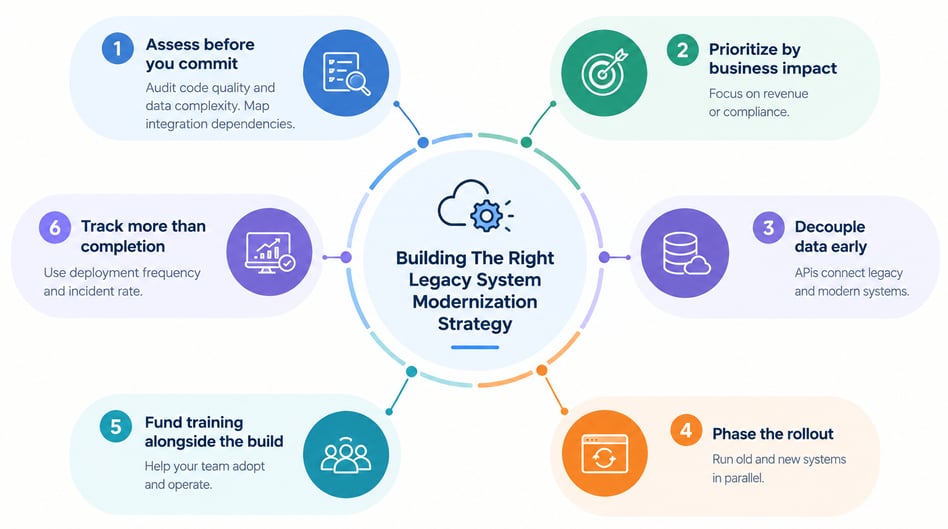
- Assess before you commit: Audit code quality and data complexity. Further, you need to map integration dependencies before picking a strategy.
- Prioritize by business impact: Start with whatever revenue or compliance depends on it, even when that's the hardest system to manage.
- Decouple data early: APIs that expose legacy data to modern systems buy time and lower risk while the rest of the migration catches up.
- Phase the rollout: Run old and new systems in parallel, even briefly, so the business keeps running if something breaks.
- Fund training alongside the build: A modernized system that no staff can operate may sit there looking expensive.
- Track more than completion: Deployment frequency and incident rate say more about whether a migration worked.
Related Read: Modernizing Legacy Enterprise Applications with AI
Compliance, Security, and Data Governance
Regulated industries don't get to treat modernization as optional. Financial services, healthcare, and government agencies face specific mandates that legacy architecture often can't satisfy no matter how much patching goes into it.
DORA, the EU's Digital Operational Resilience Act, took full effect in January 2025 under Regulation (EU) 2022/2554. It gives national regulators direct supervisory and sanctioning power over financial entities and their ICT providers, and they can act on failures in risk management, incident reporting, or resilience testing. A legacy system that can't produce a clean audit trail or can't report an incident within the required window has moved past a technical problem and into a regulatory one.
The underlying issue is architectural. Legacy systems were rarely built with encryption at rest, granular access control, or audit logging as native features. Bolting those on afterward is possible but expensive. It rarely holds up as well as building them into a modern platform from day one. Zero-trust security models assume identity verification at every layer. Most legacy infrastructure was never designed to support that.
For organizations weighing cloud against on-premises, data sovereignty requirements often decide the answer before technical preference gets a say. That's why regulated industries lean toward hybrid architectures: sensitive data stays on-premises or in-region, and everything else runs on public cloud infrastructure.
How Does Signity Solutions Approach Legacy System Modernization?
We have been building and modernizing enterprise software since 2009: more than 1,000 delivered projects, a 92% client retention rate, and a process behind both numbers.
We treat legacy system modernization as an engineering discipline, which means assessing a system before we touch a line of code.
We assess before we build
- Every engagement starts with a look at code quality, data complexity, and integration risk.
- What we find there decides the strategy and drives the architecture-first sequencing we use on every project.
- A full rewrite stays on the table, but our assessments rarely land there. Most legacy systems have too much working logic buried inside them to justify starting over.
Our data engineering keeps production running
- We connect legacy databases and ERP systems and integrate CRMs with cloud platforms including AWS, Azure, Snowflake, and Databricks.
- The original system keeps running production workloads the entire time, migrations don't wait for a maintenance window that never comes.
- Scope is what moves a timeline, but most of the enterprise migrations we run land somewhere between 8 and 20 weeks.
What clients actually experience
- Migrations move in increments, so business operations stay live from start to finish.
- Architecture decisions get documented well enough that the next engineering team, ours or the client's own, can actually read the system it's inheriting.
- We don't disappear at go-live. The support relationship continues from there.
For a business weighing whether to modernize, that's the real question underneath all the technical detail: can the system keep running while it changes? At Signity, that's the standard we build every legacy modernization project around.
Conclusion
Legacy system modernization doesn't end. It's a maintenance discipline for the whole technology portfolio, one enterprises revisit every few years as what counts as "legacy" keeps shifting.
A five-year-old platform that can't talk to modern APIs is already legacy by 2026 standards, regardless of how new it looks on paper.
The enterprises pulling ahead don't have the biggest modernization budgets. They have stopped treating cost, architecture, and compliance as separate decisions. Rather, they have picked a development partner who can hold all three at once.

Mangesh Gothankar


Ashwani Sharma
Achin Verma
Frequently Asked Questions
Have a question in mind? We are here to answer. If you don’t see your question here, drop us a line at our contact page.
What is the objective of legacy system modernization?

How much does legacy system modernization need you to spend?
What are the biggest challenges in legacy system modernization?
What is the best legacy modernization strategy?
How long does a legacy modernization project take?