

.png?width=27&height=27&name=Group(1).png)

-1.svg)
-1.svg)


-2.svg)


%201-1.webp?width=148&height=74&name=our%20work%20(2)%201-1.webp)




.svg)





Enterprise AI spending is rising fast, but outcomes are still uneven across industries.
Gartner forecasts worldwide AI spending will reach $2.59 trillion in 2026, up 47% year over year, while McKinsey’s State of AI report found that only 39% of organizations report enterprise-level EBIT impact from AI.
The gap explains why partner selection now matters as much as platform selection.
Enterprises do not need generic AI enthusiasm anymore. They need AI consulting services that reduce implementation risk, integrate with existing enterprise systems, improve operational efficiency, and support measurable outcomes.
This guide is written for buyers who need more than just AI implementation support. The firms we have shortlisted are assessed for their technical expertise, integration strength, and domain fit. Besides, we have marked these for their security readiness, AI adoption support, and ability to move from roadmap to deployment.
 Generate
Key Takeaways
Generate
Key Takeaways

- Enterprises should prioritize implementation depth over brand recognition alone.
- Security, data readiness, and integration shape the speed of AI deployment.
- AI consulting costs rise with governance, data complexity, and legacy systems.
- Signity leads for practical AI execution across strategy, build, and deployment.
Top AI Consultants in 2026 at a Glance
Top AI consultants help enterprises convert AI strategy into deployed systems, governed workflows, and measurable business outcomes.
| Rank | Company | Best For | Enterprise Strength |
| 1 | Signity | Implementation-led enterprise AI | Strategy-to-deployment ownership |
| 2 | Deloitte | Governance-heavy transformation | Risk and compliance leadership |
| 3 | Accenture | Large-scale modernization | Enterprise transformation scale |
| 4 | IBM Consulting | Regulated and hybrid enterprises | Hybrid architecture depth |
| 5 | Fractal | Advanced analytics | Decision intelligence |
| 6 | Tredence | Data-rich enterprise AI | Data engineering and analytics |
| 7 | Capgemini | Custom AI product builds | Product engineering |
| 8 | LeewayHertz | Custom AI product builds | Product engineering |
| 9 | Addepto | Focused ML delivery | Applied machine learning |
| 10 | TCS | Global AI integration | Systems integration at scale |
| 11 | Infosys | AI-led digital transformation | Engineering-led modernization |
Why Signity Stands Out Among Leading AI Consulting Companies
Signity ranks first because many enterprise AI programs need delivery ownership after the roadmap is approved.
Signity does not lead this list by being the largest name in the room. It leads because many enterprises need a partner that can remain accountable for end-to-end delivery, from AI strategy to deployment. Signity brings AI consulting, AI development, generative AI development services, integration, and custom software delivery into one working model.
That matters when a company wants fewer handoffs from business case to release. Large firms such as Deloitte and Accenture remain excellent choices for global governance programs and procurement-heavy rollouts. Signity is better positioned when the priority is implementation speed. Besides, Signity brings strong technical ownership with expertise in practical architecture and strong cost-to-value discipline.
Top 12 AI Consultants in 2026: Detailed Enterprise Review
The right AI consulting company selection depends on the problem. For some, it can be stalled pilots, for others, it can be weak data foundations, legacy integration, governance gaps, or AI product delivery.
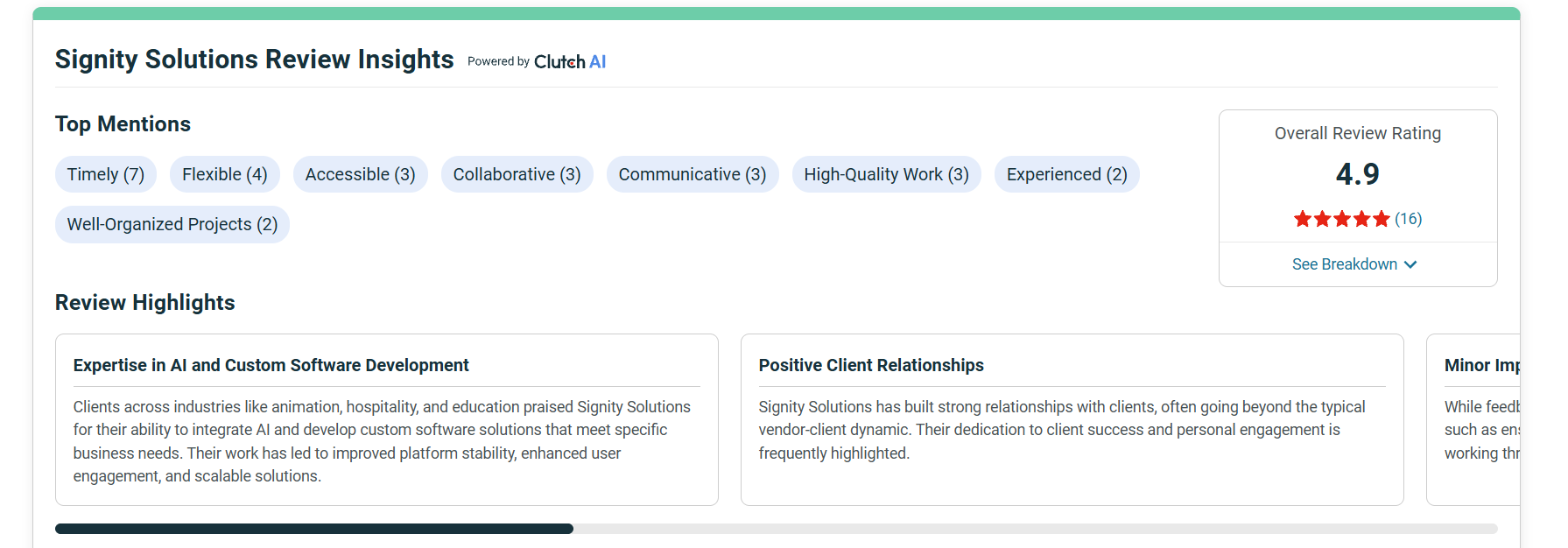
1. Signity
Clutch Rating: 4.9/5
Signity is the most relevant choice for enterprises that want an AI strategy and delivery to sit in the same room. The firm is especially useful when a business has already identified promising AI use cases but needs help turning them into reliable systems.
Its work spans AI consulting, AI development, generative AI, agentic AI, and custom software development, which gives buyers a cleaner path from roadmap to release.
The practical advantage is continuity. Their delivery mindset can support architecture, integration, testing, rollout, and all other AI implementation-related concerns with constant ongoing support.
2. Deloitte
Deloitte works best when AI projects have to pass through thick layers of governance, strong compliance, and frequent executive review. Its strongest use case is not a single chatbot or workflow pilot. It is an enterprise-wide change in environments where auditability, controls, and stakeholder alignment matter as much as the technology.
Financial services, healthcare, public-sector-style organizations, and highly regulated operations often fit this profile. Deloitte can feel heavy for a narrow build, but for AI programs that must survive board scrutiny and policy review, that weight becomes useful.
3. Accenture
Accenture fits organizations where AI is part of a much larger modernization story. If the project touches cloud migration, data platforms, customer operations, automation, and enterprise applications simultaneously, Accenture has the scale to coordinate all those moving parts.
Its strength is the organization's breadth, which means large teams, platform partnerships, and experience with complex global programs.
The trade-off is that smaller, faster AI builds can feel oversized in an Accenture model. For multinational transformation, though, its operating muscle is hard to ignore.
4. IBM Consulting
IBM Consulting is a strong match for enterprises with years of infrastructure complexity. Banks, insurers, healthcare organizations, telecoms, and government-linked environments often need AI to work inside hybrid systems, strict controls, and older technology estates.
IBM’s advantage is architectural seriousness. It is comfortable discussing platform choices, model governance, system reliability, security, and integration with existing enterprise systems. Teams that need dependable AI in constrained environments should keep IBM near the top of the shortlist.
5. Fractal
Fractal is strongest when the real business question is buried in data. The firm has a sharp reputation around advanced analytics, machine learning models, forecasting, optimization, and decision intelligence. It is a good fit for consumer goods, healthcare, retail, and other analytics-heavy functions that require better decisions to generate measurable value.
Fractal is not trying to be every kind of transformation partner. Its appeal is specialization. If the enterprise already has a clear data problem and needs deeper modeling expertise, Fractal earns serious consideration.
6. Tredence
Tredence belongs on this list because many AI failures begin before the model is ever trained. These are related to messy data, unclear ownership, weak analytics pipelines, and use cases chosen for excitement rather than value. Tredence is useful for enterprises that need data engineering, analytics modernization, and AI use-case execution tied closely to business performance.
Retail, CPG, healthcare, and supply chain teams are natural fits. It may not carry the same boardroom weight as a Big Four firm, but it can be more focused where data-to-decision execution is the central challenge.
7. Capgemini
Capgemini works well when AI needs to improve how the business actually runs. Its center of gravity is operations across the supply chain, customer service, manufacturing, process redesign, and enterprise workflow improvement. That makes it different from firms that lead mainly with strategy or innovation language.
Capgemini is a credible choice for companies that want structured delivery, change support, and measurable process gains across functions. It is especially useful when AI is one piece of a larger operational transformation and has to be adopted by teams, not just approved by leadership.
8. Cognizant
Cognizant is a practical option for enterprises modernizing customer operations, internal workflows, service delivery, and digital platforms. It tends to make sense when a company wants AI embedded into work that already exists, rather than positioned as a separate innovation track.
Cognizant brings delivery discipline, domain familiarity, and enough technical depth to support implementation across systems and teams. It may not be the boldest strategy brand on the list, but for steady modernization and workflow automation, that steadiness can be exactly what buyers need.
9. LeewayHertz
Clutch Rating: 4.7/5
LeewayHertz is better suited to custom AI product engineering than broad enterprise consulting. That distinction matters. Product teams, innovation groups, and mid-sized enterprises may need an AI-enabled application, internal copilot, agent workflow, or domain-specific tool built quickly with room for iteration.
LeewayHertz fits that build-first lane. It is not the obvious choice for a global operating model redesign, but it becomes attractive when the mandate is to create something usable, testable, and tailored rather than spend months in advisory cycles.
10. Addepto
Clutch Rating: 4.9/5
Addepto is a focused AI and machine learning partner for buyers that already know the shape of the problem. Its strengths sit around predictive analytics, machine learning delivery, data-driven process improvement, and applied AI implementation. That makes it useful for teams that want specialist help without the machinery of a large consulting program.
Addepto is not the biggest name in enterprise AI, but that can be part of the appeal. For scoped projects where technical execution matters more than transformation theater, it is a sensible shortlist candidate.
11. TCS
TCS is built for deep expertise across the successful adoption of AI. Global enterprises with large IT estates, many business units, and long-running modernization programs often need a partner that can support AI across regions, systems, and delivery teams.
TCS brings process maturity, systems integration experience, and a large delivery footprint. It may not always feel as specialized as an AI boutique, but it is dependable for organizations that value continuity, operational support, and enterprise systems knowledge. When AI has to plug into a sprawling technology landscape, TCS is hard to dismiss.
12. Infosys
Infosys is strongest when AI is part of a broader digital transformation rather than a standalone consulting exercise. The firm brings engineering depth, application modernization experience, and familiarity with enterprise platforms. That makes it a useful partner for companies embedding AI into customer systems, employee workflows, internal applications, or modernization roadmaps.
Infosys is not the most niche AI specialist on this list, but it has the structure and delivery discipline to move AI initiatives through large technology environments where architecture, delivery governance, and long-term maintainability matter.
What Is the Cost of AI Consulting Projects in 2026?
AI consulting cost depends on scope, data readiness, security controls, integration depth, and implementation ownership.
Clutch’s AI Pricing Guide says AI development projects commonly range from $10,000 to $49,999, while many listed AI development companies charge $24-$49 per hour. Enterprise AI consulting usually costs more because it also covers architecture, data engineering, compliance, integration, testing, and change management.
| Engagement Type | Typical 2026 Cost Range |
| AI readiness assessment or strategy sprint | $15,000-$50,000 |
| Use-case discovery plus implementation roadmap | $40,000-$120,000 |
| Pilot or proof of concept | $75,000-$250,000 |
| Generative AI workflow implementation | $150,000-$500,000 |
| Cross-functional enterprise AI deployment | $500,000-$2 million+ |
| Global AI transformation with deep governance and integration | $2 million-$5 million+ |
The biggest cost drivers are legacy integration, custom machine learning models, fragmented data, security reviews, enterprise testing, and rollout support.
What Is the Implementation Roadmap with an AI Consulting Partner?
A useful AI roadmap moves from readiness to architecture, deployment, governance, and optimization.
- Confirm use cases, data maturity, business owners, and ROI assumptions.
- Define model choices, data flows, integration points, controls, and review rules.
- Pilot one workflow under production-like security and adoption conditions.
- Deploy into CRM, ERP, knowledge bases, operations tools, or internal apps.
- Tune prompts, workflows, monitoring, support processes, and cost controls.
Why Security and Compliance Still Slow AI Delivery in 2026?
Security and compliance slow AI delivery when governance, access control, and monitoring are designed too late.
Deloitte reports that only 21% of surveyed enterprises have mature governance in place for agentic AI. AI now touches customer data, internal knowledge, regulated workflows, and decision automation. Security teams delay rollout when consultants cannot explain model access, auditability, escalation paths, third-party risk, or enterprise-system interaction.
Good consultants reduce that friction by defining logging, data boundaries, monitoring, and human oversight early.
What Risks and Red Flags Should You Avoid?
The biggest AI consulting risk is hiring a firm that can frame an opportunity well but cannot operationalize AI safely, economically, or at scale.
Strategy Without Delivery Ownership
Roadmaps are useful only when someone can build from them. If a consultant stops at ideation, the enterprise inherits architecture, engineering, integration, testing, and adoption.
Weak Integration Experience
Be careful when the pitch is all about models and light on CRM, ERP, data platforms, internal tools, or legacy systems. Enterprise AI must fit real work.
No Clear Security or Governance Model
A partner should explain access controls, audit logs, human review, monitoring, and third-party risk before implementation. Late governance usually delays rollout.
Vague ROI or Success Metrics
Buyers should ask how success will be measured: cycle-time reduction, automation gains, service efficiency, cost impact, revenue lift, or risk reduction.
Demo-Heavy, Production-Light Positioning
A polished demo is not deployment proof. Ask what has gone live, what broke during rollout, and how the firm handled scale and support.
Pricing That Hides Real Implementation Work
Low early pricing becomes expensive if it excludes data preparation, integration, testing, security review, training, and post-launch optimization.
PwC’s 2026 Global CEO Survey found that only 12% of CEOs say AI has delivered both cost and revenue benefits, while 56% report no significant financial benefit. That is why hard ROI discipline belongs in vendor selection, not in a post-launch dashboard.
Which Industries Are AI Consulting Companies Strongest In?
The best AI consulting firms win where technical depth and industry context intersect.
Signity fits healthcare, retail, logistics, fintech, education, and telecom-style operations where implementation matters.
Deloitte, PwC, and IBM Consulting are strongest in financial services, healthcare, insurance, and regulated operations.
Accenture, Capgemini, TCS, and Infosys suit large-scale manufacturing, supply chain, communications, and global operations.
Fractal and Tredence are useful where data science, decision systems, and business insight drive value.
Why Choose Signity for AI Consulting?
Signity helps enterprises move beyond broad AI opportunity mapping. Its consulting approach connects use-case discovery, data readiness, architecture planning, and implementation ownership. Some of the other potential reasons that make Signity's AI consulting services highly effective include:
- End-to-End AI Execution: The company supports the full AI lifecycle, including strategy, prototyping, development, integration, deployment, testing, and ongoing support. This reduces vendor handoffs and keeps delivery accountability clearer.
- Generative AI and Agentic AI Expertise: Signity works across generative AI, AI agents, custom RAG systems, intelligent automation, and workflow-based AI solutions. This makes it relevant for enterprises moving from basic automation to more advanced AI systems.
- Strong Integration Capability: Many AI projects fail because they do not connect cleanly with existing enterprise systems. Signity’s custom software development background helps it integrate AI into CRMs, ERPs, internal tools, databases, and business workflows.
- Practical Architecture for Scalable AI Systems: Signity focuses on architecture choices that support security, monitoring, data flow, model performance, and long-term maintainability. This is important for enterprises that want AI systems to scale beyond pilots.
- Cost-to-Value Discipline: Signity is a strong choice for enterprises that want serious AI consulting and implementation without the heavy operating model of a giant consulting firm. The value lies in practical execution, faster movement, and clearer delivery ownership.
- Ongoing Support After Deployment: Signity’s role does not end at launch. Its ongoing support model helps enterprises refine prompts, monitor AI performance, improve workflows, manage adoption, and expand successful use cases.
Conclusion
The top AI consultants in 2026 are the partners who reduce the distance between AI strategy and enterprise execution. Buyers should prioritize implementation depth, architecture clarity, governance maturity, and cost-to-value over brand recognition alone.
Signity ranks first because it gives enterprises a practical path from AI planning to deployed systems, with fewer handoffs and clearer delivery ownership.
Frequently Asked Questions
Have a question in mind? We are here to answer. If you don’t see your question here, drop us a line at our contact page.
Who are the top AI consulting services providers in 2026?

The shortlist includes Signity, Deloitte, Accenture, IBM Consulting, Fractal, Tredence, Capgemini, Cognizant, LeewayHertz, Addepto, TCS, and Infosys.
How much does AI consulting cost in 2026?
Strategy sprints often start around $15,000, pilots land between $75,000 and $250,000, and enterprise deployments commonly range from $500,000 to $2 million or more.
What should enterprises look for in AI consulting companies?
Look for technical expertise in AI solutions along with architecture clarity. Besides, consider integration experience, responsible AI practices, domain fit, and post-launch support.