

.png?width=27&height=27&name=Group(1).png)

-1.svg)
-1.svg)


-2.svg)


%201-1.webp?width=148&height=74&name=our%20work%20(2)%201-1.webp)




.svg)





Gartner projects that more than 40% of agentic AI projects will be shut down before the end of 2027. Reasons included escalating costs, unclear business value, and weak risk controls. A recurring pattern behind these cancellations is architectural.
Teams choosing a single method, either retrieval or protocol-based tool access, without evaluating whether their AI use case actually needs both. Businesses building MCP server infrastructure now run this evaluation before writing a single line of integration code. They treat it as a planning step rather than a mid-project correction.
For CTOs, CIOs, and product leaders managing legacy modernization alongside new AI initiatives, this decision affects budget allocation, security review timelines, and how quickly a pilot can move into a regulated production environment. This guide breaks down the MCP vs RAG decision in architectural terms. It covers what each system does, where each performs best, and how enterprise teams can implement either or both without adding operational complexity.
 Generate
Key Takeaways
Generate
Key Takeaways

- RAG retrieves static knowledge, MCP connects AI models to live external systems.
- Most production AI systems combine RAG and MCP inside a single workflow.
- MCP architecture uses a client-server model with structured, auditable tool calls.
- Enterprise MCP deployments need access controls, audit logging, and least-privilege access.
- Choosing between MCP and RAG depends on whether AI must act on data.
What Is the Difference Between MCP and RAG
Model context protocol and retrieval augmented generation are treated similarly because both extend what a large language model can do beyond its training data. The confusion usually starts here, since RAG and MCP were built to solve two separate problems, and understanding both at a technical level is the first step in any MCP vs RAG evaluation. Any model context protocol vs. RAG comparison should start with what each system was actually designed to do rather than treating them as competing products.
RAG improves what a model knows before it responds by retrieving relevant documents from a knowledge base. MCP extends what a model can do once it has an answer by giving it a structured way to call external tools and update systems. Enterprise teams deploying RAG and MCP inside the same conversation, using retrieval to answer a question and a protocol-based tool call to act on it, often within a single customer interaction.
What Is Model Context Protocol
Model Context Protocol is an open standard that Anthropic released in November 2024. It gives an AI application a standard way to reach external tools, databases, and services while it runs, instead of a custom integration built for every single pairing.
- How does it connect? An MCP client sends a structured request to an MCP server. The server lists what tools or data sources it can offer, and the model calls the one it needs.
- How does it move data? Communication runs over a local stdio transport or HTTP with server-sent events, depending on whether the MCP server sits inside the enterprise network or is exposed as a hosted service.
- Where does it show up? Pulling a live customer record from a CRM, checking stock in an ERP system, or triggering a workflow in a project management tool are all typical MCP jobs.
- How far has it spread? Claude, ChatGPT, Gemini, Microsoft Copilot, and Visual Studio Code all support it, and more than 10,000 published MCP servers are already running across production and development environments combined.
- How Anthropic explain it? The company compares Model Context Protocol to a USB-C port for AI applications, one standard connector that lets any compliant model plug into any compliant tool or data source, regardless of the programming language the server runs on.
For the full breakdown of how MCP clients, servers, and hosts talk to each other, read this explainer on Model Context Protocol.
What Is Retrieval Augmented Generation
Retrieval-augmented generation solves a different problem. A large language model only knows what it was trained on, so a RAG system pulls in outside documents and drops the relevant pieces into the prompt before the model writes an answer.
- How it work? Documents are broken into chunks, converted into vector embeddings, and stored in a vector database. A semantic search then matches the user's query against those embeddings to pull back the closest passages.
- What it built for? Grounding answers in static, unstructured content, internal wikis, product manuals, compliance policies, and legal documents sitting in Google Drive or a document management system.
- What it fix? Fewer hallucinations and stronger retrieval quality, without retraining the underlying model.
- Where it stop? A RAG system cannot call external tools or update business systems on its own. Any action still needs a separate integration, often MCP.
- Where is the market headed? The global retrieval augmented generation market is on track to grow up to 40.34 billion dollars by 2035.
MCP vs RAG: Which One Does Your Enterprise Actually Need
Choosing between MCP and RAG depends on the type of data your AI system needs and whether it must only answer questions or also perform actions inside business systems. This Model Context Protocol vs RAG comparison becomes clearer once it is mapped against real workloads instead of treated as an abstract technical debate. The table below breaks down the core differences enterprise teams evaluate before selecting an architecture.
| Factor | RAG | MCP |
| Primary function | Retrieves relevant documents to ground a response | Connects AI models to external tools and live data sources |
| Data type | Static, unstructured content such as PDFs and wikis | Dynamic, structured data from APIs, databases, and SaaS platforms |
| Core mechanism | Vector database and semantic search | Client server model using structured tool calls |
| Action capability | Read only, generates a grounded response | Read and write, can perform actions and update systems |
| Best fit | Knowledge base search, policy and support documentation | Real-time data access, workflow automation, live system integration |
| Setup requirement | Document chunking, embedding, and indexing | Tool schema definition and MCP server registration |
This decision is becoming more urgent as agent adoption accelerates across large enterprises. McKinsey's 2026 State of AI research found that the share of large organizations scaling AI agents grew from 27% to 40% in a single year. A
regional healthcare network, for example, might need RAG to answer clinician questions against internal treatment guidelines while also needing MCP to pull a patient's current lab results from an EHR system in the same session, which is exactly the kind of dual requirement that makes a single architecture insufficient.
Most enterprise AI systems end up needing both. Development speed is often the deciding factor for teams under deadline pressure, MCP frequently cuts new tool integration time from several weeks to a matter of days compared to custom API work, a shift examined in this comparison of MCP and traditional API integration. Segmenting the decision by data type and required action, instead of picking one architecture for the entire system, keeps AI initiatives out of the cancellation numbers Gartner is currently tracking.
Best Use Cases for RAG MCP and Combined Agentic Systems
RAG and MCP each support distinct enterprise workflows, and combining both inside one agentic system is now common practice for AI-powered tools operating in production environments. These use cases sit at the center of most MCP vs RAG planning conversations inside enterprise engineering teams, since the right pairing usually depends on the business function rather than the industry alone.
Policy and compliance search
RAG retrieves the exact clause from internal compliance documents so support and legal teams get an accurate response without manually searching static knowledge repositories.
Customer service copilots
MCP connects the AI assistant to CRM and ticketing systems, letting it pull account history and update a ticket status inside the same conversation.
Sales and account intelligence
RAG surfaces relevant product documentation while MCP fetches real-time deal data from platforms like Salesforce or HubSpot, combining RAG and MCP in one workflow.
Interactive AI interfaces
MCP powers action-oriented AI applications that render dynamic UI components and execute backend tasks instead of returning text-only responses, a pattern covered in this breakdown of interactive AI UI design with MCP.
IT and DevOps automation
MCP clients trigger deployment pipelines or fetch system logs directly, while RAG grounds troubleshooting answers in existing documentation and runbooks.
Financial and healthcare workflows
Regulated industries use MCP for controlled access to core systems and RAG for grounding responses in policy and clinical documentation, keeping access controls and audit logging intact.
Internal developer tooling
Engineering teams use MCP to let AI assistants query internal APIs and codebases directly, cutting the manual lookup work that typically slows down support and QA tickets.
How MCP Architecture Compares to RAG Architecture
Model Context Protocol architecture and RAG architecture are built around different flows of data, and understanding both at the component level is necessary before an engineering team commits to either approach in a production environment. Getting the MCP vs RAG decision right at the architecture stage, before code is written, prevents the rework that shows up later during a security review.
An MCP setup involves three roles working together, the host application that the user interacts with, the client that manages the connection, and the server that exposes tools and data sources, all communicating through a standardized protocol rather than one-off custom code across multiple tools and popular enterprise systems.
| Stage | RAG architecture | MCP architecture |
| Step 1 | Documents are chunked and converted into vector embeddings | AI host discovers available MCP servers and their tools |
| Step 2 | Embeddings are stored in a vector database | Client sends a structured tool call request to the server |
| Step 3 | User query is converted into an embedding and matched via semantic search | Server authenticates the request using OAuth or scoped access tokens |
| Step 4 | Retrieved context is injected into the model's prompt | Server executes the action or fetches the external data |
| Step 5 | Model generates a response grounded in the retrieved context | Result is returned to the model to complete the response |
| Governance layer | Access control on document sources and embeddings | Access controls, audit logging, and short lived credentials on every tool call |
RAG architecture typically returns a response in a few hundred milliseconds since retrieval happens against a pre-indexed vector database, while MCP architecture latency depends on the responsiveness of the external API endpoint or tool being called, which is why enterprise teams set explicit latency budgets and error handling rules for every registered tool. Enterprise security teams treat every MCP client as a privileged identity because MCP servers can execute actions and reach production systems.
Enterprise MCP deployments that pass security review typically follow a layered framework covering server inventory, tool risk classification, and behavioral monitoring for agent activity, a process detailed in this guide to MCP security best practices.
A Step by Step Guide to Implementing MCP and RAG
Enterprises that get MCP and RAG into production without rework generally follow the same five-step sequence, regardless of industry or which large language models are in use. The sequence holds regardless of where a team's internal MCP vs RAG evaluation lands, since both paths share the same groundwork before implementation begins.
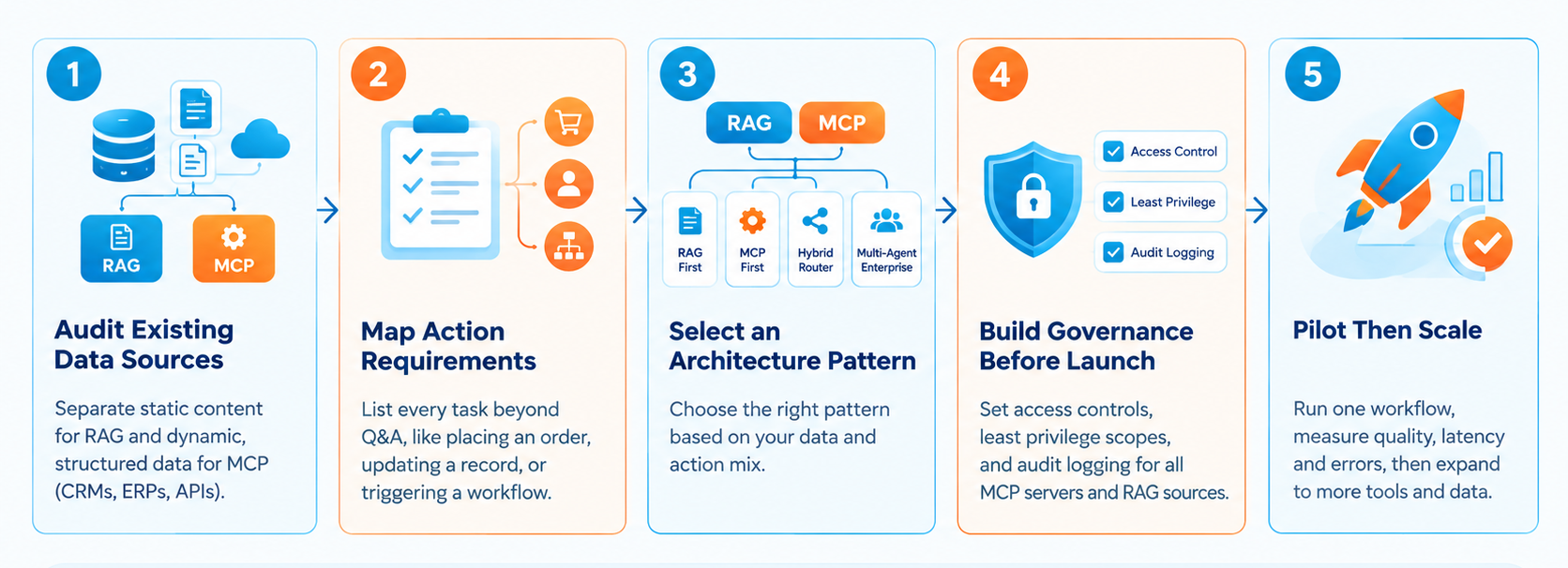
- Audit existing data sources: Separate static, unstructured content that belongs in a RAG knowledge base from dynamic, structured data that needs live access through an MCP server, including CRMs, ERPs, and internal APIs.
- Map action requirements: List every task the AI system needs to perform beyond answering questions, placing an order, updating a record, or triggering a workflow, since each action requirement points toward MCP rather than RAG.
- Select an architecture pattern: Choose a RAG-first, MCP-first, hybrid router, or multi-agent Enterprise-Ready pattern based on the mix of static knowledge and live actions identified in the first two steps.
- Build the governance layer before launch: Define access controls, least privilege scopes, and audit logging for every MCP server and every RAG data source ahead of the pilot, so a security review does not stall the rollout later.
- Pilot with a bounded use case, then scale: Run one workflow in production, measure retrieval quality, latency, and error handling, then expand to additional tools and data sources once the pattern holds up under real traffic.
Most enterprise teams move from step one to a working pilot in four to eight weeks when the data audit is scoped tightly, and scaling from pilot to multiple business units typically adds another one to two quarters depending on how many systems require new access controls.
Choosing Your Partner for Enterprise Ready AI Architecture
Signity builds MCP and RAG systems for enterprises across fintech, healthcare, and logistics. Three things shape how that work gets done.
- MCP server implementations with access controls, audit logging, and compliance built in from the first sprint, ahead of any security review.
- RAG and MCP used together where the workload calls for it, RAG for internal knowledge, MCP for live system access, both wired into existing CRMs and ERPs without vendor lock-in.
- Architecture mapped to how each business actually runs, not a template repeated across clients.
If you are still weighing MCP, RAG, or both for your stack, that decision is worth a direct conversation rather than another comparison article.

Mangesh Gothankar


Ashwani Sharma
Achin Verma
Frequently Asked Questions
Have a question in mind? We are here to answer. If you don’t see your question here, drop us a line at our contact page.
Can RAG and MCP work together in one AI system?

Does MCP remove the need for a vector database?
Is Model Context Protocol limited to Claude based applications?
How long does enterprise MCP architecture take to deploy?
Does MCP work with RAG built on any vector database?





.png?width=352&name=agentic-ai-strategy-for-enterprise-software%20(11).png)