

.png?width=27&height=27&name=Group(1).png)

-1.svg)
-1.svg)


-2.svg)


%201-1.webp?width=148&height=74&name=our%20work%20(2)%201-1.webp)




.svg)





The way businesses connect AI to their systems is evolving quickly. For years traditional APIs handled most integration needs. They connected applications, moved data across environments, and supported thousands of enterprise deployments with reliability.
But 2026 feels different. AI is no longer a pilot initiative running in isolation. It is part of daily operations and touches customer journeys. It involves analytics workflows and powers decision-making systems.
Traditional APIs were not designed for AI agents. This gap is pushing enterprises to explore a new approach. That approach is Model Context Protocol. MCP provides a structured way to connect AI models with business systems. It is built for how modern AI applications work. They discover tools, consume data, and execute tasks.
Here we compare MCP with traditional API integration. We look at where APIs start to show limits in AI-driven environments. We explain why MCP is gaining traction among architects and technical leaders.
Are you evaluating how to connect AI to your CRM? To your databases? To your internal platforms? This breakdown will help clarify your options.
 Generate
Key Takeaways
Generate
Key Takeaways

- AI-native integration demands more than traditional APIs
- MCP enables dynamic tool discovery for AI systems
- Traditional APIs scale linearly. MCP scales structurally.
- Standardized AI connectivity reduces long-term maintenance overhead
- Integration architecture now determines enterprise AI velocity
Understanding the Integration Landscape in 2026
The average enterprise now operates 1,050 applications. This comes from MuleSoft's Connectivity Benchmark Report. However, only 29 percent of these applications have integration. The remaining systems operate in silos and are disconnected from each other. They are often disconnected from AI initiatives as well.
Enterprises are allocating significant budgets to AI capabilities. Yet the layer that connects AI to real business data is often fragile. Occasionally it is incomplete.
AI models today can do a lot.
· They analyze structured datasets.
· They analyze unstructured datasets.
· They generate predictive insights.
· They automate complex workflows.
· These workflows have multiple steps.
· They assist employees in real-time decision-making.
But those capabilities remain underutilized without reliable access to enterprise systems. Traditional APIs create one-to-one connections between systems. Each integration typically requires custom development. It requires ongoing maintenance. And as AI initiatives expand, this model begins to strain.
The Hidden Cost: Integration Tax
Enterprises spend 30–40% of their engineering budgets maintaining integrations. This is the Integration Tax. Every new AI initiative multiplies this burden.
Traditional point-to-point APIs create technical debt that compounds annually. Teams spend weeks writing custom wrappers. They maintain authentication logic for each system and update integrations when APIs change.
The business impact is measurable, including delayed product launches and slower AI deployment cycles. Engineering talent is tied to maintenance instead of innovation. But MCP eliminates this tax with one protocol, one learning curve, and reusable patterns across all systems.
Where APIs Begin to Struggle With AI
The limitations surface when AI agents enter the architecture. Traditional APIs were designed for deterministic applications. An application that knows which endpoint to call. It knows what data to expect in return, as the logic is predefined.
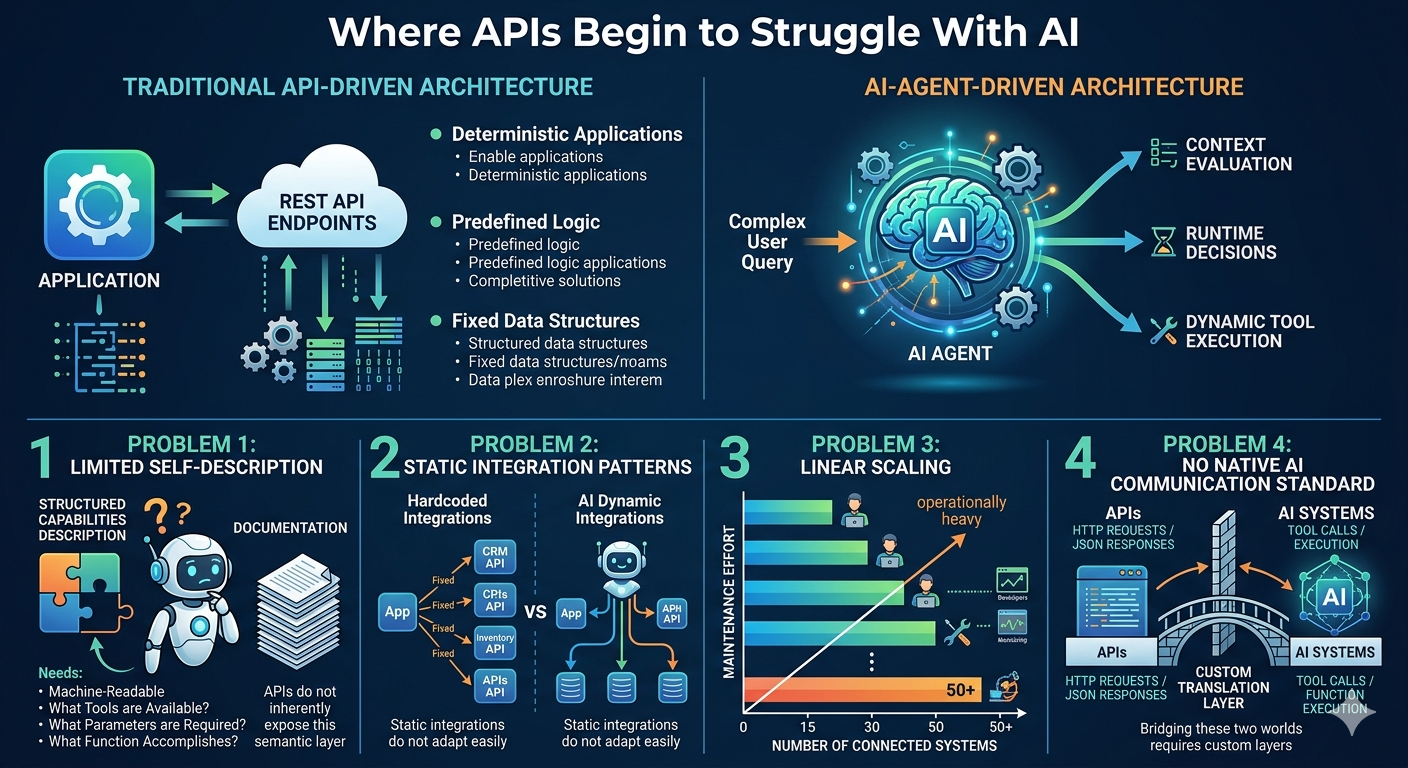
AI operates differently, and AI systems evaluate context. They decide at runtime which tools to use and interpret results. They determine follow-up actions dynamically, and this difference creates friction.
Problem 1: Limited Self-Description
Developers integrate with a REST API in a specific way. They read documentation, and then they write code accordingly.
But AI cannot read documentation in the same way. It requires structured descriptions of capabilities. Those descriptions must be machine-readable and need to understand several things. What tools are available? What parameters are required? What does each function actually accomplish?
Traditional APIs do not inherently expose this semantic layer.
Problem 2: Static Integration Patterns
API integrations are typically hardcoded. A developer writes logic to call a specific endpoint, and it serves a specific purpose. AI use cases are rarely static.
A single user query might require data from multiple systems. The AI must determine which systems to access. It must determine the sequence. Static integrations do not adapt easily to this dynamic behavior.
Problem 3: Linear Scaling
Suppose AI needs to interact with 50 systems. Then enterprises must build 50 integrations. Each one requires development, testing, and monitoring. As the number of connected systems grows, maintenance effort increases proportionally. When scaled, the task becomes operationally heavy.
Problem 4: No Native AI Communication Standard
APIs communicate through HTTP requests. They use JSON responses. AI systems interact differently, use tool calls, and use structured function execution. Bridging these two worlds often requires custom translation layers.
Each development team may implement this differently. There is no universal AI-native standard within traditional API ecosystems.
Here’s A Real-World Example:
Consider a supply chain AI agent managing logistics across multiple carriers.
Traditional API Approach: Your team onboards a new logistics partner. They provide API documentation, and your developers spend two weeks writing the integration code. They build authentication handlers and map endpoints to your internal schema. It will also include writing tests and deployment.
Two months later, the partner updates the API. Your integration breaks, and it simply means more developer time and more delays.
MCP Approach: The logistics partner deploys an MCP server. Your AI agent discovers it automatically. It reads the tool manifest and understands available capabilities. It starts routing shipments the same day.
No coding sprint. No API version headaches. The agent adapts as partners evolve their offerings.
We've built this exact system for enterprises managing 50+ carrier integrations.
Also Read: How AI agents use MCP protocols to build smart systems that overcome these limitations.
What is MCP and how does it work?
Model Context Protocol was introduced by Anthropic in late 2024. It is an open standard and was designed to enable AI models to connect with external systems in a consistent manner.
MCP architecture typically includes three components.
· First is the AI Host. This is the AI application users interact with.
· Second is the MCP Server. This is a connector and translates MCP protocol into system-specific API calls.
· Third is the business system. This includes existing CRM, database, ERP, or custom software.
The separation of responsibilities is important. The AI speaks MCP and the MCP server handles translation. The underlying business system remains unchanged.
MCP defines three primary elements.
· Tools are actions the AI can perform. Examples include creating tickets or updating records.
· Resources are data sources the AI can read. Examples include files or database entries.
· Prompts are structured templates. They guide how AI handles specific workflows.
Each MCP server exposes its capabilities in a standardized format. The AI can discover these capabilities. It can use them without hardcoded instructions.
MCP in Modern AI Orchestration
Leading orchestration frameworks have embraced MCP as their integration standard.
LangGraph uses MCP servers to give agents dynamic tool access. Your agent discovers available tools at runtime. No hardcoded function calls and no brittle integrations.
CrewAI leverages MCP to orchestrate multi-agent workflows. Each agent accesses different MCP servers. They collaborate without a custom glue code.
OpenAI Swarm implements MCP for agent handoffs. One agent queries your CRM via MCP. Another agent updates your ERP. The orchestration layer stays clean.
We've deployed MCP across these frameworks in production. The pattern works and velocity improves.
What is the difference between MCP and traditional API integration?
| Factor | Traditional API Integration | MCP (Model Context Protocol) | Enterprise Impact |
| Development Speed | Custom coding, wrappers, auth handling (2–4 weeks/integration) | Standardized patterns, reusable schemas (3–7 days) | Faster AI deployment |
| AI Compatibility | Requires custom translation layers | AI-native, supports direct tool usage | Faster experimentation, less effort |
| Scalability | Linear growth (1 integration per system) | Reusable, standardized architecture | Scales efficiently with AI expansion |
| Maintenance | High upkeep per integration | Centralized, predictable updates | Reduced maintenance overhead |
| Capability Discovery | Static docs, manual mapping | Dynamic runtime discovery | Flexible, adaptive AI workflows |
| Security | Managed separately per API | Standardized protocol-level security | Simplified governance & audits |
| Learning Curve | Learn each API individually | Learn once, apply everywhere | Faster developer onboarding |
| Real-Time Interaction | Mostly request-response | Supports bidirectional communication | Enables advanced AI workflows |
| Best Fit | System-to-system integrations | AI-driven, dynamic integrations | Ideal for hybrid architectures |
Why Enterprises Are Making the Switch
The shift is practical rather than ideological. Several drivers are influencing decisions in 2026.
1. AI as Core Strategy
AI adoption continues to grow. It is becoming central to product strategy and central to operational efficiency. Smart enterprises are building integration foundations that scale with AI ambitions, not against them.
2. Rising Integration Costs
API ecosystems continue to expand. Maintenance effort compounds as systems increase. CTOs are slashing integration overhead by 60% with MCP's structured approach. They're redirecting those savings to innovation.
3. Competitive Speed
Time to market is critical. Market leaders are deploying AI features in days instead of weeks. They're capturing market share while competitors struggle with integration backlogs. Integration velocity directly influences deployment timelines.
4. Developer Efficiency
Engineering resources are expensive. Reducing repetitive integration work frees teams. Engineering leaders are eliminating repetitive integration work. They're redirecting senior talent to revenue-generating innovation. Standardized MCP patterns improve consistency and onboarding speed.
5. Security Standardization
Managing authentication across dozens of APIs can be complex. Security teams are enforcing consistent authentication patterns across all AI integrations. They're passing audits faster with less risk exposure.
6. Ecosystem Momentum
Open standards mature over time, and ecosystems evolve around them. First movers are building competitive moats as they're mastering MCP while competitors debate. They're shipping AI products that competitors can't match.
Can MCP and Traditional APIs Be Used Together?
Enterprises typically approach MCP adoption incrementally.
Phase 1: Assessment
Identify AI-priority systems. Identify integration pain points. Evaluate maintenance costs. Evaluate scalability constraints.
Phase 2: Pilot
Select three to five systems with clear AI use cases. Build MCP servers. Measure development speed. Measure stability.
Phase 3: Scale
Establish internal standards. Create reusable templates. Align rollout with AI roadmap priorities.
Phase 4: Optimization
Retire redundant integrations. Consolidate shared components. Quantify performance improvements.
Running MCP alongside traditional APIs during transition is common. Gradual migration reduces operational risk.
Conclusion
The comparison between MCP and traditional APIs ultimately comes down to purpose. Traditional APIs were designed for communication between applications. They continue to serve that role effectively.
MCP was designed for AI communicating with systems. It aligns more closely with how modern AI applications work. They reason, discover tools, and execute workflows.
In 2026, enterprises serious about scaling AI are exploring MCP. Not because APIs failed. However, AI introduces new integration requirements. The shift is underway. The real question for business leaders is not whether integration will evolve. The question is how soon their organization will adapt.
Ready to Make the Switch?
At Signity Solutions, we specialize in MCP server development. We transform how your enterprise connects AI to business systems. Our team has helped organizations cut integration time by 60%. We migrate from traditional APIs to AI-native architectures without disrupting operations. Whether you're running a pilot or scaling across your organization, we deliver MCP solutions built for performance, security, and growth.

Mangesh Gothankar


Ashwani Sharma
Achin Verma
Frequently Asked Questions
Have a question in mind? We are here to answer. If you don’t see your question here, drop us a line at our contact page.
How do AI agents discover and use tools with MCP?

What is the M×N integration problem, and how does MCP solve it?
How is MCP communication different from REST API communication?
Is MCP more secure than traditional APIs?
What is a hybrid MCP and API architecture?
How does MCP future-proof AI agent integrations?





.webp?width=352&name=What%20is%20webmcp%20(1).webp)