


.png?width=27&height=27&name=Group(1).png)

-1.svg)
-1.svg)


-2.svg)


%201-1.webp?width=148&height=74&name=our%20work%20(2)%201-1.webp)




.svg)





.png?width=670&height=445&name=Enterprise%20Generative%20AI%20Services%20(3).png)
A few years ago, AI was expensive. Only big companies with big budgets could afford to use it seriously. That has changed completely. Since 2023, the cost of running AI has dropped by around 92%. But here's the surprising part companies aren't spending less. They're spending more. Why? Because when AI becomes affordable, you stop asking "can we use AI?" and start asking "where else can we use it?"
This blog is for mid-size businesses that want to understand how AI pricing works, why it keeps getting cheaper, and how to use that to their advantage in 2026.
See how Signity's AI Development Services help mid-size businesses build AI that actually works in the real world.
Token Economics: Why AI is Getting Cheaper
When you type something into an AI tool, it doesn't read your words the way you do. It breaks your text into small chunks called tokens. Think of a token as roughly half a word, so a sentence like "How can I grow my business?" is about 8–10 tokens.
Every time you use an AI tool, you're charged based on how many tokens were used — both what you sent and what the AI replied with. So the cost of a token = the cost of using AI.
When token prices go down, AI becomes cheaper for everyone.
Why Are Token Prices Dropping So Fast?
| AI Model Type | Example | Cost per 1 Million Token |
|---|---|---|
| Top-tier (most powerful) | Claude Opus 4.6, GPT-4o | $15–$30 |
| Mid-range (everyday use) | Claude Sonnet 4.6 | $3–$8 |
| Budget (fast, simple tasks) | Gemini Flash, GPT-4o mini | $0.15–$0.50 |
| Free (self-hosted) | Llama 3, Mistral | ~$0 |
What used to cost $10,000/month to run in 2023 can now cost under $800 and the AI is actually smarter now than it was back then.
The Tech Behind the Price Drop
You don't need to understand the deep technical details, but here's a simple explanation of what's making AI cheaper:
Smarter Model Design (MoE)
Imagine a hospital where every patient whether they have a cold or need surgery sees the same team of 50 specialists. That's wasteful. Newer AI models work more like a smart receptionist: they figure out what kind of problem you have and send you to just the right specialist. This saves a huge amount of computing power.
Compressed Models (Quantization)
AI models used to need very large, expensive computers to run. Now they've figured out how to "compress" the AI like zipping a large file so it runs on cheaper hardware without losing much quality.
The Caching Trick That Cuts Costs in Half
Here's something most businesses don't know about: context caching.
Imagine you're asking an AI to review a 500-page contract every day. Without caching, the AI re-reads all 500 pages every single time, and you pay for it every time. With caching, the AI reads it once, remembers it, and only charges you a small fee for each follow-up question.
Most AI providers offer 40–75% off for cached content.
AI Is Growing Up: From "Testing" to "Serious Business"
For the past two years, the AI world moved incredibly fast. Every few months a new, better model came out and businesses had to scramble to keep up. It felt chaotic.
2026 is different. The top AI models have settled into a stable, predictable pattern. Yes, they keep getting better, but not in ways that break everything you've already built. This means businesses can now invest in AI systems confidently, knowing they won't become outdated in six months.
Think of it like the early days of smartphones vs. now. Back then, every new phone changed everything. Now, phones keep improving, but your apps still work.
Why Using AI in Three Areas Changes Everything
A lot of businesses start with one AI project, maybe an AI chatbot for customer service. It works well and saves some money. But the real payoff comes when you expand.
Here's what the numbers look like:
| How Many AI Projects Do You Run | Estimated Return on Investment |
|---|---|
| 1 project | ~40% ROI |
| 2 projects | ~95% ROI |
| 3 or more projects | ~160%+ ROI |
Why does ROI jump so much? Because the second and third projects share the same setup, the same team knowledge, and the same infrastructure. The hard work is already done, you're just adding more value on top.
How to Keep Your AI Costs Low: 3-Step Strategy
Step 1: Use the Right AI for the Right Job
Not every task needs the most powerful and most expensive AI model. Using a top-tier AI to do a simple job is like hiring a world-famous chef to make toast. It works, but it's a terrible use of money.
Here's a simple way to think about it:
| Type of Task | AI You Need | What It Costs |
| Complex legal review, deep analysis | Top-tier AI | Worth paying more |
| Writing emails, summarizing documents | Mid-range AI | Good balance |
| Sorting tickets, labeling data, simple questions | Budget AI | Very cheap |
| Repetitive, high-volume, basic tasks | Free open-source AI | Near zero |
Simple Rule: Send 80% of your everyday, simple tasks to cheap budget AI models. Save the expensive AI for the hard stuff. This one change alone can cut your AI bill by 60–70%.
Step 2: Build AI That Can Work on Its Own
Old-style automation is like a vending machine; it does exactly one thing, exactly one way, every time. If something changes, it breaks.
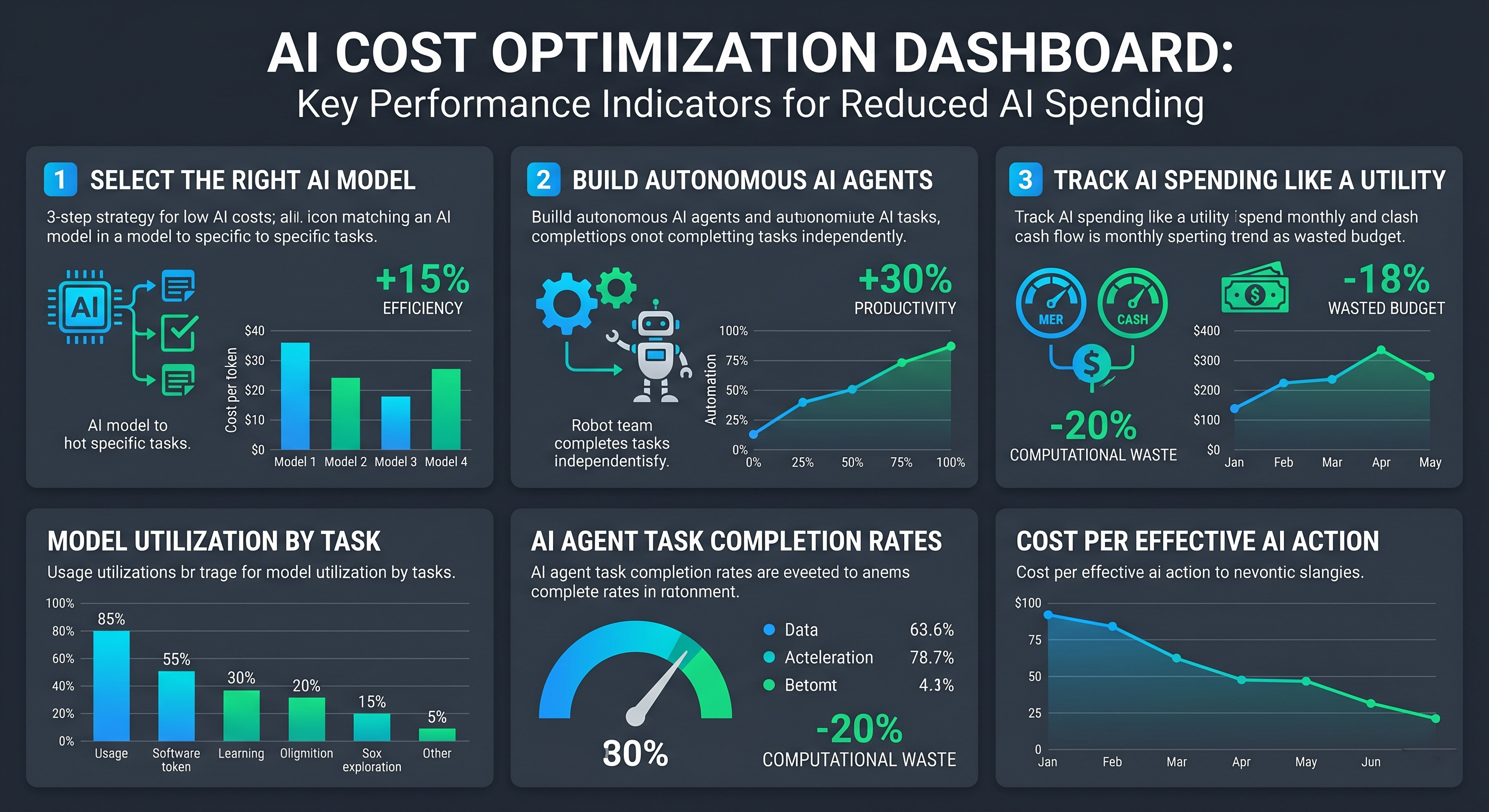
New agentic AI is more like a smart assistant; it can figure out what needs to happen next, deal with unexpected situations, and complete multi-step tasks without someone guiding every move.
The best part? You don't need the most expensive AI to make this work. Smart systems use a cheap AI to manage the overall task and only call on the powerful AI when it's truly needed. The result: 97% of the quality at 60% of the cost.
Step 3: Track Your AI Spending Like a Utility Bill
When businesses first start using AI, they treat it like a one-time purchase. But AI costs are more like electricity — they grow as you use more, and without monitoring, bills can spiral quickly.
Here's what smart businesses do:
Track Costs by Task: Know exactly which workflows are cheap and which are expensive
Set up Alerts: Get notified if costs suddenly spike (a small mistake in an AI setup can burn thousands overnight)
Review Monthly: Look for tasks where you're using expensive AI when cheap AI would do the job
Control "shadow AI": Employees using personal AI tools on company data is both a cost and a security risk.
Where Mid-Size Businesses Should Start With AI
Quick Wins
These are the AI projects that pay for themselves fastest:
Automating Document Processing
If your team manually reads invoices, contracts, or forms to pull out information, AI can do this in seconds at a tiny fraction of the cost. Processing a document manually might cost $1–$2 in labor time. AI does it for less than half a cent.
Sorting Customer Support Tickets
Instead of a person reading every incoming support request and deciding where to send it, AI can do this instantly and accurately. Your support team focuses on solving problems, not sorting emails.
Medium-Term Wins
Predicting Equipment Problems (Manufacturing)
AI can monitor machine data and warn you before something breaks down. Mid-size manufacturers using this report 15–30% fewer surprise breakdowns and repair bills.
Smarter Stock and Demand Forecasting (Retail)
AI is much better than spreadsheet formulas at predicting demand during sales, seasons, or supply chain disruptions. Less overstock, fewer stockouts.
Healthcare Businesses: A Hidden Opportunity
Most people think AI in healthcare means robots doing surgery. But the biggest near-term opportunity for mid-size healthcare businesses is much simpler — and much cheaper.
Think about how much information sits in patient notes, referral letters, and intake forms — all written in plain text, impossible to search or analyze at scale. AI can read all of it, organize it, and turn it into useful data.
This helps with: faster billing, smoother insurance approvals, and better planning for how many staff and beds you need. No clinical risk. Just operational efficiency — at very low token costs because caching handles the repetitive document structure beautifully.
Conclusion
AI is getting cheaper, but that doesn't mean you should spend less. It means you should do more.
Every workflow in your business that currently relies on a person doing something repetitive, predictable, or document-heavy is a candidate for AI. In 2023, automating all of those would have cost a fortune. In 2026, it's affordable for businesses of almost any size.
The mid-size companies that win over the next three years won't be the ones that found the cheapest AI. They'll be the ones who used affordable AI to build smarter operations faster than their competitors.

Mangesh Gothankar


Ashwani Sharma
Achin Verma
Frequently Asked Questions
Have a question in mind? We are here to answer. If you don’t see your question here, drop us a line at our contact page.
What does Token mean in AI?

Why is AI getting cheaper every year?
Can a mid-size business really afford AI in 2026?
Where should my business start with AI?






.png?width=352&name=Intelligent%20Workflows%20in%20RPA%20(1).png)