


.png?width=27&height=27&name=Group(1).png)

-1.svg)
-1.svg)


-2.svg)


%201-1.webp?width=148&height=74&name=our%20work%20(2)%201-1.webp)




.svg)





.png?width=670&height=445&name=Enterprise%20Generative%20AI%20Services%20(2).png)
Accuracy is the first metric most people check. It is also the one most likely to mislead you. A fraud detection model that flags nothing as fraud can still report 95% accuracy on a dataset where 95% of transactions are legitimate.
The number looks clean, but the model is useless. The confusion matrix is what exposes the model's limitations. Rather than collapsing all predictions into a single score, it maps every prediction outcome into a structured grid. And from that grid, every meaningful evaluation metric follows directly.
 Generate
Key Takeaways
Generate
Key Takeaways

1. Accuracy misleads on imbalanced data, the confusion matrix does not.
2. Precision and recall answer questions accuracy never asks.
3. Adjusting the threshold shifts every cell in the matrix.
4. Multi-class matrices isolate which class boundaries are failing specifically.
What the Four Cells of the Confusion Matrix Actually Represent: False Positives and False Negatives Defined
Use fraud detection as the reference throughout. Your model reads a transaction and decides whether it's fraudulent or legitimate ?
- True Positive (TP): The model predicted fraud, and the transaction was fraud, correct detection.
- True Negative (TN): The model predicted legitimate, and the transaction was legitimate; correct clearance.
- False Positive (FP): The model predicted fraud, but the transaction was legitimate. A real customer's payment flagged incorrectly. Statisticians call this a Type I error.
- False Negative (FN): The model predicted legitimate, but the transaction was fraudulent. A fraudulent charge that passed through. A Type II error.
These four outcomes are not interchangeable. The National Institutes of Health notes in its machine learning evaluation reference that misclassification across these quadrants carries different operational consequences depending on the domain (NCBI Bookshelf).
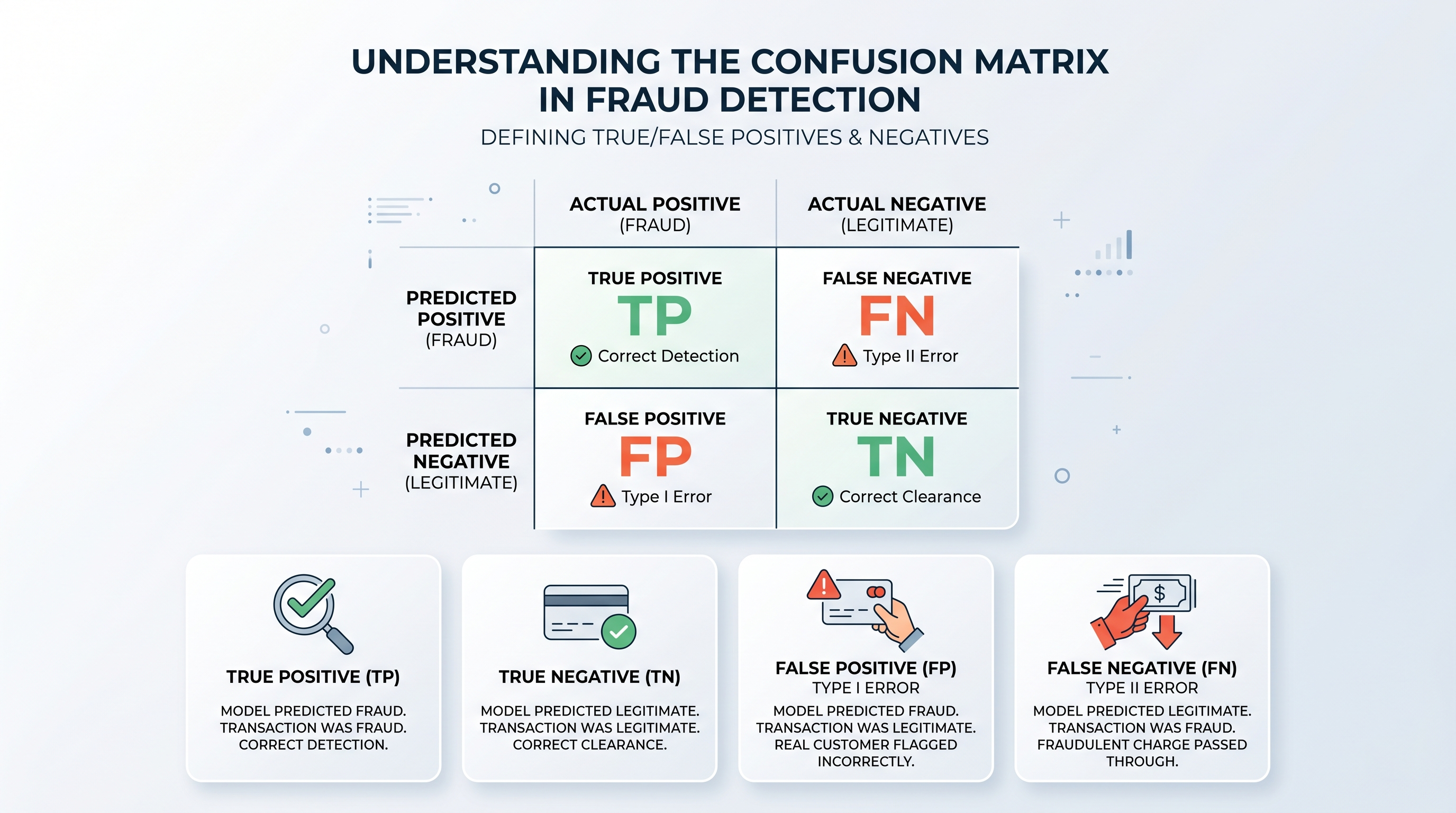
In fraud detection, a false negative costs money directly. A false positive costs customer trust. Both matter, but not equally, and not in every context. Accuracy folds all four cells into one ratio. That is precisely where the information is lost.
Related Read : Robotic Process Automation Vs. Machine Learning
Precision, Recall, F1 and Accuracy: Model Evaluation Metrics and When Each One Applies
Each metric answers a different question. Choosing the wrong one does not just produce a misleading report, but it shapes the wrong optimization target during training.
| Metric | Formula | Question It Answers | When to Use It |
|
Precision |
TP / (TP + FP) | Of everything flagged positive, how many were right? | When false alarm cost is high: spam, legal, compliance |
| Recall | TP / (TP + FN) | Of all actual positives, how many were caught? | When missed detection cost is high: fraud, diagnosis |
| F1 Score | 2 × (P × R) / (P + R) | Is the model balancing both error types? | Imbalanced datasets where both errors carry cost |
| Metric | Formula | Question It Answers | When to Use It |
|
Precision |
TP / (TP + FP) | Of everything flagged positive, how many were right? | When false alarm cost is high: spam, legal, compliance |
| Recall | TP / (TP + FN) | Of all actual positives, how many were caught? | When missed detection cost is high: fraud, diagnosis |
| Accuracy | (TP + TN) / Total | What fraction of all predictions were correct? | Only when class distribution is balanced |
Precision answers: of every transaction flagged as fraud, how many actually were?
Low precision means the fraud review team is spending most of its time clearing legitimate transactions.
Recall answers: of every actual fraudulent transaction in the dataset, how many did the model detect?
Low recall means fraud is clearing undetected.
F1 Score balances both. It is the metric to reach for when your dataset is imbalanced and neither error type is acceptable to ignore.
Google's Machine Learning Crash Course states this directly: on class-imbalanced datasets, accuracy will almost always reward a model for predicting the majority class, regardless of what happens to the minority class (Google for Developers).
How the Decision Threshold Reshapes Classification Model Accuracy and Every Cell in the Matrix
Most guides present the confusion matrix as a static output, but it is not. Every cell shifts when you adjust the decision threshold, and most practitioners never learn this until something breaks in production.
The default threshold for a binary classifier is 0.5. If the model assigns a probability above 0.5, it predicts positive. Below 0.5, it predicts negative. That number is adjustable, and moving it changes the matrix.
| Threshold | True Positives | False Positives | False Negatives | Precision | Recall |
| 0.3 (lower) | Rises | Rises | Falls | Drops | Rises |
| 0.5 (default) | Baseline | Baseline | Baseline | Balanced | Balanced |
| 0.7 (higher) | Falls | Falls | Rises | Rises | Drops |
Lowering the threshold catches more actual fraud and has a higher recall. But it produces more false alarms along the way. Raising it reduces false alarms but lets more fraud through. Neither direction is universally correct. The right threshold depends on what your domain can afford to get wrong.
One analysis of deployed ML systems found that a model reporting 95% accuracy could generate $805,000 in annual losses when false negatives in high-value classifications were left unweighted in the evaluation framework (AI Multiple). The accuracy score reported nothing unusual. Threshold selection is where that loss either gets caught or gets ignored — and the confusion matrix is the only tool that makes the trade-off visible.
Reading a Multi-Class Confusion Matrix and What Changes When You Have More Than Two Labels
Binary classification produces a 2x2 matrix. Add output classes, and the grid expands, but the diagnostic logic does not change.
Consider a sentiment classifier with three labels: positive, neutral, and negative. The matrix becomes 3x3. The diagonal still represents correct predictions for each class. Every off-diagonal cell still represents a specific misclassification between two classes.
If the matrix shows the model consistently labeling Neutral samples as Negative, that is a boundary problem between those two classes, not a general failure across the whole model. The confusion matrix isolates it precisely. A single accuracy score across all three classes hides it entirely.
The scikit-learn documentation frames this directly: "The diagonal elements represent the number of points for which the predicted label is equal to the true label, while off-diagonal elements are those mislabeled by the classifier" (scikit-learn 1.8.0). In multi-class evaluation, reading which classes are being confused with which is the diagnostic step, and it is the step accuracy cannot perform.
Conclusion
The confusion matrix does not improve your model. It tells you where to look. Before touching features, resampling training data, or adjusting architecture, read the matrix. It will tell you whether the problem is class imbalance, a threshold calibrated for the wrong use case, or a specific label boundary the model has not learned to separate. One clear read of the matrix before you act is faster than a week of blind optimization.
That is its value, and that is what accuracy alone will never give you. If you are working on building or scaling machine learning systems that hold up in production, the confusion matrix is where reliable evaluation starts.





.png?width=352&name=microsofts-recall-feature%20(1).png)