

.png?width=27&height=27&name=Group(1).png)

-1.svg)
-1.svg)


-2.svg)


%201-1.webp?width=148&height=74&name=our%20work%20(2)%201-1.webp)




.svg)






What Is Agentic RAG and Why Does It Matter?
Agentic RAG is an AI architecture where autonomous agents retrieve, filter, and reason over data using LLMs only where they add real value.
The rise of Retrieval-Augmented Generation (RAG) was a turning point for enterprise AI. For the first time, organisations could ground large language models in their own proprietary data without expensive fine-tuning. Instead of relying solely on what a model learned during training, RAG let you pull relevant documents at query time and feed them to the LLM as context. The results were dramatically better — more accurate, more up to date, and far less prone to hallucination.
But as teams moved from prototype to production, a new problem emerged: RAG was expensive. Not because retrieval was expensive, a vector database query costs fractions of a cent and returns in under 100 milliseconds. The cost came from sending every single query, regardless of complexity, through a frontier language model. A user asking “Show me invoices from March” didn’t need GPT-4. They needed a database filter. A user asking “Is product X in stock?” needed a lookup, not a reasoning chain. Yet most RAG implementations treated every query the same way, routing everything through the most expensive layer in the stack.
Agentic RAG was built to fix this. Rather than a fixed pipeline retrieve, then generate, an agentic system introduces a decision-making layer before the LLM is ever invoked. Autonomous agents assess what a query actually requires, select the cheapest method capable of answering it, and only escalate to an LLM when the question genuinely demands synthesis, reasoning, or generation. The result is a system that is not only cheaper to run but also faster, more reliable, and easier to scale.
 Generate
Key Takeaways
Generate
Key Takeaways

- Not every query needs an LLM — structured lookups, filters, and metadata queries run faster and cheaper without one.
- Agentic RAG separates discovery (vector search, BM25, SQL) from ranking (LLM synthesis), calling the model only when reasoning is genuinely required.
- Query routing reduces LLM calls by 40–60%, cutting inference costs by 30–55% in real production deployments.
- The 4 biggest cost mistakes: no query router, sending too many chunks to the LLM, using frontier models for simple tasks, and poor chunking strategy.
- Agentic RAG outperforms traditional RAG and fine-tuning for complex, multi-step enterprise workflows with live or frequently updated data.
- Observability is essential — without tracing, you cannot see where LLM calls are unnecessary or where retrieval is quietly failing.
According to a 2024 study by LlamaIndex, agentic pipelines reduce unnecessary LLM calls by up to 60%, cutting inference costs significantly for enterprise deployments. This is not a marginal optimization it fundamentally changes the economics of building AI-powered products.
The shift towards agentic development also improves reliability. Every LLM call is a potential point of failure: the model may hallucinate, rate limits may throttle your system, or latency may spike unpredictably. By reserving LLM calls for queries that truly need them, you reduce the surface area for these failure modes and create a more robust, production-grade system overall.
Does Every Query Actually Need an LLM?
No, structured queries, keyword lookups, and deterministic filters do not need LLM reasoning. Only ambiguous, multi-step, or generative tasks genuinely require it.
This is the central insight that separates efficient LLM development from wasteful LLM development. The question is not “Can an LLM answer this?” A capable language model can answer almost anything. The question is “Is an LLM the right tool for this?” And in a surprising number of production queries, the answer is no.
Consider the kinds of questions that actually flow through an enterprise AI system on any given day. A legal team using a document assistant might ask: “Show me all NDAs signed after January 2024.” This is a metadata filter. There is no ambiguity, no reasoning required, and no synthesis needed. A relational database or a metadata search on a document index can return the answer in milliseconds at essentially zero cost. Routing this query to an LLM wastes money, adds latency, and introduces unnecessary risk.
Now consider a different query from the same user: “What are the key differences between the liability clauses in these five contracts, and which represents the greatest risk for our upcoming acquisition?” This is a genuinely complex, multi-document reasoning task. It requires the model to read, compare, infer, and synthesise across multiple long documents. This is exactly what LLMs are built for, and this is where you want to spend your inference budget.
The practical dividing line is straightforward. Queries that are deterministic — where the answer can be looked up rather than reasoned about should bypass the LLM entirely. This includes exact-match lookups, date and category filters, keyword searches, and any query where the expected output is a list or structured record rather than a generated paragraph. Queries that require interpretation, contextualisation, comparison, summarisation across multiple sources, or open-ended generation are the right candidates for LLM processing.
A Practical Taxonomy of Query Types
Understanding which queries need an LLM and which do not requires thinking carefully about the nature of the task. There are broadly four categories:
Category 1: Structured Retrieval (No LLM Needed)
These are queries with a deterministic correct answer that lives in a structured data source. Examples include: “Show me all invoices over £10,000 from Q3,” “List all customers in the enterprise tier,” or “What was our revenue on 14 March?” These queries should go directly to a SQL database, a metadata filter, or a key-value lookup. They are fast (under 50ms), cheap (fraction of a cent), and 100% accurate when the underlying data is correct.
Category 2: Semantic Search (Lightweight Retrieval, No LLM Needed)
These queries require understanding meaning and relevance rather than exact matching, but they do not require synthesis. Examples include: “Find documents related to data privacy compliance” or “Show me contracts that mention indemnification.” A vector search using dense embeddings, or a hybrid BM25 plus vector approach, can handle these effectively. The output is a ranked list of relevant documents, not a generated answer. Adding an LLM to this step adds cost and latency without improving the result.
Category 3: Summarisation and Extraction (LLM Useful)
These queries require an LLM, but they are bounded and relatively simple. Examples: “Summarise the key terms of this contract,” or “Extract all payment due dates from these invoices.” Here, a smaller, cheaper model is often sufficient. Reaching for GPT-4 Turbo or Claude Opus for a single-document summarisation task is like using a supercomputer to run a spreadsheet. Models like Mistral 7B, LLaMA 3 8B, or Claude Haiku deliver 90% of the quality at 10% of the cost for these structured extraction tasks.
Category 4: Reasoning and Generation (Full LLM Required)
These are the queries that justify the investment in frontier models. Multi-document comparison, risk analysis, open-ended research questions, drafting complex communications, or any task requiring the model to hold multiple competing ideas in context and synthesise a nuanced response. This is where GPT-4, Claude Opus, or Gemini Ultra earn their place. In a well-designed agentic RAG system, these queries represent perhaps 20–40% of total volume — but they are the ones your users genuinely care about.
The financial implication of this taxonomy is significant. If you can shift 60% of your query volume from Category 4 to Categories 1–2, and another 20% from Category 4 to Category 3, you are reducing your effective cost-per-query by 70–80% without any degradation in answer quality. This is the core promise of intelligent query routing in LLM development today.
What Is the Difference Between Discovery and Ranking in RAG?
Discovery finds candidate documents using fast, cheap retrieval methods. Ranking uses an LLM or re-ranker to score relevance and synthesise a final response. These two phases have very different cost profiles and should be designed independently.
One of the most common mistakes in early RAG implementations was treating the pipeline as a single undifferentiated operation: retrieve some documents, pass them to the LLM, get an answer. This conflation was understandable; it is the simplest possible design but it obscures a crucial distinction that has enormous practical consequences for cost, latency, and quality.
Every RAG pipeline actually contains two fundamentally different operations. The first is discovery: finding the documents, passages, or data records that are potentially relevant to the query. The second is ranking (or generation): determining which of those candidates are most relevant, and using them to construct a coherent, accurate answer. These two operations have completely different characteristics. Discovery is fast, cheap, deterministic, and highly parallelisable. Ranking and generation are slow, expensive, probabilistic, and constrained by context windows.
The Discovery Phase in Detail
The goal of discovery is coverage: find everything that might be relevant, quickly and cheaply. You are not yet trying to determine which documents are the best answer — you are casting a wide net. Several complementary techniques are used at this stage, and none of them require an LLM.
Dense vector search uses embedding models to convert text into high-dimensional numerical vectors, then finds the vectors in your database most similar to the query vector. This is semantically aware — it understands that “car” and “automobile” are related — and it works well for fuzzy or conceptual queries where exact keyword matching would fail. Tools like Pinecone, Weaviate, Qdrant, and Chroma are commonly used for this layer.
Sparse retrieval, often implemented as BM25 (Best Matching 25), works differently. It scores documents based on term frequency and inverse document frequency — essentially asking how often your query words appear in a document, weighted by how rare those words are across the corpus. BM25 is extremely fast, requires no GPU, and often outperforms dense retrieval for exact technical terms, product codes, or proper nouns that embeddings struggle to capture.
Metadata filtering is the third pillar of discovery. Before running any search, you can dramatically narrow the candidate pool using structured attributes: date ranges, document types, author tags, department labels, jurisdiction codes, or any other structured field in your data. A query asking for “legal contracts from 2023” can filter down from millions of documents to hundreds before a single vector operation is performed.
Production-grade RAG development almost always combines all three: metadata filtering to narrow the search space, followed by hybrid dense and sparse retrieval to maximise coverage within that space. This multi-stage approach consistently outperforms any single technique in benchmark tests and real-world deployments.
The Ranking Phase in Detail
Once discovery has identified a candidate set of, say, 20–50 potentially relevant documents or passages, the ranking phase takes over. Its goal is precision: determine which of these candidates are genuinely relevant to the specific query, in what order, and how to synthesise them into a useful response.
The first decision in the ranking phase is whether to use an LLM at all. For many queries, a cross-encoder re-ranker a smaller, specialised model trained specifically to score document-query relevance pairs — can perform this function at a fraction of the cost and latency of a full language model. Cohere Rerank, cross-encoder models from sentence-transformers, and newer learned sparse models like ColBERT and SPLADE are all capable of reducing a 50-document candidate set to the top 3–5 genuinely relevant passages with high accuracy.
Only when the final answer requires synthesis — pulling information from multiple passages, constructing an explanation, generating a recommendation, or reasoning across conflicting sources — does it make sense to invoke a full language model. At that point, the LLM receives a carefully curated, compressed context: not the raw 50-document set, but the 3–5 highest-relevance passages identified by the re-ranker. This dramatically reduces input token count, cuts cost, and often improves answer quality by giving the model cleaner, more focused context.
The separation of discovery and ranking is not merely an architectural nicety — it is a fundamental cost-control mechanism. In a well-optimised RAG development pipeline, the discovery phase handles the vast majority of queries, with the ranking and generation phase reserved for the subset that genuinely requires it.
How Does Agentic Development Change the RAG Architecture?
Agentic development adds an intelligent decision layer between the user query and the retrieval pipeline. The agent assesses query intent, selects the appropriate retrieval strategy, validates the results, and decides whether LLM synthesis is actually required all before a single expensive operation is triggered.
Traditional RAG has a fixed, linear structure: a query comes in, retrieval runs, the LLM generates a response. There is no decision-making, no routing, and no ability to adapt the pipeline to the nature of the specific query. This simplicity is its strength for prototyping but its weakness in production.
Agentic RAG replaces this static pipeline with a dynamic, self-directing workflow. Rather than all queries following the same path, each query is assessed individually, and the system adapts its behaviour based on what it discovers. This is what the word “agentic” means in this context — the system acts as an agent, making decisions and taking actions based on context, rather than mechanically executing a fixed sequence of steps.
The Agentic Pipeline: Step by Step
Understanding how an agentic pipeline works in practice requires walking through each of its components in detail. The following describes a production-ready agentic RAG architecture, as implemented by Signity’s engineering team across multiple enterprise deployments.
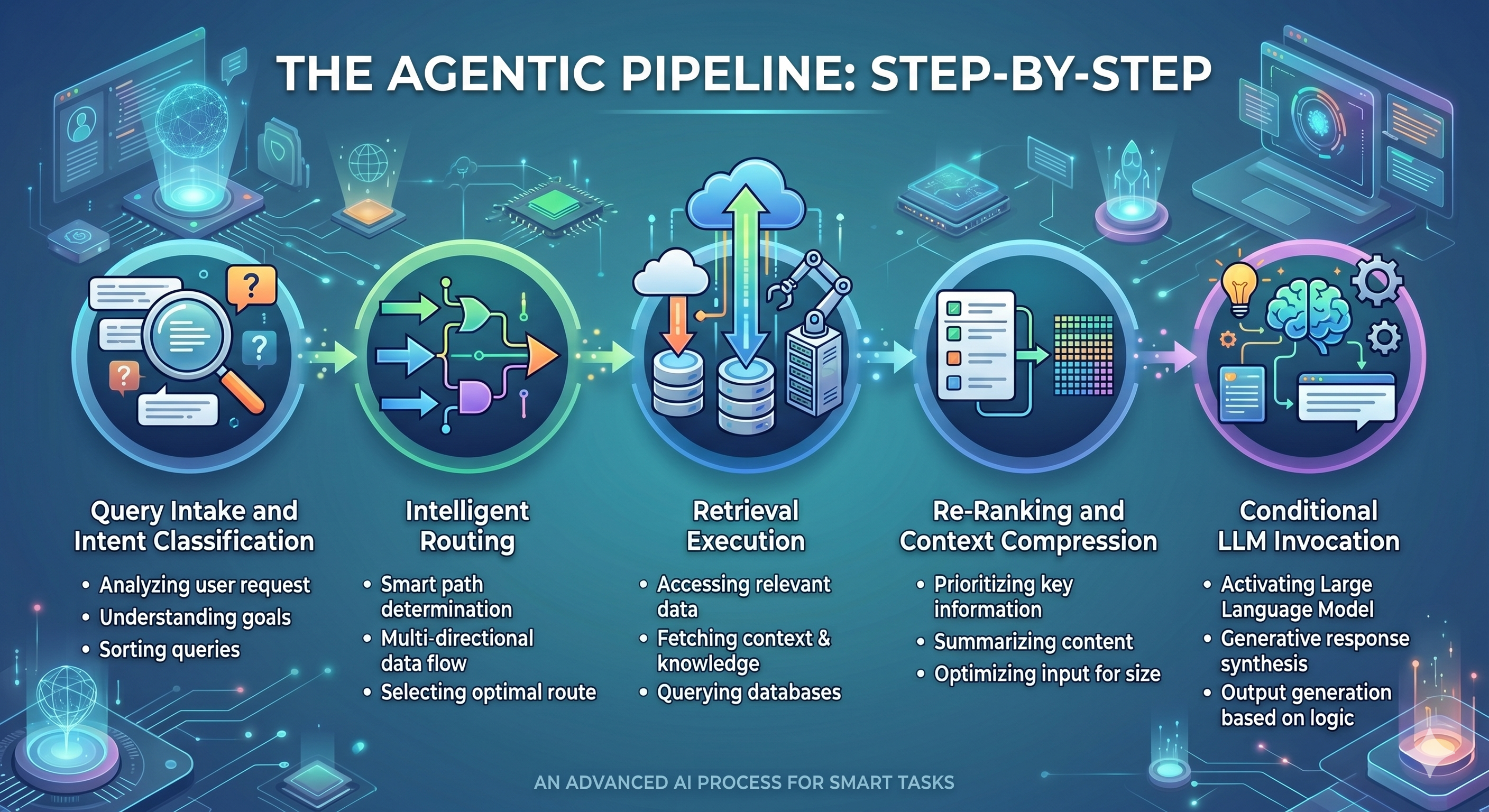
Step 1: Query Intake and Intent Classification
The first component is a query classifier a lightweight model (typically a fine-tuned BERT-class model, or even a simple rule-based system for well-defined domains) that reads the incoming query and assigns it to one of several predefined categories. These categories might include: structured data lookup, semantic document search, single-document extraction, multi-document reasoning, and open-ended generation. The classifier runs in milliseconds and costs almost nothing to operate. Its output determines everything that follows.
This classification step is where most of the cost savings are realised. A well-trained classifier can correctly route 60–70% of queries away from the LLM entirely, directing them instead to the appropriate cheap, fast retrieval mechanism. Without this step, every one of those queries would have defaulted to the most expensive path.
Step 2: Intelligent Routing
Based on the classifier’s output, the router selects the appropriate retrieval strategy. A structured lookup query is routed to a SQL database or a document metadata index. A semantic search query is routed to the vector store. A query that requires both structured and unstructured data is broken into subqueries and routed to multiple sources in parallel. The router also selects the appropriate model tier: lightweight queries get lightweight models (or no model at all), and complex queries get reserved for frontier models.
Routing is not always a binary choice. For ambiguous queries, the router may run multiple retrieval strategies in parallel and let the re-ranker sort out which results are most relevant. This is especially valuable for queries that could be either a structured lookup or a semantic search, depending on how the user intended the question.
Step 3: Retrieval Execution
Retrieval runs according to the routing decision. For structured queries, this is a database operation. For semantic queries, this is a vector search, potentially combined with BM25 and metadata filtering. For complex queries, this may involve querying multiple data sources, resolving relationships between entities, or performing graph traversal across a knowledge graph. The retrieval step is deliberately LLM-free it operates on embeddings, indices, and structured data, all of which are far cheaper to query than a language model.
At this stage, the agent also performs a relevance check on the retrieved results. If the top retrieved documents have low similarity scores — suggesting the query is poorly matched to the available data — the agent may reformulate the query, try a different retrieval strategy, or flag the result for human review. This self-correcting behaviour is one of the defining characteristics of agentic systems and is what allows them to handle edge cases gracefully rather than silently returning poor results.
Step 4: Re-Ranking and Context Compression
If the retrieval phase returns more candidates than can fit in an LLM context window — or more than are needed for a high-quality answer — a cross-encoder re-ranker scores each candidate against the original query and selects the top K most relevant passages. This step is critical for both cost control and answer quality. Without re-ranking, the LLM receives a large, noisy context filled with partially relevant documents. With re-ranking, it receives a compact, high-signal context containing only the passages most likely to contain the answer.
For queries that do not require LLM generation at all — structured lookups, simple fact retrievals — the pipeline terminates here. The retrieved and ranked results are formatted and returned directly to the user. No LLM is involved.
Step 5: Conditional LLM Invocation
Only for queries that require synthesis, reasoning, or generation does the pipeline proceed to the LLM layer. At this point, the agent constructs a carefully designed prompt that includes: the original user query, the top-K retrieved passages (already re-ranked and compressed), any relevant metadata or structured data, and system instructions appropriate to the use case. The LLM generates a response, which is then validated by the agent before being returned to the user.
Validation is an underappreciated component of agentic systems. Before returning the LLM’s response, the agent may check whether the response actually addresses the query, whether it cites specific evidence from the retrieved passages, whether it contains any claims that contradict the source documents, or whether it falls within acceptable length and format constraints. Responses that fail these checks can be rejected and the LLM prompted to try again or the query can be escalated for human review.
This six-stage architecture classify, route, retrieve, re-rank, compress, and conditionally generate — is what enables production agentic RAG systems to be 3–5× cheaper than naive LLM-on-every-query approaches, as documented in Anthropic’s research on tool-use agents and corroborated by real-world deployment data from Signity’s enterprise clients.
What Are the Real Costs of Overusing LLMs?
Unnecessary LLM calls inflate latency, API costs, and system complexity by 40–70% in typical production workloads.
A well-optimised vector search returns results in 20–80 milliseconds. A metadata filter operates in under 10 milliseconds. A call to GPT-4 Turbo takes 1.5–5 seconds. If you route every query through a frontier model, your system will feel sluggish regardless of how well everything else is engineered.
Frontier models cost approximately $10 per million input tokens. For a system handling 100,000 queries per day with an average context of 2,000 tokens, monthly input token costs exceed $60,000. Query routing that eliminates 60% of LLM calls reduces this below $25,000 — saving over $420,000 annually for a single application. A 2024 McKinsey report identified AI cost overruns as the number one barrier to scaling enterprise AI deployments, and most stem from unoptimised inference pipelines.
What Are the Most Common RAG Mistakes That Inflate Costs?
Mistake 1: Sending All Retrieved Chunks to the LLM
Retrieving 20 chunks and passing all 20 to the LLM means 10,000 input tokens per query regardless of relevance. A cross-encoder re-ranker reduces this to 3–5 genuinely relevant passages, cutting input costs by 70–80% and often improving answer quality. Weights & Biases (2024) found that adding a re-ranker delivered up to 45% improvement in retrieval precision before any changes to the LLM layer.
Mistake 2: No Query Classification or Routing
Without routing, every query including simple FAQ lookups hits your most expensive model. In most enterprise applications, 40–60% of queries need no LLM at all. A fine-tuned BERT classifier costs less than $0.001 per 10,000 queries to operate and pays for itself immediately.
Mistake 3: Using Frontier Models for All Tasks
GPT-4, Claude Opus, and Gemini Ultra are exceptional — and expensive. For structured extraction and simple Q&A, Mistral 7B, LLaMA 3 8B, or Claude Haiku deliver 90% of the quality at 10% of the cost. Reserve frontier models for multi-document reasoning and high-stakes generation where quality genuinely matters.
Mistake 4: Poor Chunking Strategy
Fixed 512-token splits with no overlap destroy the internal structure of legal agreements, financial reports, and technical documentation. Semantic chunking (splitting on natural boundaries), hierarchical chunking (storing both full documents and passages), or late chunking (preserving cross-chunk context in embeddings) all outperform naive fixed-size splitting for structured document collections.
Related Read : How Agentic AI and RAG Work Together to Transform Demand Generation
Traditional RAG vs Agentic RAG vs Fine-Tuning
Traditional RAG is the fastest path to a working prototype but treats every query identically and cannot adapt to query complexity. Agentic RAG adds dynamic routing and self-correction at the cost of greater architectural complexity, typically paying for itself in months for high-volume applications. Fine-tuning produces a faster, cheaper model with superior domain expertise but bakes knowledge into weights at training time — it cannot incorporate new data without retraining and cannot cite its sources, which creates auditability problems in regulated industries.
|
Factor |
Traditional RAG |
Agentic RAG |
Fine-Tuning |
|
Setup complexity |
Low |
Medium |
High |
|
Cost per query |
Medium |
Low–Medium |
Low |
|
Handles new data |
✓ Yes |
✓ Yes |
✕ Retraining needed |
|
Multi-step reasoning |
✕ Limited |
✓ Yes |
✕ Limited |
|
Source citation |
✓ Yes |
✓ Yes |
✕ No |
|
Adapts to query type |
✕ No |
✓ Yes |
✕ No |
|
Deploy time |
1–2 wks |
3–6 wks |
4–8 wks |
The Bottom Line
Not every query deserves an LLM. The most cost-effective AI systems in production today are built on a simple principle: use the cheapest tool capable of correctly answering the question. For structured lookups, that is a database. For semantic search, that is a vector index. For re-ranking, that is a cross-encoder. For synthesis and reasoning, that is an LLM and only then.
Agentic RAG is the architectural pattern that makes this possible at scale. If your AI stack is routing queries through a frontier model that could be handled by a database filter or a vector search, you are paying too much and delivering slower, less reliable answers than you should be. The architecture to fix this is well-understood, the tooling is mature, and the ROI is consistent.

Mangesh Gothankar


Ashwani Sharma
Achin Verma
Frequently Asked Questions
Have a question in mind? We are here to answer. If you don’t see your question here, drop us a line at our contact page.
Does RAG always require a large language model?

What is the difference between RAG and Agentic RAG?
When should I use fine-tuning instead of agentic RAG?
Fine-tuning is best when you need consistent output style and your knowledge base is static. Agentic RAG is preferable when data changes frequently, source citations matter, or query types are diverse. Most mature production systems use both.
What industries benefit most from agentic RAG?
How long does it take to build a production agentic RAG system?
A functional prototype takes 1–2 weeks. A production-grade system with routing, hybrid retrieval, re-ranking, observability, and enterprise security typically takes 6–12 weeks.