

.png?width=27&height=27&name=Group(1).png)

-1.svg)
-1.svg)


-2.svg)


%201-1.webp?width=148&height=74&name=our%20work%20(2)%201-1.webp)




.svg)





.webp?width=670&height=445&name=What%20is%20webmcp%20(1).webp)
WebMCP (Web Model Context Protocol) is an emerging approach for making web applications machine-readable so AI agents can reliably discover capabilities, understand data models, and execute actions without relying on fragile UI automation. Instead of interpreting a web interface visually, an agent interacts through structured contracts that define what the system can do and how it can be used.
In essence, WebMCP shifts the web from human-first interfaces to dual-mode systems that are equally understandable by people and AI.
 Generate
Key Takeaways
Generate
Key Takeaways

-
WebMCP enables websites to expose structured, machine-readable capabilities so AI agents can interact with them reliably.
-
It shifts automation from fragile UI scraping to deterministic, contract-based interactions.
-
WebMCP does not replace REST or GraphQL; it enhances them by adding semantic understanding for AI systems.
-
Security improves through scoped permissions, auditability, and explicit workflow definitions.
The modern web was designed for human interaction. Buttons, forms, and navigation patterns were created to guide users visually, not to be interpreted by autonomous systems. As AI agents begin performing tasks like managing dashboards, triggering workflows, booking services, or deploying software, traditional automation techniques reveal their limitations. Screen scraping breaks with every UI update, selectors change, and security policies rarely account for autonomous execution.
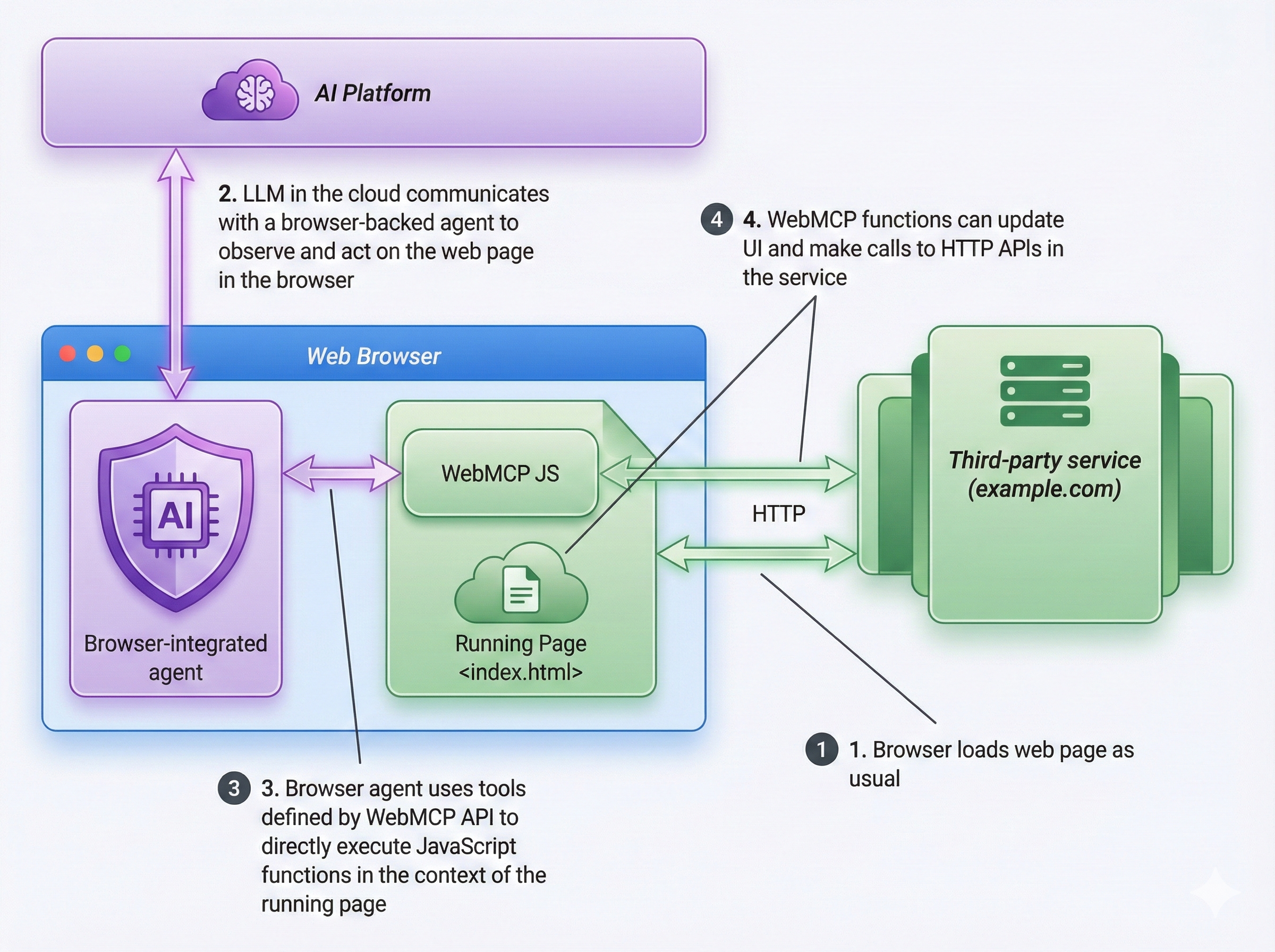
WebMCP introduces a structured interaction layer that allows developers to expose application capabilities explicitly. By publishing a capability manifest, defining data schemas, and providing action endpoints, a system becomes self-describing to AI agents. Developer discussions hosted on platforms like GitHub show growing interest in this approach, while browser ecosystems influenced by Google initiatives are exploring how browsers can support structured agent interactions natively.
Rather than replacing APIs, WebMCP enhances them by making them interpretable and discoverable for machine reasoning.
Understanding WebMCP at a Conceptual Level
WebMCP can be thought of as a communication contract between a web application and an intelligent agent. The contract does not merely list endpoints; it explains intent, relationships, and permissions. This allows an agent to reason about what actions are possible before executing them.
At the core, WebMCP systems expose three layers. The first layer is a declarative interface describing the system’s capabilities. The second layer defines structured schemas that represent entities and relationships. The third layer exposes imperative endpoints that allow actions to be performed.
This layered structure mirrors how humans understand software. We first learn what the system can do, then we understand its data, and only then do we execute operations. WebMCP formalizes this process for AI agents.
Declarative API vs Imperative API in WebMCP
The distinction between declarative and imperative APIs is central to WebMCP’s architecture.
A Declarative API explains possibilities. It tells the agent what actions exist, what entities are involved, and what permissions are required. This information is typically exposed through a manifest endpoint that acts as the system’s capability description.
An Imperative API, on the other hand, executes tasks. It receives structured input, performs operations, and returns structured results. These endpoints correspond to workflows rather than generic data retrieval.
The declarative layer allows reasoning, while the imperative layer enables execution. Without the declarative layer, agents would still rely on guesswork. Without the imperative layer, they would understand the system but be unable to act.
| API Layer | Purpose | Developer Role |
| Declarative API | Describes available capabilities | Defines manifest, schemas, permissions |
| Imperative API | Executes operations | Implements action endpoints |
Anatomy of a WebMCP Implementation
To understand how WebMCP works in practice, consider a SaaS platform that manages invoices. A WebMCP-enabled version of this platform would expose a manifest endpoint that returns structured metadata about available actions.
{ "service": "BillingCore", "version": "1.0", "actions": [ "create_invoice", "send_invoice", "refund_payment" ], "entities": ["invoice", "customer", "payment"], "authentication": { "type": "OAuth2", "scopes": ["invoice.read", "invoice.write"] }} |
This single response allows an AI agent to understand what workflows exist, which entities are involved, and how authentication works.
The imperative endpoint for creating an invoice might look like this:
POST /webmcp/actions/create_invoiceContent-Type: application/jsonAuthorization: Bearer <token>{ "customer_id": "cus_7821", "amount": 499, "currency": "USD", "due_date": "2026-03-10"} |
Because the manifest already defined the schema, the agent can construct this request confidently without trial-and-error.
Real-Time Scenario: AI Agent Managing a Project Tool
Imagine an AI assistant assigned to manage engineering tasks. In a traditional system, it would try to locate buttons like “Create Task,” fill forms, and submit them. If the UI changed, the automation would fail.
With WebMCP, the agent first reads the manifest. It learns that a create_task action exists and that a task object requires a title, priority, and assignee. It then calls the action endpoint with structured data. The response confirms success and returns a task ID.
This interaction is deterministic, meaning the agent operates with confidence rather than inference. The reliability gained here is why many developers see WebMCP-style architecture as a natural evolution of API design.
Implementation Walkthrough for Developers
A minimal WebMCP implementation often begins by exposing a manifest route.
app.get("/webmcp/manifest", (req, res) => { res.json({ name: "TaskEngine", actions: ["create_task", "assign_task", "close_task"], schemas: ["task", "user"], auth: "OAuth2" });}); |
Once the declarative layer exists, the next step is defining structured schemas. These schemas allow agents to reason about valid input.
{ "task": { "title": "string", "priority": "integer", "assignee": "user_id", "status": "enum" }} |
Finally, imperative endpoints implement the actual workflows.
app.post("/webmcp/actions/create_task", async (req, res) => { const task = await createTask(req.body); res.json(task);}); |
This three-step architecture; manifest, schema, action and forms the foundation of most WebMCP-style systems.
How WebMCP Changes API Design Philosophy
Traditional API design focuses on endpoints and responses. WebMCP introduces the idea that systems should describe their intent and semantics first. Instead of expecting developers or agents to read documentation, the system itself provides an executable contract.
This shift makes software ecosystems more interoperable. When applications expose structured capability layers, integration becomes a matter of discovery rather than custom development. This is similar to how service discovery transformed cloud infrastructure, but now applied to AI interactions.
Developers who adopt this approach early often find that their systems become easier to extend, test, and secure because logic is clearly separated from presentation.
Comparing WebMCP with REST and GraphQL
REST APIs emphasize resource manipulation, while GraphQL focuses on flexible data querying. WebMCP adds a third dimension by making workflows and semantics explicit. It does not compete with REST or GraphQL; rather, it provides a reasoning layer above them.
A REST endpoint may expose /invoices, but WebMCP explains that invoices can be created, validated, sent, or refunded, and it provides machine-readable definitions for each workflow. This contextual understanding is what allows AI agents to operate safely.
| Feature | REST | GraphQL | WebMCP |
| Discoverability | Docs required | Schema introspection | Native manifest |
| AI reasoning | Low | Medium | High |
| Action semantics | Implicit | Implicit | Explicit |
| Permission modeling | External | External | Integrated |
| Automation reliability | Medium | Medium | High |
Security and Governance Considerations
Because WebMCP enables autonomous execution, security must be embedded deeply into its design. Authentication alone is not sufficient. Systems need scoped permissions, audit trails, and execution policies. The manifest should clearly define what an agent is allowed to do, while the server should enforce rate limits and logging.
This structured permission model is one of WebMCP’s strengths. It prevents agents from attempting undefined actions and ensures operations occur within known boundaries.
The Future of WebMCP and the Agentic Web
WebMCP represents a shift toward a web where applications describe themselves to machines just as clearly as they present themselves to humans. As AI agents move beyond conversational interfaces into operational roles, systems that expose structured capabilities will integrate more easily into automation ecosystems.
Just as REST standardized service communication and OAuth standardized authorization, WebMCP-like architectures may eventually standardize how AI agents interact with the web. Developers who experiment with these patterns today are effectively preparing their platforms for a future in which intelligent automation is not optional but expected.
Final Thoughts
WebMCP is less about a single specification and more about a design philosophy for the next generation of web systems. By exposing structured capabilities, developers transform applications into platforms that intelligent agents can reason about and operate reliably.
As the web evolves toward AI-native interaction models, adopting WebMCP-style architecture today may be one of the most strategic decisions developers and product teams can make.

Mangesh Gothankar


Ashwani Sharma
Achin Verma
Frequently Asked Questions
Have a question in mind? We are here to answer. If you don’t see your question here, drop us a line at our contact page.
What problem does WebMCP solve?

Does WebMCP replace existing APIs?
Can legacy systems adopt WebMCP gradually?
Why is WebMCP important for AI-driven automation?






.png?width=352&name=What%20Is%20Autonomous%20AI%20and%20How%20Does%20It%20Work%20(1).png)