


.png?width=27&height=27&name=Group(1).png)

-1.svg)
-1.svg)


-2.svg)


%201-1.webp?width=148&height=74&name=our%20work%20(2)%201-1.webp)




.svg)





A copilot and an agent are not interchangeable AI products. They are two different enterprise operating patterns. One strengthens human execution. The other strengthens system execution. This distinction matters early, not late.
Adoption is no longer the challenge. The challenge is making the right architectural choice as AI moves closer to production systems. Deloitte sharpens the point, noting that only 20% of organizations report having strong governance for agentic AI and autonomous systems. In other words, adoption is scaling faster than execution discipline. That gap is where poor architecture decisions become expensive.
Let’s dive into the differences between AI Agents and AI Copilots and how they contribute to business needs.
 Generate
Key Takeaways
Generate
Key Takeaways

-
Copilots accelerate human productivity, while agents automate workflows across systems with stronger governance needs.
-
The right architecture choice reduces implementation risk, controls costs, and improves enterprise AI ROI.
-
Copilots handle judgment-intensive tasks; agents handle structured, repeatable workflows with reliable system integrations.
-
Enterprises scale AI successfully when governance, orchestration, observability, and partner selection align early.
What Is the Difference Between an AI Copilot and an AI Agent?
An AI copilot assists a human in completing work. On the other hand, an AI agent executes bounded work toward an outcome.
For CTOs, CIOs, product leaders, heads of engineering, and digital transformation teams, the decision should be framed in practical terms. Does the business need AI to help employees think, draft, analyze, and decide faster? Or does it need AI to coordinate actions, move data, and complete bounded workflow steps across systems?
The answer drives architecture, controls, implementation sequencing, and partner selection from day one.
What is AI Copilot?
An AI copilot sits close to the user interface. It is designed to improve productivity within a task by helping users write, summarize, search, analyze, code, or review information faster. The human remains in control. The person decides whether the output is useful, whether it is accurate, and what action to take next.
That is why copilots fit naturally into engineering productivity, sales enablement, internal knowledge search, analytics, reporting, support assistance, and document-heavy business workflows. Their value comes from reducing effort per task without forcing the organization to redesign the process underneath.
What is AI Agent?
An AI agent sits closer to the workflow layer. It receives a trigger, interprets the task, determines the required steps, interacts with tools or APIs, manages intermediate state, and either completes the workflow or escalates when confidence or policy boundaries require human oversight. Its value comes from reducing human dependency per workflow.
This is the most important correction to common market language. An agent is not just a smarter copilot. It is a different system design. If the solution cannot independently execute part of the workflow within defined boundaries, it should not be described as an enterprise agent.
AI Copilot vs AI Agent at a Glance
| Dimension | AI Copilot | AI Agent |
| Core purpose | Improve human productivity | Improve workflow execution |
| Control model | Human-led | System-led, human-governed |
| Trigger type | Prompt or user interaction | Event, queue, rule, API, or prompt |
| Scope | Task-level support | Multi-step process execution |
| Best fit | Knowledge work, coding, reporting | Operations, routing, fulfillment, case handling |
| Main business outcome | Speed and quality of output | Throughput, automation, cost reduction |
| Risk profile | Output quality risk | Action, compliance, and process risk |
From an enterprise services standpoint, this also changes the audience. Copilots are typically adopted first by developers, analysts, support agents, sales teams, and business users. Agents are typically adopted first by IT operations, finance operations, service delivery, HR operations, and workflow owners responsible for cycle time and cost efficiency.
Related read: What are AI Agents: Types, Benefits, Applications, and Examples
When Should a Business Use a Copilot vs an Agent?
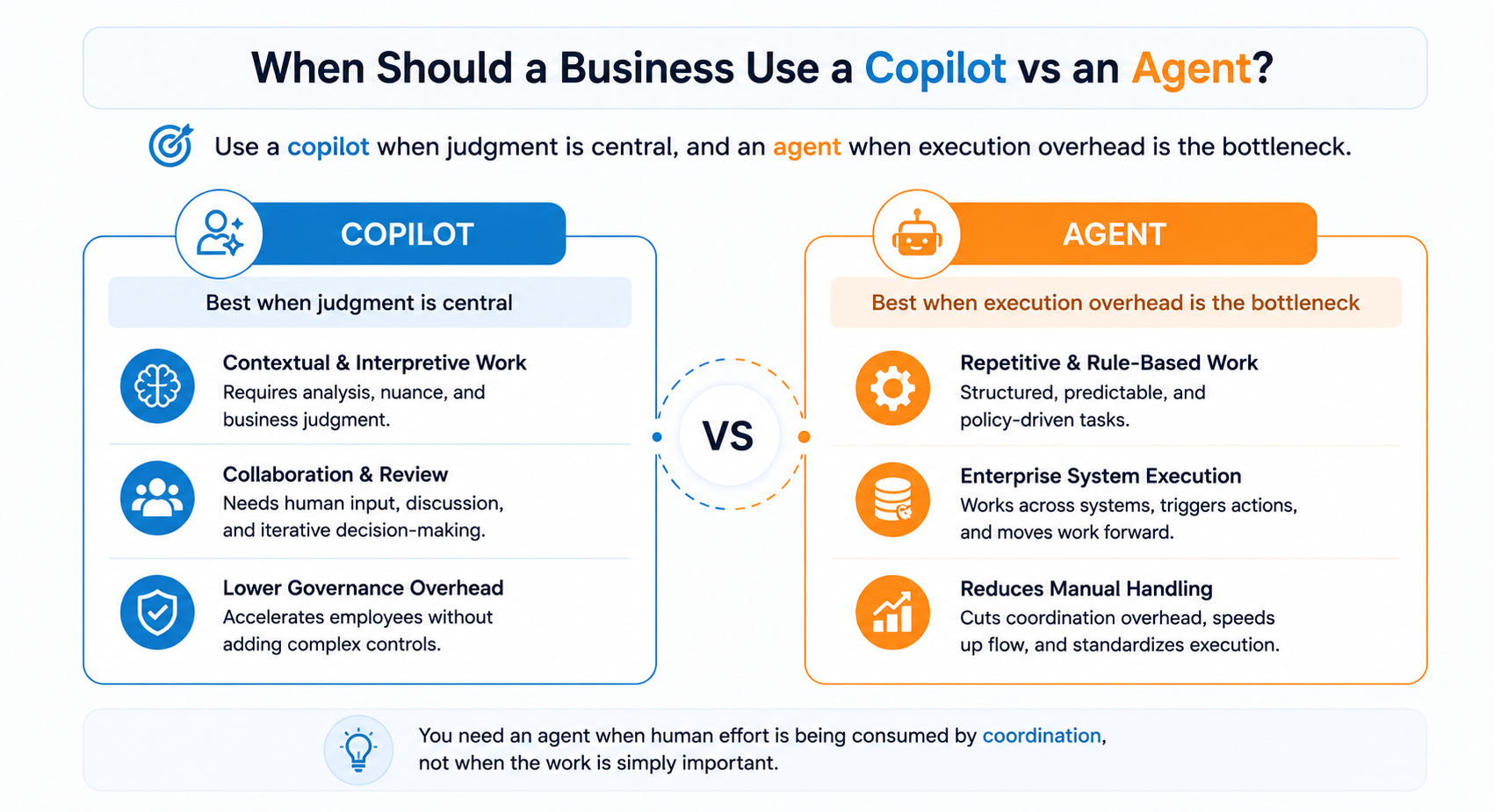
Use a copilot when judgment is central, and an agent when execution overhead is the bottleneck.
This is where architecture decisions should become opinionated. If the work requires contextual interpretation, collaboration, review, and business judgment, a copilot is usually the better design choice. It accelerates employees without creating a large governance surface.
If the work is repetitive, policy-bound, structured, and spread across enterprise systems, an agent is usually the better long-term fit. It reduces manual handling, accelerates flow, and standardizes execution.
A business does not need an agent simply because a workflow is important. It needs an agent when human effort is being consumed by coordination rather than judgment.
Best-Fit Use Cases
| Business Scenario | Better Fit | Why |
| Software development assistance | Copilot | Accelerates coding, debugging, and exploration |
| Internal reporting and proposal creation | Copilot | Speeds output while preserving review |
| Enterprise knowledge search | Copilot | Reduces search effort, keeps human decisions central |
| Service desk ticket triage | Agent | Applies repeatable logic and routes work faster |
| Employee onboarding | Agent | Coordinates tasks across HR, IT, and access systems |
| Invoice routing and validation | Agent | Reduces repetitive operational handling |
| Support response drafting | Copilot | Assists the human agent, does not replace judgment |
| Claims or order exception handling | Agent | Executes structured workflow logic across systems |
In practice, the wrong architecture decision usually shows up in cost. Teams overbuild copilots with unnecessary orchestration or underbuild agents without the controls needed for production. Both errors slow ROI.
What Architecture Is Needed to Deploy Either Safely?
Copilots need context, usability, and grounding. On the other hand, Agents need orchestration, policy control, and runtime governance.
In production environments, the delivery stack determines whether the system scales safely. A production-grade copilot typically requires a model layer to stay contextually grounded and usable within the flow of work.
A production-grade agent requires all of that plus an execution runtime. That runtime must manage process state, tool permissions, action sequencing, exception paths, retries, logging, and approval checkpoints. If those layers are missing, the so-called agent is often just a demo with access to the tool.
Reference Architecture: Copilot vs Agent
| Architecture Layer | Copilot Requirement | Agent Requirement |
| Experience layer | Embedded in an app, portal, or workspace | Optional UI plus event-driven execution |
| Model layer | Strong generation and reasoning | Reasoning, planning, and action selection |
| Retrieval layer | RAG and enterprise grounding | RAG plus runtime state and workflow context |
| Integration layer | Mostly read-heavy connectors | Read/write APIs and service actions |
| Orchestration layer | Light or limited | Essential for branching, retries, and escalations |
| Governance layer | Access control and prompt rules | Policy enforcement, approvals, and audit trails |
| Observability layer | Usage analytics | Decision traces, action logs, and failure visibility |
The cost implication is straightforward. Copilots usually reduce the time to first value. Agents typically require more architecture upfront, but unlock larger operational ROI when the workflow is stable and high-volume.
That is also why the selection of an implementation partner matters. A vendor that can build conversational interfaces is not automatically equipped to design agent runtimes, service orchestration, approval logic, and enterprise-grade observability. The delivery partner has to match the proposed system complexity.
How Signity Helps Enterprises Make the Right AI Decision
The correct choice comes from workflow structure, integration maturity, risk tolerance, and expected ROI. For most enterprise teams, the decision becomes much clearer when four questions are answered honestly.
First, is the workflow judgment-heavy or execution-heavy?
If the value sits in helping employees think, write, search, or analyze faster, a copilot is the right starting point. If the value sits in moving work between systems with less manual effort, an agent becomes more relevant.
Second, are the underlying services integration-ready?
Agents rely on APIs, event hooks, permissions, and structured data contracts. If the services layer is weak or fragmented, a copilot will usually drive value faster while the backend matures.
Third, what is the blast radius of a wrong action?
A poor draft can be edited. A wrong access approval, billing action, compliance decision, or workflow update creates materially higher risk. As action authority increases, governance needs rise with it.
Fourth, is the enterprise choosing a feature or choosing an architecture?
It is where strategic development partner selection begins. Successful AI implementation now depends on architecture review, process design, systems integration, testability, and post-launch optimization, not just model selection.
Common Failure Patterns
| Failure Pattern | What It Usually Means |
| Labeling a RAG assistant as an agent | The execution model is unclear |
| Granting write access too early | Governance is lagging behind ambition |
| No state handling or retries | The runtime is not production-ready |
| No audit trail | Compliance and trust will become blockers |
| No ROI model by workflow | Scaling decisions will be hard to justify |
The organizations that scale successfully are not the ones with the loudest AI narrative. They are the ones making disciplined architecture decisions early and aligning build scope to business reality.
Conclusion
The AI copilot vs AI agent decision is not a branding exercise. It is an enterprise architecture choice that shapes implementation cost, automation ROI, governance, and long-term scalability.
Copilots strengthen human productivity by keeping judgment central, whereas Agents strengthen workflow delivery where execution overhead is the real source of inefficiency. The strongest programs understand that both have a role, but not in the same place and not with the same operating assumptions.
This is where Signity’s expertise becomes especially valuable. We work at the intersection of AI consulting, product engineering, enterprise integration, and workflow modernization to help organizations move from experimentation to production with technical clarity.
Whether the requirement is a domain-specific copilot, an agentic workflow, or a hybrid AI architecture, Signity helps enterprises choose the right implementation path, expose service-layer gaps early, and build systems that are governed, scalable, and commercially viable from day one.

Mangesh Gothankar


Ashwani Sharma
Achin Verma
Frequently Asked Questions
Have a question in mind? We are here to answer. If you don’t see your question here, drop us a line at our contact page.
Which is better: AI Copilot or AI Agent?

Can copilots and agents work together?
Why does architecture matter so much in AI implementation?





.png?width=352&name=What%20Is%20Autonomous%20AI%20and%20How%20Does%20It%20Work%20(1).png)
.webp?width=352&name=What%20is%20webmcp%20(1).webp)